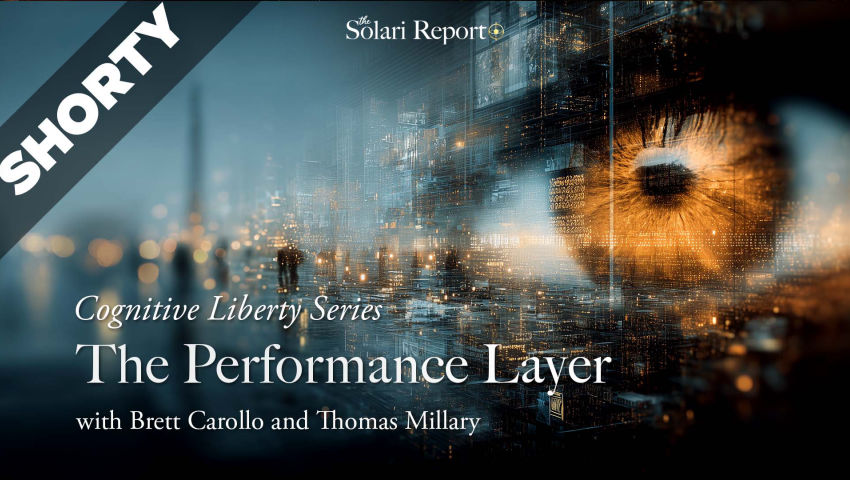
This 6-pillar curriculum teaches the basic literacy we need to be personally and financially successful and to do so in a manner in which together we evolve a culture that supports the emergence of an advanced human civilization.
“Once you see the mechanics of it, it demystifies it, it disenchants it, and it’s no longer entertaining. It no longer entrains you, it no longer entertains you.”
~ Brett Carollo
Propaganda in the 1990s Was Targeted Broadly; Now It’s More Personalized, and We All Have a Digital Handler
Entertainment, sports, music, and celebrity have become the delivery system for a formulated consciousness. We don’t resist it because we don’t experience it as instruction. The question is what that system has been instructing us to do.
This conversation made me realize that there may be another layer to the mechanisms you are exposing.
You show how techniques of influence can move from direct institutional involvement into culture, psychology, technology, algorithms and feedback systems. But while listening, another question kept coming up for me:
What happens once these techniques are no longer just being used, but have become embedded in the structure itself? How do they acquire a reason to keep existing and what keeps them necessary?
Until very recently, I wasn’t aware of the concept of “Bootleggers and Baptists” at all. It came up almost in passing in a Dutch podcast by Bennink and Bergsma and suddenly it gave me another way of looking at this question.
Not because it explains who originally designed these techniques or what their intentions were, but because it may help us understand what happens after they become embedded.
Different people and institutions do not need the same motives to keep the same system alive. One may act for security, another for profit, research, political influence, technological progress or simply because it is their job. Together, however, they can create something none of them could create alone:
a system that continuously produces new reasons for its own existence.
1. A problem justifies a technique.
2. The technique creates infrastructure.
3. The infrastructure creates interests and dependencies.
4. Those interests create new reasons to keep the technique.
And that brings us to something we urgently need to understand.
WAR = OFF LIMITS.
But saying that we are against war is not enough.
If we work inside systems that build, finance, legitimise, normalise or maintain the structures that make war possible, we need to understand what part we ourselves are playing in that system.
That includes the people who believe they are in positions of power. Because anyone can genuinely believe that they are serving security, science, technology, government or society — and still be maintaining one small but essential part of a much larger machinery.
In my opinion, it is not enough to expose the techniques. What ultimately has to be understood is the structure that gives these techniques their reason to exist and what keeps them necessary. Only then can everyone inside that structure begin to see what they are actually helping to keep alive.
And thank you, Joshua, for taking this on and opening up this conversation. Making these mechanisms visible is essential, because without seeing the structure, it is almost impossible to recognize our own place within it.
And if WAR = OFF LIMITS, that awareness has to start now. We all have to become aware of our own place within the system that makes war possible.
“In my opinion, it is not enough to expose the techniques. What ultimately has to be understood is the structure that gives these techniques their reason to exist and what keeps them necessary. Only then can everyone inside that structure begin to see what they are actually helping to keep alive.”
See how the you support the system in your daily thoughts, money and actions, and then steadily withdraw support.
Coming clean has real power. Indeed that is where our power lies.
I think you are right that a great deal of our power lies in becoming aware of how we ourselves participate in these systems through our thoughts, money and actions and then consciously withdrawing that support where we can.
Your comment also made me think about something else: What happens when we are not even aware of what a system has decided about us?
For me, this is not entirely theoretical. Over many years, I had built an international network on LinkedIn of more than a thousand people, including many who were professionally engaged with human rights at a high level. When my visibility and access disappeared, I effectively disappeared from that network as well.
Whatever mechanism caused it, I was not presented with evidence, given a meaningful opportunity to defend myself, or able to restore what had been lost. I even raised the issue with European and American government bodies, trying to find out who was responsible for protecting people when something like this happens. What became painfully clear was that responsibility seemed to disappear between the platform, the technology and the institutions: nobody considered themselves responsible, and nobody intervened. The consequences for me were very real, and they continue to this day.
But something else became visible as well: What did the people who remained do when someone in their network suddenly disappeared?
In my case, apparently very little. Despite the nature of that network, nobody succeeded in bringing me back into that space or seriously questioning what had happened.
Whether or not this was deliberately designed as a test, it functioned like one: remove someone from the visible network and observe whether the network notices, questions it, resists it, or simply adapts to that person’s absence.
That experience left me with a question that goes directly back to your point about our own responsibility: how can we consciously withdraw our support or defend ourselves if we do not even know how a system has classified us, or why?
And this is where I think the implications of AI become much more serious.
We are already living in a world of enormous databases and digital profiles. Our communications, behavior, associations and identities can increasingly become data that systems can analyze and classify.
Classification by itself is already consequential. But when these classifications start feeding into systems that can act with lethal force, the stakes change completely.
Autonomous and increasingly AI-assisted weapons are being developed.
Put those developments together and we have to ask a deeply uncomfortable question:
What happens when a human being becomes a data profile, that profile becomes a target, and the target can be eliminated without another human being ever having to physically confront the person who is going to die?
That changes something fundamental about war.
The human distance between decision and consequence can become almost complete:
database → classification → target → autonomous weapon → person gone.
No soldier needs to look that person in the eyes. No pilot needs to release the weapon. Perhaps eventually no individual operator even experiences themselves as having killed someone. The act itself disappears from perception: what remains on the screen is data, classification, a target and a completed task — not the human life that has ended.
And for everyone who remains, the most disturbing possibility is that almost nothing appears to have happened. There is no battlefield in front of them.
This is why Article 11 of the Universal Declaration of Human Rights matters so much to me: a person accused of a crime is presumed innocent until proven guilty according to law, with a genuine opportunity to defend themselves.
A database entry is not proof.
A pattern is not guilt.
An association is not a crime.
A prediction is not a verdict.
Before systems acquire ever greater power over human lives, people must be able to know what has been recorded about them, what classifications have been made, correct false information, challenge conclusions and be heard by another human being.
Because if we fail to establish those safeguards while the consequence is still exclusion from a network, what happens when one day the consequence is no longer exclusion from a platform, but exclusion from life itself?
That is the line we must never cross.WAR = OFF LIMITS
You articulate beautifully, Monique… The problem is that war is absolutely necessary to the system as it is and as the system has been for a very long time. Those controlling the matrix have no desire to change or negotiate with plebs.
I would bet that a majority of people, myself definitely included, do not believe that war can create peace in any way, shape, or form. Yet those who pull the strings fund the wars on both sides. AND THEY could care less about human rights; they hate us.
Yes, it seems many of recent mass rituals that are televised throughout the world have a satanic and transgender agenda to them. How else is a one world, one god (Lucifer) religion going to take over? Many of the movies are so dystopian and it’s always the government, an assassin trained hero, or a vaccine that saves the day.
Dear Joshua,
I appreciate you so much and the content you bring to Solari. This interview is so rich. It will take me a while to chew on it. Thank you for introducing us to these 2 young erudites.
God bless you.
Thank you so much for this. Like others, I’ll likely watch this a few times and take notes. Actually, my mind is blown. I lived on Laurel Canyon in the 1970s, I was an exec in the music industry (A&R and promotion) with a company you’d know as one of the powerhouses of the time, and my boyfriend was a TV director of some shows you would recognize as iconic for the period. Few would have been as immersed in the LA entertainment industry than me at that time. It seems a miracle that I never came across indications of what is described here. I’m also told by some experts in the field of MKUltra that its very possible I was in the program and have cover memories. . . Oh well, at 73 it’s a little late to sort all of that out.





























































































This conversation made me realize that there may be another layer to the mechanisms you are exposing.
You show how techniques of influence can move from direct institutional involvement into culture, psychology, technology, algorithms and feedback systems. But while listening, another question kept coming up for me:
What happens once these techniques are no longer just being used, but have become embedded in the structure itself? How do they acquire a reason to keep existing and what keeps them necessary?
Until very recently, I wasn’t aware of the concept of “Bootleggers and Baptists” at all. It came up almost in passing in a Dutch podcast by Bennink and Bergsma and suddenly it gave me another way of looking at this question.
Not because it explains who originally designed these techniques or what their intentions were, but because it may help us understand what happens after they become embedded.
Different people and institutions do not need the same motives to keep the same system alive. One may act for security, another for profit, research, political influence, technological progress or simply because it is their job. Together, however, they can create something none of them could create alone:
a system that continuously produces new reasons for its own existence.
1. A problem justifies a technique.
2. The technique creates infrastructure.
3. The infrastructure creates interests and dependencies.
4. Those interests create new reasons to keep the technique.
And that brings us to something we urgently need to understand.
WAR = OFF LIMITS.
But saying that we are against war is not enough.
If we work inside systems that build, finance, legitimise, normalise or maintain the structures that make war possible, we need to understand what part we ourselves are playing in that system.
That includes the people who believe they are in positions of power. Because anyone can genuinely believe that they are serving security, science, technology, government or society — and still be maintaining one small but essential part of a much larger machinery.
In my opinion, it is not enough to expose the techniques. What ultimately has to be understood is the structure that gives these techniques their reason to exist and what keeps them necessary. Only then can everyone inside that structure begin to see what they are actually helping to keep alive.
And thank you, Joshua, for taking this on and opening up this conversation. Making these mechanisms visible is essential, because without seeing the structure, it is almost impossible to recognize our own place within it.
And if WAR = OFF LIMITS, that awareness has to start now. We all have to become aware of our own place within the system that makes war possible.
Amen!
“In my opinion, it is not enough to expose the techniques. What ultimately has to be understood is the structure that gives these techniques their reason to exist and what keeps them necessary. Only then can everyone inside that structure begin to see what they are actually helping to keep alive.”
See how the you support the system in your daily thoughts, money and actions, and then steadily withdraw support.
Coming clean has real power. Indeed that is where our power lies.
Thank you, Catherine.
I think you are right that a great deal of our power lies in becoming aware of how we ourselves participate in these systems through our thoughts, money and actions and then consciously withdrawing that support where we can.
Your comment also made me think about something else: What happens when we are not even aware of what a system has decided about us?
For me, this is not entirely theoretical. Over many years, I had built an international network on LinkedIn of more than a thousand people, including many who were professionally engaged with human rights at a high level. When my visibility and access disappeared, I effectively disappeared from that network as well.
Whatever mechanism caused it, I was not presented with evidence, given a meaningful opportunity to defend myself, or able to restore what had been lost. I even raised the issue with European and American government bodies, trying to find out who was responsible for protecting people when something like this happens. What became painfully clear was that responsibility seemed to disappear between the platform, the technology and the institutions: nobody considered themselves responsible, and nobody intervened. The consequences for me were very real, and they continue to this day.
But something else became visible as well: What did the people who remained do when someone in their network suddenly disappeared?
In my case, apparently very little. Despite the nature of that network, nobody succeeded in bringing me back into that space or seriously questioning what had happened.
Whether or not this was deliberately designed as a test, it functioned like one: remove someone from the visible network and observe whether the network notices, questions it, resists it, or simply adapts to that person’s absence.
That experience left me with a question that goes directly back to your point about our own responsibility: how can we consciously withdraw our support or defend ourselves if we do not even know how a system has classified us, or why?
And this is where I think the implications of AI become much more serious.
We are already living in a world of enormous databases and digital profiles. Our communications, behavior, associations and identities can increasingly become data that systems can analyze and classify.
Classification by itself is already consequential. But when these classifications start feeding into systems that can act with lethal force, the stakes change completely.
Autonomous and increasingly AI-assisted weapons are being developed.
Put those developments together and we have to ask a deeply uncomfortable question:
What happens when a human being becomes a data profile, that profile becomes a target, and the target can be eliminated without another human being ever having to physically confront the person who is going to die?
That changes something fundamental about war.
The human distance between decision and consequence can become almost complete:
database → classification → target → autonomous weapon → person gone.
No soldier needs to look that person in the eyes. No pilot needs to release the weapon. Perhaps eventually no individual operator even experiences themselves as having killed someone. The act itself disappears from perception: what remains on the screen is data, classification, a target and a completed task — not the human life that has ended.
And for everyone who remains, the most disturbing possibility is that almost nothing appears to have happened. There is no battlefield in front of them.
This is why Article 11 of the Universal Declaration of Human Rights matters so much to me: a person accused of a crime is presumed innocent until proven guilty according to law, with a genuine opportunity to defend themselves.
A database entry is not proof.
A pattern is not guilt.
An association is not a crime.
A prediction is not a verdict.
Before systems acquire ever greater power over human lives, people must be able to know what has been recorded about them, what classifications have been made, correct false information, challenge conclusions and be heard by another human being.
Because if we fail to establish those safeguards while the consequence is still exclusion from a network, what happens when one day the consequence is no longer exclusion from a platform, but exclusion from life itself?
That is the line we must never cross.WAR = OFF LIMITS
You articulate beautifully, Monique… The problem is that war is absolutely necessary to the system as it is and as the system has been for a very long time. Those controlling the matrix have no desire to change or negotiate with plebs.
I would bet that a majority of people, myself definitely included, do not believe that war can create peace in any way, shape, or form. Yet those who pull the strings fund the wars on both sides. AND THEY could care less about human rights; they hate us.
L0L…”before all of us were born, the JFK assassination”…I was on the recess playground teetertotter, second grade.
Yes, it seems many of recent mass rituals that are televised throughout the world have a satanic and transgender agenda to them. How else is a one world, one god (Lucifer) religion going to take over? Many of the movies are so dystopian and it’s always the government, an assassin trained hero, or a vaccine that saves the day.
I became acquainted with Amish carpenters and farmers in 2004. They’re outside of our world and so much happier and healthier.
Dear Joshua,
I appreciate you so much and the content you bring to Solari. This interview is so rich. It will take me a while to chew on it. Thank you for introducing us to these 2 young erudites.
God bless you.
Thank you so much for this. Like others, I’ll likely watch this a few times and take notes. Actually, my mind is blown. I lived on Laurel Canyon in the 1970s, I was an exec in the music industry (A&R and promotion) with a company you’d know as one of the powerhouses of the time, and my boyfriend was a TV director of some shows you would recognize as iconic for the period. Few would have been as immersed in the LA entertainment industry than me at that time. It seems a miracle that I never came across indications of what is described here. I’m also told by some experts in the field of MKUltra that its very possible I was in the program and have cover memories. . . Oh well, at 73 it’s a little late to sort all of that out.