This 6-pillar curriculum teaches the basic literacy we need to be personally and financially successful and to do so in a manner in which together we evolve a culture that supports the emergence of an advanced human civilization.
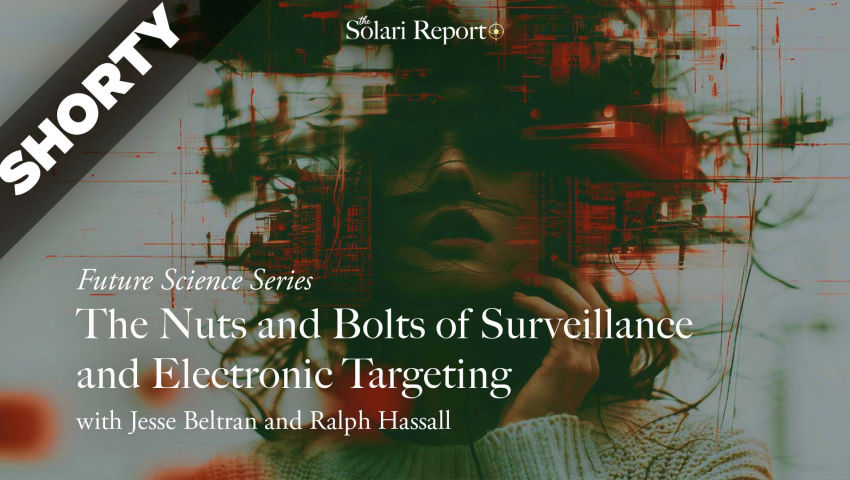
Future Science Series: The Nuts and Bolts of Surveillance and Electronic Targeting
with Jesse Beltran and Ralph Hassall
“Certainly, neurotechnologies raise a broad spectrum of ethical and legal issues that go far beyond mental privacy, such as new threats to mental integrity, freedom of thought and personal identity…. [O]ur personal freedom is largely dependent on this inner realm of cognition that no one in principle is allowed to invade.”
~ Roberto Andorno and Andrea Lavazza, “How to deal with mind-reading technologies”
Mk-Ultra Never Stopped; They Just Changed the Name
In this Future Science Series episode of the Solari Report, Ulrike Granögger and Catherine Austin Fitts speak with TSCM (technical surveillance countermeasures) investigator Jesse Beltran and Ralph Hassall about the hardware behind surveillance and electronic targeting.
After listening to this interview, another question emerges. Much of the discussion concerns what increasingly sophisticated technologies may be capable of doing to human beings: detecting signals, collecting information, identifying individuals, measuring biological processes and potentially influencing them. But perhaps the direction of the question should also be reversed. What does such a system need from human beings in order to function reliably?
Before considering the technology, however, there is another layer that may be important. Human beings do not simply receive information and convert it directly into behaviour. Information becomes accessible through our senses and is subsequently given meaning. Yet people are generally not consciously aware of the degree to which different sensory and information-processing channels contribute to that process. What we see, hear, feel and otherwise perceive does not necessarily enter awareness with equal weight, and those relationships may differ considerably between individuals.
This raises a potentially important question in relation to the frequencies discussed in the interview. If external stimulation can subtly alter sensory, attentional or biological processing, it would not necessarily have to impose a specific thought or command in order to influence what follows. Even small changes in the relative accessibility or salience of information could potentially alter the information from which meaning and choice emerge. The relevant chain would then begin much earlier than behaviour:
information → sensory access → awareness → meaning → choice → behaviour.
The hypothesis worth investigating is therefore whether external influence could act somewhere within that earlier process. If so, a person might remain conscious of making their own decisions while being unaware that the relative accessibility or weighting of the information preceding those decisions had changed.
That question becomes important because the underlying technologies should not only be considered separately. The Internet of Bodies, miniature and battery-free biosensors, wireless communication with implants, neural recording, electrical stimulation and closed-loop systems already demonstrate that digital systems can interact with biological processes in increasingly sophisticated ways. At the same time, AI, digital identity and digital payment infrastructures are developing rapidly. The question is therefore not simply what each technology can do on its own, but what becomes possible when previously separate technological domains become interoperable.
A biological signal, for example, has very little value without context. A system must know where the signal comes from, to whom it belongs, what it represents and whether its meaning remains sufficiently stable over time. If several signals are measured separately, they must somehow be combined into a meaningful representation of the individual. Only then can measurement become classification, classification become prediction and prediction potentially become the basis for intervention.
If intervention subsequently changes the person who is being measured, however, a feedback loop appears. The system is no longer merely observing a biological reality; it may simultaneously be altering the reality it measures. A changed biological or behavioural state produces new signals, those signals are measured again, the new state is classified, and the system can respond once more. This raises a fundamental problem: how does the system distinguish autonomous human change from a change that was partly produced by its own previous intervention?
This matters because every predictive system ultimately depends on sufficiently reliable relationships between identity, signal, meaning and response. More data do not automatically solve that problem. As long as the relationship between a person, their signals and the meaning attributed to those signals remains sufficiently stable, additional data can make the model more accurate. But if the human source itself changes, more data can also reinforce a model whose assumptions are no longer correct.
Human beings are particularly difficult in this respect because they are not static data sources. We learn, adapt, change our minds, alter our routines, respond differently to circumstances and change physiologically over time. Awareness itself can change behaviour. If people become aware that they are being observed, classified or influenced, that knowledge may alter the very behaviour the system is attempting to predict. the question is than How do we accelerate awareness of the processes through which we perceive information, give it meaning and arrive at our own choices?
This creates an intriguing reversal. Human variability is usually treated as a problem that technology has to overcome through better sensors, larger datasets and more sophisticated AI. But what if that variability is not merely technical noise? What if the capacity of human beings to change independently is itself one of the fundamental limits of systems that depend on recognising and predicting them?
And there may be an even deeper dimension to that question. If autonomy begins not with behaviour but with the process through which information becomes accessible, acquires meaning and eventually contributes to choice, then protecting human autonomy cannot concern behaviour alone. It must also concern the integrity of the process that precedes behaviour. A technology capable of subtly altering that process would potentially affect not merely what a person does, but the informational conditions from which that person experiences, interprets and chooses.
For one individual, a change may make little difference to a large predictive system. An unusual response can simply be treated as an anomaly and compared with the person’s previous behaviour or with a much larger reference population. The system still has millions of other observations from which to derive its baseline.
When sufficiently large numbers of people change independently, something else happens: the reference population itself begins to move. Scale alone, however, is not enough. If a million people all start behaving in exactly the same way, they simply create another recognisable pattern that may be even easier for AI to classify. What matters is therefore not uniform collective behaviour, but scale combined with autonomy, human variation and decentralisation. The more independently people change, the greater the variety a system must continue to identify, interpret and predict.
The decisive vulnerability of systems that seek to observe, classify and influence human beings may therefore not lie primarily in behaviour itself, but in the largely pre-conscious processes through which information becomes accessible, is weighted, acquires meaning and eventually contributes to choice. If external influence can subtly alter the relative salience or accessibility of sensory and cognitive information without announcing itself as influence, then a person may continue to experience their decisions as fully their own while the informational conditions from which those decisions arise have already been modified. In such a case, influence does not need to override the will; it only needs to remain outside the field of recognition.
This is why large-scale increases in awareness of one’s own processes of perception, interpretation and meaning-making would amount to more than behavioral variation. They could change the very human conditions on which a system depends to keep individuals sufficiently legible, stable and predictable. Awareness then ceases to be merely a private psychological good and becomes a structural condition for autonomy: the capacity not only to choose, but to protect the integrity of the process through which choice becomes possible in the first place.
Yet this produces a disturbing Catch-22. Unawareness may help stabilise such a system by continuously supplying it with relatively consistent and unexamined human patterns, while increasing awareness may broaden the system by providing it with new patterns of human adaptation from which it can learn. The unaware human may therefore reinforce the existing model, while the aware human risks expanding it. If that is the architecture we are dealing with, neither unconscious participation nor conscious adaptation within the same feedback loop offers a genuine way out. The deeper question is whether human autonomy ultimately requires breaking the loop itself: removing the conditions under which increasingly intimate aspects of human perception, biology and choice can continuously be converted into inputs for systems designed to model and influence them.
When technologies originally developed in military and security contexts begin to measure, model or act upon these earlier stages of human information processing, they can no longer be adequately understood as surveillance alone. They must also be examined as potential interventions in the very conditions under which human beings perceive, interpret and determine their own actions.
This becomes especially relevant when biological signals are considered. Individual measurements have limited value unless they can be reliably connected to a person, interpreted in relation to other signals and compared over time. Somewhere, those separate measurements therefore have to become an integrated representation of the individual. Whether that happens locally, in the cloud or through distributed processing is secondary to the larger point: the real value may not lie in the individual signal at all, but in the system’s ability to maintain reliable connections between identity, biological state, behavior, meaning and prediction.
That is also where a dependency appears. A system must be able to determine that particular signals belong to a particular person, that their meaning remains sufficiently stable, and that a change originates in the person rather than being the consequence of an earlier intervention by the system itself. If financial, behavioral and biological information are eventually combined, this problem becomes even more complex because different systems operate with different identities, time scales, error rates and reference models. The more domains that are connected, the more valuable the integrated model may become — but also the more relationships have to remain reliable for that model to retain its meaning.
This is why the possible convergence of AI, digital identity, the Internet of Bodies and digital currencies deserves attention. These technologies do not have to be parts of one system today for their potential interoperability to matter. A digital currency can connect identity to economic activity; Internet of Bodies technologies can connect identity to biological information; AI can classify patterns and predict behavior; and closed-loop technologies can, in principle, add feedback to what has been measured. The important question is what becomes possible if these functions are increasingly connected.
If such an architecture were used not only to observe behavior but also to keep behavior within particular parameters, feedback would acquire a clear function. The system would measure, compare, classify and respond, after which the changed state could be measured again. What counts as “wrong” behavior would not even have to be expressed in moral terms. For a technical system it could simply mean behavior that falls outside a defined, expected or permitted range. Once classification begins to produce consequences, however, measurement is no longer merely observation; it becomes a potential instrument of behavioral governance.
This also gives the idea of a biological “harness” a more precise place in the hypothesis. If biological influence were capable of reducing human variability, its function might not only be to influence an individual at a particular moment. It could also help maintain the stability and predictability on which recognition, classification and further intervention depend. Normalization would then concern not only the data, but potentially the human source from which those data originate.
And this is where the canary in the coal mine becomes important. If autonomous human change makes no difference to such a system, there is nothing to correct. If the system absorbs that change without difficulty, that too tells us something. But if particular forms of autonomous change repeatedly produce recalibration, altered classification or some form of corrective feedback, the reaction itself becomes relevant. The canary must also be able to remain silent; otherwise every observation could simply be interpreted as confirmation. What matters is whether a reproducible relationship exists between human change and system response.
This leads directly to the question of peace. Traditional protest is visible: people march, demonstrate, petition and collectively express opposition. But within an infrastructure designed to observe, classify and predict behavior, protest itself also becomes information. A new form of non-violent protest may therefore have to work differently. It should not require people to attack technology, manipulate signals, understand AI or experiment with their bodies. The technical investigation belongs with researchers. Participation itself would have to remain simple, voluntary, peaceful and possible on a large scale.
What that action would be is precisely what still has to be discovered. The essential question is whether ordinary expressions of human autonomy can affect the dependencies on which an integrated predictive system relies. If increasing numbers of people become more autonomous without all behaving in the same way, the challenge for such a system is not simply more data. It is maintaining reliable meaning across an increasingly variable population.
This reverses the original perspective. Instead of asking only what increasingly sophisticated systems can do to human beings, we can also ask what those systems continuously need from human beings in order to work. A system intended to recognize, classify, predict and potentially correct human behavior requires sufficiently reliable identity, signals, meaning, reference populations and feedback. Its technological sophistication does not remove those dependencies.
That creates an interesting possibility for a new form of peace protest. The objective would not be technological sabotage, but the restoration of human autonomy. If large-scale yet decentralised human variation eventually makes unwanted surveillance, prediction, economic conditioning or biological influence less reliable, the loss of control would not itself be the protest. It would be a consequence of people becoming less predictable as a collective without surrendering their individuality.
The question therefore becomes whether human autonomy itself can expose the information limits of increasingly integrated systems of identification, economic participation, classification, prediction and influence. And if those systems ultimately depend on human beings remaining sufficiently identifiable and predictable, their greatest limitation may lie not in the technology, but in the irreducible variability of human beings themselves.
If this hypothesis is correct, however, where do we begin? Simply bringing millions of people into the streets may no longer be sufficient. For an AI system, a mass protest can itself become a recognisable collective pattern: something that can be observed, classified and incorporated into the very information environment being challenged.
The problem becomes even more difficult if large parts of the population are not even aware of the infrastructure in which they may already be participating. We cannot assume a shared understanding of what is happening, let alone a shared interpretation of its implications. COVID demonstrated how rapidly a society can fragment when people are confronted with an invisible threat, conflicting information, institutional pressure and radically different perceptions of reality. Reproducing that division would not create resistance to such a system; it could make society even easier to separate into identifiable and opposing groups.
So the first challenge for a genuinely new form of peace protest may be more fundamental than mobilisation. How do millions of people become aware of an infrastructure they cannot readily see, without turning that awareness itself into another predictable collective response or another source of division? And if people discover that their own biological and informational participation is part of what sustains such an infrastructure, what would it actually mean to stop feeding it?
For me, this is where the Holy Spirit comes in. If everything plays out and develops as you describe so eloquently, and to the point, it is not a problem to be solved only by the 21st-century human mind.
I believe that we can only break out with a completely different kind of mental language, one that is not based on black and white letters and linear grammar organsing our thoughts. That linear grammar has been decoded by AI which is precisely why “they” can read the internal conversation and listen to our thoughts. We need a new internal language logic, one that I refer to as “pictographic” and multidimensional, that cannot be captured by the digital.
The ability to think on several levels simultaneously. Or to speak in several languages simultaneously.
Acts, Chapter 2 teaches that this is possible through the Holy Spirit.
Thank you for this response. It really made me think, because I believe you are touching on another layer of the question I was trying to explore.
What I mean by the Holy Spirit is the living consciousness that permeates the entire cosmos and connects all living beings. And that is why I think what you are saying about multidimensional thinking and communication is so important. Perhaps what now needs to develop is our conscious capacity to access and communicate within that much larger field.
For me, that begins with step one: people need to understand how they themselves are “wired” — how they receive and process information, how their different senses function as gateways through which consciousness is accessed, and with what intensity they use each of those gateways.
Most people are hardly aware of this in themselves. We see, hear, feel, smell and taste, but we rarely recognise that these different gateways do not necessarily give us access to information with the same intensity. Their relative intensity can differ considerably from one person to another, creating a highly individual way of accessing, processing and giving meaning to information.
And that is where your idea becomes especially interesting to me. If we are barely conscious of even this most basic configuration — which gateways we use and with what intensity — how could we recognise communication taking place at a much more subtle or multidimensional level?
Learning how we ourselves are wired may therefore be a first step towards consciously accessing and developing the much larger multidimensional capacity you are describing.
Three words came over and over into my head when listening to this heavy subject; trust (in God)), Grace and shadowwork. This problem humanity can’t tackle alone, we need help of the Divine.
If enough of humanity can keep Christ alive in their hearts this will happen. Plus of Solari subscription is that it offers a menue to do shadowwork from beginner to heavy lifting in that department.
My grandmother was a victim of the MK Ultra “Bardo” soul ejection experiments performed at Spring Grove Institution in Baltimore, MD in the 1950’s. She was subjected to psychedelic tea and extreme electroshock for 2-3 years. She lost all memory of her childhood and most of her earlier life. My grandfather (a dysfunctional alcoholic) told my then early twenties Mother to “get her out of there before they kill her.” My Mother refused to let me investigate, and preferred to block out and forget those times. Elavil and Mellaril kept my Grandmother in some kind of balance but she was never healthy again. Given what I know now, I believe from things I witnessed, that she was still under attack when I was a child. My cousin may have been targeted later. His alcoholism and “clairaudience” destroyed his family life, but eventually he learned to live in spite of it all.
Decades later I was watching the TV series Orphan Black about human clones. One of the clones was described as violently crazy, “but she is good with children.” That was the exact description they used for my Grandmother. I was stunned when I heard them say it on that TV show. My Sister and I miss her very much. She was great with kids.
In 2021 in fully 5G Fort Myers, FL, I experienced V2K twice – the same phrases, the same sensation of utter calm and peace… about 1-2 minutes apart. I advised myself that I would feel safe, and be at peace when I got my covid shot. At the time, I was outdoors raking leaves. When the repetition started, I knew from my research what was happening. I reacted strongly with a mental banishing statement and it has never happened again.
I had been asking myself over and over, how could anyone who had known me for 20+ years get that shot?! All my closest friends and family got it. I should have been an informational defense that would protect them from all forms of manipulation by any organization. How could they do this?! And now I knew. Where 5G was available, V2K was used to slip the suggestion into the minds of the general public, and override their gut understanding of reality. I bet it was used to reinforce decisions to go ahead and get the shot too.
I am very grateful to the TI community and it’s leaders for their intense courage and bravery. I didn’t know about any of this until about two weeks before super soldier Max Spiers died in Poland. Without their reporting and testimonials (and Elana Freeland’s book series “Sub-Rosa America”), I would never have connected the dots. Love and blessings to every single person who is enduring this most heinous nightmare. Please don’t give up.
































































































This was a great interview, thank you, please could we see more on this very important topic.
After listening to this interview, another question emerges. Much of the discussion concerns what increasingly sophisticated technologies may be capable of doing to human beings: detecting signals, collecting information, identifying individuals, measuring biological processes and potentially influencing them. But perhaps the direction of the question should also be reversed. What does such a system need from human beings in order to function reliably?
Before considering the technology, however, there is another layer that may be important. Human beings do not simply receive information and convert it directly into behaviour. Information becomes accessible through our senses and is subsequently given meaning. Yet people are generally not consciously aware of the degree to which different sensory and information-processing channels contribute to that process. What we see, hear, feel and otherwise perceive does not necessarily enter awareness with equal weight, and those relationships may differ considerably between individuals.
This raises a potentially important question in relation to the frequencies discussed in the interview. If external stimulation can subtly alter sensory, attentional or biological processing, it would not necessarily have to impose a specific thought or command in order to influence what follows. Even small changes in the relative accessibility or salience of information could potentially alter the information from which meaning and choice emerge. The relevant chain would then begin much earlier than behaviour:
information → sensory access → awareness → meaning → choice → behaviour.
The hypothesis worth investigating is therefore whether external influence could act somewhere within that earlier process. If so, a person might remain conscious of making their own decisions while being unaware that the relative accessibility or weighting of the information preceding those decisions had changed.
That question becomes important because the underlying technologies should not only be considered separately. The Internet of Bodies, miniature and battery-free biosensors, wireless communication with implants, neural recording, electrical stimulation and closed-loop systems already demonstrate that digital systems can interact with biological processes in increasingly sophisticated ways. At the same time, AI, digital identity and digital payment infrastructures are developing rapidly. The question is therefore not simply what each technology can do on its own, but what becomes possible when previously separate technological domains become interoperable.
A biological signal, for example, has very little value without context. A system must know where the signal comes from, to whom it belongs, what it represents and whether its meaning remains sufficiently stable over time. If several signals are measured separately, they must somehow be combined into a meaningful representation of the individual. Only then can measurement become classification, classification become prediction and prediction potentially become the basis for intervention.
If intervention subsequently changes the person who is being measured, however, a feedback loop appears. The system is no longer merely observing a biological reality; it may simultaneously be altering the reality it measures. A changed biological or behavioural state produces new signals, those signals are measured again, the new state is classified, and the system can respond once more. This raises a fundamental problem: how does the system distinguish autonomous human change from a change that was partly produced by its own previous intervention?
This matters because every predictive system ultimately depends on sufficiently reliable relationships between identity, signal, meaning and response. More data do not automatically solve that problem. As long as the relationship between a person, their signals and the meaning attributed to those signals remains sufficiently stable, additional data can make the model more accurate. But if the human source itself changes, more data can also reinforce a model whose assumptions are no longer correct.
Human beings are particularly difficult in this respect because they are not static data sources. We learn, adapt, change our minds, alter our routines, respond differently to circumstances and change physiologically over time. Awareness itself can change behaviour. If people become aware that they are being observed, classified or influenced, that knowledge may alter the very behaviour the system is attempting to predict. the question is than How do we accelerate awareness of the processes through which we perceive information, give it meaning and arrive at our own choices?
This creates an intriguing reversal. Human variability is usually treated as a problem that technology has to overcome through better sensors, larger datasets and more sophisticated AI. But what if that variability is not merely technical noise? What if the capacity of human beings to change independently is itself one of the fundamental limits of systems that depend on recognising and predicting them?
And there may be an even deeper dimension to that question. If autonomy begins not with behaviour but with the process through which information becomes accessible, acquires meaning and eventually contributes to choice, then protecting human autonomy cannot concern behaviour alone. It must also concern the integrity of the process that precedes behaviour. A technology capable of subtly altering that process would potentially affect not merely what a person does, but the informational conditions from which that person experiences, interprets and chooses.
For one individual, a change may make little difference to a large predictive system. An unusual response can simply be treated as an anomaly and compared with the person’s previous behaviour or with a much larger reference population. The system still has millions of other observations from which to derive its baseline.
When sufficiently large numbers of people change independently, something else happens: the reference population itself begins to move. Scale alone, however, is not enough. If a million people all start behaving in exactly the same way, they simply create another recognisable pattern that may be even easier for AI to classify. What matters is therefore not uniform collective behaviour, but scale combined with autonomy, human variation and decentralisation. The more independently people change, the greater the variety a system must continue to identify, interpret and predict.
The decisive vulnerability of systems that seek to observe, classify and influence human beings may therefore not lie primarily in behaviour itself, but in the largely pre-conscious processes through which information becomes accessible, is weighted, acquires meaning and eventually contributes to choice. If external influence can subtly alter the relative salience or accessibility of sensory and cognitive information without announcing itself as influence, then a person may continue to experience their decisions as fully their own while the informational conditions from which those decisions arise have already been modified. In such a case, influence does not need to override the will; it only needs to remain outside the field of recognition.
This is why large-scale increases in awareness of one’s own processes of perception, interpretation and meaning-making would amount to more than behavioral variation. They could change the very human conditions on which a system depends to keep individuals sufficiently legible, stable and predictable. Awareness then ceases to be merely a private psychological good and becomes a structural condition for autonomy: the capacity not only to choose, but to protect the integrity of the process through which choice becomes possible in the first place.
Yet this produces a disturbing Catch-22. Unawareness may help stabilise such a system by continuously supplying it with relatively consistent and unexamined human patterns, while increasing awareness may broaden the system by providing it with new patterns of human adaptation from which it can learn. The unaware human may therefore reinforce the existing model, while the aware human risks expanding it. If that is the architecture we are dealing with, neither unconscious participation nor conscious adaptation within the same feedback loop offers a genuine way out. The deeper question is whether human autonomy ultimately requires breaking the loop itself: removing the conditions under which increasingly intimate aspects of human perception, biology and choice can continuously be converted into inputs for systems designed to model and influence them.
When technologies originally developed in military and security contexts begin to measure, model or act upon these earlier stages of human information processing, they can no longer be adequately understood as surveillance alone. They must also be examined as potential interventions in the very conditions under which human beings perceive, interpret and determine their own actions.
This becomes especially relevant when biological signals are considered. Individual measurements have limited value unless they can be reliably connected to a person, interpreted in relation to other signals and compared over time. Somewhere, those separate measurements therefore have to become an integrated representation of the individual. Whether that happens locally, in the cloud or through distributed processing is secondary to the larger point: the real value may not lie in the individual signal at all, but in the system’s ability to maintain reliable connections between identity, biological state, behavior, meaning and prediction.
That is also where a dependency appears. A system must be able to determine that particular signals belong to a particular person, that their meaning remains sufficiently stable, and that a change originates in the person rather than being the consequence of an earlier intervention by the system itself. If financial, behavioral and biological information are eventually combined, this problem becomes even more complex because different systems operate with different identities, time scales, error rates and reference models. The more domains that are connected, the more valuable the integrated model may become — but also the more relationships have to remain reliable for that model to retain its meaning.
This is why the possible convergence of AI, digital identity, the Internet of Bodies and digital currencies deserves attention. These technologies do not have to be parts of one system today for their potential interoperability to matter. A digital currency can connect identity to economic activity; Internet of Bodies technologies can connect identity to biological information; AI can classify patterns and predict behavior; and closed-loop technologies can, in principle, add feedback to what has been measured. The important question is what becomes possible if these functions are increasingly connected.
If such an architecture were used not only to observe behavior but also to keep behavior within particular parameters, feedback would acquire a clear function. The system would measure, compare, classify and respond, after which the changed state could be measured again. What counts as “wrong” behavior would not even have to be expressed in moral terms. For a technical system it could simply mean behavior that falls outside a defined, expected or permitted range. Once classification begins to produce consequences, however, measurement is no longer merely observation; it becomes a potential instrument of behavioral governance.
This also gives the idea of a biological “harness” a more precise place in the hypothesis. If biological influence were capable of reducing human variability, its function might not only be to influence an individual at a particular moment. It could also help maintain the stability and predictability on which recognition, classification and further intervention depend. Normalization would then concern not only the data, but potentially the human source from which those data originate.
And this is where the canary in the coal mine becomes important. If autonomous human change makes no difference to such a system, there is nothing to correct. If the system absorbs that change without difficulty, that too tells us something. But if particular forms of autonomous change repeatedly produce recalibration, altered classification or some form of corrective feedback, the reaction itself becomes relevant. The canary must also be able to remain silent; otherwise every observation could simply be interpreted as confirmation. What matters is whether a reproducible relationship exists between human change and system response.
This leads directly to the question of peace. Traditional protest is visible: people march, demonstrate, petition and collectively express opposition. But within an infrastructure designed to observe, classify and predict behavior, protest itself also becomes information. A new form of non-violent protest may therefore have to work differently. It should not require people to attack technology, manipulate signals, understand AI or experiment with their bodies. The technical investigation belongs with researchers. Participation itself would have to remain simple, voluntary, peaceful and possible on a large scale.
What that action would be is precisely what still has to be discovered. The essential question is whether ordinary expressions of human autonomy can affect the dependencies on which an integrated predictive system relies. If increasing numbers of people become more autonomous without all behaving in the same way, the challenge for such a system is not simply more data. It is maintaining reliable meaning across an increasingly variable population.
This reverses the original perspective. Instead of asking only what increasingly sophisticated systems can do to human beings, we can also ask what those systems continuously need from human beings in order to work. A system intended to recognize, classify, predict and potentially correct human behavior requires sufficiently reliable identity, signals, meaning, reference populations and feedback. Its technological sophistication does not remove those dependencies.
That creates an interesting possibility for a new form of peace protest. The objective would not be technological sabotage, but the restoration of human autonomy. If large-scale yet decentralised human variation eventually makes unwanted surveillance, prediction, economic conditioning or biological influence less reliable, the loss of control would not itself be the protest. It would be a consequence of people becoming less predictable as a collective without surrendering their individuality.
The question therefore becomes whether human autonomy itself can expose the information limits of increasingly integrated systems of identification, economic participation, classification, prediction and influence. And if those systems ultimately depend on human beings remaining sufficiently identifiable and predictable, their greatest limitation may lie not in the technology, but in the irreducible variability of human beings themselves.
If this hypothesis is correct, however, where do we begin? Simply bringing millions of people into the streets may no longer be sufficient. For an AI system, a mass protest can itself become a recognisable collective pattern: something that can be observed, classified and incorporated into the very information environment being challenged.
The problem becomes even more difficult if large parts of the population are not even aware of the infrastructure in which they may already be participating. We cannot assume a shared understanding of what is happening, let alone a shared interpretation of its implications. COVID demonstrated how rapidly a society can fragment when people are confronted with an invisible threat, conflicting information, institutional pressure and radically different perceptions of reality. Reproducing that division would not create resistance to such a system; it could make society even easier to separate into identifiable and opposing groups.
So the first challenge for a genuinely new form of peace protest may be more fundamental than mobilisation. How do millions of people become aware of an infrastructure they cannot readily see, without turning that awareness itself into another predictable collective response or another source of division? And if people discover that their own biological and informational participation is part of what sustains such an infrastructure, what would it actually mean to stop feeding it?
For me, this is where the Holy Spirit comes in. If everything plays out and develops as you describe so eloquently, and to the point, it is not a problem to be solved only by the 21st-century human mind.
I believe that we can only break out with a completely different kind of mental language, one that is not based on black and white letters and linear grammar organsing our thoughts. That linear grammar has been decoded by AI which is precisely why “they” can read the internal conversation and listen to our thoughts. We need a new internal language logic, one that I refer to as “pictographic” and multidimensional, that cannot be captured by the digital.
The ability to think on several levels simultaneously. Or to speak in several languages simultaneously.
Acts, Chapter 2 teaches that this is possible through the Holy Spirit.
Thank you for this response. It really made me think, because I believe you are touching on another layer of the question I was trying to explore.
What I mean by the Holy Spirit is the living consciousness that permeates the entire cosmos and connects all living beings. And that is why I think what you are saying about multidimensional thinking and communication is so important. Perhaps what now needs to develop is our conscious capacity to access and communicate within that much larger field.
For me, that begins with step one: people need to understand how they themselves are “wired” — how they receive and process information, how their different senses function as gateways through which consciousness is accessed, and with what intensity they use each of those gateways.
Most people are hardly aware of this in themselves. We see, hear, feel, smell and taste, but we rarely recognise that these different gateways do not necessarily give us access to information with the same intensity. Their relative intensity can differ considerably from one person to another, creating a highly individual way of accessing, processing and giving meaning to information.
And that is where your idea becomes especially interesting to me. If we are barely conscious of even this most basic configuration — which gateways we use and with what intensity — how could we recognise communication taking place at a much more subtle or multidimensional level?
Learning how we ourselves are wired may therefore be a first step towards consciously accessing and developing the much larger multidimensional capacity you are describing.
Three words came over and over into my head when listening to this heavy subject; trust (in God)), Grace and shadowwork. This problem humanity can’t tackle alone, we need help of the Divine.
If enough of humanity can keep Christ alive in their hearts this will happen. Plus of Solari subscription is that it offers a menue to do shadowwork from beginner to heavy lifting in that department.
For those not familiar with Shadowwork https://audio.solari.com/sr2017/20171016_Shadow_Work.pdf
My grandmother was a victim of the MK Ultra “Bardo” soul ejection experiments performed at Spring Grove Institution in Baltimore, MD in the 1950’s. She was subjected to psychedelic tea and extreme electroshock for 2-3 years. She lost all memory of her childhood and most of her earlier life. My grandfather (a dysfunctional alcoholic) told my then early twenties Mother to “get her out of there before they kill her.” My Mother refused to let me investigate, and preferred to block out and forget those times. Elavil and Mellaril kept my Grandmother in some kind of balance but she was never healthy again. Given what I know now, I believe from things I witnessed, that she was still under attack when I was a child. My cousin may have been targeted later. His alcoholism and “clairaudience” destroyed his family life, but eventually he learned to live in spite of it all.
Decades later I was watching the TV series Orphan Black about human clones. One of the clones was described as violently crazy, “but she is good with children.” That was the exact description they used for my Grandmother. I was stunned when I heard them say it on that TV show. My Sister and I miss her very much. She was great with kids.
In 2021 in fully 5G Fort Myers, FL, I experienced V2K twice – the same phrases, the same sensation of utter calm and peace… about 1-2 minutes apart. I advised myself that I would feel safe, and be at peace when I got my covid shot. At the time, I was outdoors raking leaves. When the repetition started, I knew from my research what was happening. I reacted strongly with a mental banishing statement and it has never happened again.
I had been asking myself over and over, how could anyone who had known me for 20+ years get that shot?! All my closest friends and family got it. I should have been an informational defense that would protect them from all forms of manipulation by any organization. How could they do this?! And now I knew. Where 5G was available, V2K was used to slip the suggestion into the minds of the general public, and override their gut understanding of reality. I bet it was used to reinforce decisions to go ahead and get the shot too.
I am very grateful to the TI community and it’s leaders for their intense courage and bravery. I didn’t know about any of this until about two weeks before super soldier Max Spiers died in Poland. Without their reporting and testimonials (and Elana Freeland’s book series “Sub-Rosa America”), I would never have connected the dots. Love and blessings to every single person who is enduring this most heinous nightmare. Please don’t give up.
Thank you for this illuminating testimony. To describe and show the many ways this happens is so helpful to recognize where it may be used on us.
Yes …and here was the grandmaster of them all! https://solari.com/hero-of-the-week-july-5-2021-dr-rauni-leena-luukanen-kilde-1939-2015/
Really great article. Thank you very much.
Incredibly helpful to identify the intrusive AI around us and within us. thnks
Why am I having so much difficulty in finding my favorite report, Financial Rebellion?
Just go to Solari in the News. We republish them there https://solari.com/solari-in-the-news/