Become a member: Subscribe

Solari Report

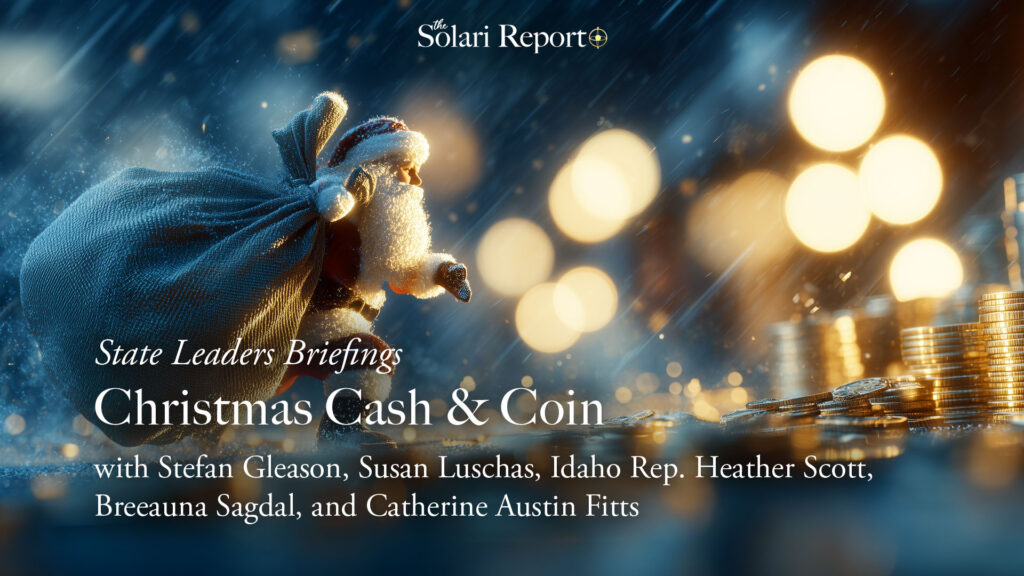
Briefing for State Leaders: Christmas Cash & Coin

Video Now Available

with Stefan Gleason, Susan Luschas, Idaho Rep. Heather Scott, Breeauna Sagdal, and Catherine Austin Fitts

“Cash offers recipients the flexibility to choose how they spend the money, whether it’s on essential items, experiences, or saving for future needs.”

~ CashEssentials
play-rounded-fill

State Leaders Briefings – Christmas Cash and Coin V-2

 
LanguageEnglish
Welcome to the December Solari Briefing on Christmas cash and coin. We’ve got a wonderful array of panelists today, and we’re excited to have all of y’all with us. All of our previous briefings are available on our Financial Transaction Freedom website, and if you have any trouble finding those, please feel free. Free to email me. My email is elizabeth@solari.com. We’ve got an outstanding lineup of guests today. Starting us off is gonna be Breeauna Sagdal. She is a policy fellow at the Beef Initiatives Foundation, author of the Solari Report, cash substack, contributing author at the Brownstone Institute Door to Freedom and a prolific writer and individual li, or to advance individual liberty and freedom for all. Thank you so much for joining us today, Breeauna. Oh, hello. Thank you so much for having me on. Were we going to do, I thought we were going to do a prayer. Oh my gosh. I forgot the prayer. Yes, Catherine would you please lead us in prayer? Thank you so much. Thank you. For our prayer, I’m going to read a section of an essay we publish every year at Christmas time. It’s called In Ho Domini by in ho ano Domini by Vermont Royster. And it’s about Jesus. So let me begin. In the middle then of a sudden, there was a light in the world and a man from Galilee saying, render unjust Caesar, the things which are Caesars and unto God, the things that are god’s, and the voice from Galilee, which would defy, Caesar offered a new kingdom in which every man could walk upright and bow to none, but his God. As much as you’ve done it unto one of the least of these, my brethren, you have done it unto me. And he sent this gospel of the kingdom of men into the uttermost ends of the earth. So the light came into the world and the men who lived in darkness were afraid, and they tried to lower curtains so that men would still believe salvation lay were the leaders. But it came to pass for a while in diverse places that the truth did set men free. Although the men of darkness were offended and they tried to put out the light, the voice said, hasty walk while you have the light, let darkness come upon you. For Heath that walketh in darkness knoweth not wither. He goeth. Along the road to Damascus, the light shone brightly, but afterward, pole of Tauruses two was so afraid. He feared that other Caesars, other prophets might one day persuade men that man was nothing. Save a servant unto them. That man might yield up their birthright from God for potage and walk. No more in freedom. Then might it come to pass? That darkness would settle again over the lands and there would be a burning of books. And men would think only of what they should eat and what they should wear and would give heat only to New Caesars and to false prophets. Then might it come to pass that men would not look upward to see even a winner star in the east. And once more there would be no light at all in the darkness. And so Paul, the apostle of the son of men, spoke to his brethren, the Galatians, the words he would have us remember afterward in each of the year of his Lord. Stand fast. Therefore, in the liberty where Earth Christ has made us free and be not entangled again with a yoke of bondage. Gracious Heavenly Father, thank you for the opportunity to gather in this wonderful holiday season to appreciate that our freedoms come to us by divine and we thank you for that. And we thank you as we enter the season where we celebrate the birth of your son and the coming of the covenant of grace. In Jesus’ name we pray. Amen. Okay, Breeauna, take it away. Amen. That was wonderful, Catherine. Thank you so much. Alright so I am going to be giving just a very brief overview of the top stories for 2025. Alright. So if you guys have had an opportunity to follow along with this sub stack I would highly encourage you to to check out the substack. Either way, make sure that you are subscribed and share it with your friends and family. So first and foremost on our list of top stories in 2025 is the Hung Is Hungry, for Cash. So cash becomes a constitutional right in 2025 in the country of Hungary. This is a constitutional amendment where. Cash payments are a fundamental right, and it now carries the force of the force of law. And I’ll just I’ll read from the Substack a little bit with limited exceptions such as online subscriptions or automated vending without staff businesses must now accept cash in Hungarian, Florence. I’m not exactly sure how to pronounce that, I apologize. But this is for, in, this is the Hungarian dollar essentially. And that’s this for all in-person transactions. The move addresses the country’s robust cash economy. This is really important because Hungarians still make half of all of their offline purchases using cash, and there’s over 8,500 billion Huff still in circulation today. So the law also supports the 10% of the population without access to banking without a bank account. In fact I think Hungary is. Maybe second or third in to the United States. The United States still has a 14% of the population that is unbanked and needs access, or excuse me, lacks access to BA banking. Number two is Slovenia. Again. Slovenia has enshrined cash acceptance and cash as legal tender in their constitution. And this is a really interesting story because it comes amid the backdrop of the EU Commission, the
bank for international settlements, the European Central Bank pushback.
And what’s really fascinating about the Sylvania story is that their legal scholars used EU monetary policies against the governing structures and the central bankers that were pushing back on them in their pursuit. So the people ended up winning out. But what’s interesting is that legal scholars decided that cash fits the. Legal definition of a resilient form of currency. So it’s a pretty interesting story sparked by grassroots petition. Over 50,000 signatories. And the law underscores cash’s important role in a crisis during which digital systems often fail. The third top story is Ireland. Ireland thi this is actually really impressive for I, I would say any country in the United Kingdom, especially Ireland, has had some really interesting things happening. I digress. The point is Ireland recently just moved to pass a new cash acceptance. Law that also mandates a certain amount of ATMs within a 10 kilometer proximity from populated areas. So I think Irish lawmakers drew heavily from what is happening in, in France, and maybe Vanessa can speak to that a little bit. But France for example, has had a law on the books since the, 1980s that mandates cash acceptance. However, there’s a dwindling amount of ATMs, so there’s less access to cash. And I, Irish lawmakers really, I think drew upon that experience to stop the cashless creep. And so when they ha, when they passed this legislation, for example, they also included that there would need to be a
a sort of threshold for how many ATMs there were in the country.
The law is going to be taking effect by the end of this year and should be fully implemented starting in early 2024. But this is a really important bill, the steps combat. Rural access gaps and fraud, excuse me, fraud risks. For example, Ireland has quickly risen on the charts for the amount of card fraud that the country is ex country is experiencing. And it, last year alone, the country lost $160 million to credit card scams. It’s, costing the the Irish people quite a bit of money using card processing payments and cash is just much more resilient. So very excited for the people of Ireland and all three EU nations that are fighting back. And using the EU commission and the UN’s sustainable development goals and agenda 2030
contractually obligated laws

u using their words against them in a sort of defined way, if you will.
Anyways, so I think that’s really fun. Okay. So New York, and I understand I’m gonna pause here for just a second, but I’ll just outline this. So New York actually just past assembly bill 7 9 2 9 a and its companion bill in the Senate, which mandates a refreshing hedge against growing digital control and to actually. Enshrined in law, the protection of cash payments. So I’m gonna pause here and allow my colleagues to speak on this. Susan, did you have some comments? We had a post on the substack kind of questioning maybe some underlying issues with such a bill that I thought you might have some reputations to. Yeah, I had a lot of things to say about the post on the substack. They were basically saying that cash laws are no good because of the B2B transaction. So they’re saying that even if a consumer can pay cash, the B2B transactions are all electronic.
I, think that assumption is not necessarily true.
A lot of small businesses buy things from other small businesses, and those are not necessarily all electronic. The other thing is you can take cash from a consumer and deposit it in your bank account and then you could do all kinds of things with it. You could write a check, you could a CH transfer it, you could do credit card payments from it, whatever you wanna do with it. They were making the argument that banks charge fees to take cash and to deposit cash. Then my argument would be from Catherine, who would probably say then find a new bank, find a local, a good local bank who doesn’t charge fees to deposit cash. I think there’s still plenty of banks that do that. The other thing I would say to the Substack post is we do have 11 states that I’m aware of in the United States with blanket cash laws like this, where basically businesses must, accept cash. We have 11 states already. And Massachusetts, I think is the oldest state. They passed that in 1978. So they’ve been doing it for a long time. I think the most recent one was Montana. That was 2003 I think, or four. So there’s a lot of states doing cash transactions and they don’t seem to have businesses closing because of it or any problems with B2B. So I’m not sure if a person wrote that that comment about cash is useless ’cause the merchants can’t do anything with it, or if a bot wrote it or what, but it’s just nonsensical to me. So I wanted to speak up briefly about it and I’ll give it back to Brie and stop stop on my soapbox here.
Awesome.
Thank you so much for sharing that. Susan. Carolyn, do you wanna hop in and talk about the Ohio Cash bill or did you wanna. Sure. There actually are two bills. I was just looking at the legislature site, which is not, easily searchable, but apparently there’s a house and a Senate version. The senate version covers only transactions that are $500 or or less. And it includes governmental entities. So the state would have to accept cash payments. The house version doesn’t have an upper limit on it. And it has some exclusions for things like rental cars. This is what’s really weird. Rental car. Rental vehicles. It, as long as they would accept a cashier’s check I don’t know what that would, help in terms of having security, which is why you ordinarily have to use a credit card to rent a car because they want a security against damage on the car. But that’s, one exclusion. And then parking lots there’s a municipal parking lots and then certain other parking lots that o only accept mobile payments. And it also has a private right of action and the violation is a violation of the consumer fraud law. And so the attorney general can bring actions the same as, he can bring actions in cases of violation of a, of the consumer fraud laws. So it seems like a pretty good both of them. Obviously having a lid of $500 is less. Good than, no limit. But both of them are pretty good versions. Thank you so much for sharing about that. Carolyn Brie, back to you.
Thank you so much.
I appreciate it. So speaking of a $500 transaction limit let’s see. The last item on the list for this year is HR 1138. This is in Congress right now. It has not passed, and in fact, it may have stalled out with the government shutdown, but it would be fantastic if this bill picked up sponsors, co-sponsors and began to make its way through the finance committee where it’s currently sitting. This is called the Payment Choice Act of 2025. And it is a bill to ensure the United States currency is treated as legal tinder and to be accepted as payment for purchases of good and services at brick and mortar businesses throughout the United States. And for other purposes, that’s pretty typical of legislation in Congress, by the way, for other purposes. Anyways, this is sponsored by Representative John Rose from Tennessee. Thank you very much Elizabeth. Down there. You guys are great. HR 1138 would require brick and mortar stores to accept cash for transactions up to $500 and would ban price hikes for cash users. This is really important and you’re gonna hear more about this from Susan Luschas and our wonderful representative from Idaho. Heather, Ms. Ms. Heather, and. This is an important concept because in particular pieces of legislation that we’re seeing across the country right now businesses are attempting to charge cash users more money for a convenience fee, for example. Anyways, so this, bill would prevent that from being able to happen. The bill is currently co-sponsored by 17 different representatives from both sides of the aisle, including reps, Joyce Beaty of Ohio and Warren Davidson, all also, or Republican from Ohio. And then there’s a there’s a sister companion bill in the Senate and that is sponsored by Senator Kevin Kramer of North Dakota and co-sponsored by Senator John Federman out of Pennsylvania. So that’s really interesting. The Senate bill is S 2 3 2 6, and the language is exactly the same. This would be a really good time being that Congress will be out for the holidays and. Some of your members of Congress may hold a town hall meeting. It could be virtual, it might be at a Cracker Barrel, for example. This would be a really good time to talk to your representative in the house and ask your member of Congress to consider co-sponsoring the let’s see sorry, HR 1138. Again, the Payment Choice Act of 2025. So this was a really important bill and. This would be the time to ask for co-sponsors and hopefully with enough co-sponsors we can get it moving outta the finance committee and potentially to the house floor. And who knows, we might just be able to pass it. That’s all that I have for you guys. I wanted to say thank you so much. It’s been a pleasure writing for the audience and it has been an incredible honor being able to work with the Solari crew this year. Thank you so much and have a great Merry Christmas and a happy New Year. Awesome. Thank you Breeauna. We’ve loved having you join the team this year. It’s been really fun working with you. Okay, up next we have Susan Lucas. Susan is an MIT educated electrical engineer turned farmer and ranger who moved to South Dakota in 2020 from California Silicon Valley. Aware of the escalating attacks on cash, Susan and her household made the decision to always pay with cash. When the Sioux Falls School District announced that it was going to take all of its sporting and fine arts events, cashless, Susan decided it was take time to take more of a public stand. Susan pitched legislation requiring the acceptance of cash payments for admission to school, a affiliated events to her local representative, John Sharda, representative Sharda and Susan and her team, cash team got the bill signed into law Today. She’ll be updating us on what she’s up to now. Welcome Susan.
Thank you, Elizabeth.
Thanks for having me. So I’ve just been, I’ve just been turling for cash here in South Dakota. On the next slide, it says, who am I? I’m just a normal citizen in South Dakota who’s been working on cash topics for several years, and sometimes I’m successful and sometimes I’m not so successful. But I just keep turling and keep going. I’m not afraid. So I wanna talk. Next slide. I wanna talk about a few things. I wanna talk about Cash, Halloween Cash, Christmas Cash, Easter Cash Library and then some legislation that we’re doing for this session in South Dakota. And then cash every day, because that’s really my goal is to get everyone paying with cash all the time every day, because that’s how I think we’re gonna win. So first next slide. Cash. Halloween. We’ve been doing cash Halloween for several years. What we do is when the trick or treaters come to our house, instead of giving ’em candy, we give them a dollar bill with a sticker on the back or a piece of paper with a quarter taped on the back that says cash is king. And why pay with cash? We’ve been doing this for a few years. It’s been wildly successful, so if you have the courage to try it, I, from everyone I’ve heard who’ve actually tried it, they’ve had amazing comments, amazing results with it, and it just, it’s shocking how well it works. I’m actually shocked myself, this is probably, the most successful thing I’ve done on cash is this right here. Thank you to all the subscribers all over the country and all over the world who’ve done this with me. I think we reached a lot more kids than I ever imagined we ever would. This year we crashed a state park trick or treat event. We got 800 kids there, and then I got about 150 kids at my door. So that was about 950 kids in South Dakota. Some of them got dollar bills, some of them got quarters with cash messages. And then what I said to them is pay with cash, not credit. And I tell the little kids that and they go back and tell their mommy, pay with cash, not credit. And they hear that year over year and they start to, it just starts to sink in and it plants a seed. So I encourage you to try it and you’ll be shockingly surprised at how well this works. So we have Christmas coming up. Next slide shows our cash. Christmas float. This is my neighborhood float. Let me explain to you how this works. So this is my 80 some year old neighbor’s pickup, white pickup truck. And in the back of bed of the pickup, sit the adults with the adult beverages and in the trailer, behind the pickup, sit the kids with their parents and they throw stuff off the float. So we’ve always thrown ca candy off the neighborhood float, which was not my idea, it was the neighbor’s idea, but whatever. And so this year I decided, okay, let’s throw quarters off. We can’t really throw dollar bills off because we have wind here in South Dakota, so they might blow away, but quarters would drop to the floor if you threw them out of a float. So I ended up getting my five-year-old neighbor to come over. She likes to come over, and we sat for half an hour and we taped quarters on the back of those paper cash messages. We have a whole bag of ’em, and we were gonna throw ’em off our float this year. But then South Dakota weather hit, it’s always a Saturday after Thanksgiving, and we were in the negative temperatures, and you can imagine sitting on this open air float. And negative temperatures did not, people weren’t excited about that. So our float got canceled. So I’m, totally bummed about it, but this has been what we’re gonna do next year. So we’ve already got our quarters taped. The kids. It’s amazing how much a kindergartner. My, my 16, 15-year-old doesn’t really like taping quarters anymore. She’s over it. But a five-year-old neighbor who doesn’t do it all the time at home thinks it’s really fun and you can get that done in half an hour with a five-year-old. Next slide. Cash Christmas this year. This is what I’m giving my teenager for Christmas. Don’t tell her she is in final exams today. So I’m sure she’s not listening to this, but this is what she’s getting. So let me explain a little background about why I think this is a good idea for my kid. My kid is a freshman in college. She’s very proud of the fact that her parents are evil and she’s putting herself through college. So she’s very proud of that and she should be. So she’s very cheap and she’s constantly not wanting to drive her car because gas costs money and thinking about all these things, which is great. So one thing we’re gonna do is give her $10 cash per month if she doesn’t have any digital purchases that month. And my 18-year-old actually does not have a credit card, but she does have a debit card so she can pay with her debit card. So the idea is she needs to go get cash and pay with cash and not use her debit card that month. And if she does that and shows me her transaction statement, we’re gonna give her $10 cash for that every month. And I actually think this is gonna work just because I, my 18-year-old is so cheap. So we’ll see how it goes, but that’s what she’s getting this year, so don’t tell her. Okay. The next slide is an adult cash coupon. I thought not everyone has a cheap 18-year-old like I do. So what else could you do? So this is another idea. You could gift your pledge to someone else. So you could make a cash pledge that for one month I will only use cash. And see how that works for you. See what kind of conversations that might get you in or just see how, you can live like that. And once it becomes a habit, like my family’s been doing it for years, it’s a habit. It’s just our credit cards we use in case of emergency only. So, you might wanna try it. It’s an idea for, Christmas. So the other thing we do on the next slide is cash Easter. We’ve been doing this for a few years too. I’m finding that cash Easter was greatly successful the first few years. We have a neighborhood Easter egg hunt and I put people put candy or whatever they want in the eggs. I always put cash with a cash message and I feel like the kids were into it the first couple years and now they it’s the same kids in the neighborhood over and over. And now they expect it and they get the same thing at Halloween. So it’s lost its novelty. For us. So now what I’m gonna do this Easter is I’m gonna take these things and I’m gonna hide them anonymously in the playgrounds and the parks around town. I’m just gonna put ’em in playgrounds and parks and just, I’m not even necessarily gonna know who’s gonna find them or what’s gonna happen to ’em, but I’m just gonna sprinkle ’em around parks and just see, what happens. So that’s what I’m doing this year on Easter. The next slide is actually a cash free library. So this is another subscriber’s free library book in her free library, the little free library thing that sits outside your house. And she decided to put cash stickers on her library books, and she does this all year long and I think it is just such a cool idea, such a great idea. And the subscriber just just knocked it out of the park. So thanks to her for coming up with the idea and and doing this next slide. By the way, that subscriber is not in South Dakota either. This is, I’m so thankful to all of you all over the country that are promoting cash. Thank you. Yeah, we’re with you. We actually are starting to get a really nice cash network of people giving feedback and doing all kinds of cool things and coming up with better ideas than I ever had. So for me, cash legislation is an excuse to bring awareness to cash. I personally don’t think any bill in the legislature is gonna save us. I think we’ve gotta save ourselves. And so for me, cash legislation is, bringing publicity, bringing awareness to cash, getting people to talk about cash. I thought it was a real win last session with when one of our representatives said, it seems like all we do is talk about cash. And I said, yes, that’s exactly what I want the legislature talking about is cash. So we’re running two bills again in South Dakota this year. The next slide is our first bill. It’s the. House concurrent resolution. So we have a representative in the house, John Sharda, he’s fantastic. And he’s running this concurrent resolution. So I’m gonna read you the first
I’m gonna read you the first line of it here.
So it in a concurrent resolution, encouraging the citizens of South Dakota to pay with cash to support businesses that offer a cash discount and encourage the businesses of South Dakota to accept cash. And then it, you go into the, whereas clauses. So whereas payment with cash prevents tracking and controlling purchases, whereas payment with cash means the pays location, Rena remains anonymous. Whereas payment with cash saves businesses money on transaction fees. I’ll just say blah, blah, blah. From there, we’ve got a few other good reasons in here. Then the, it starts with the therefore clauses. So then, now therefore be it resolved that the citizens of South Dakota are strongly encouraged to pay with physical cash whenever and wherever possible and be it further resolve. The citizens of South Dakota are strongly encouraged to support businesses that offer a cash discount and be it for further resolved. The businesses in South Dakota are strongly encouraged to offer a cash discount, so that’s our concurrent resolution. This is not a law necessarily, it’s just a resolution basically to bring awareness to cash. The house does have to vote on it. It will go, I believe, first to committee. I assume this would go again to commerce and energy, and then it would go to the house floor and then it would go to Senate committee and through, so it would go through in a normal process of a normal bill. It’s just, it’s not a law, it’s a resolution, and so this is really. To bring awareness and raise awareness about cash. Which was my goal. To begin with next slide shows what we’re gonna, what’s gonna be part of our testimony for this bill is our Cash South Dakota Cash Business businesses with a lower cash price. So we have a website and a flyer with by city in South Dakota with businesses that have a cash discount or a lower cash price. So that will be part of our testimony, is to bring awareness to the flyer and the website. And then the next slide shows the second bill that we’re gonna run. We’re gonna run cash at retail attempt number two. We ran this bill last session. We ran businesses and the government must accept cash for purchases under a hundred dollars. That’s what we ran last session. We, I went back and listened to our testimony on it. We were in committee testimony for about an hour. I personally think we rocked the testimony. I think we just did so well. We presented statistics. All of that is on the turtle link for cash website. All of our statistics, all of our handouts we gave them. I just thought we did a fantastic job listening back to it. And we had a lot of friends on the committee. We had two people tell us they wanted the bill brought back, but we got a zero to 13 vote in committee. So we lost on the vote big time. But we did plant a seed. We did raise awareness and our representative, John Arda, wants to bring this back and he actually had one of those representatives from last year reach out to him and say, bring this back. So we’re gonna bring it back. And the good news is that I was able to list the testimony from last session. So I’m trying to make better testimony this time. We cleaned up some language. Then we also do this is cash at retail, less than a hundred dollars. It includes the government entities and the government contractors. As we know, government is often contracting stuff out. And we added an equal payment clause, which was copied basically from the Ohio legislation and the Idaho legislation that Representative Scott’s gonna talk to us about. This means equal payment clause means you can’t charge more for a cash payment than you do for any other payment, and we do not have this problem in South Dakota that I’m aware of. We had the threat of this problem. The threat was in this cash at school events bill that we got through the legislature last session. We had three. Let me say it this way. I’ve had sent out three emails to various schools and various districts saying, you’re violating state law because you’re not accepting cash for your school event. Okay. So just because we passed a bill doesn’t mean that they’re following that anybody’s following. Doesn’t mean the schools are following it. You’d think the schools would follow it because they’re state funded, but apparently some of them don’t think they have to, even though we passed a bill. So I sent three emails to three different schools at various points in the fall saying You’re not accepting cash, and that’s violating state law. Long story short, one school who will remain nameless said, okay, we’re gonna charge $15 cash at the gate and only $6 on the app online. And I said, okay, that’s fantastic. Do that because then we’ll bring another bill about equal payment and about cash acceptance. That will only help us. Basically because people in South Dakota aren’t gonna think that’s right, that you charge grandma $15 at the gate the rich sort of middle class person, or not rich, but middle class person only has to pay $6 on the app. That’s not gonna go over well here. So that’ll be a great bill for next session. And I’ll put your high school name on it too. So let’s say they, so anyway, they backed down on that. They did not do that, but that was a threat. So we haven’t seen problems with businesses charging more for cash payments, but you can certainly see where that might come in. The other argument I’m planning to make is there was the visa cash cashless challenge a few years ago where they offered food trucks $10,000 to go cashless. So you can imagine if you’re offered $10,000 not to cash or $10,000 not to accept cash, then. You wanna make that up by charging the cash people more money if you’re not gonna get your $10,000. So you can see if credit card companies are bribing people, then you know, then that could potentially create an issue with businesses wanting to charge more for cash payments. And we have seen that in the past. So that’s the other argument I’m planning to make there on that equal payment clause.
Those are the two bills we’re running.
We’re running cash at retail and we’re running a concurrent resolution to use, encourage people and businesses to use cash and offer a cash discount. And in summary on the next slide I really think we have to save ourselves. I think local government can’t save us. I think bills, legislative bills can’t save us. The governor can’t save us Congress. Congress won’t save us, Trump won’t save us. The only savior is many of us using cash every day all of the time. And that’s what they’re afraid of. They’re afraid of the people rising up and not complying. And in my mind, using cas. It’s a very low friction thing to do. You don’t have to stand outside football games in a cash costume like I did, handing out dollar bills. You don’t have to knock doors you just use cash all the time. So that’s what I’m really encouraging and people to do and trying to raise awareness about. That’s really my goal. So the next slide shows team cash resources on Solari
all my, all of our bills and testimony.
We’ve got a draft of our concurrent resolution that’s up there. If the states that already have cash laws might wanna just pass a concurrent resolution, encouraging their citizens to use cash and encouraging businesses to offer a cash discount. All the, all of our language is there. You, it’s in draft format ’cause it hasn’t been through legal yet. But you can find all that there as well as statistics and, yeah. And testimony points. There’s my email address. You’re welcome to email me if you want, if you have questions or if there’s anything I can help you with in promoting cash. I did see the comment in the chat about what are the 11 states that have cash laws. I, it’s on that website actually. If you click on that website and then click on other resources, you’ll see the map. There’s actually a US map of the states that have a cashless ban or I think that’s how they phrased it. But I will dig up the original source for that and I’ll post it in the chat as soon as I’m done talking. And get a minute on my computer here. I will post that in the chat. So in summary, use the next slide. Use cash every day. Pay by check if you can’t use cash and refuse to shop at businesses that don’t take cash. And don’t be afraid to at least do these things. Turtle forth.
Thank you so much, Susan.
That was wonderful. We’ll be hearing more from Catherine later, but Catherine, I think you had a special announcement right now.
I wanted to announce the CEL Hero for the year 2025.
Is, are you ready for this? Susan Luschas and Susan, we couldn’t be more thrilled. We as we have a hero of the week every week on the Solari Report, and it’s a very big deal to be the hero of the year, and I just put down some words that describe Susan and describe why she’s been chosen. First and foremost is integrity. This is somebody who really walks her talk leadership. She’s not only been a leader in South Dakota, but for the Solari team, she’s really. Inspired us and we’ve changed direction as a result of next word, her intelligence and her realism about what is the most effective way to get something done on the ground. As you can tell, this is a person who takes action every day in every way, and does it with extraordinary creativity. The, we had so many subscribers do Halloween or cash Halloween, including John Titus did Cash Halloween. Susan, I don’t know if he told you that. And and we just think these are incredible ways. If you look at having a hundred kids run and tell their parents about cash, what a great way to spread the word virally. Persistence. Susan as er here of the year gets a turtle award and generosity. She’s been very generous with Susan, with your time. And all of your research and all the work you put into testifying in, South Dakota, you’ve made available to people all over the country. And I just think if you pull up the next slide, Susan joins an incredible group of people including I would say, because she is an engineer. Leonardo da Vinci was here of the year in 2019, so you’re the second engineer who’s been here of the year. But we had Mark Skidmore, John Rappaport, da Vinci, Russ, and Pam Martins, who have Wall Street weak, then Wim Hoff, Polly, Tommy. We had Senator Nicely and Representative Halsey of Tennessee last year was Congressman Thomas Massey, another MIT graduate. So I guess the three engineers you, Thomas Massey and Da Vinci are, we have a predilection for, engineers at Solari. So Susan, congratulations. Thank you so much. We are so grateful for everything you do and for knowing you and we just can’t thank you enough. Big round of applause from everybody. Thank you so much. Catherine, if I can just say something to me, this is really a hero of the year for cash and for all of you all over the country that did HA. Cash Halloween and Cash Library and all the cash things that everybody is doing and really we’re all heroes of the year for using cash. Just thank you all for using cash and spread the word as best you can. And if you’re not comfortable spreading the word, that’s fine. Just use cash every day and don’t shop at businesses that don’t take cash. Thank you. Thank you, Susan. Okay,
wonderful.
Congratulations, Susan. You definitely deserve it. Up next, we have representative Heather Scott. Representative Scott has been a member of the Idaho House of Representatives since 2014. She is a professional aquatic biologist, a small business owner, and the co-chair of the Idaho Freedom Caucus. Today she’ll be sharing with us about a piece of legislation she passed on cash acceptance and also what she’s working on in the 20 20 26 session. Welcome representative Scott. Thank you, Elizabeth. It’s hard to come after Susan. I, was just so proud when I was listening to all that I had no idea, but the power of the educated and engaged citizen and, What most of government doesn’t realize is, all power is in the people. And, you’ve proved that. And so I was, it was really great to hear that I, I toyed with throwing out coins. I was only gonna send out nickels from the parades and I didn’t know that’d be a great look for a politician to be throwing nickels out and money to the citizens. So I I resisted, but I love what you’re doing, so very exciting. So they asked me to just come on and share a little bit about the bill that I got passed. We got passed about three, two years ago 2024 session. And it was a cash bill. I had tried to run it a couple times to force businesses to accept cash along with government. I couldn’t quite get the business part passed. Obviously it was just a harder lift telling businesses what to do and what not to do not letting them make the choice. So what we did was passed a really simple piece of legislation that just said that government has to accept cash. And I, think someone’s, they’re gonna pull up my bill. I, I don’t know. I don’t see it up there. But we, by taking it out of the businesses too and putting it in the government, it, it just got put in a general section of, state government and government affair affairs under miscellaneous. So it was pretty much a standalone bill. It was pretty easy. We didn’t get into a lot of complicated code. It was just a brand new section of code and, I don’t see it up, but I have it in front of me. But it was House Bill four 17 in 2024. And it literally, it just says any official department, board, commission or agency of the state of Idaho that accepts payment for transactions shall accept cash as a method of payment along with any other method. And then we did add a clause in there that just said that, they may not charge an additional fee for a cash payment. And it seemed, I guess my, we tried, like I said, you have to just kinda keep trying it and they did try to put a limit on it oh, $500 and, we just kept it super simple and by co I would say compromising by not doing that business section. It just passed right through, which was really cool. But what I didn’t realize would happen is exactly what Susan mentioned is governments just not following the law. And or they try to skirt around it. And what we’ve seen is the biggest skirt around the law is the universities. And what they are doing is in order to get into their football games or, whatever, they make you stand in line. You stand in line to pay, you get up there with your cash and they’re like, oh, I’m sorry. You have to go over to this other line and put your cash in the machine and get a card and pay with a card, which is, just a skirt around the law. And but that’s their workaround. There’s always the workaround. I think Susan had asked me before the call when we were getting ready, just what, could you use for reasons to promote this? And I think the one thing I would say is. Most citizens are starting to wake up. They, realize something is just not quite right. They watch what happened with COVID, with the control coming from Global Control. They’re starting to see little pieces of, things come together. And I would say as our country is founded on Christian principles many are aware of no buying or selling in the end days without, without a mark. And nobody knows really what that looks like or what it’s gonna look like. And I think that you can, use that to help try to, people know, you don’t have to say it, you just say, we know where this is headed to a cashless society and we wanna avoid it at all cost. And then when you add that to the facts from Solari and the tracking and the central banks, it all just came together in Idaho. So. that’s really all I was gonna share. It’s, been a couple years ago since I, I’ve got it passed. It looks like it’s just coming up on the screen for those of you watching, and I can answer questions at the end if there’s any other questions about it. And then the other thing that I was asked to share is that I’ve been working with Solari to to run an another bill this year on the programmable money. And so that I think they have a standalone bill on that. And we’ve worked it into our code. I, think, I’m hoping that it will we’ll get traction this year. I, think there’s a really good possibility. I, truly believe more and more people are waking up and with groups like what Susan’s doing with the cash. I’m very hopeful for the programmable money. And we’re not outlawing it the way, it’s written. It’s not outlawing it, but it is, basically saying they can’t they can’t discriminate against you. They can’t use things against you to not use your money. So I think that’s really all I had and I’ll answer some questions at the end if anyone has any or however you wanna work it, Elizabeth. Awesome. Yes. We’ll do a q and A at the end, so if anybody has any questions, there’s actually a q and a box or you can put it into the webinar chat. But the q and a box does make it a little easier for us to keep track of the questions. Okay. Up next we have Stefan Gleason. Stefan Gleason is the chairman of the Sound Money Defense League and President of the Money Metals Exchange, a national precious. Company, a new service with over 1 million Raiders. Gleason’s articles and expert comments have appeared in the Wall Street Journal, Detroit News, Washington Times, and the National Review. Thank you Stefan, for joining us today. Thank you. Great to be here. And also to follow Heather Scott, who’s one of the really great conservatives for over a decade in Idaho, where Money Metals is located. She’s in the Coeur d’Alene area. There’s a lot of really good folks up there in the legislature. But anyway, it’s great to be with you guys. I just have the opportunity here to just briefly talk about giving of gold and silver for Christmas.
This is again sound money.
The idea that this is the money that the US Constitution has prescribed as the money of the, nation. We’ve gotten away from that. The federal Reserve note, of course, is unbacked. And just putting a piece of silver or gold into somebody’s hand, at least for me, and I think I’ve seen this over the years, it gets the wheels turning about in somebody’s mind about what is money. And we’ve all thought that paper money as we grow up, as this is the money, this is money. And we, and maybe never really thought about the fact that it’s really just a, an instrument, a debt instrument, and there’s nothing backing it. And it’s a useful tool of course, because it is off the grid and it’s specy and it’s payment and it’s still accepted. Ultimately the real money, the money that holds its value over time is, gold and silver. And I think once you put a piece of gold or silver into somebody’s hands, I think it starts getting the wheels turning it, it allows for new conversations about what is money and what is value and, what is this Federal Reserve system. It, it really can start a process, I think, in somebody’s transition into understanding what money is and, maybe changing the way that they, view their investments and their savings over time to their benefit. So I, I think giving a piece of silver in particular, which is very accessible still, even though it’s doubled in value in, in terms of federal reserves notes over the last year, is certainly a a good way of giving out a gift that would hold value that wouldn’t just end up in a garage sale next year, that kind of thing. I have the opportunity here just to show a few ideas. There’s different ways to approach investing in precious metals. And I just want to start by just pointing out our philosophy as a bullion dealer. Money Metals Exchange is a bullion dealer. We’re also involved heavily in, in sound money, public policy, leading that across the country, removing taxes, doing things to promote sound money. But the core, of my operation is, buying and selling of gold and silver. We also store, we have one of the largest deposit depositories in, North America. And our philosophy is that you should always be looking at what is the actual melt value of the metal that you’re buying. And unfortunately about half of our industry is populated by companies that are doing a, disservice to those who have finally gotten to that point where they realize that gold and silver is something they need to own. Which of course, most Americans haven’t figured that out yet. But then at the last minute they get diverted in and upsold into supposedly rare or collectible coins and. It’s been particularly prevalent when it comes to cable television with celebrity spokespeople and so forth. Just about all of the dealers and companies that are out there on TV advertising with celebrity spokespeople are actually doing a bait and switch where they try to upsell people into very high premium. Types of things and get them to put their IRAs in gold eagle proof coins or some special issue, 1.25 ounce Canadian such and such coin. And unfortunately a lot of folks have really gotten gotten ripped off over the years with that business model. And it’s also a very high pressure model, involves a lot of high commission pre salespeople that call you constantly. So first, the first thing that people need to think about is what is the melt value of what I’m buying? And the melt value is essentially the, spot value. What is this metal worth on the market as silver or as gold? And that’s a highly transparent value that is around the clock. Is my screen okay? Here we go. And I should mention we’re not the only bullion dealer. There are other good dealers in the country, large dealers that are online. That compete with us that are, doing the right thing in terms of their business models. I’ll even mention apmex, SD Bullion, JM Bullion. These are bullion dealers that, that are not doing the sales model that I mentioned that is so problematic. So all of us will have on our websites the spot price. And this is the, round the clock. Five days a week, 24 hours a day. It’s clo the market’s closed on weekends but the price is always still displayed. And that’s the global market price for gold and silver. Now, just because it says silver is at 63.99 doesn’t mean you can buy silver 63.99. That’s the price on the London market for a thousand ounce bars. That’s the benchmark. That’s really only the, place where that price is actually the price. But that’s how it’s set. And then it’s a reference point for the products that are, available. And in most cases, you’re gonna see a premium above the spot, price of the metal. But it shouldn’t necessarily be very much, especially if you’re buying more than just onesie, twosie type of things. Now you know it for real money that you’re investing. Focus on the melt value or the spot price and how much above or below you’re paying and try to keep it very low in terms of very close to the spot price. There are times when it deviates and might be 15% higher than the spot price on silver or 20% sometimes depending on market conditions. But on the whole, as long as you’re paying re relatively close to the spot price, you’re doing fine. And especially for your big money that you get into larger items like thou a hundred ounce bars of silver, one ounce bars of gold 10 ounce bars of gold. Things like this are highly efficient ways of getting ounces at the best price per ounce. So moving beyond that you also have things the idea of giving a gift in precious metals. Now, in the case of gifts, I would say it’s a little bit of a different consideration because you also wanna, you might wanna do something that’s special or unique or, maybe makes a nice presentation. And so that might be a scenario where you might look at paying some, buying something that has a higher premium. So I’m gonna go to our gift page here. There’s a link at the top and there’s just a bunch of ideas here, a bunch of categories, and these are all more kind of gifty type items. So they aren’t always gonna be the low premium bull items, but they’re not gonna be. Super expensive. Also another thing that meant, I should mention is the smaller something is tend, it tends to be more expensive over the spot price because of the minting costs and especially in the case of silver. We have a category here, holiday silver bullion, where you have some items that are nice ideas. You got ornaments colorized, silver bars, Santa. These are silver rounds. This is a pretty low cost way of buying silver. Those premiums on the non Christmas items are even a little bit lower. So here the price of silver’s about 64. This is about 68. So what is that 6% over the spot price to buy a Rudolph silver round. If you’d bought it six months ago, it would’ve been th $20 less because of silver’s. Gone ballistic here. But anyway, there’s some good ideas in here. Ornaments. My son was just polishing the, this one actually tarnished, I guess not all silver will tarnish, but this one did a year ago. We bought it, it was a little bit tarnished, so we, he actually polished that last weekend. Colorized items, this is neat.
Little, added pizazz we got all these different major leagues
major league baseball, the NBA, some of the favorite teams. I think we have all the all the NFL teams in there. So if you’ve got a fan, now this is pure silver. Some of ’em are coming in. We don’t have ’em all in stock yet, but they’ll be in any day. You’ve got a football fan, that might be a nice gift. Lots of ideas there. Now I wanna mention jewelry. Most of the jewelry that is available in the US stores is gonna, not gonna be the kind of jewelry you wanna buy. It’s stuff that’s gonna be literally many multiples of the actual metal value. And that would be, so that’s a thing in the US people people buy these, 14 karat jewelry, they’ll pay a thousand dollars for something, but it may only have $200 of gold in it. So in India and other parts of the world, the jewelry is more of a bullion type jewelry where it may still have a lot of the same beauty, but it’s almost entirely or mostly valued based on the metal content. So we actually have some of these items where you’re looking at maybe 40% over the gold price rather than 400%. So if you’re interested in that kind of stuff, we have some great ideas in here. Now, again you look at these prices, $2,000, this is about a third of an ounce. So it’s, about 50%, 40% over the spot price. You’re not necessarily used to seeing those kind of prices on a pendant, and that’s because it’s probably. 14 carat or even gold plated. That’s the other side of it. These things can be expensive because gold is quite expensive, but at the end of the day, you’re mostly getting gold and that has a a value that can be recovered. And then there’s other things that are smaller and cheaper, but bull and jewelry is another nice thing to consider.
So here’s, this is the kind of thing, you don’t wanna buy more than one
of these, but there’s some companies that will try to put, fill your IRA with all of these things with entirely filled with silver proof coins at 50% or more over the spot price. You don’t wanna do that, but as a gift maybe a particular year, a birth year you can, come up with stuff that makes a nice presentation, it has a nice box certificates, that kind of thing. Anyway, lots of cool stuff. Silver bullets. People really like these. These are you can kill werewolves with these. They actually f actually fit in the, in, in the a nine millimeter. Apparently it will fit in, the chamber. It won’t, I don’t think you can fully close it, but anyway, it’s just a cool novelty. Again, these are gonna be a little higher, but they’re pure silver, so you’re paying a, you’re paying a premium for those, but it makes a nice gift.
Lots of good stuff.
Fractional gold coins. Nowadays with gold, you’re obviously you’re paying it it’s, shocking how little gold you get for the money these days. It’s $4,300 an ounce. But, and that’s why silver might be a better, avenue because it, really does feel like you’re getting more. But here’s here’s a key chain. This is a half gram bar of gold. On a key chain. It costs a hundred dollars. It’s a little bit of a higher premium again, because it’s such a small piece of gold. And the minting cost is material but again, makes a nice gift going into silver just in general. Silver bullion, silver coin, silver round silver bars Give a one ounce silver bar, $4 over the spot price, for example. There’s all kinds of different ideas. So anyway just, I’ll let people go. I don’t need to belabor it further, but please go to money metals.com if you’re looking for some gift ideas or if you wanna actually make approach it from an event investment standpoint. We’ll obviously help you in any way you need. Happy to help. And again, there’s a couple other good bull dealers out there. They probably have their own gift shops as well. You can, go check out. So anyway, Merry Christmas and thank you so much Catherine and the team for letting me speak about this today. Awesome. Thank you so much for joining us, Stefan. We really appreciate your knowledge on this subject. Coming up next. Coming up next, we have Catherine Austin Fitts. Catherine served as the managing director and member of the board of directors of the Wall Street Investment Bank, Dylan Reed and Company. She served as Assistant Secretary of Housing and Federal Housing Commissioner at the United States Department of Housing and Urban Development in the first Bush administration and was the president of Hamilton Securities Group, incorporated. Catherine is now the president of Solari, publisher of the Solari Report and managing member of Solari Investment Screens. Welcome Catherine. So thank you Elizabeth, and thank you everyone. Thank you Stefan. That was great. I had no idea that I could get silver bullets. I’ve always heard about Silver Bullets, but it never occurred to me I could go online and buy ’em. Before I dive into talking about the People Bank, I was wondering if I could bring Tim in. Tim, if you’re there, could you unmute and would you be willing just to review with us under tax rules how much we can gift in one year, if we wanna give to family and friends what the, rules are. Is Tim there? Yes. Hi Catherine, can you hear me? Yeah, Tim. Yeah, sure. So you have you can give
silver and gold if you wish.
And, but when you’re giving that, you are, it’s a capital asset, so that means it’s subject to capital gains tax. And so you are giving it. The person who receives it gets your basis. So if you pay $30 for a coin and you give it for Christmas for $60, if the person you gave it to goes to sell it, their basis is $30 just like it was for you. The limit that you’re talking about for a limit for giving is $19,000 for 2025. So that’s another limit. That’s just a limit where you don’t have to file gift tax paperwork if you stay below that. It’s not that you can’t give more than that, but you have to start filing IRS paperwork. And
one I guess one other thing about giving, sometimes you try to give,
you may consider giving for education purposes and you cannot give anything. You can’t give gold or silver and get a deduction for it while paying tuition. And you can’t do that for, and you, there’s no tax benefit to giving it for a to a 5 29 because there’s no federal deduction for that. So I don’t know if that covers just the basics of what you want to cover. So the one question I would ask is if you’re giving it to your heirs, of course you have a lifetime exclusion, so you can go above that 19,000, can’t you, if you give it to your heirs at your death. So if you give it I think there’s, I’m not i’ll, answer two ways. See if this, answers your question. If you wait until you die and then you leave it to your heirs, currently there’s what’s called a step up in basis. So if you paid a, penny for gold and it’s a million dollars an ounce when you pass, then your heirs can sell that for and pay no tax on it. But if you’re giving, if you’re giving cash. So I can give 19,000 in cash. That’s not a that’s, tax free. But if it’s an error, can I give them a is there a lifetime exclusion if I’m giving cash? Yes. It’s currently $14 million per individual. Yeah. So you, it gets into, you have to file, if you give more than 19,000, you have to file a form. And at the end of your life, the IRS totals all your gifts, plus all your assets. And if you’re above the threshold, currently $14 million for an individual, then you’re, you might pay a state tax, but below that you wouldn’t. Okay. Okay. Okay. I’m in no risk unless I win the lottery. Thank you, Tim. You’re welcome. Okay so, let’s talk about the People bank. My we, every year we do a wonderful holiday greeting at the Solari Report that describes all the wealth of things that are going on during the holiday season. And I told my favorite story is the quote at the top of our holiday greeting. Maybe if someone, if Ricardo, if you could just put a link to the holiday greeting in the chat. But it’s a story of Harper Lee. Harper Lee was a young writer living in New York, supporting herself by working in a travel agency. And she explained to her friends that she just weekends and evenings was not enough to really write. And she had two wonderful friends who decided that they had a very good year in business and they decided to gift her and they put it as a check in the Christmas tree. And the gift was enough money so she could quit her job working at the travel agency and write for a year. So they, it was basically a gift of time. They gave her the money she needed to. Pay her living expenses for a year while she wrote. And what she wrote that year was To Kill a Mockingbird, which has by the time of her death it sold 40 million copies. And as a result, Harper Lee was quite financially secure for the rest of her life. And of course we know To Kill a Mockingbird is a wonderful book and very, famous. And I like to say, I think that’s one of the greatest Christmas presents I ever heard. Now not everybody can afford to fund a year’s worth of expenses, but I think it’s a wonderful example of investing in people. So I wanna talk a little bit about my expression, the People Bank. What happened to me was in in 1996, I was a very successful entrepreneur. I’d had a very successful career in Wall Street and then worked in the first Bush administration, started a company. I consulted 30 people in the process of starting the company. They all said it was a ridiculous idea. It turned out to be a very good idea. The company was very successful, and needless to say, I was doing quite well. I had, monthly income of about a million dollars in the company, and our expenses were about 800,000. And we were spending the rest of it just building software. And the, equity value of the company was quite quite significant. And Carolyn Betts, our general counsel was, there at the time she can remember, and she’s with us tonight Anyway what happened was I started into a process. We were targeted by the Department of Justice and we, and by a lawsuit. And I found myself in a process where I had 18 audits and investigations, 12 tracks of litigation, a smear campaign, and and literally physical harassment. And needless to say, what happens when that happens is you begin to lose. You have a Rolodex of 5,000 people who all stop returning your phone calls, and literally you’re cut off for most credit.
And, income.
Literally I went from having a million dollars a month in the business of income to having 800,000 of expenses, but no income. And it’s quite a crash course in how to economize. And anyway, so one of the things I discovered was that
the, essentially the Department of Justice also targeted my
family and friends, trying to get them to drop me and not help me. And I had one wonderful uncle who bought some of my farmland that I was selling to his family farm that I owned a percentage of. And I had warned him that he might be targeted if he did and sure enough, he had he got a call from the Department of Housing and Urban Development Inspector General’s office saying, your niece is a criminal. Why are you helping her? And we wanna see all the financial statements on the farm. And he said I’d be delighted to send them, but please just send me a letter because I wanna make sure I, do everything up and up with my attorney checking, and instead of sending him a letter, they showed up at his door a week later in Portsmouth, New Hampshire with a subpoena three FBI guys in the hood, inspector General. And it was clearly designed to intimidate him. And what happened was my family, many members of my family apparently got on a conference call with my uncle and said if we help her or associate with her, we’ll be targeted, so we need to all drop her. And my uncle said, no, I’m not gonna drop her. And the reason I’m not gonna drop her is because she’s always helped us. She made a lot of money and she’s lent or gifted or helped everybody in the family. Whenever anybody was in trouble, she always helped. And so now that she’s in trouble, I’m not gonna drop her. He was a very standup guy and sure enough he continued to support. And so my family didn’t drop me thanks to his sort of intervention. And over the next 11 years one of the things I discovered in the process was that I had gifted or lent what turned out to be about 250,000. I never counted it up. But because of what was happening with my finances, I had to count it up and I gifted or lent people 250,000. And over the next 11 years, thanks to my sort of my uncle in the lead, people gifted or repaid to me 250,000. And it wasn’t. We won, the big pieces of the litigation, we got a settlement, and when the settlement came in, I wanted to square it with everybody who lent or helped. And I sat down and did the calculations and realized, wow, I had lent or gifted 250, and by some miracle, really almost exactly the same had come back to me in gifts or loans. And it was so shocking when I did the calculation and I realized that this. Magical balancing of what I’d gifted to, to what had come or lend and what had come back. And I was so struck by it. I called my CPA and I had said, I want to do the taxes before I do anything with this money once we get the settlement. And I called my CPA and. I had a 500,000 in a 401k that I’d had to cash out and pay huge fees on so that I could use it for make work compliance. They, put you in a squeeze where they create all this very expensive make work and, so if you’re gonna keep up with it, you watch enormous amounts of money go down the drain. Anyway, I’d cashed out the 401k, paid 225,000 in taxes and fees and then used the rust for this make work compliance. So my CPA said, let’s fund up that 401k again. And one of the reasons I’d had to cash out the four oh k is right before they hit me with the subpoenas. The IRS had miraculously put it under audit, so I couldn’t, borrow from the 401k anyway, so I said to them. I said to my CPA, Nope. I am never going into business with the US government again. Being in a 401k means I won’t be free to, do the report and do what I do. So I’m gonna take that 500,000 and I’m gonna bonus it back out on the people bank because that’s the only bank I trust. And so I use that 500,000 to pay people back or to gift back things that they gifted to me or to pay fairly large bonuses to the people who had stuck with me and helped. And out the 500,000 went on the people bank. And I had several people tell me, oh you need that money because. Now that you’ve been destroyed, you’re a failure and you know you ought to go off and live in the woods and read for the rest of your life ’cause you’ll never do anything. I said, no, I’m gonna start a company called er. It’s gonna be very successful. Don’t worry about it. I’m gonna put this 500,000 out on the people back. Now I mentioned that because what I discovered was in a, situation as the one I was in, in a highly political situation where people are trying to control you with the financial system. If there’s one bank you can trust, it’s the people bank. So one of my favorite quotes is from a doctor in Switzerland. He said, the currency of the future will be relationships of trust. And one of the things I discovered is that when you’re in a situation and I think we’re all now going into exactly the kind of situation that Carolyn and I were in once upon a time. The question is who can you trust and how can you. Money circulating out on the people bank. One of the reasons I love cash and all the work that Susan’s doing is that
you see how that trust works and that liquidity works.
There’s something called a hand or a partnership that many of the immigrants use when they’re when they’re saving towards buying a house or buying a car. And you come together, it’s like a C circle and everybody comes together once a month or once a week maybe. They come together for a potluck dinner, and then a hand is the amount of money everybody puts into the circle. It’s like a savings club. So 10 people start a circle, everybody puts in $10, and then one person takes all the money each time. And literally what you realize is if you do something like this before you know it, everybody’s got thousands of dollars circulating out on the people bank instead of being in a, in financial institutions where more and more they feel like they’re being controlled. And I think for these kinds of systems to work, and they’ve worked for many immigrants in the process of saving when they came to America. But for these systems to work, it means we have to be trustworthy and we have to work together. I just got back from another wonderful trip to Idaho and seeing Representative Scott, summer colleagues, and it’s always marvelous to watch them because you have the Idaho Free, Idaho Freedom Caucus, and you’re watching legislators working together under very high friction, difficult circumstance, getting enormous amounts done for freedom. There was one health and representative Scott
get how, help me make sure I get this right, but you guys passed the
first law, I think in the country saying that healthcare treatment could not be mandated to people in Idaho. Is that correct? Yeah, the first health freedom act across the country. And no one can make the decisions on your healthcare, but you
325 million people are gonna have to move on.
No, we don’t have any more room. I know. Anyway but, it’s the currency of the future in this period will be relationships of trust. And and so I really encourage you, Christmas is a time of giving and if people need cash in the short run, you’re gonna wanna give ’em cash if they need to be investing. Coins, as Stefan said, is is the way to go. But we really want you to think about in 2006, 2025, the holiday season, and then in 2026, how are you going to invest in the people bank and how are you going to be a person that the people bank can trust? Because that’s what it’s gonna take to have the kind of financial revolution that Susan’s talking about, aspiring, and that we all need to be inspiring in our day-to-day life. So that’s the people bank. I turn it back to you, Elizabeth. Do we have time for questions? We definitely do. We’ve got about 40 minutes left and we had some questions come in. Maureen asks, some say old coins will not be confiscated if the government begins taking up gold and silver. Any thoughts on that
and any panelists?
Feel free to chime in to answer. Stephanie, do you want to take that one? I’m sorry, what was the question again? Could you repeat it? The, question is a new miss mad some people see that old coins will not be seized. What do you think? Yeah. The, that is okay. So that, implies that the US government is constrained by what it did in 1933. So this is, I think it’s, first of all, the US government believes that it has the authority under, Federal Law, trading with the Enemy Act. And I think the War Powers act to seize any private asset for any reason and a time of emergency. Back in 1933, FDR did Expropriate, he compelled said that if you have more than five ounces of gold, that’s not a collectible, you have to turn it in and we’ll give you $20 as a payment. And then six months later, they changed the price of gold to $35 an ounce. Basically swindling everybody who turned in their goal. But they did exempt collectible coins. And so that has now been stated as though that’s some sort of precedent that has to be followed in the future. So first of all, I think there was a different scenario, which is that in order to inflate the currency, they needed more gold in the treasury to do so at the time, because that was the way it worked. We no longer have that constraint. They can inflate the currency. Without gold in the treasury and they do it all the time. So maybe the rationale, if it was at any basis for it, it doesn’t really exist. And the other is there’s a practicality that I don’t think that it’s likely that gold they’ll go door to door and seize any form of gold collectible or otherwise. They can do much more creative and easier things like say that you have to buy US treasuries in your IRA account in order to maintain your tax preference or something like that in order to maintain the, tax efficiency, things like that. Or maybe they’ll do a windfall profits tax on gold. So these things are, doable. But I guess my point is I wouldn’t put a whole lot of stock in the idea that collectible truly collectible gold coins are somehow specially confiscation proof. I think that’s often used as a way of pushing people into paying for the high premium stuff on the idea that this is somehow,
protected.
I, think that if, you’re gonna end up de fact by de facto having part of your wealth confiscated, if you buy something that’s two, three times more than the price of gold on the basis that it’s somehow gonna protect you from some, like unlikely future confiscation. So you’re basically giving into an immediate confiscation of half of your investment for the potential protection of a fairly unlikely confiscation later. I and it’s usually not even collectible the people that perpetuate that argument, they say this is collectible, but it’s really not. At the end of the day, there are some true collectibles, but you have to be an expert to really get into that market, in my opinion. And that’s why we, think people should stay, keep it simple and just buy bullion and look at what the melt value is and try not to pay much more than that. So I, went on there, but hopefully that covers. So the issue, I agree with everything you said, Stefan, but I want also want to emphasize that when the gold was confiscated, it was only there was only one person I had gold home at home that got it confiscated. It was the ones that were hold institutionally. But more importantly, at the time of the confiscation of gold, was an important part of family wealth. If you look at what percentage it is of family wealth now, it’s tiny. All the monies and IRAs are 4 0 1 Ks. So if you’re gonna confiscate, you’re gonna go where the money is. And in 30 in the thirties the money was in gold. Now it’s in the IRAs of 4 0 1 Ks.
I think doubly for that reason, the whole concept that new miss
mad are worth paying value for any, premium for is completely absurd. I would into it. And to build upon that, another thing that we notice that happens is at, in a bull market, as the metals prices rise, the premium does not necessarily rise at the same rate. And in fact, in many cases, the premium falls right as a percentage, if not in real terms, in actual federal reserve, no terms.
And then if you look at a Mad Max scenario with a total breakdown are you really
gonna be able to find somebody to pay you three times the spot price of this for this coin that you paid when you bought it to when people need the money and, wanna have something that’s fungible or liquid. That’s that. And, we’re already seeing that now, where things that are at a premium have come down quite a bit and a lot of stuff that was sold at way at high premiums is basically being bought back at a round spot. You might get an extra few dollars. You end up losing a lot of that investment. Now there are times when like a pre 1933 coin, you can buy it at spot, you can buy it at the actual gold value. And at that point, all of that premium has gone away. And now you have a piece of history that you’re buying for the melt value. That’s great. And we we sell that kind of stuff on our site like Liberty $10 liberty coins. We sell them at 1% over spot. They’re pre 1933. They’re not necessarily the graded ones that are in the slabs and cases. The, but even those are pretty cheap nowadays. Unless you have something truly rare. I thank you so much, Steph. And this next question is also for you. Someone asked, what do you recommend for those of us who got sold into buying rare coins? I want to make the switch to bullion, but not sure the best way to do it without losing with the same dealer.
And we have a lot of those folks come come in and it’s, discouraging, but I think
that the damage has already been done. I, would say so. I don’t necessarily think that you should sell them Now you
the damage was done when you bought it in terms of the loss or the
not capturing the gain that you would’ve gotten at this point. It’s worth what it’s worth and it might very well be worth basically the same as something else that you would buy today a new, and so there’s not much point in trading out of it, in my opinion. It’s definitely worth the price of silver or the price of gold. But I don’t think you’d necessarily wanna incur transaction costs just to switch it into a silver bar or a, one ounce gold coin or a gold eagle. But there may be exceptions to that. So if you wanna call money metals and ask Hey, I’ve got this, what would you pay me for it? Do you think the premium will go down further from here? My guess is you’ll probably just wanna hold onto it at this point because it is worth the value of the medal at least. Awesome. Tha thank you so much Stephan. Katherine this is a question for you from John. Katherine, would you comment on the popping silver scene today, or do you think it’s best to stick to purely cash? Thanks for your work. I really love Solari.
I’m not sure I understand the question because cash is for transactions.
Yeah, silver is for investment, so I’m very enthusiastic about silver. Obviously it’s run up a tremendous amount but it is still relatively cheap compared to gold. So the gold silver ratio is still attractive and I think, whether or not it makes sense for you to be buying silver right now depends very much on many issues related to your holdings and where you’re going and what you need. But I I continue to be, and if you, listen to the Slayer Report equity overview that we do with Tim quarterly, I continue to be a long-term bull on gold and silver. Stefan, do you wanna, I haven’t looked at the chart. I’m assuming it looks very overbought right now.
Yeah.
It’s really hard to, predict, but I did not expect silver to break through. So convincingly the $50 level, which had held it for 45 years, but now that it has, it appears that it’s it’s re-rating, if you will. It’s moving into a new zone. And from a technical standpoint, some people think it’s very, quickly gonna get to $72 which is another 10% gain from here. But I think that if you don’t already own a, meaningful amount of gold and silver, then you don’t really have the luxury of waiting. And that applies to 98% of the American people. So everybody thinks, oh it’s, the top. I don’t wanna buy the top. If you don’t have any, you need to buy some. If you already have a good position, then you know, start thinking about timing and trading and not trading, but timing the market. I personally think silver’s gonna go a lot higher. I think it will outperform gold even more from here. Historically, in a bull market, silver goes accelerates in the latter half of a bull market compared to gold. And the gold silver ratio is just around 70. In 19, in 2011, when it last, the last bull market, it got to about 32, which which would imply a double in the silver price compared to gold not moving. If we got back to that. So it’s, but again don’t, buy more than you can afford. And keep in mind that these are volatile, especially silver. So I’m gonna put up a link in the chat. Let me get it for a second. But I want to emphasize what Stefan just said. When it comes to precious metal holding, there’s a core position and then there’s an investment position. And your core position is what you have For the worst case, it’s central bank insurance. And if you don’t have your core, you need to get your core and, you need to get it I would say in a reasonably timely way. If it’s an investment position, then you wanna make sure you’re buying smart, which is why if it’s run up a lot maybe it’s time to, to say average in. Okay. But you wanna be careful to not buy too high at the same time. I’m with you Steph. And I think the gold silver ratio can drop a lot more. So that implies silver’s gonna continue to rise. Susan’s got her hand up, Elizabeth, so can we ask her in? Sure. Susan, would you like to add something? Yeah, I had a comment on Stefan’s talk actually, and relative to this discussion, that’s a crazy comment, but I figured I’d make it anyway because it’s relevant, was relevant to me and might be relevant to some other people. Stefan was talking about the premium over spot and he was also talking about jewelry and how in, in India particularly, they wear their, precious metals. So one of the things I did in college, I went to MIT with Thomas Massey. Is that I went to Harvard. There was one thing Harvard was good at or good for back then, and that was their jewelry making class. They had it in the basement down at Harvard. I, just looked at Harvard extension. It turns out they have a more of a jewelry history class now, but they used to have jewelry making. So I made my own wedding rings and there were a bunch of us cheapskates from MIT who went to Harvard to make our wedding rings. And we just ordered gold or whatever we wanted to make our wedding rings out of. And we took it to Harvard and went and made our wedding rings. So you can make your own jewelry and in fact, I was just looking, Harvard Extension doesn’t have that anymore, but I noticed that Sioux Falls extension has jewelry making. So one thing you could do that might be fun is order some relatively low premium metals and go have fun in the jewelry making class.
Awesome.
I had no idea that you made your own wedding read, Susan. That is so cool. Richard asked, how does the panel view us real estate as a hedge against confiscation and as a holder of value? It’s a little bit off topic, but I thought I’d ask it confiscation. Of course that’s tough because it doesn’t you can’t take your real estate with you and, hide it. So I guess, and that’s, a risk, but real estate is a decent inflation hedge goes on average three 4% up per year, which is probably barely not keeping up with inflation depends on the location the way, but the way that people make money in real estate is by essentially becoming debtors. And so you’re, if you buy it with leverage you’re shorting the dollar by buying, with a, loan and paying that over time. So you have a tangible asset that you’re holding for the long term and then you’re shorting the dollar at the same time. So it’s, almost a double barrel debt. On on, inflation. And that’s been a pretty good bet the last a hundred years. ’cause that’s baked in, that’s the plan. You buy it with cash, you’ll probably keep up if you buy it with leverage assuming you can handle that and are careful with it. That’s how you, can actually beat, beat the government at its own game. Oh, but I’ll add one thing. If you have land, you can grow food. And that adds a whole nother realm into investment in your future for health and stuff. Farmland is never about investment, in my opinion. So just my 2 cents. Definitely agree. Okay. This question is from Doug. How does the panel feel about the suspension of minting pennies? Will this affect cash flow?
I’ll mention that we sell pennies by the pound by 34 pound bags at 10 to
about 20% over the spot price of copper. It’s actually the best way. These are the pre 1983 ones. The current ones are mostly zinc. And so I think they’re only worth about a penny and a half in metal. But the copper ones are worth about 4 cents, I believe, right now, in terms of the, and that’s pre 1983. So if you can find those and pull ’em outta circulation, people do that. There’s people that do that at scale. In fact, we’re actually communicating with the US mint right now to find out if the fact that it’s no longer being minted means that it’s no longer illegal to melt copper. ’cause they have a prohibition on that. So we’ll let you know what they say. They probably won’t answer it, but but anyway it’s, interesting there’s been a lot more interest in copper in particular, and also pennies in particular since all of this has happened in terms of the bullion market. But the other part of the question, I don’t really, I don’t really have a of you. Susan, I see your hand is raised. Oh, it might be still raised from earlier. Yeah. No. I do have my hand raised on this one. I would like to comment. I talked to my local banker. I have a very good local bank here in South Dakota. She said there is no penny shortage, so she said they’re having no trouble getting pennies. I’ve never seen a business so far here in South Dakota that’s had trouble giving me pennies. We, I saw one store had a, note that they were gonna round if it was not a nickel sort of transaction, but that was a multi-state company. And my banker thinks that that they’re gonna start minting pennies again. She thinks that we’re gonna get a new administration in the next election probably, and she said they’ll probably start minting pennies again. That’s her, perspective, and she said, at least in South Dakota, we have no penny shortage. So I’m not really sure if this penny thing is just a trial balloon to try to get rid of physical cash and say, see, use your credit card. It’s better. Or I’m just not really sure what the OP is here. I think there’s some kind of op I think there was an article that Carolyn, or maybe someone I saw from somebody that said. It’s cheaper to keep minting pennies because now you have to make mint more nickels and they cost more money. So it’s actually cheaper to keep minting pennies. So that part of it doesn’t make any sense, which makes me think there’s a higher goal here. Maybe a trial balloon or something like that. Anyway, those are my thoughts on pennies. Yeah, and the whole thing is just a perfect example of number one Gresham’s law. That things the bad money stays in circulation, the good money comes out. Those pennies that are copper have been pulled out of ci circulation. But also just the it’s it’s, ironic they say this is a cost saving measure, but and, maybe it is ’cause it costs 4 cents to mint a penny, even the zinc one. But of course it’s just such great proof of the devaluation. And if you look at the case of 90% silver, it’s trading currently the same quarter. If you know the difference between the two one’s pre 1965. That’s 45 times the, quarter, the value of it as legal tender. The, and that’s, how much depreciation we’ve had in, 50 years of the Federal Reserve note. So I just have to mention that when I lived in Washington and I all my life, whenever I see a penny on the ground, I pick it up. I, always pick it up and, ’cause I think it’s also good luck, but when I lived in Washington, I would, I can’t tell you how many pennies I collected every year, just picking them up from the ground. I moved to Tennessee and I, didn’t see or was able to pick up a penny for two years. It took me two years until I saw a penny on the ground. So I think part of Penny’s getting canceled is Washington culture.
Interesting, Susan.
Okay. You’re, was there anything else? Yeah, I wanted to, yeah, I forgot to say one more thing on the pennies that I wanted to mention. If you wanna I’ve found, maybe this is just my family, that if you wanna know what’s go really going on or what’s being pushed, the propaganda being pushed, just listen to your kid in public school and what they come home with. And then, you’re like, whoa. ’cause I don’t normally listen to news or pay any attention to that. So the other, I think it was last week my high schooler came home and said, mom, all my friends are all of a sudden talking about pennies. They’re saying that we all want to, we should all save our pennies in our piggy bank because someday they’re gonna be worth a million dollars and we should all start hoarding pennies. That’s what she came home saying, and I said, oh. Where’d you get that? And she’s I don’t know. All my friends are saying that. They’re all saying the same thing. And I said, and then I said are you guys gonna do that? Are you guys gonna do that? And she’s I don’t know, but we’re talking about, so
interesting.
I’ll have to start saving some pennies. Okay. This question for the panel says, could you please comment on JP Morgan, precious metals trading desk suddenly moving to Singapore. Any thoughts on that?
Just in general, there is a major sort of move of precious metals
market infrastructure to Asia. It used to be that New York was the center of the financial world. London in the precious metals market has been significant. But over the last 10 years, huge amounts of metal has been flowing out of the west, going to Swiss refineries. Formed into kilo bars and sent to Singapore, sent to Hong Kong sent, to Shanghai and so forth. So I think that’s, and that’s where the growth is in our market in terms of all the excitement around new vaults and new businesses being launched in the precious metals market. They just had the LBMA meeting in Asia. It was in Kyoto. So it’s just, that’s where a lot of infrastructure is being built for the precious metals market and gold and silver flow, especially gold flows to where it’s most adored and they have savings in that part of the world. So they’re stockpiling gold. China has way more gold than they’re admitting. We’ve, revealed this in some of our own research. A lot of other people in, the mainstream have now picked this up. China may have as may even have the, be the second largest central bank holder. A lot of it’s held in other entities within the government. They, but bottom line is that’s, they understand what’s happening. They understand what we’re doing to the Federal Reserve note, and they’re acting accordingly. And that’s where the market’s growing. JP Morgan and, many others are, building out in Asia for sure.
Fascinating.
Barbara asks, in an estate, is gold, silver in asset that is marked to market when inherited the way that a house is? I think that might be determined by if gold and silver is recognized as legal tinder, I’m not a lawyer, but Carolyn, maybe you, so I answered this in the chat. It’s a capital, any capital asset, whether it’s stocks or bonds or gold and silver.
Steps.
The current law is that it steps up in basis. So if you hold it until you pass away and you leave it to your heirs, they can sell it on the day that you die and pay no capital gains tax. Scold and silver is taxed as as collectible. So it’s taxed at a 28% rate instead of capital gains, which is a sliding rate based on income. But the answer is it steps up like other things like, a house or gold and silver at the current time under the current law. It is not how it was depending on the law, it changes over time, but that’s the answer.
Awesome.
Thank you so much. Barbara asks, where do you recommend keeping precious metals? Is there a home safe that anyone wants to suggest or anything like that?
So I’m gonna put in the chat a interview we did with the president of Hidden Safes.
About how to hold cold and silver at home or in your, personal possession. So your choice is to hold it yourself or to hold it in a depository or in a safe de deposit box. Do you seven, since you are running a depository, do you wanna talk about the depository option? Yeah. It, first of all, I think it’s really good. Everybody should at least have some other gold and silver in their personal possession at home. That should be part of what your, planning is, even if it’s a small amount. And part of security is keeping your mouth shut maybe a trusted person or two should know where it is. Not necessarily holding it in your safe ha. Or using a decoy safe, we actually have something called a book safe that looks like a dictionary that you can put it on your bookshelf. Bookshelf. It’s, it could be a good Christmas gift. It’s like $30. Moving beyond that though, when you have larger amounts. And or where you want to have more convenience to sell, situating it with a a, dealer with a depository like money metals is a good idea. We have the largest private vault in North America in terms of a class three gold vault for it’s 8,500 square feet, twice the size of Fort Knox, guarded around the clock, full-time security. Half our employees are armed dual controls, all kinds of stuff so we have I won’t say how much, but it’s, what would it be? 10 figures in, metal stored in our facility insured by Lloyds of London. It’s convenient if you have silver in particular, and you have a lot of it, then you don’t have to ship it to get the best price when you sell it. A couple of our competitors also have deposit depositories. So it’s, worth doing if you have a large amount, if you live in a state place where you feel unsafe, if also if you want the convenience of selling without having to ship it or deliver it to a local coin shop, that might not pay you very much. ’cause that’s not necessarily the best place to sell. So anyway, those are the options. And it’s it, costs a lot less to store it in a depository than it would cost for you to add it to your insurance policy on your homeowner’s policy. And there’s a limit to how much insurance you can get under a personal articles policy for something stored in your house. You might be able to get maybe 25, $50,000. It’ll probably cost you 1% a year if you can even get it. Whereas a, depository will have both the security and the insurance for less than 1% a year. In our case it’s, about a little less than half percent. So that’s something to think about, but everybody should have some gold and silver they can get their hands on immediately. So start with that. I would just I posted an interview that Tim and I did where we covered all the different issues of getting to know gold and silver. But I would like to point out that when I was an investment advisor, one of the things I learned, and I saw it in my client base, is that one of the number one ways people lost money on precious metals was they forgot where they put it.
So I’m sure you’ve seen that stuff.
So yeah, just make sure you have a system when if you hide it, that you have a system to remind yourself where you put it. And tell one trusted person, at least leave it in an instructions in your will. In the case of a depository, you can put a beneficiary on the account and that kind of thing. I like the idea of sending it to the depository in Idaho. I think that’s a really good choice. We’re, securing the state. We I’ve actually visited the depository. It’s, amazing. It, is just amazing the security features there and it, the simplicity but the, security features, awesome. Send it to Idaho. We’ll take care of it for you here. Thanks Heather. No confiscation from Heather and her colleagues. That’s not gonna happen, right? No way. No way. We’ll stand up to those feds when they come after it.
Representative Scott, someone is asking about if they can sue Boise
State for not accepting cash. They play the workaround game by sending you to a kiosk to get a card in exchange for cash. I believe your bill only applied to government agencies, right? Not universities. No, that we included the universities, so that’s why they’ve done the cash card to get around our bill and, Okay, gotcha. So we’ve had a big problem in our state with the city of Boise not wanting to follow the law. Other government agencies not following the law. They just ignore the law and as a result, we don’t wanna put a consequence in every direction we give to government because it, there should be a, just a, minimum. I, usually just follow the law. Government should always follow the law, but we’re in, a place in society where they pick and choose the laws they want. So we are working on a blanket bill this year that will have consequences in the tax they get back to the jurisdictions if they violate the law. There’s not gonna be a penalty like, oh, if you don’t do this or that, it’s just gonna be a blanket if you do not follow the law, we can withhold as a state your taxes your sales tax dispersion. And so that is what we are looking at. It will take care of the city that refuses to follow our flag law to restrict certain offensive flags and. Hopefully the university with, the cash guards.
Good question.
Susan, did you wanna chime? Oh, awesome. Thank you. Yeah, I had a question for Representative Scott. I actually read your bill when I heard you were gonna be on, which I guess was a few days ago, and maybe I’m remembering incorrectly, but I did not see anything in your bill about universities. So how did you do that? Or is that because they’re government entities ’cause they’re Bo, board of Regents funded or how, are the universities in the language is the number one question. And then I have another comment about them not following the law. So as I mentioned, we had that problem in South Dakota with cash at school events and I was able to get everyone to comply basically by threatening emails. But when my daughter went to New York City, who’s had a blanket cash law for many years, not New York State, New York City, she went there last year to march in the Macy’s day Thanksgiving parade. And all the parents were saying, don’t send your kid with cash because it’s not safe. They, you should send them with these prepaid visa cards or whatever, which of course have fees. And I just said in the parent chat, I said New York City has a cash law. They have to accept cash. And in fact with, cash, there’s no fees. And my daughter, she can stuff some in her bra stuff, some in her socks stuff, some in her her little pocket in her pants and all, the places she can put five bucks in all the places. Okay. And hopefully not all of it gets stolen. Okay. So, then my daughter went to New York City, which has had this blanket cash law for many years. And I said did everyone take cash? And she said, no, mom, there were a few businesses that just did not take cash, even though it was law in New York City. And I said, wow, it’s amazing. They’re just not following the law, which is part of the reason I use Legis. I think of legislation as bringing awareness, bringing attention, because we all have to use cash all of the time. And then the laws will be whether people follow the law or not. We’ll be irrelevant because if we’re all using it all of the time, it’s gonna be used. So that was my New York comment that I wanted to go ahead and make. But back to Representative Scott. I would love to hear how the universities were included in your bill. Okay, so I
I made it very specific because I’ve done other things before and they’ve tried
to say, oh, we don’t qualify under that. So I put any official department, board, commission or agency of the state of Idaho, they are an agency that the universities are covered under one of those. That’s what my LSO said that the universities are covered under. I said I wanna make sure colleges are in there, but I don’t wanna say colleges. And so that language incorporates all of ’em. Awesome. And as to government not following the law, people not following the law. We used to start with 10 laws, right? A long time ago. The 10, 10 laws. And look how many laws we have to just keep passing law after law to get society to behave. We are, toward the end of times, I would say. And our country was built on a moral with, assumption of a moral body of people. And so as we get further and further into the timeline I, think it’s gonna continue to be a problem. You can only pass so many laws and unless the people you know you, have year after year of children being pumped out of these government schools, that they don’t understand rights, they don’t understand morals, they they’re activists. It’s. It’s a quick decay of our society that we’re seeing and it’s frustrating. So I don’t know. At some point you can’t force people to follow the law if you don’t have the electorate and the citizens like what you’re doing, the engaged citizen out there pushing it and holding them accountable, at some point we’ll lose. So we hope it’s not soon, but, okay. Awesome. Thank you for clarifying that. Yeah. I had read your bill and I didn’t recognize that universities were covered under it either, so that’s, that was a great way to handle that. Very, clever. Susan, this question is for you. Someone asked if a business does not accept cash currently, what would you say to them in order to get them to change their mind? I thought maybe you would have some personal experience with that.
I. I generally don’t because usually the person working in
the business is not the owner. Sometimes that person is the owner. If they are, I might try to engage them, but usually the people that are doing that aren’t really engageable. So what I do in that case, for example, we do have a few businesses here that don’t take cash, is that when I talk about this locally, to either just in person to people or for example, I’m go to speak at some groups, Republican, democrat, freedom people, whatever groups. I say, let’s not shop at the businesses that don’t take cash. And I have a list. That list wouldn’t necessarily be relevant here because I don’t think anyone here lives in the Sioux Falls area. But I do have a list of businesses and I say, let’s put this car wash out of business, please. And I, talk about that every time I get in the cash discussion with someone local. So if, you are local, I don’t know that there are any local people on here, but if there are businesses not taking ca accepting cash in South Dakota, please let me know. I think I know of most of them and I do have a list and I am promoting that list and just trying to get people not to use those businesses. Unfortunately most of them seem to be what I would call not small companies. They don’t care we are seeing the small companies or the smaller companies here are the ones offering the cash discount and trying to pass that onto the consumer and things like that. And so the ones that aren’t taking cash here tend to be medium to larger businesses. Got it. Representative Scott, I see your hand is raised.
Yeah.
I would just say too to that. I agree, it’s the corporations the airlines don’t wanna take cash anymore. It’s the big corporations and anytime you can promote local, just buying local, supporting local, and I’ve, started to put a lot into my language anymore about the corporations. I just call ’em the corporations and, people get it. And I wanna share a real encouraging story. I’ve been volunteering at a thrift store for, it’s probably been 25 years now. It’s a bunch of elderly ladies that run it, and they just have a cash box. I just was thinking about that, like, where do I shop that has cash? Oh, they don’t accept any credit cards. They don’t, have anything. It’s just a cash box every day. They count the money and it it’s, really cool. I guess it’s just really cool. I just wanna share that. So that’s thinking of it. Awesome. Yeah, that is cool. A system of trust. Barbara asks, under a collapsed situation, how would you be able to get your gold out of a depository?
I guess that’s probably for me

we, anyone can come and pick up their gold.
We have backup, all kinds of things. Backup power, backup security systems solar, gas all batteries. So we will be functioning. Now whether the phone lines are working, that’s a little out of our control. We have backup on that as well. But obviously there’s things can go down.
Coming to our facility, you can pick up the metals.
We use different carriers. If the carriers are not functioning, that’s an issue. But your metal is secure. And that’s something you have to weigh. You have to weigh how much do you want the security and perhaps cost efficiency of a depository from an insurance standpoint versus having personal possession. And we think the answer is you should do both. First you should have personal possession. And if you have a more significant amount, then consider a depository. But I would say less than 5% of our customers store in the depository. Most people want personal possession. We send out 2000 boxes a day through FedEx in the mail and so forth. Different means depending on the situation. And so most people want personal possession. That’s why they want gold and silver. They don’t want the counterparty risk. Not that you don’t directly own it in our depo depository, but you are. It’s away from you. You’re relying on us. That can be good, but in some scenarios it’s not what you want. And in most scenarios, people wanna have personal possession. And I encourage that because then you, have the money in your, hand. It’s it’s not reliant on anyone else’s promise or com or performance. So again, 95% of the folks want personal possession. Awesome. Thank you so much. Seven. Thank you everyone of our panelists today. This has been a great briefing. I just put a link into the chat where you can find all of the recordings for all of the briefings that we’ve done this year. We haven’t announced our schedule yet for next year, but classically we always do these briefings on Thursday from two to four Eastern. So please feel free to check back at the link I just posted to see when we announce our next one. Oh, Catherine, you have your hand raised. Yeah. Two questions. So somebody wanted to know if they could get a copy of the PowerPoints and I asked Ricardo to make a PDF. Did he send that to you or is he gonna post it at the briefing? We’ll post Catherine, it’s, where is it posted in the monthly briefings at FT two. So I’ll, post the chats. Yeah. Does anyone else wanna say anything before we close? ’cause we have hit the four o’clock hour. Thank you. And Merry Christmas, Mery Christmas. Everybody have a wonderful holiday and, a wonderful Christmas. Happy holidays. Merry Christmas. Thank you everyone for joining us. Hope everybody has a good rest of the year. See you in January.

Audio

AUDIO TRACK

Briefing for State Leaders: Christmas Cash & Coin

State Leaders Briefings – Christmas Cash and Coin V-2

 
LanguageEnglish
Welcome to the December Solari Briefing on Christmas cash and coin. We’ve got a wonderful array of panelists today, and we’re excited to have all of y’all with us. All of our previous briefings are available on our Financial Transaction Freedom website, and if you have any trouble finding those, please feel free. Free to email me. My email is elizabeth@solari.com. We’ve got an outstanding lineup of guests today. Starting us off is gonna be Breeauna Sagdal. She is a policy fellow at the Beef Initiatives Foundation, author of the Solari Report, cash substack, contributing author at the Brownstone Institute Door to Freedom and a prolific writer and individual li, or to advance individual liberty and freedom for all. Thank you so much for joining us today, Breeauna. Oh, hello. Thank you so much for having me on. Were we going to do, I thought we were going to do a prayer. Oh my gosh. I forgot the prayer. Yes, Catherine would you please lead us in prayer? Thank you so much. Thank you. For our prayer, I’m going to read a section of an essay we publish every year at Christmas time. It’s called In Ho Domini by in ho ano Domini by Vermont Royster. And it’s about Jesus. So let me begin. In the middle then of a sudden, there was a light in the world and a man from Galilee saying, render unjust Caesar, the things which are Caesars and unto God, the things that are god’s, and the voice from Galilee, which would defy, Caesar offered a new kingdom in which every man could walk upright and bow to none, but his God. As much as you’ve done it unto one of the least of these, my brethren, you have done it unto me. And he sent this gospel of the kingdom of men into the uttermost ends of the earth. So the light came into the world and the men who lived in darkness were afraid, and they tried to lower curtains so that men would still believe salvation lay were the leaders. But it came to pass for a while in diverse places that the truth did set men free. Although the men of darkness were offended and they tried to put out the light, the voice said, hasty walk while you have the light, let darkness come upon you. For Heath that walketh in darkness knoweth not wither. He goeth. Along the road to Damascus, the light shone brightly, but afterward, pole of Tauruses two was so afraid. He feared that other Caesars, other prophets might one day persuade men that man was nothing. Save a servant unto them. That man might yield up their birthright from God for potage and walk. No more in freedom. Then might it come to pass? That darkness would settle again over the lands and there would be a burning of books. And men would think only of what they should eat and what they should wear and would give heat only to New Caesars and to false prophets. Then might it come to pass that men would not look upward to see even a winner star in the east. And once more there would be no light at all in the darkness. And so Paul, the apostle of the son of men, spoke to his brethren, the Galatians, the words he would have us remember afterward in each of the year of his Lord. Stand fast. Therefore, in the liberty where Earth Christ has made us free and be not entangled again with a yoke of bondage. Gracious Heavenly Father, thank you for the opportunity to gather in this wonderful holiday season to appreciate that our freedoms come to us by divine and we thank you for that. And we thank you as we enter the season where we celebrate the birth of your son and the coming of the covenant of grace. In Jesus’ name we pray. Amen. Okay, Breeauna, take it away. Amen. That was wonderful, Catherine. Thank you so much. Alright so I am going to be giving just a very brief overview of the top stories for 2025. Alright. So if you guys have had an opportunity to follow along with this sub stack I would highly encourage you to to check out the substack. Either way, make sure that you are subscribed and share it with your friends and family. So first and foremost on our list of top stories in 2025 is the Hung Is Hungry, for Cash. So cash becomes a constitutional right in 2025 in the country of Hungary. This is a constitutional amendment where. Cash payments are a fundamental right, and it now carries the force of the force of law. And I’ll just I’ll read from the Substack a little bit with limited exceptions such as online subscriptions or automated vending without staff businesses must now accept cash in Hungarian, Florence. I’m not exactly sure how to pronounce that, I apologize. But this is for, in, this is the Hungarian dollar essentially. And that’s this for all in-person transactions. The move addresses the country’s robust cash economy. This is really important because Hungarians still make half of all of their offline purchases using cash, and there’s over 8,500 billion Huff still in circulation today. So the law also supports the 10% of the population without access to banking without a bank account. In fact I think Hungary is. Maybe second or third in to the United States. The United States still has a 14% of the population that is unbanked and needs access, or excuse me, lacks access to BA banking. Number two is Slovenia. Again. Slovenia has enshrined cash acceptance and cash as legal tender in their constitution. And this is a really interesting story because it comes amid the backdrop of the EU Commission, the
bank for international settlements, the European Central Bank pushback.
And what’s really fascinating about the Sylvania story is that their legal scholars used EU monetary policies against the governing structures and the central bankers that were pushing back on them in their pursuit. So the people ended up winning out. But what’s interesting is that legal scholars decided that cash fits the. Legal definition of a resilient form of currency. So it’s a pretty interesting story sparked by grassroots petition. Over 50,000 signatories. And the law underscores cash’s important role in a crisis during which digital systems often fail. The third top story is Ireland. Ireland thi this is actually really impressive for I, I would say any country in the United Kingdom, especially Ireland, has had some really interesting things happening. I digress. The point is Ireland recently just moved to pass a new cash acceptance. Law that also mandates a certain amount of ATMs within a 10 kilometer proximity from populated areas. So I think Irish lawmakers drew heavily from what is happening in, in France, and maybe Vanessa can speak to that a little bit. But France for example, has had a law on the books since the, 1980s that mandates cash acceptance. However, there’s a dwindling amount of ATMs, so there’s less access to cash. And I, Irish lawmakers really, I think drew upon that experience to stop the cashless creep. And so when they ha, when they passed this legislation, for example, they also included that there would need to be a
a sort of threshold for how many ATMs there were in the country.
The law is going to be taking effect by the end of this year and should be fully implemented starting in early 2024. But this is a really important bill, the steps combat. Rural access gaps and fraud, excuse me, fraud risks. For example, Ireland has quickly risen on the charts for the amount of card fraud that the country is ex country is experiencing. And it, last year alone, the country lost $160 million to credit card scams. It’s, costing the the Irish people quite a bit of money using card processing payments and cash is just much more resilient. So very excited for the people of Ireland and all three EU nations that are fighting back. And using the EU commission and the UN’s sustainable development goals and agenda 2030
contractually obligated laws

u using their words against them in a sort of defined way, if you will.
Anyways, so I think that’s really fun. Okay. So New York, and I understand I’m gonna pause here for just a second, but I’ll just outline this. So New York actually just past assembly bill 7 9 2 9 a and its companion bill in the Senate, which mandates a refreshing hedge against growing digital control and to actually. Enshrined in law, the protection of cash payments. So I’m gonna pause here and allow my colleagues to speak on this. Susan, did you have some comments? We had a post on the substack kind of questioning maybe some underlying issues with such a bill that I thought you might have some reputations to. Yeah, I had a lot of things to say about the post on the substack. They were basically saying that cash laws are no good because of the B2B transaction. So they’re saying that even if a consumer can pay cash, the B2B transactions are all electronic.
I, think that assumption is not necessarily true.
A lot of small businesses buy things from other small businesses, and those are not necessarily all electronic. The other thing is you can take cash from a consumer and deposit it in your bank account and then you could do all kinds of things with it. You could write a check, you could a CH transfer it, you could do credit card payments from it, whatever you wanna do with it. They were making the argument that banks charge fees to take cash and to deposit cash. Then my argument would be from Catherine, who would probably say then find a new bank, find a local, a good local bank who doesn’t charge fees to deposit cash. I think there’s still plenty of banks that do that. The other thing I would say to the Substack post is we do have 11 states that I’m aware of in the United States with blanket cash laws like this, where basically businesses must, accept cash. We have 11 states already. And Massachusetts, I think is the oldest state. They passed that in 1978. So they’ve been doing it for a long time. I think the most recent one was Montana. That was 2003 I think, or four. So there’s a lot of states doing cash transactions and they don’t seem to have businesses closing because of it or any problems with B2B. So I’m not sure if a person wrote that that comment about cash is useless ’cause the merchants can’t do anything with it, or if a bot wrote it or what, but it’s just nonsensical to me. So I wanted to speak up briefly about it and I’ll give it back to Brie and stop stop on my soapbox here.
Awesome.
Thank you so much for sharing that. Susan. Carolyn, do you wanna hop in and talk about the Ohio Cash bill or did you wanna. Sure. There actually are two bills. I was just looking at the legislature site, which is not, easily searchable, but apparently there’s a house and a Senate version. The senate version covers only transactions that are $500 or or less. And it includes governmental entities. So the state would have to accept cash payments. The house version doesn’t have an upper limit on it. And it has some exclusions for things like rental cars. This is what’s really weird. Rental car. Rental vehicles. It, as long as they would accept a cashier’s check I don’t know what that would, help in terms of having security, which is why you ordinarily have to use a credit card to rent a car because they want a security against damage on the car. But that’s, one exclusion. And then parking lots there’s a municipal parking lots and then certain other parking lots that o only accept mobile payments. And it also has a private right of action and the violation is a violation of the consumer fraud law. And so the attorney general can bring actions the same as, he can bring actions in cases of violation of a, of the consumer fraud laws. So it seems like a pretty good both of them. Obviously having a lid of $500 is less. Good than, no limit. But both of them are pretty good versions. Thank you so much for sharing about that. Carolyn Brie, back to you.
Thank you so much.
I appreciate it. So speaking of a $500 transaction limit let’s see. The last item on the list for this year is HR 1138. This is in Congress right now. It has not passed, and in fact, it may have stalled out with the government shutdown, but it would be fantastic if this bill picked up sponsors, co-sponsors and began to make its way through the finance committee where it’s currently sitting. This is called the Payment Choice Act of 2025. And it is a bill to ensure the United States currency is treated as legal tinder and to be accepted as payment for purchases of good and services at brick and mortar businesses throughout the United States. And for other purposes, that’s pretty typical of legislation in Congress, by the way, for other purposes. Anyways, this is sponsored by Representative John Rose from Tennessee. Thank you very much Elizabeth. Down there. You guys are great. HR 1138 would require brick and mortar stores to accept cash for transactions up to $500 and would ban price hikes for cash users. This is really important and you’re gonna hear more about this from Susan Luschas and our wonderful representative from Idaho. Heather, Ms. Ms. Heather, and. This is an important concept because in particular pieces of legislation that we’re seeing across the country right now businesses are attempting to charge cash users more money for a convenience fee, for example. Anyways, so this, bill would prevent that from being able to happen. The bill is currently co-sponsored by 17 different representatives from both sides of the aisle, including reps, Joyce Beaty of Ohio and Warren Davidson, all also, or Republican from Ohio. And then there’s a there’s a sister companion bill in the Senate and that is sponsored by Senator Kevin Kramer of North Dakota and co-sponsored by Senator John Federman out of Pennsylvania. So that’s really interesting. The Senate bill is S 2 3 2 6, and the language is exactly the same. This would be a really good time being that Congress will be out for the holidays and. Some of your members of Congress may hold a town hall meeting. It could be virtual, it might be at a Cracker Barrel, for example. This would be a really good time to talk to your representative in the house and ask your member of Congress to consider co-sponsoring the let’s see sorry, HR 1138. Again, the Payment Choice Act of 2025. So this was a really important bill and. This would be the time to ask for co-sponsors and hopefully with enough co-sponsors we can get it moving outta the finance committee and potentially to the house floor. And who knows, we might just be able to pass it. That’s all that I have for you guys. I wanted to say thank you so much. It’s been a pleasure writing for the audience and it has been an incredible honor being able to work with the Solari crew this year. Thank you so much and have a great Merry Christmas and a happy New Year. Awesome. Thank you Breeauna. We’ve loved having you join the team this year. It’s been really fun working with you. Okay, up next we have Susan Lucas. Susan is an MIT educated electrical engineer turned farmer and ranger who moved to South Dakota in 2020 from California Silicon Valley. Aware of the escalating attacks on cash, Susan and her household made the decision to always pay with cash. When the Sioux Falls School District announced that it was going to take all of its sporting and fine arts events, cashless, Susan decided it was take time to take more of a public stand. Susan pitched legislation requiring the acceptance of cash payments for admission to school, a affiliated events to her local representative, John Sharda, representative Sharda and Susan and her team, cash team got the bill signed into law Today. She’ll be updating us on what she’s up to now. Welcome Susan.
Thank you, Elizabeth.
Thanks for having me. So I’ve just been, I’ve just been turling for cash here in South Dakota. On the next slide, it says, who am I? I’m just a normal citizen in South Dakota who’s been working on cash topics for several years, and sometimes I’m successful and sometimes I’m not so successful. But I just keep turling and keep going. I’m not afraid. So I wanna talk. Next slide. I wanna talk about a few things. I wanna talk about Cash, Halloween Cash, Christmas Cash, Easter Cash Library and then some legislation that we’re doing for this session in South Dakota. And then cash every day, because that’s really my goal is to get everyone paying with cash all the time every day, because that’s how I think we’re gonna win. So first next slide. Cash. Halloween. We’ve been doing cash Halloween for several years. What we do is when the trick or treaters come to our house, instead of giving ’em candy, we give them a dollar bill with a sticker on the back or a piece of paper with a quarter taped on the back that says cash is king. And why pay with cash? We’ve been doing this for a few years. It’s been wildly successful, so if you have the courage to try it, I, from everyone I’ve heard who’ve actually tried it, they’ve had amazing comments, amazing results with it, and it just, it’s shocking how well it works. I’m actually shocked myself, this is probably, the most successful thing I’ve done on cash is this right here. Thank you to all the subscribers all over the country and all over the world who’ve done this with me. I think we reached a lot more kids than I ever imagined we ever would. This year we crashed a state park trick or treat event. We got 800 kids there, and then I got about 150 kids at my door. So that was about 950 kids in South Dakota. Some of them got dollar bills, some of them got quarters with cash messages. And then what I said to them is pay with cash, not credit. And I tell the little kids that and they go back and tell their mommy, pay with cash, not credit. And they hear that year over year and they start to, it just starts to sink in and it plants a seed. So I encourage you to try it and you’ll be shockingly surprised at how well this works. So we have Christmas coming up. Next slide shows our cash. Christmas float. This is my neighborhood float. Let me explain to you how this works. So this is my 80 some year old neighbor’s pickup, white pickup truck. And in the back of bed of the pickup, sit the adults with the adult beverages and in the trailer, behind the pickup, sit the kids with their parents and they throw stuff off the float. So we’ve always thrown ca candy off the neighborhood float, which was not my idea, it was the neighbor’s idea, but whatever. And so this year I decided, okay, let’s throw quarters off. We can’t really throw dollar bills off because we have wind here in South Dakota, so they might blow away, but quarters would drop to the floor if you threw them out of a float. So I ended up getting my five-year-old neighbor to come over. She likes to come over, and we sat for half an hour and we taped quarters on the back of those paper cash messages. We have a whole bag of ’em, and we were gonna throw ’em off our float this year. But then South Dakota weather hit, it’s always a Saturday after Thanksgiving, and we were in the negative temperatures, and you can imagine sitting on this open air float. And negative temperatures did not, people weren’t excited about that. So our float got canceled. So I’m, totally bummed about it, but this has been what we’re gonna do next year. So we’ve already got our quarters taped. The kids. It’s amazing how much a kindergartner. My, my 16, 15-year-old doesn’t really like taping quarters anymore. She’s over it. But a five-year-old neighbor who doesn’t do it all the time at home thinks it’s really fun and you can get that done in half an hour with a five-year-old. Next slide. Cash Christmas this year. This is what I’m giving my teenager for Christmas. Don’t tell her she is in final exams today. So I’m sure she’s not listening to this, but this is what she’s getting. So let me explain a little background about why I think this is a good idea for my kid. My kid is a freshman in college. She’s very proud of the fact that her parents are evil and she’s putting herself through college. So she’s very proud of that and she should be. So she’s very cheap and she’s constantly not wanting to drive her car because gas costs money and thinking about all these things, which is great. So one thing we’re gonna do is give her $10 cash per month if she doesn’t have any digital purchases that month. And my 18-year-old actually does not have a credit card, but she does have a debit card so she can pay with her debit card. So the idea is she needs to go get cash and pay with cash and not use her debit card that month. And if she does that and shows me her transaction statement, we’re gonna give her $10 cash for that every month. And I actually think this is gonna work just because I, my 18-year-old is so cheap. So we’ll see how it goes, but that’s what she’s getting this year, so don’t tell her. Okay. The next slide is an adult cash coupon. I thought not everyone has a cheap 18-year-old like I do. So what else could you do? So this is another idea. You could gift your pledge to someone else. So you could make a cash pledge that for one month I will only use cash. And see how that works for you. See what kind of conversations that might get you in or just see how, you can live like that. And once it becomes a habit, like my family’s been doing it for years, it’s a habit. It’s just our credit cards we use in case of emergency only. So, you might wanna try it. It’s an idea for, Christmas. So the other thing we do on the next slide is cash Easter. We’ve been doing this for a few years too. I’m finding that cash Easter was greatly successful the first few years. We have a neighborhood Easter egg hunt and I put people put candy or whatever they want in the eggs. I always put cash with a cash message and I feel like the kids were into it the first couple years and now they it’s the same kids in the neighborhood over and over. And now they expect it and they get the same thing at Halloween. So it’s lost its novelty. For us. So now what I’m gonna do this Easter is I’m gonna take these things and I’m gonna hide them anonymously in the playgrounds and the parks around town. I’m just gonna put ’em in playgrounds and parks and just, I’m not even necessarily gonna know who’s gonna find them or what’s gonna happen to ’em, but I’m just gonna sprinkle ’em around parks and just see, what happens. So that’s what I’m doing this year on Easter. The next slide is actually a cash free library. So this is another subscriber’s free library book in her free library, the little free library thing that sits outside your house. And she decided to put cash stickers on her library books, and she does this all year long and I think it is just such a cool idea, such a great idea. And the subscriber just just knocked it out of the park. So thanks to her for coming up with the idea and and doing this next slide. By the way, that subscriber is not in South Dakota either. This is, I’m so thankful to all of you all over the country that are promoting cash. Thank you. Yeah, we’re with you. We actually are starting to get a really nice cash network of people giving feedback and doing all kinds of cool things and coming up with better ideas than I ever had. So for me, cash legislation is an excuse to bring awareness to cash. I personally don’t think any bill in the legislature is gonna save us. I think we’ve gotta save ourselves. And so for me, cash legislation is, bringing publicity, bringing awareness to cash, getting people to talk about cash. I thought it was a real win last session with when one of our representatives said, it seems like all we do is talk about cash. And I said, yes, that’s exactly what I want the legislature talking about is cash. So we’re running two bills again in South Dakota this year. The next slide is our first bill. It’s the. House concurrent resolution. So we have a representative in the house, John Sharda, he’s fantastic. And he’s running this concurrent resolution. So I’m gonna read you the first
I’m gonna read you the first line of it here.
So it in a concurrent resolution, encouraging the citizens of South Dakota to pay with cash to support businesses that offer a cash discount and encourage the businesses of South Dakota to accept cash. And then it, you go into the, whereas clauses. So whereas payment with cash prevents tracking and controlling purchases, whereas payment with cash means the pays location, Rena remains anonymous. Whereas payment with cash saves businesses money on transaction fees. I’ll just say blah, blah, blah. From there, we’ve got a few other good reasons in here. Then the, it starts with the therefore clauses. So then, now therefore be it resolved that the citizens of South Dakota are strongly encouraged to pay with physical cash whenever and wherever possible and be it further resolve. The citizens of South Dakota are strongly encouraged to support businesses that offer a cash discount and be it for further resolved. The businesses in South Dakota are strongly encouraged to offer a cash discount, so that’s our concurrent resolution. This is not a law necessarily, it’s just a resolution basically to bring awareness to cash. The house does have to vote on it. It will go, I believe, first to committee. I assume this would go again to commerce and energy, and then it would go to the house floor and then it would go to Senate committee and through, so it would go through in a normal process of a normal bill. It’s just, it’s not a law, it’s a resolution, and so this is really. To bring awareness and raise awareness about cash. Which was my goal. To begin with next slide shows what we’re gonna, what’s gonna be part of our testimony for this bill is our Cash South Dakota Cash Business businesses with a lower cash price. So we have a website and a flyer with by city in South Dakota with businesses that have a cash discount or a lower cash price. So that will be part of our testimony, is to bring awareness to the flyer and the website. And then the next slide shows the second bill that we’re gonna run. We’re gonna run cash at retail attempt number two. We ran this bill last session. We ran businesses and the government must accept cash for purchases under a hundred dollars. That’s what we ran last session. We, I went back and listened to our testimony on it. We were in committee testimony for about an hour. I personally think we rocked the testimony. I think we just did so well. We presented statistics. All of that is on the turtle link for cash website. All of our statistics, all of our handouts we gave them. I just thought we did a fantastic job listening back to it. And we had a lot of friends on the committee. We had two people tell us they wanted the bill brought back, but we got a zero to 13 vote in committee. So we lost on the vote big time. But we did plant a seed. We did raise awareness and our representative, John Arda, wants to bring this back and he actually had one of those representatives from last year reach out to him and say, bring this back. So we’re gonna bring it back. And the good news is that I was able to list the testimony from last session. So I’m trying to make better testimony this time. We cleaned up some language. Then we also do this is cash at retail, less than a hundred dollars. It includes the government entities and the government contractors. As we know, government is often contracting stuff out. And we added an equal payment clause, which was copied basically from the Ohio legislation and the Idaho legislation that Representative Scott’s gonna talk to us about. This means equal payment clause means you can’t charge more for a cash payment than you do for any other payment, and we do not have this problem in South Dakota that I’m aware of. We had the threat of this problem. The threat was in this cash at school events bill that we got through the legislature last session. We had three. Let me say it this way. I’ve had sent out three emails to various schools and various districts saying, you’re violating state law because you’re not accepting cash for your school event. Okay. So just because we passed a bill doesn’t mean that they’re following that anybody’s following. Doesn’t mean the schools are following it. You’d think the schools would follow it because they’re state funded, but apparently some of them don’t think they have to, even though we passed a bill. So I sent three emails to three different schools at various points in the fall saying You’re not accepting cash, and that’s violating state law. Long story short, one school who will remain nameless said, okay, we’re gonna charge $15 cash at the gate and only $6 on the app online. And I said, okay, that’s fantastic. Do that because then we’ll bring another bill about equal payment and about cash acceptance. That will only help us. Basically because people in South Dakota aren’t gonna think that’s right, that you charge grandma $15 at the gate the rich sort of middle class person, or not rich, but middle class person only has to pay $6 on the app. That’s not gonna go over well here. So that’ll be a great bill for next session. And I’ll put your high school name on it too. So let’s say they, so anyway, they backed down on that. They did not do that, but that was a threat. So we haven’t seen problems with businesses charging more for cash payments, but you can certainly see where that might come in. The other argument I’m planning to make is there was the visa cash cashless challenge a few years ago where they offered food trucks $10,000 to go cashless. So you can imagine if you’re offered $10,000 not to cash or $10,000 not to accept cash, then. You wanna make that up by charging the cash people more money if you’re not gonna get your $10,000. So you can see if credit card companies are bribing people, then you know, then that could potentially create an issue with businesses wanting to charge more for cash payments. And we have seen that in the past. So that’s the other argument I’m planning to make there on that equal payment clause.
Those are the two bills we’re running.
We’re running cash at retail and we’re running a concurrent resolution to use, encourage people and businesses to use cash and offer a cash discount. And in summary on the next slide I really think we have to save ourselves. I think local government can’t save us. I think bills, legislative bills can’t save us. The governor can’t save us Congress. Congress won’t save us, Trump won’t save us. The only savior is many of us using cash every day all of the time. And that’s what they’re afraid of. They’re afraid of the people rising up and not complying. And in my mind, using cas. It’s a very low friction thing to do. You don’t have to stand outside football games in a cash costume like I did, handing out dollar bills. You don’t have to knock doors you just use cash all the time. So that’s what I’m really encouraging and people to do and trying to raise awareness about. That’s really my goal. So the next slide shows team cash resources on Solari
all my, all of our bills and testimony.
We’ve got a draft of our concurrent resolution that’s up there. If the states that already have cash laws might wanna just pass a concurrent resolution, encouraging their citizens to use cash and encouraging businesses to offer a cash discount. All the, all of our language is there. You, it’s in draft format ’cause it hasn’t been through legal yet. But you can find all that there as well as statistics and, yeah. And testimony points. There’s my email address. You’re welcome to email me if you want, if you have questions or if there’s anything I can help you with in promoting cash. I did see the comment in the chat about what are the 11 states that have cash laws. I, it’s on that website actually. If you click on that website and then click on other resources, you’ll see the map. There’s actually a US map of the states that have a cashless ban or I think that’s how they phrased it. But I will dig up the original source for that and I’ll post it in the chat as soon as I’m done talking. And get a minute on my computer here. I will post that in the chat. So in summary, use the next slide. Use cash every day. Pay by check if you can’t use cash and refuse to shop at businesses that don’t take cash. And don’t be afraid to at least do these things. Turtle forth.
Thank you so much, Susan.
That was wonderful. We’ll be hearing more from Catherine later, but Catherine, I think you had a special announcement right now.
I wanted to announce the CEL Hero for the year 2025.
Is, are you ready for this? Susan Luschas and Susan, we couldn’t be more thrilled. We as we have a hero of the week every week on the Solari Report, and it’s a very big deal to be the hero of the year, and I just put down some words that describe Susan and describe why she’s been chosen. First and foremost is integrity. This is somebody who really walks her talk leadership. She’s not only been a leader in South Dakota, but for the Solari team, she’s really. Inspired us and we’ve changed direction as a result of next word, her intelligence and her realism about what is the most effective way to get something done on the ground. As you can tell, this is a person who takes action every day in every way, and does it with extraordinary creativity. The, we had so many subscribers do Halloween or cash Halloween, including John Titus did Cash Halloween. Susan, I don’t know if he told you that. And and we just think these are incredible ways. If you look at having a hundred kids run and tell their parents about cash, what a great way to spread the word virally. Persistence. Susan as er here of the year gets a turtle award and generosity. She’s been very generous with Susan, with your time. And all of your research and all the work you put into testifying in, South Dakota, you’ve made available to people all over the country. And I just think if you pull up the next slide, Susan joins an incredible group of people including I would say, because she is an engineer. Leonardo da Vinci was here of the year in 2019, so you’re the second engineer who’s been here of the year. But we had Mark Skidmore, John Rappaport, da Vinci, Russ, and Pam Martins, who have Wall Street weak, then Wim Hoff, Polly, Tommy. We had Senator Nicely and Representative Halsey of Tennessee last year was Congressman Thomas Massey, another MIT graduate. So I guess the three engineers you, Thomas Massey and Da Vinci are, we have a predilection for, engineers at Solari. So Susan, congratulations. Thank you so much. We are so grateful for everything you do and for knowing you and we just can’t thank you enough. Big round of applause from everybody. Thank you so much. Catherine, if I can just say something to me, this is really a hero of the year for cash and for all of you all over the country that did HA. Cash Halloween and Cash Library and all the cash things that everybody is doing and really we’re all heroes of the year for using cash. Just thank you all for using cash and spread the word as best you can. And if you’re not comfortable spreading the word, that’s fine. Just use cash every day and don’t shop at businesses that don’t take cash. Thank you. Thank you, Susan. Okay,
wonderful.
Congratulations, Susan. You definitely deserve it. Up next, we have representative Heather Scott. Representative Scott has been a member of the Idaho House of Representatives since 2014. She is a professional aquatic biologist, a small business owner, and the co-chair of the Idaho Freedom Caucus. Today she’ll be sharing with us about a piece of legislation she passed on cash acceptance and also what she’s working on in the 20 20 26 session. Welcome representative Scott. Thank you, Elizabeth. It’s hard to come after Susan. I, was just so proud when I was listening to all that I had no idea, but the power of the educated and engaged citizen and, What most of government doesn’t realize is, all power is in the people. And, you’ve proved that. And so I was, it was really great to hear that I, I toyed with throwing out coins. I was only gonna send out nickels from the parades and I didn’t know that’d be a great look for a politician to be throwing nickels out and money to the citizens. So I I resisted, but I love what you’re doing, so very exciting. So they asked me to just come on and share a little bit about the bill that I got passed. We got passed about three, two years ago 2024 session. And it was a cash bill. I had tried to run it a couple times to force businesses to accept cash along with government. I couldn’t quite get the business part passed. Obviously it was just a harder lift telling businesses what to do and what not to do not letting them make the choice. So what we did was passed a really simple piece of legislation that just said that government has to accept cash. And I, think someone’s, they’re gonna pull up my bill. I, I don’t know. I don’t see it up there. But we, by taking it out of the businesses too and putting it in the government, it, it just got put in a general section of, state government and government affair affairs under miscellaneous. So it was pretty much a standalone bill. It was pretty easy. We didn’t get into a lot of complicated code. It was just a brand new section of code and, I don’t see it up, but I have it in front of me. But it was House Bill four 17 in 2024. And it literally, it just says any official department, board, commission or agency of the state of Idaho that accepts payment for transactions shall accept cash as a method of payment along with any other method. And then we did add a clause in there that just said that, they may not charge an additional fee for a cash payment. And it seemed, I guess my, we tried, like I said, you have to just kinda keep trying it and they did try to put a limit on it oh, $500 and, we just kept it super simple and by co I would say compromising by not doing that business section. It just passed right through, which was really cool. But what I didn’t realize would happen is exactly what Susan mentioned is governments just not following the law. And or they try to skirt around it. And what we’ve seen is the biggest skirt around the law is the universities. And what they are doing is in order to get into their football games or, whatever, they make you stand in line. You stand in line to pay, you get up there with your cash and they’re like, oh, I’m sorry. You have to go over to this other line and put your cash in the machine and get a card and pay with a card, which is, just a skirt around the law. And but that’s their workaround. There’s always the workaround. I think Susan had asked me before the call when we were getting ready, just what, could you use for reasons to promote this? And I think the one thing I would say is. Most citizens are starting to wake up. They, realize something is just not quite right. They watch what happened with COVID, with the control coming from Global Control. They’re starting to see little pieces of, things come together. And I would say as our country is founded on Christian principles many are aware of no buying or selling in the end days without, without a mark. And nobody knows really what that looks like or what it’s gonna look like. And I think that you can, use that to help try to, people know, you don’t have to say it, you just say, we know where this is headed to a cashless society and we wanna avoid it at all cost. And then when you add that to the facts from Solari and the tracking and the central banks, it all just came together in Idaho. So. that’s really all I was gonna share. It’s, been a couple years ago since I, I’ve got it passed. It looks like it’s just coming up on the screen for those of you watching, and I can answer questions at the end if there’s any other questions about it. And then the other thing that I was asked to share is that I’ve been working with Solari to to run an another bill this year on the programmable money. And so that I think they have a standalone bill on that. And we’ve worked it into our code. I, think, I’m hoping that it will we’ll get traction this year. I, think there’s a really good possibility. I, truly believe more and more people are waking up and with groups like what Susan’s doing with the cash. I’m very hopeful for the programmable money. And we’re not outlawing it the way, it’s written. It’s not outlawing it, but it is, basically saying they can’t they can’t discriminate against you. They can’t use things against you to not use your money. So I think that’s really all I had and I’ll answer some questions at the end if anyone has any or however you wanna work it, Elizabeth. Awesome. Yes. We’ll do a q and A at the end, so if anybody has any questions, there’s actually a q and a box or you can put it into the webinar chat. But the q and a box does make it a little easier for us to keep track of the questions. Okay. Up next we have Stefan Gleason. Stefan Gleason is the chairman of the Sound Money Defense League and President of the Money Metals Exchange, a national precious. Company, a new service with over 1 million Raiders. Gleason’s articles and expert comments have appeared in the Wall Street Journal, Detroit News, Washington Times, and the National Review. Thank you Stefan, for joining us today. Thank you. Great to be here. And also to follow Heather Scott, who’s one of the really great conservatives for over a decade in Idaho, where Money Metals is located. She’s in the Coeur d’Alene area. There’s a lot of really good folks up there in the legislature. But anyway, it’s great to be with you guys. I just have the opportunity here to just briefly talk about giving of gold and silver for Christmas.
This is again sound money.
The idea that this is the money that the US Constitution has prescribed as the money of the, nation. We’ve gotten away from that. The federal Reserve note, of course, is unbacked. And just putting a piece of silver or gold into somebody’s hand, at least for me, and I think I’ve seen this over the years, it gets the wheels turning about in somebody’s mind about what is money. And we’ve all thought that paper money as we grow up, as this is the money, this is money. And we, and maybe never really thought about the fact that it’s really just a, an instrument, a debt instrument, and there’s nothing backing it. And it’s a useful tool of course, because it is off the grid and it’s specy and it’s payment and it’s still accepted. Ultimately the real money, the money that holds its value over time is, gold and silver. And I think once you put a piece of gold or silver into somebody’s hands, I think it starts getting the wheels turning it, it allows for new conversations about what is money and what is value and, what is this Federal Reserve system. It, it really can start a process, I think, in somebody’s transition into understanding what money is and, maybe changing the way that they, view their investments and their savings over time to their benefit. So I, I think giving a piece of silver in particular, which is very accessible still, even though it’s doubled in value in, in terms of federal reserves notes over the last year, is certainly a a good way of giving out a gift that would hold value that wouldn’t just end up in a garage sale next year, that kind of thing. I have the opportunity here just to show a few ideas. There’s different ways to approach investing in precious metals. And I just want to start by just pointing out our philosophy as a bullion dealer. Money Metals Exchange is a bullion dealer. We’re also involved heavily in, in sound money, public policy, leading that across the country, removing taxes, doing things to promote sound money. But the core, of my operation is, buying and selling of gold and silver. We also store, we have one of the largest deposit depositories in, North America. And our philosophy is that you should always be looking at what is the actual melt value of the metal that you’re buying. And unfortunately about half of our industry is populated by companies that are doing a, disservice to those who have finally gotten to that point where they realize that gold and silver is something they need to own. Which of course, most Americans haven’t figured that out yet. But then at the last minute they get diverted in and upsold into supposedly rare or collectible coins and. It’s been particularly prevalent when it comes to cable television with celebrity spokespeople and so forth. Just about all of the dealers and companies that are out there on TV advertising with celebrity spokespeople are actually doing a bait and switch where they try to upsell people into very high premium. Types of things and get them to put their IRAs in gold eagle proof coins or some special issue, 1.25 ounce Canadian such and such coin. And unfortunately a lot of folks have really gotten gotten ripped off over the years with that business model. And it’s also a very high pressure model, involves a lot of high commission pre salespeople that call you constantly. So first, the first thing that people need to think about is what is the melt value of what I’m buying? And the melt value is essentially the, spot value. What is this metal worth on the market as silver or as gold? And that’s a highly transparent value that is around the clock. Is my screen okay? Here we go. And I should mention we’re not the only bullion dealer. There are other good dealers in the country, large dealers that are online. That compete with us that are, doing the right thing in terms of their business models. I’ll even mention apmex, SD Bullion, JM Bullion. These are bullion dealers that, that are not doing the sales model that I mentioned that is so problematic. So all of us will have on our websites the spot price. And this is the, round the clock. Five days a week, 24 hours a day. It’s clo the market’s closed on weekends but the price is always still displayed. And that’s the global market price for gold and silver. Now, just because it says silver is at 63.99 doesn’t mean you can buy silver 63.99. That’s the price on the London market for a thousand ounce bars. That’s the benchmark. That’s really only the, place where that price is actually the price. But that’s how it’s set. And then it’s a reference point for the products that are, available. And in most cases, you’re gonna see a premium above the spot, price of the metal. But it shouldn’t necessarily be very much, especially if you’re buying more than just onesie, twosie type of things. Now you know it for real money that you’re investing. Focus on the melt value or the spot price and how much above or below you’re paying and try to keep it very low in terms of very close to the spot price. There are times when it deviates and might be 15% higher than the spot price on silver or 20% sometimes depending on market conditions. But on the whole, as long as you’re paying re relatively close to the spot price, you’re doing fine. And especially for your big money that you get into larger items like thou a hundred ounce bars of silver, one ounce bars of gold 10 ounce bars of gold. Things like this are highly efficient ways of getting ounces at the best price per ounce. So moving beyond that you also have things the idea of giving a gift in precious metals. Now, in the case of gifts, I would say it’s a little bit of a different consideration because you also wanna, you might wanna do something that’s special or unique or, maybe makes a nice presentation. And so that might be a scenario where you might look at paying some, buying something that has a higher premium. So I’m gonna go to our gift page here. There’s a link at the top and there’s just a bunch of ideas here, a bunch of categories, and these are all more kind of gifty type items. So they aren’t always gonna be the low premium bull items, but they’re not gonna be. Super expensive. Also another thing that meant, I should mention is the smaller something is tend, it tends to be more expensive over the spot price because of the minting costs and especially in the case of silver. We have a category here, holiday silver bullion, where you have some items that are nice ideas. You got ornaments colorized, silver bars, Santa. These are silver rounds. This is a pretty low cost way of buying silver. Those premiums on the non Christmas items are even a little bit lower. So here the price of silver’s about 64. This is about 68. So what is that 6% over the spot price to buy a Rudolph silver round. If you’d bought it six months ago, it would’ve been th $20 less because of silver’s. Gone ballistic here. But anyway, there’s some good ideas in here. Ornaments. My son was just polishing the, this one actually tarnished, I guess not all silver will tarnish, but this one did a year ago. We bought it, it was a little bit tarnished, so we, he actually polished that last weekend. Colorized items, this is neat.
Little, added pizazz we got all these different major leagues
major league baseball, the NBA, some of the favorite teams. I think we have all the all the NFL teams in there. So if you’ve got a fan, now this is pure silver. Some of ’em are coming in. We don’t have ’em all in stock yet, but they’ll be in any day. You’ve got a football fan, that might be a nice gift. Lots of ideas there. Now I wanna mention jewelry. Most of the jewelry that is available in the US stores is gonna, not gonna be the kind of jewelry you wanna buy. It’s stuff that’s gonna be literally many multiples of the actual metal value. And that would be, so that’s a thing in the US people people buy these, 14 karat jewelry, they’ll pay a thousand dollars for something, but it may only have $200 of gold in it. So in India and other parts of the world, the jewelry is more of a bullion type jewelry where it may still have a lot of the same beauty, but it’s almost entirely or mostly valued based on the metal content. So we actually have some of these items where you’re looking at maybe 40% over the gold price rather than 400%. So if you’re interested in that kind of stuff, we have some great ideas in here. Now, again you look at these prices, $2,000, this is about a third of an ounce. So it’s, about 50%, 40% over the spot price. You’re not necessarily used to seeing those kind of prices on a pendant, and that’s because it’s probably. 14 carat or even gold plated. That’s the other side of it. These things can be expensive because gold is quite expensive, but at the end of the day, you’re mostly getting gold and that has a a value that can be recovered. And then there’s other things that are smaller and cheaper, but bull and jewelry is another nice thing to consider.
So here’s, this is the kind of thing, you don’t wanna buy more than one
of these, but there’s some companies that will try to put, fill your IRA with all of these things with entirely filled with silver proof coins at 50% or more over the spot price. You don’t wanna do that, but as a gift maybe a particular year, a birth year you can, come up with stuff that makes a nice presentation, it has a nice box certificates, that kind of thing. Anyway, lots of cool stuff. Silver bullets. People really like these. These are you can kill werewolves with these. They actually f actually fit in the, in, in the a nine millimeter. Apparently it will fit in, the chamber. It won’t, I don’t think you can fully close it, but anyway, it’s just a cool novelty. Again, these are gonna be a little higher, but they’re pure silver, so you’re paying a, you’re paying a premium for those, but it makes a nice gift.
Lots of good stuff.
Fractional gold coins. Nowadays with gold, you’re obviously you’re paying it it’s, shocking how little gold you get for the money these days. It’s $4,300 an ounce. But, and that’s why silver might be a better, avenue because it, really does feel like you’re getting more. But here’s here’s a key chain. This is a half gram bar of gold. On a key chain. It costs a hundred dollars. It’s a little bit of a higher premium again, because it’s such a small piece of gold. And the minting cost is material but again, makes a nice gift going into silver just in general. Silver bullion, silver coin, silver round silver bars Give a one ounce silver bar, $4 over the spot price, for example. There’s all kinds of different ideas. So anyway just, I’ll let people go. I don’t need to belabor it further, but please go to money metals.com if you’re looking for some gift ideas or if you wanna actually make approach it from an event investment standpoint. We’ll obviously help you in any way you need. Happy to help. And again, there’s a couple other good bull dealers out there. They probably have their own gift shops as well. You can, go check out. So anyway, Merry Christmas and thank you so much Catherine and the team for letting me speak about this today. Awesome. Thank you so much for joining us, Stefan. We really appreciate your knowledge on this subject. Coming up next. Coming up next, we have Catherine Austin Fitts. Catherine served as the managing director and member of the board of directors of the Wall Street Investment Bank, Dylan Reed and Company. She served as Assistant Secretary of Housing and Federal Housing Commissioner at the United States Department of Housing and Urban Development in the first Bush administration and was the president of Hamilton Securities Group, incorporated. Catherine is now the president of Solari, publisher of the Solari Report and managing member of Solari Investment Screens. Welcome Catherine. So thank you Elizabeth, and thank you everyone. Thank you Stefan. That was great. I had no idea that I could get silver bullets. I’ve always heard about Silver Bullets, but it never occurred to me I could go online and buy ’em. Before I dive into talking about the People Bank, I was wondering if I could bring Tim in. Tim, if you’re there, could you unmute and would you be willing just to review with us under tax rules how much we can gift in one year, if we wanna give to family and friends what the, rules are. Is Tim there? Yes. Hi Catherine, can you hear me? Yeah, Tim. Yeah, sure. So you have you can give
silver and gold if you wish.
And, but when you’re giving that, you are, it’s a capital asset, so that means it’s subject to capital gains tax. And so you are giving it. The person who receives it gets your basis. So if you pay $30 for a coin and you give it for Christmas for $60, if the person you gave it to goes to sell it, their basis is $30 just like it was for you. The limit that you’re talking about for a limit for giving is $19,000 for 2025. So that’s another limit. That’s just a limit where you don’t have to file gift tax paperwork if you stay below that. It’s not that you can’t give more than that, but you have to start filing IRS paperwork. And
one I guess one other thing about giving, sometimes you try to give,
you may consider giving for education purposes and you cannot give anything. You can’t give gold or silver and get a deduction for it while paying tuition. And you can’t do that for, and you, there’s no tax benefit to giving it for a to a 5 29 because there’s no federal deduction for that. So I don’t know if that covers just the basics of what you want to cover. So the one question I would ask is if you’re giving it to your heirs, of course you have a lifetime exclusion, so you can go above that 19,000, can’t you, if you give it to your heirs at your death. So if you give it I think there’s, I’m not i’ll, answer two ways. See if this, answers your question. If you wait until you die and then you leave it to your heirs, currently there’s what’s called a step up in basis. So if you paid a, penny for gold and it’s a million dollars an ounce when you pass, then your heirs can sell that for and pay no tax on it. But if you’re giving, if you’re giving cash. So I can give 19,000 in cash. That’s not a that’s, tax free. But if it’s an error, can I give them a is there a lifetime exclusion if I’m giving cash? Yes. It’s currently $14 million per individual. Yeah. So you, it gets into, you have to file, if you give more than 19,000, you have to file a form. And at the end of your life, the IRS totals all your gifts, plus all your assets. And if you’re above the threshold, currently $14 million for an individual, then you’re, you might pay a state tax, but below that you wouldn’t. Okay. Okay. Okay. I’m in no risk unless I win the lottery. Thank you, Tim. You’re welcome. Okay so, let’s talk about the People bank. My we, every year we do a wonderful holiday greeting at the Solari Report that describes all the wealth of things that are going on during the holiday season. And I told my favorite story is the quote at the top of our holiday greeting. Maybe if someone, if Ricardo, if you could just put a link to the holiday greeting in the chat. But it’s a story of Harper Lee. Harper Lee was a young writer living in New York, supporting herself by working in a travel agency. And she explained to her friends that she just weekends and evenings was not enough to really write. And she had two wonderful friends who decided that they had a very good year in business and they decided to gift her and they put it as a check in the Christmas tree. And the gift was enough money so she could quit her job working at the travel agency and write for a year. So they, it was basically a gift of time. They gave her the money she needed to. Pay her living expenses for a year while she wrote. And what she wrote that year was To Kill a Mockingbird, which has by the time of her death it sold 40 million copies. And as a result, Harper Lee was quite financially secure for the rest of her life. And of course we know To Kill a Mockingbird is a wonderful book and very, famous. And I like to say, I think that’s one of the greatest Christmas presents I ever heard. Now not everybody can afford to fund a year’s worth of expenses, but I think it’s a wonderful example of investing in people. So I wanna talk a little bit about my expression, the People Bank. What happened to me was in in 1996, I was a very successful entrepreneur. I’d had a very successful career in Wall Street and then worked in the first Bush administration, started a company. I consulted 30 people in the process of starting the company. They all said it was a ridiculous idea. It turned out to be a very good idea. The company was very successful, and needless to say, I was doing quite well. I had, monthly income of about a million dollars in the company, and our expenses were about 800,000. And we were spending the rest of it just building software. And the, equity value of the company was quite quite significant. And Carolyn Betts, our general counsel was, there at the time she can remember, and she’s with us tonight Anyway what happened was I started into a process. We were targeted by the Department of Justice and we, and by a lawsuit. And I found myself in a process where I had 18 audits and investigations, 12 tracks of litigation, a smear campaign, and and literally physical harassment. And needless to say, what happens when that happens is you begin to lose. You have a Rolodex of 5,000 people who all stop returning your phone calls, and literally you’re cut off for most credit.
And, income.
Literally I went from having a million dollars a month in the business of income to having 800,000 of expenses, but no income. And it’s quite a crash course in how to economize. And anyway, so one of the things I discovered was that
the, essentially the Department of Justice also targeted my
family and friends, trying to get them to drop me and not help me. And I had one wonderful uncle who bought some of my farmland that I was selling to his family farm that I owned a percentage of. And I had warned him that he might be targeted if he did and sure enough, he had he got a call from the Department of Housing and Urban Development Inspector General’s office saying, your niece is a criminal. Why are you helping her? And we wanna see all the financial statements on the farm. And he said I’d be delighted to send them, but please just send me a letter because I wanna make sure I, do everything up and up with my attorney checking, and instead of sending him a letter, they showed up at his door a week later in Portsmouth, New Hampshire with a subpoena three FBI guys in the hood, inspector General. And it was clearly designed to intimidate him. And what happened was my family, many members of my family apparently got on a conference call with my uncle and said if we help her or associate with her, we’ll be targeted, so we need to all drop her. And my uncle said, no, I’m not gonna drop her. And the reason I’m not gonna drop her is because she’s always helped us. She made a lot of money and she’s lent or gifted or helped everybody in the family. Whenever anybody was in trouble, she always helped. And so now that she’s in trouble, I’m not gonna drop her. He was a very standup guy and sure enough he continued to support. And so my family didn’t drop me thanks to his sort of intervention. And over the next 11 years one of the things I discovered in the process was that I had gifted or lent what turned out to be about 250,000. I never counted it up. But because of what was happening with my finances, I had to count it up and I gifted or lent people 250,000. And over the next 11 years, thanks to my sort of my uncle in the lead, people gifted or repaid to me 250,000. And it wasn’t. We won, the big pieces of the litigation, we got a settlement, and when the settlement came in, I wanted to square it with everybody who lent or helped. And I sat down and did the calculations and realized, wow, I had lent or gifted 250, and by some miracle, really almost exactly the same had come back to me in gifts or loans. And it was so shocking when I did the calculation and I realized that this. Magical balancing of what I’d gifted to, to what had come or lend and what had come back. And I was so struck by it. I called my CPA and I had said, I want to do the taxes before I do anything with this money once we get the settlement. And I called my CPA and. I had a 500,000 in a 401k that I’d had to cash out and pay huge fees on so that I could use it for make work compliance. They, put you in a squeeze where they create all this very expensive make work and, so if you’re gonna keep up with it, you watch enormous amounts of money go down the drain. Anyway, I’d cashed out the 401k, paid 225,000 in taxes and fees and then used the rust for this make work compliance. So my CPA said, let’s fund up that 401k again. And one of the reasons I’d had to cash out the four oh k is right before they hit me with the subpoenas. The IRS had miraculously put it under audit, so I couldn’t, borrow from the 401k anyway, so I said to them. I said to my CPA, Nope. I am never going into business with the US government again. Being in a 401k means I won’t be free to, do the report and do what I do. So I’m gonna take that 500,000 and I’m gonna bonus it back out on the people bank because that’s the only bank I trust. And so I use that 500,000 to pay people back or to gift back things that they gifted to me or to pay fairly large bonuses to the people who had stuck with me and helped. And out the 500,000 went on the people bank. And I had several people tell me, oh you need that money because. Now that you’ve been destroyed, you’re a failure and you know you ought to go off and live in the woods and read for the rest of your life ’cause you’ll never do anything. I said, no, I’m gonna start a company called er. It’s gonna be very successful. Don’t worry about it. I’m gonna put this 500,000 out on the people back. Now I mentioned that because what I discovered was in a, situation as the one I was in, in a highly political situation where people are trying to control you with the financial system. If there’s one bank you can trust, it’s the people bank. So one of my favorite quotes is from a doctor in Switzerland. He said, the currency of the future will be relationships of trust. And one of the things I discovered is that when you’re in a situation and I think we’re all now going into exactly the kind of situation that Carolyn and I were in once upon a time. The question is who can you trust and how can you. Money circulating out on the people bank. One of the reasons I love cash and all the work that Susan’s doing is that
you see how that trust works and that liquidity works.
There’s something called a hand or a partnership that many of the immigrants use when they’re when they’re saving towards buying a house or buying a car. And you come together, it’s like a C circle and everybody comes together once a month or once a week maybe. They come together for a potluck dinner, and then a hand is the amount of money everybody puts into the circle. It’s like a savings club. So 10 people start a circle, everybody puts in $10, and then one person takes all the money each time. And literally what you realize is if you do something like this before you know it, everybody’s got thousands of dollars circulating out on the people bank instead of being in a, in financial institutions where more and more they feel like they’re being controlled. And I think for these kinds of systems to work, and they’ve worked for many immigrants in the process of saving when they came to America. But for these systems to work, it means we have to be trustworthy and we have to work together. I just got back from another wonderful trip to Idaho and seeing Representative Scott, summer colleagues, and it’s always marvelous to watch them because you have the Idaho Free, Idaho Freedom Caucus, and you’re watching legislators working together under very high friction, difficult circumstance, getting enormous amounts done for freedom. There was one health and representative Scott
get how, help me make sure I get this right, but you guys passed the
first law, I think in the country saying that healthcare treatment could not be mandated to people in Idaho. Is that correct? Yeah, the first health freedom act across the country. And no one can make the decisions on your healthcare, but you
325 million people are gonna have to move on.
No, we don’t have any more room. I know. Anyway but, it’s the currency of the future in this period will be relationships of trust. And and so I really encourage you, Christmas is a time of giving and if people need cash in the short run, you’re gonna wanna give ’em cash if they need to be investing. Coins, as Stefan said, is is the way to go. But we really want you to think about in 2006, 2025, the holiday season, and then in 2026, how are you going to invest in the people bank and how are you going to be a person that the people bank can trust? Because that’s what it’s gonna take to have the kind of financial revolution that Susan’s talking about, aspiring, and that we all need to be inspiring in our day-to-day life. So that’s the people bank. I turn it back to you, Elizabeth. Do we have time for questions? We definitely do. We’ve got about 40 minutes left and we had some questions come in. Maureen asks, some say old coins will not be confiscated if the government begins taking up gold and silver. Any thoughts on that
and any panelists?
Feel free to chime in to answer. Stephanie, do you want to take that one? I’m sorry, what was the question again? Could you repeat it? The, question is a new miss mad some people see that old coins will not be seized. What do you think? Yeah. The, that is okay. So that, implies that the US government is constrained by what it did in 1933. So this is, I think it’s, first of all, the US government believes that it has the authority under, Federal Law, trading with the Enemy Act. And I think the War Powers act to seize any private asset for any reason and a time of emergency. Back in 1933, FDR did Expropriate, he compelled said that if you have more than five ounces of gold, that’s not a collectible, you have to turn it in and we’ll give you $20 as a payment. And then six months later, they changed the price of gold to $35 an ounce. Basically swindling everybody who turned in their goal. But they did exempt collectible coins. And so that has now been stated as though that’s some sort of precedent that has to be followed in the future. So first of all, I think there was a different scenario, which is that in order to inflate the currency, they needed more gold in the treasury to do so at the time, because that was the way it worked. We no longer have that constraint. They can inflate the currency. Without gold in the treasury and they do it all the time. So maybe the rationale, if it was at any basis for it, it doesn’t really exist. And the other is there’s a practicality that I don’t think that it’s likely that gold they’ll go door to door and seize any form of gold collectible or otherwise. They can do much more creative and easier things like say that you have to buy US treasuries in your IRA account in order to maintain your tax preference or something like that in order to maintain the, tax efficiency, things like that. Or maybe they’ll do a windfall profits tax on gold. So these things are, doable. But I guess my point is I wouldn’t put a whole lot of stock in the idea that collectible truly collectible gold coins are somehow specially confiscation proof. I think that’s often used as a way of pushing people into paying for the high premium stuff on the idea that this is somehow,
protected.
I, think that if, you’re gonna end up de fact by de facto having part of your wealth confiscated, if you buy something that’s two, three times more than the price of gold on the basis that it’s somehow gonna protect you from some, like unlikely future confiscation. So you’re basically giving into an immediate confiscation of half of your investment for the potential protection of a fairly unlikely confiscation later. I and it’s usually not even collectible the people that perpetuate that argument, they say this is collectible, but it’s really not. At the end of the day, there are some true collectibles, but you have to be an expert to really get into that market, in my opinion. And that’s why we, think people should stay, keep it simple and just buy bullion and look at what the melt value is and try not to pay much more than that. So I, went on there, but hopefully that covers. So the issue, I agree with everything you said, Stefan, but I want also want to emphasize that when the gold was confiscated, it was only there was only one person I had gold home at home that got it confiscated. It was the ones that were hold institutionally. But more importantly, at the time of the confiscation of gold, was an important part of family wealth. If you look at what percentage it is of family wealth now, it’s tiny. All the monies and IRAs are 4 0 1 Ks. So if you’re gonna confiscate, you’re gonna go where the money is. And in 30 in the thirties the money was in gold. Now it’s in the IRAs of 4 0 1 Ks.
I think doubly for that reason, the whole concept that new miss
mad are worth paying value for any, premium for is completely absurd. I would into it. And to build upon that, another thing that we notice that happens is at, in a bull market, as the metals prices rise, the premium does not necessarily rise at the same rate. And in fact, in many cases, the premium falls right as a percentage, if not in real terms, in actual federal reserve, no terms.
And then if you look at a Mad Max scenario with a total breakdown are you really
gonna be able to find somebody to pay you three times the spot price of this for this coin that you paid when you bought it to when people need the money and, wanna have something that’s fungible or liquid. That’s that. And, we’re already seeing that now, where things that are at a premium have come down quite a bit and a lot of stuff that was sold at way at high premiums is basically being bought back at a round spot. You might get an extra few dollars. You end up losing a lot of that investment. Now there are times when like a pre 1933 coin, you can buy it at spot, you can buy it at the actual gold value. And at that point, all of that premium has gone away. And now you have a piece of history that you’re buying for the melt value. That’s great. And we we sell that kind of stuff on our site like Liberty $10 liberty coins. We sell them at 1% over spot. They’re pre 1933. They’re not necessarily the graded ones that are in the slabs and cases. The, but even those are pretty cheap nowadays. Unless you have something truly rare. I thank you so much, Steph. And this next question is also for you. Someone asked, what do you recommend for those of us who got sold into buying rare coins? I want to make the switch to bullion, but not sure the best way to do it without losing with the same dealer.
And we have a lot of those folks come come in and it’s, discouraging, but I think
that the damage has already been done. I, would say so. I don’t necessarily think that you should sell them Now you
the damage was done when you bought it in terms of the loss or the
not capturing the gain that you would’ve gotten at this point. It’s worth what it’s worth and it might very well be worth basically the same as something else that you would buy today a new, and so there’s not much point in trading out of it, in my opinion. It’s definitely worth the price of silver or the price of gold. But I don’t think you’d necessarily wanna incur transaction costs just to switch it into a silver bar or a, one ounce gold coin or a gold eagle. But there may be exceptions to that. So if you wanna call money metals and ask Hey, I’ve got this, what would you pay me for it? Do you think the premium will go down further from here? My guess is you’ll probably just wanna hold onto it at this point because it is worth the value of the medal at least. Awesome. Tha thank you so much Stephan. Katherine this is a question for you from John. Katherine, would you comment on the popping silver scene today, or do you think it’s best to stick to purely cash? Thanks for your work. I really love Solari.
I’m not sure I understand the question because cash is for transactions.
Yeah, silver is for investment, so I’m very enthusiastic about silver. Obviously it’s run up a tremendous amount but it is still relatively cheap compared to gold. So the gold silver ratio is still attractive and I think, whether or not it makes sense for you to be buying silver right now depends very much on many issues related to your holdings and where you’re going and what you need. But I I continue to be, and if you, listen to the Slayer Report equity overview that we do with Tim quarterly, I continue to be a long-term bull on gold and silver. Stefan, do you wanna, I haven’t looked at the chart. I’m assuming it looks very overbought right now.
Yeah.
It’s really hard to, predict, but I did not expect silver to break through. So convincingly the $50 level, which had held it for 45 years, but now that it has, it appears that it’s it’s re-rating, if you will. It’s moving into a new zone. And from a technical standpoint, some people think it’s very, quickly gonna get to $72 which is another 10% gain from here. But I think that if you don’t already own a, meaningful amount of gold and silver, then you don’t really have the luxury of waiting. And that applies to 98% of the American people. So everybody thinks, oh it’s, the top. I don’t wanna buy the top. If you don’t have any, you need to buy some. If you already have a good position, then you know, start thinking about timing and trading and not trading, but timing the market. I personally think silver’s gonna go a lot higher. I think it will outperform gold even more from here. Historically, in a bull market, silver goes accelerates in the latter half of a bull market compared to gold. And the gold silver ratio is just around 70. In 19, in 2011, when it last, the last bull market, it got to about 32, which which would imply a double in the silver price compared to gold not moving. If we got back to that. So it’s, but again don’t, buy more than you can afford. And keep in mind that these are volatile, especially silver. So I’m gonna put up a link in the chat. Let me get it for a second. But I want to emphasize what Stefan just said. When it comes to precious metal holding, there’s a core position and then there’s an investment position. And your core position is what you have For the worst case, it’s central bank insurance. And if you don’t have your core, you need to get your core and, you need to get it I would say in a reasonably timely way. If it’s an investment position, then you wanna make sure you’re buying smart, which is why if it’s run up a lot maybe it’s time to, to say average in. Okay. But you wanna be careful to not buy too high at the same time. I’m with you Steph. And I think the gold silver ratio can drop a lot more. So that implies silver’s gonna continue to rise. Susan’s got her hand up, Elizabeth, so can we ask her in? Sure. Susan, would you like to add something? Yeah, I had a comment on Stefan’s talk actually, and relative to this discussion, that’s a crazy comment, but I figured I’d make it anyway because it’s relevant, was relevant to me and might be relevant to some other people. Stefan was talking about the premium over spot and he was also talking about jewelry and how in, in India particularly, they wear their, precious metals. So one of the things I did in college, I went to MIT with Thomas Massey. Is that I went to Harvard. There was one thing Harvard was good at or good for back then, and that was their jewelry making class. They had it in the basement down at Harvard. I, just looked at Harvard extension. It turns out they have a more of a jewelry history class now, but they used to have jewelry making. So I made my own wedding rings and there were a bunch of us cheapskates from MIT who went to Harvard to make our wedding rings. And we just ordered gold or whatever we wanted to make our wedding rings out of. And we took it to Harvard and went and made our wedding rings. So you can make your own jewelry and in fact, I was just looking, Harvard Extension doesn’t have that anymore, but I noticed that Sioux Falls extension has jewelry making. So one thing you could do that might be fun is order some relatively low premium metals and go have fun in the jewelry making class.
Awesome.
I had no idea that you made your own wedding read, Susan. That is so cool. Richard asked, how does the panel view us real estate as a hedge against confiscation and as a holder of value? It’s a little bit off topic, but I thought I’d ask it confiscation. Of course that’s tough because it doesn’t you can’t take your real estate with you and, hide it. So I guess, and that’s, a risk, but real estate is a decent inflation hedge goes on average three 4% up per year, which is probably barely not keeping up with inflation depends on the location the way, but the way that people make money in real estate is by essentially becoming debtors. And so you’re, if you buy it with leverage you’re shorting the dollar by buying, with a, loan and paying that over time. So you have a tangible asset that you’re holding for the long term and then you’re shorting the dollar at the same time. So it’s, almost a double barrel debt. On on, inflation. And that’s been a pretty good bet the last a hundred years. ’cause that’s baked in, that’s the plan. You buy it with cash, you’ll probably keep up if you buy it with leverage assuming you can handle that and are careful with it. That’s how you, can actually beat, beat the government at its own game. Oh, but I’ll add one thing. If you have land, you can grow food. And that adds a whole nother realm into investment in your future for health and stuff. Farmland is never about investment, in my opinion. So just my 2 cents. Definitely agree. Okay. This question is from Doug. How does the panel feel about the suspension of minting pennies? Will this affect cash flow?
I’ll mention that we sell pennies by the pound by 34 pound bags at 10 to
about 20% over the spot price of copper. It’s actually the best way. These are the pre 1983 ones. The current ones are mostly zinc. And so I think they’re only worth about a penny and a half in metal. But the copper ones are worth about 4 cents, I believe, right now, in terms of the, and that’s pre 1983. So if you can find those and pull ’em outta circulation, people do that. There’s people that do that at scale. In fact, we’re actually communicating with the US mint right now to find out if the fact that it’s no longer being minted means that it’s no longer illegal to melt copper. ’cause they have a prohibition on that. So we’ll let you know what they say. They probably won’t answer it, but but anyway it’s, interesting there’s been a lot more interest in copper in particular, and also pennies in particular since all of this has happened in terms of the bullion market. But the other part of the question, I don’t really, I don’t really have a of you. Susan, I see your hand is raised. Oh, it might be still raised from earlier. Yeah. No. I do have my hand raised on this one. I would like to comment. I talked to my local banker. I have a very good local bank here in South Dakota. She said there is no penny shortage, so she said they’re having no trouble getting pennies. I’ve never seen a business so far here in South Dakota that’s had trouble giving me pennies. We, I saw one store had a, note that they were gonna round if it was not a nickel sort of transaction, but that was a multi-state company. And my banker thinks that that they’re gonna start minting pennies again. She thinks that we’re gonna get a new administration in the next election probably, and she said they’ll probably start minting pennies again. That’s her, perspective, and she said, at least in South Dakota, we have no penny shortage. So I’m not really sure if this penny thing is just a trial balloon to try to get rid of physical cash and say, see, use your credit card. It’s better. Or I’m just not really sure what the OP is here. I think there’s some kind of op I think there was an article that Carolyn, or maybe someone I saw from somebody that said. It’s cheaper to keep minting pennies because now you have to make mint more nickels and they cost more money. So it’s actually cheaper to keep minting pennies. So that part of it doesn’t make any sense, which makes me think there’s a higher goal here. Maybe a trial balloon or something like that. Anyway, those are my thoughts on pennies. Yeah, and the whole thing is just a perfect example of number one Gresham’s law. That things the bad money stays in circulation, the good money comes out. Those pennies that are copper have been pulled out of ci circulation. But also just the it’s it’s, ironic they say this is a cost saving measure, but and, maybe it is ’cause it costs 4 cents to mint a penny, even the zinc one. But of course it’s just such great proof of the devaluation. And if you look at the case of 90% silver, it’s trading currently the same quarter. If you know the difference between the two one’s pre 1965. That’s 45 times the, quarter, the value of it as legal tender. The, and that’s, how much depreciation we’ve had in, 50 years of the Federal Reserve note. So I just have to mention that when I lived in Washington and I all my life, whenever I see a penny on the ground, I pick it up. I, always pick it up and, ’cause I think it’s also good luck, but when I lived in Washington, I would, I can’t tell you how many pennies I collected every year, just picking them up from the ground. I moved to Tennessee and I, didn’t see or was able to pick up a penny for two years. It took me two years until I saw a penny on the ground. So I think part of Penny’s getting canceled is Washington culture.
Interesting, Susan.
Okay. You’re, was there anything else? Yeah, I wanted to, yeah, I forgot to say one more thing on the pennies that I wanted to mention. If you wanna I’ve found, maybe this is just my family, that if you wanna know what’s go really going on or what’s being pushed, the propaganda being pushed, just listen to your kid in public school and what they come home with. And then, you’re like, whoa. ’cause I don’t normally listen to news or pay any attention to that. So the other, I think it was last week my high schooler came home and said, mom, all my friends are all of a sudden talking about pennies. They’re saying that we all want to, we should all save our pennies in our piggy bank because someday they’re gonna be worth a million dollars and we should all start hoarding pennies. That’s what she came home saying, and I said, oh. Where’d you get that? And she’s I don’t know. All my friends are saying that. They’re all saying the same thing. And I said, and then I said are you guys gonna do that? Are you guys gonna do that? And she’s I don’t know, but we’re talking about, so
interesting.
I’ll have to start saving some pennies. Okay. This question for the panel says, could you please comment on JP Morgan, precious metals trading desk suddenly moving to Singapore. Any thoughts on that?
Just in general, there is a major sort of move of precious metals
market infrastructure to Asia. It used to be that New York was the center of the financial world. London in the precious metals market has been significant. But over the last 10 years, huge amounts of metal has been flowing out of the west, going to Swiss refineries. Formed into kilo bars and sent to Singapore, sent to Hong Kong sent, to Shanghai and so forth. So I think that’s, and that’s where the growth is in our market in terms of all the excitement around new vaults and new businesses being launched in the precious metals market. They just had the LBMA meeting in Asia. It was in Kyoto. So it’s just, that’s where a lot of infrastructure is being built for the precious metals market and gold and silver flow, especially gold flows to where it’s most adored and they have savings in that part of the world. So they’re stockpiling gold. China has way more gold than they’re admitting. We’ve, revealed this in some of our own research. A lot of other people in, the mainstream have now picked this up. China may have as may even have the, be the second largest central bank holder. A lot of it’s held in other entities within the government. They, but bottom line is that’s, they understand what’s happening. They understand what we’re doing to the Federal Reserve note, and they’re acting accordingly. And that’s where the market’s growing. JP Morgan and, many others are, building out in Asia for sure.
Fascinating.
Barbara asks, in an estate, is gold, silver in asset that is marked to market when inherited the way that a house is? I think that might be determined by if gold and silver is recognized as legal tinder, I’m not a lawyer, but Carolyn, maybe you, so I answered this in the chat. It’s a capital, any capital asset, whether it’s stocks or bonds or gold and silver.
Steps.
The current law is that it steps up in basis. So if you hold it until you pass away and you leave it to your heirs, they can sell it on the day that you die and pay no capital gains tax. Scold and silver is taxed as as collectible. So it’s taxed at a 28% rate instead of capital gains, which is a sliding rate based on income. But the answer is it steps up like other things like, a house or gold and silver at the current time under the current law. It is not how it was depending on the law, it changes over time, but that’s the answer.
Awesome.
Thank you so much. Barbara asks, where do you recommend keeping precious metals? Is there a home safe that anyone wants to suggest or anything like that?
So I’m gonna put in the chat a interview we did with the president of Hidden Safes.
About how to hold cold and silver at home or in your, personal possession. So your choice is to hold it yourself or to hold it in a depository or in a safe de deposit box. Do you seven, since you are running a depository, do you wanna talk about the depository option? Yeah. It, first of all, I think it’s really good. Everybody should at least have some other gold and silver in their personal possession at home. That should be part of what your, planning is, even if it’s a small amount. And part of security is keeping your mouth shut maybe a trusted person or two should know where it is. Not necessarily holding it in your safe ha. Or using a decoy safe, we actually have something called a book safe that looks like a dictionary that you can put it on your bookshelf. Bookshelf. It’s, it could be a good Christmas gift. It’s like $30. Moving beyond that though, when you have larger amounts. And or where you want to have more convenience to sell, situating it with a a, dealer with a depository like money metals is a good idea. We have the largest private vault in North America in terms of a class three gold vault for it’s 8,500 square feet, twice the size of Fort Knox, guarded around the clock, full-time security. Half our employees are armed dual controls, all kinds of stuff so we have I won’t say how much, but it’s, what would it be? 10 figures in, metal stored in our facility insured by Lloyds of London. It’s convenient if you have silver in particular, and you have a lot of it, then you don’t have to ship it to get the best price when you sell it. A couple of our competitors also have deposit depositories. So it’s, worth doing if you have a large amount, if you live in a state place where you feel unsafe, if also if you want the convenience of selling without having to ship it or deliver it to a local coin shop, that might not pay you very much. ’cause that’s not necessarily the best place to sell. So anyway, those are the options. And it’s it, costs a lot less to store it in a depository than it would cost for you to add it to your insurance policy on your homeowner’s policy. And there’s a limit to how much insurance you can get under a personal articles policy for something stored in your house. You might be able to get maybe 25, $50,000. It’ll probably cost you 1% a year if you can even get it. Whereas a, depository will have both the security and the insurance for less than 1% a year. In our case it’s, about a little less than half percent. So that’s something to think about, but everybody should have some gold and silver they can get their hands on immediately. So start with that. I would just I posted an interview that Tim and I did where we covered all the different issues of getting to know gold and silver. But I would like to point out that when I was an investment advisor, one of the things I learned, and I saw it in my client base, is that one of the number one ways people lost money on precious metals was they forgot where they put it.
So I’m sure you’ve seen that stuff.
So yeah, just make sure you have a system when if you hide it, that you have a system to remind yourself where you put it. And tell one trusted person, at least leave it in an instructions in your will. In the case of a depository, you can put a beneficiary on the account and that kind of thing. I like the idea of sending it to the depository in Idaho. I think that’s a really good choice. We’re, securing the state. We I’ve actually visited the depository. It’s, amazing. It, is just amazing the security features there and it, the simplicity but the, security features, awesome. Send it to Idaho. We’ll take care of it for you here. Thanks Heather. No confiscation from Heather and her colleagues. That’s not gonna happen, right? No way. No way. We’ll stand up to those feds when they come after it.
Representative Scott, someone is asking about if they can sue Boise
State for not accepting cash. They play the workaround game by sending you to a kiosk to get a card in exchange for cash. I believe your bill only applied to government agencies, right? Not universities. No, that we included the universities, so that’s why they’ve done the cash card to get around our bill and, Okay, gotcha. So we’ve had a big problem in our state with the city of Boise not wanting to follow the law. Other government agencies not following the law. They just ignore the law and as a result, we don’t wanna put a consequence in every direction we give to government because it, there should be a, just a, minimum. I, usually just follow the law. Government should always follow the law, but we’re in, a place in society where they pick and choose the laws they want. So we are working on a blanket bill this year that will have consequences in the tax they get back to the jurisdictions if they violate the law. There’s not gonna be a penalty like, oh, if you don’t do this or that, it’s just gonna be a blanket if you do not follow the law, we can withhold as a state your taxes your sales tax dispersion. And so that is what we are looking at. It will take care of the city that refuses to follow our flag law to restrict certain offensive flags and. Hopefully the university with, the cash guards.
Good question.
Susan, did you wanna chime? Oh, awesome. Thank you. Yeah, I had a question for Representative Scott. I actually read your bill when I heard you were gonna be on, which I guess was a few days ago, and maybe I’m remembering incorrectly, but I did not see anything in your bill about universities. So how did you do that? Or is that because they’re government entities ’cause they’re Bo, board of Regents funded or how, are the universities in the language is the number one question. And then I have another comment about them not following the law. So as I mentioned, we had that problem in South Dakota with cash at school events and I was able to get everyone to comply basically by threatening emails. But when my daughter went to New York City, who’s had a blanket cash law for many years, not New York State, New York City, she went there last year to march in the Macy’s day Thanksgiving parade. And all the parents were saying, don’t send your kid with cash because it’s not safe. They, you should send them with these prepaid visa cards or whatever, which of course have fees. And I just said in the parent chat, I said New York City has a cash law. They have to accept cash. And in fact with, cash, there’s no fees. And my daughter, she can stuff some in her bra stuff, some in her socks stuff, some in her her little pocket in her pants and all, the places she can put five bucks in all the places. Okay. And hopefully not all of it gets stolen. Okay. So, then my daughter went to New York City, which has had this blanket cash law for many years. And I said did everyone take cash? And she said, no, mom, there were a few businesses that just did not take cash, even though it was law in New York City. And I said, wow, it’s amazing. They’re just not following the law, which is part of the reason I use Legis. I think of legislation as bringing awareness, bringing attention, because we all have to use cash all of the time. And then the laws will be whether people follow the law or not. We’ll be irrelevant because if we’re all using it all of the time, it’s gonna be used. So that was my New York comment that I wanted to go ahead and make. But back to Representative Scott. I would love to hear how the universities were included in your bill. Okay, so I
I made it very specific because I’ve done other things before and they’ve tried
to say, oh, we don’t qualify under that. So I put any official department, board, commission or agency of the state of Idaho, they are an agency that the universities are covered under one of those. That’s what my LSO said that the universities are covered under. I said I wanna make sure colleges are in there, but I don’t wanna say colleges. And so that language incorporates all of ’em. Awesome. And as to government not following the law, people not following the law. We used to start with 10 laws, right? A long time ago. The 10, 10 laws. And look how many laws we have to just keep passing law after law to get society to behave. We are, toward the end of times, I would say. And our country was built on a moral with, assumption of a moral body of people. And so as we get further and further into the timeline I, think it’s gonna continue to be a problem. You can only pass so many laws and unless the people you know you, have year after year of children being pumped out of these government schools, that they don’t understand rights, they don’t understand morals, they they’re activists. It’s. It’s a quick decay of our society that we’re seeing and it’s frustrating. So I don’t know. At some point you can’t force people to follow the law if you don’t have the electorate and the citizens like what you’re doing, the engaged citizen out there pushing it and holding them accountable, at some point we’ll lose. So we hope it’s not soon, but, okay. Awesome. Thank you for clarifying that. Yeah. I had read your bill and I didn’t recognize that universities were covered under it either, so that’s, that was a great way to handle that. Very, clever. Susan, this question is for you. Someone asked if a business does not accept cash currently, what would you say to them in order to get them to change their mind? I thought maybe you would have some personal experience with that.
I. I generally don’t because usually the person working in
the business is not the owner. Sometimes that person is the owner. If they are, I might try to engage them, but usually the people that are doing that aren’t really engageable. So what I do in that case, for example, we do have a few businesses here that don’t take cash, is that when I talk about this locally, to either just in person to people or for example, I’m go to speak at some groups, Republican, democrat, freedom people, whatever groups. I say, let’s not shop at the businesses that don’t take cash. And I have a list. That list wouldn’t necessarily be relevant here because I don’t think anyone here lives in the Sioux Falls area. But I do have a list of businesses and I say, let’s put this car wash out of business, please. And I, talk about that every time I get in the cash discussion with someone local. So if, you are local, I don’t know that there are any local people on here, but if there are businesses not taking ca accepting cash in South Dakota, please let me know. I think I know of most of them and I do have a list and I am promoting that list and just trying to get people not to use those businesses. Unfortunately most of them seem to be what I would call not small companies. They don’t care we are seeing the small companies or the smaller companies here are the ones offering the cash discount and trying to pass that onto the consumer and things like that. And so the ones that aren’t taking cash here tend to be medium to larger businesses. Got it. Representative Scott, I see your hand is raised.
Yeah.
I would just say too to that. I agree, it’s the corporations the airlines don’t wanna take cash anymore. It’s the big corporations and anytime you can promote local, just buying local, supporting local, and I’ve, started to put a lot into my language anymore about the corporations. I just call ’em the corporations and, people get it. And I wanna share a real encouraging story. I’ve been volunteering at a thrift store for, it’s probably been 25 years now. It’s a bunch of elderly ladies that run it, and they just have a cash box. I just was thinking about that, like, where do I shop that has cash? Oh, they don’t accept any credit cards. They don’t, have anything. It’s just a cash box every day. They count the money and it it’s, really cool. I guess it’s just really cool. I just wanna share that. So that’s thinking of it. Awesome. Yeah, that is cool. A system of trust. Barbara asks, under a collapsed situation, how would you be able to get your gold out of a depository?
I guess that’s probably for me

we, anyone can come and pick up their gold.
We have backup, all kinds of things. Backup power, backup security systems solar, gas all batteries. So we will be functioning. Now whether the phone lines are working, that’s a little out of our control. We have backup on that as well. But obviously there’s things can go down.
Coming to our facility, you can pick up the metals.
We use different carriers. If the carriers are not functioning, that’s an issue. But your metal is secure. And that’s something you have to weigh. You have to weigh how much do you want the security and perhaps cost efficiency of a depository from an insurance standpoint versus having personal possession. And we think the answer is you should do both. First you should have personal possession. And if you have a more significant amount, then consider a depository. But I would say less than 5% of our customers store in the depository. Most people want personal possession. We send out 2000 boxes a day through FedEx in the mail and so forth. Different means depending on the situation. And so most people want personal possession. That’s why they want gold and silver. They don’t want the counterparty risk. Not that you don’t directly own it in our depo depository, but you are. It’s away from you. You’re relying on us. That can be good, but in some scenarios it’s not what you want. And in most scenarios, people wanna have personal possession. And I encourage that because then you, have the money in your, hand. It’s it’s not reliant on anyone else’s promise or com or performance. So again, 95% of the folks want personal possession. Awesome. Thank you so much. Seven. Thank you everyone of our panelists today. This has been a great briefing. I just put a link into the chat where you can find all of the recordings for all of the briefings that we’ve done this year. We haven’t announced our schedule yet for next year, but classically we always do these briefings on Thursday from two to four Eastern. So please feel free to check back at the link I just posted to see when we announce our next one. Oh, Catherine, you have your hand raised. Yeah. Two questions. So somebody wanted to know if they could get a copy of the PowerPoints and I asked Ricardo to make a PDF. Did he send that to you or is he gonna post it at the briefing? We’ll post Catherine, it’s, where is it posted in the monthly briefings at FT two. So I’ll, post the chats. Yeah. Does anyone else wanna say anything before we close? ’cause we have hit the four o’clock hour. Thank you. And Merry Christmas, Mery Christmas. Everybody have a wonderful holiday and, a wonderful Christmas. Happy holidays. Merry Christmas. Thank you everyone for joining us. Hope everybody has a good rest of the year. See you in January.

Downloads

Briefing for State Leaders: Christmas Cash & Coin

December 3, 2025

Solari’s monthly online briefings are designed to support state legislators, other elected officials, and engaged citizens who are working to preserve American freedoms.

The briefing on Thursday, December 11, 2025, took place from 2:00 to 4:00 PM Eastern. This special holiday briefing, part of the Solari 60-Day Cash Challenge, focused on giving cash and gold or silver coins for Christmas—practical, meaningful gifts that can help strengthen local economies and keep cash in circulation.

Catherine Austin Fitts opened the discussion by sharing her inspiring “People Bank” story, followed by an outstanding lineup of guests:

  • Stefan Gleason, of the Sound Money Defense League, on how to find a reputable coin dealer
  • Susan Luschas, on cash-related legislative updates from South Dakota
  • Idaho Rep. Heather Scott, on the successful “Cash Acceptance Bill” in Idaho requiring government agencies to accept cash
  • Breeauna Sagdal, on the top cash stories of the year
  • Catherine Austin Fitts


Links

Cash or Gifts for the Holidays? What Economists Say

Related at Solari

2025 Holiday Greetings

Catherine: Christmas Gift Ideas

The Solari 60-Day Cash Challenge

The Solari Report’s Substack (articles about cash)

Silver & Gold Payment Calculator

Gifting to the Children We Love

Turtling for Cash with Susan Luschas

Solari Young Builders Course

Creating a Building Wealth Learning Plan

Coming Clean: Building a Wonderful World (revised and updated November 2025)

Past Briefings:

Monthly Briefings (Financial Transaction Freedom website)

Solari Model Legislation: Consumer Payment Rights and Transparency Act with Tobi Maier, Esq. and Saga Stevin (November 13, 2025)

Your Right to Private Transactions Comes to You by Divine Authority – Tools to Protect Human Freedom with JP Cortez and Susan Luschas (October 10, 2025)

The Digital Control Grid: How Long Before the Frog Hits the Boiling Point? with Ryan Cristián (September 11, 2025)

The GENIUS Act and Stablecoins with Tobi Maier, Esq. (August 14, 2025)

Digital Gold Initiatives (July 10, 2025)

Keeping Cash in Circulation – A Key Tool against the Digital Control Grid (June 12, 2025)

Global Sustainability Funding Control vs. State Constitutions with Breeauna Sagdal (May 8, 2025)

Stop a Constitutional Convention (Con-Con) with Joe Wolverton, II (April 10, 2025)

Model Gold Legislation with Tim Caban and Susan Luschas (March 13, 2025)

Sovereign State Banks with Prof. Richard A. Werner (February 13, 2025)

Bitcoin Bailout with Tim Caban (January 9, 2025)


Latest solari reports


Latest Money & Markets and Ask Catherine


LATEST SOLARI culture


MOVIE

BOOK REVIEW

MUSIC

HERO

ACTION


Log in or subscribe to the Solari Report to enjoy full access to exclusive articles and features.

Already a subscriber?

  • Weekly interviews, including the popular Money & Markets show
  • Quarterly deep dives into major trends affecting you day-to-day
  • Aggregation of the most relevant news stories
  • Subscriber-only events and a digital platform to connect with other subscribers
  • Weekly subscriber Q&A sessions with Catherine and the Solari team
Learn More

© 2025 The Solari Report