




















































































Scenario #4: The Unraveling
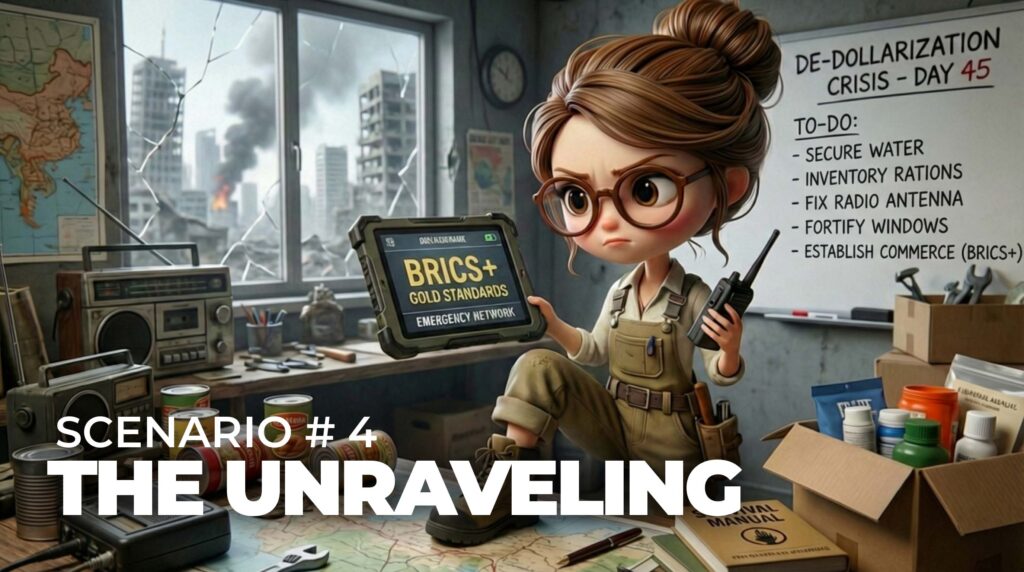
Fast De-dollarization + Intense Disruptions
In this most volatile scenario, rapid de-dollarization occurs amid (or triggered by) severe disruptions. This could manifest through multiple pathways: a sovereign debt crisis forcing dollar rejection, a major kinetic or hybrid war disrupting global trade flows, coordinated BRICS action during a U.S. political or financial crisis, cascading failures in financial infrastructure, or some combination of simultaneous shocks.
The post-WWII institutional architecture fractures rather than reforms. Multiple currency and payment systems compete without clear rules or stable relationships. Supply chains fragment along geopolitical lines. Pricing mechanisms become unreliable, as markets struggle to find equilibrium amid institutional breakdown.
This scenario features the highest tail risk—the potential for both catastrophic losses and asymmetric gains. Those positioned in hard assets, local production, essential skills, and resilient communities may prosper, while those dependent on financial assets, global supply chains, and institutional stability face severe disruption.
The control grid infrastructure (CBDCs, digital ID, surveillance systems, social credit mechanisms) may be deployed aggressively as authorities attempt to maintain order—or may fail to deploy effectively amid chaos. The outcome depends heavily on the specific nature and sequence of disruptions.
Inflation—even hyperinflation—accelerates across dollar zone supply chains, offset by deflation from economic collapse and violence. Ultimately, this scenario is deflationary in the dollar zone, with many goods and services simply not available, even at any price.
Characteristics
- Dollar experiences collapse or severe devaluation.
- Treasury market exhibits dysfunction.
- Gold reprices dramatically.
- Multiple simultaneous crises overwhelm institutional response capacity.
- Supply chain failures affect food, energy, and medicine.
- Social unrest and political instability occur in previously stable regions.
- Emergency measures become permanent features of governance.
- Despite historical analogues—1914, 1929-33, 1971, 2008—this scenario is more severe.
Risk and Opportunities
Survival mode dominates. Financial sophistication matters less than practical resilience. The hierarchy of needs reasserts itself: security, food, water, energy, shelter, community, then the ability to communicate and trade.
Real assets dramatically outperform financial assets. Productive land, stored essentials, precious metals, essential equipment, and skills that produce tangible value become the basis of wealth. Paper claims on future cash flows face impairment or default.
Community and relationships become critical infrastructure. Isolated individuals, regardless of wealth, face severe disadvantages. Networks of mutual support, local production, and trusted exchange relationships determine outcomes more than individual resources.
Those who are prepared face difficult choices about helping others versus preserving resources. Ethical frameworks developed in stable times face severe stress. Character and what Solari calls “the people bank” matter.
“The currency of the future will be relationships of trust.”