This 6-pillar curriculum teaches the basic literacy we need to be personally and financially successful and to do so in a manner in which together we evolve a culture that supports the emergence of an advanced human civilization.
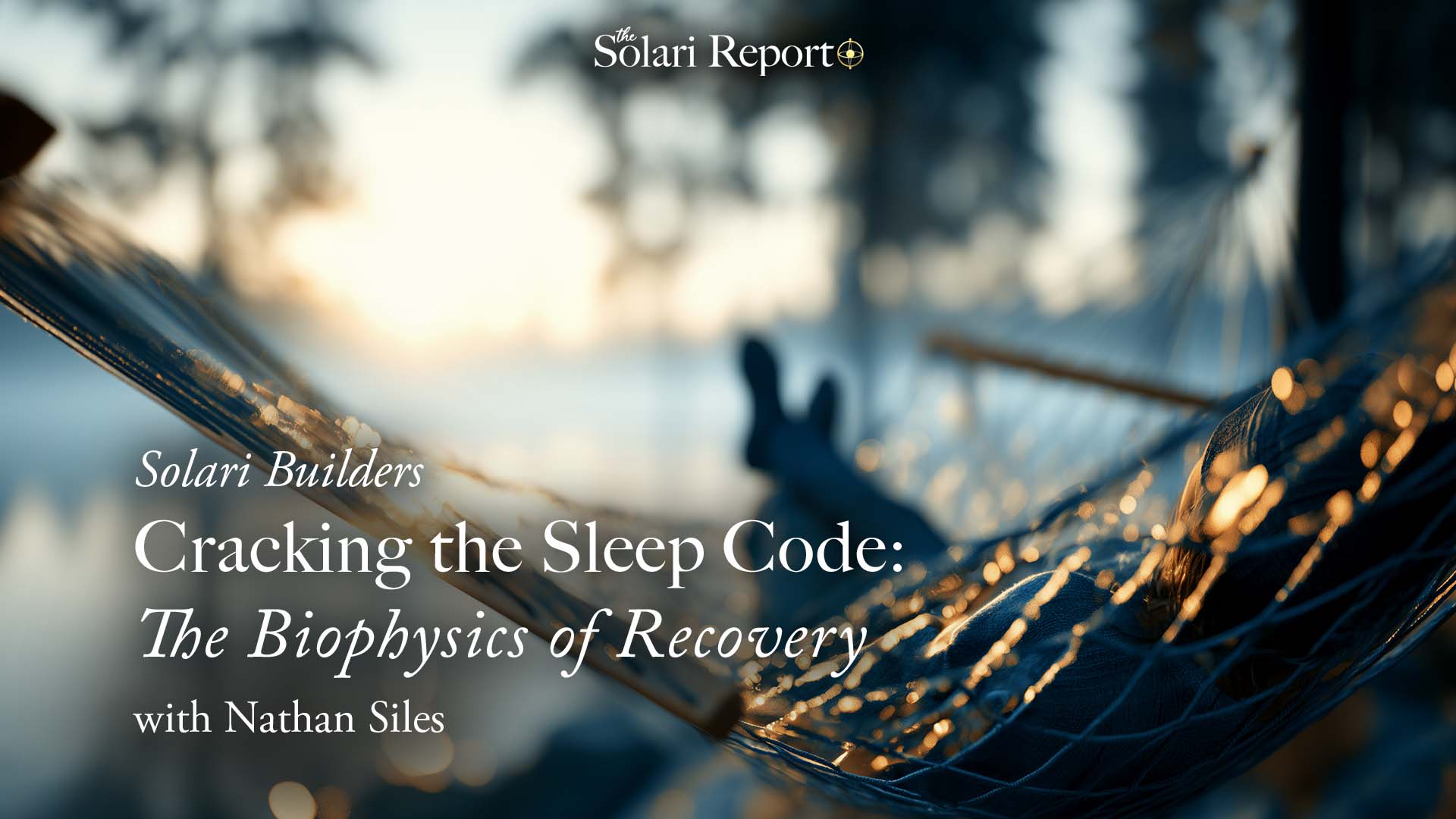
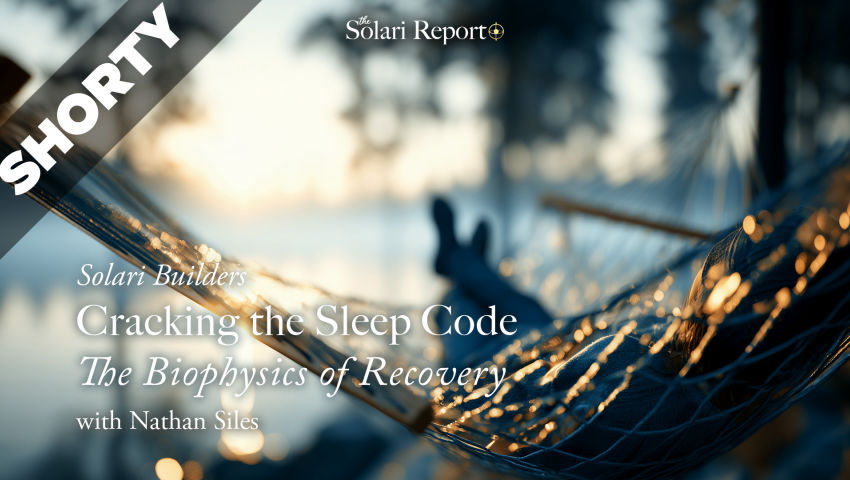
On the Solari Report, Ricardo interviews returning guest Nathan Siles about the biophysics of sleep and why modern indoor, artificial environments have disrupted it, increasing risks like cardiovascular disease, cancer, and neurodegeneration when sleep is too short or too long.
I haven’t even watched the interview yet and I completely agree.
Watch the sunrise. Get your bare feet on the ground.
Sounds easy – and most people can’t manage it.
Exactly. Good sleep is available to everyone.
Wow, this is an incredible interview. Very information dense. I took some notes and will rewatch the video, but it would be really valuable to read a transcript. Any chance one will be available?
Thank you for introducing me to Nathan Siles.
Sleeping is something I have been doing every day (or more accurately every night) for years, in fact decades, but I never gave it much thought, so I found this report particularly interesting.
Does it matter which position one sleeps in? I was told that if one sleeps on the side it is better to sleep on the right side since in this position the heart doesn’t have to pump as hard.
What about pillows – good, bad or indifferent?
Window open or shut?
Pyjamas or birthday suit?
Night cap and socks when it’s cold?
When I was in Asia I was told that the bed should be placed in the room so that when sleeping the head points north, but forgot why. Is there any truth to this?
Andrew, this is a great note. Sleep is something we do every night for decades, yet most people never think deeply about it until it stops working properly. For most of human history, the light, temperature, magnetic and electrical conditions of the environment were reasonably predictable. Modern life has disrupted many of those inputs, and today an estimated 50 to 70 million Americans live with a sleep or wakefulness disorder. Nocturia is also extremely common, particularly with age, although waking to urinate should not automatically be dismissed as normal.
The encouraging part is that sleep is largely an unconscious expression of what we repeatedly do while awake. When light exposure, movement, food timing, temperature, breathing and stress are handled consistently during the day, the nervous system has much less work to do at night.
Sleeping position
There is no single position that is best for everyone.
Sleeping on the back can provide excellent spinal symmetry, but it also allows gravity to pull the tongue and soft tissues backward. In people who snore, mouth breathe or have obstructive sleep apnea, breathing disturbances are generally more frequent and severe when lying supine. For those people, side sleeping is usually preferable.
The idea that everyone should sleep on the right because the heart does not have to pump as hard is too simplistic. The heart is well supported within the chest and does not become meaningfully overworked merely because someone lies on the left.
There are, however, individual considerations:
Left side sleeping is generally better for people with nighttime reflux because the anatomy of the stomach makes acid less likely to move into the oesophagus.
Right side sleeping may simply feel more comfortable for some people, including some with cardiac conditions, but it is not universally healthier.
Side sleeping is often the best practical compromise for breathing and comfort.
Stomach sleeping requires prolonged neck rotation and can strain the neck, jaw and lower back. It is not necessarily disastrous, and it can reduce airway collapse in some people, but it is generally the hardest position in which to maintain relaxed, neutral alignment.
Claims that one particular human sleeping position substantially improves glymphatic drainage are still premature. Much of that discussion comes from animal studies rather than strong clinical evidence in humans.
I personally sleep mostly on my side, with my head very slightly elevated, and sometimes use a weighted blanket when the room is cool enough. A gentle incline can help certain people with reflux or breathing, but 13 degrees is not a universal biological requirement. Comfort, airway stability and spinal alignment matter more than hitting one prescribed angle.
Pillows and mattresses
Pillows are neither automatically good nor bad. Their job is to fill the space between the head and the mattress so the cervical spine remains close to neutral.
A side sleeper with broad shoulders will usually need a thicker pillow than a back sleeper. Too little height allows the head to fall toward the mattress; too much pushes it in the opposite direction. The best pillow height therefore depends on shoulder width, neck length, sleeping position and mattress compression. Research suggests that pillow shape and height may matter more to cervical alignment than simply choosing a particular material.
The mattress and pillow should also work as one system. A softer mattress lets the shoulder sink farther down, so a slightly thinner pillow may be appropriate. A firmer mattress usually requires more pillow height. I generally favour supportive rather than excessively soft bedding, but not anything so hard that it creates hip, shoulder or neck pressure.
The goal is not maximum firmness. The goal is:
A clear airway, a neutral neck, a relaxed jaw, free diaphragmatic movement and no pressure points.
Mouth breathing and mouth tape: Back sleeping can encourage the mouth to fall open, but mouth taping should not be presented as a universal solution despite it being one of the most simple and effective strategies for retraining the nasal breathing reflex. A nasal dilator, attention to nasal health and a product such as Myotape may help selected people maintain nasal breathing, but anyone with nasal obstruction, significant snoring, suspected sleep apnea, respiratory disease, nausea risk or heavy alcohol or sedative use should not simply seal their mouth at night.
Window open or closed? The real objective is fresh, quiet, clean air at a comfortable temperature, not necessarily an open window at all costs.Opening a window or bedroom door can reduce overnight carbon dioxide accumulation and improve ventilation. Controlled bedroom studies have found associations between better ventilation, more deep sleep, fewer awakenings and improved perceived air quality.
However, keep the window closed when outdoor air introduces traffic noise, smoke, pollution, humidity, excessive heat, cold or allergens. In those situations, quiet mechanical ventilation or well-filtered HVAC may be better.
A useful principle is: Open when the outdoor environment is cleaner and quieter than the indoor environment. Close and filter when it is not.
Pyjamas or birthday suit? The birthday suit is often ideal because it allows easier heat dissipation, reduces constriction and removes another layer of synthetic material from the skin. However, it is not a competition. Loose, breathable clothing made from cotton, linen, wool or silk is perfectly reasonable when warmth or comfort requires it. But in my experience working with clients birthday suit results in better sleep overall.
The biological goal is to allow core temperature to decline without becoming cold enough to trigger tension, shivering or repeated waking.
Socks and a nightcap? Warm feet can genuinely help with sleep onset. Warming the hands and feet promotes distal vasodilation, allowing heat to leave the core more efficiently. In a small controlled study conducted in a cool environment, bed socks shortened sleep onset and improved several sleep measures.
A warm Epsom salt footbath can serve a similar practical purpose before bed. Wear socks when your feet are cold, but remove them if they make you overheat. I never sleep with socks even if it’s cold, your circulation should be good enought to manage this process itself, if not, then we must address another problem rather than band-aid over it with socks.
If by nightcap you mean a soft wool or cotton cap, it may be useful in a genuinely cold room, although overheating the head is counterproductive. If you mean alcohol, it may make someone feel sedated initially, but it disrupts normal sleep architecture, reduces REM sleep and often fragments the second half of the night.
Herbal tea can also be calming, particularly chamomile, lavender, rooibos or peppermint, but fluid timing matters. Oolong commonly contains caffeine, and dandelion may increase urination, so neither would be my first choice immediately before sleep. People waking to urinate should reduce late fluid volume while also investigating the broader causes rather than assuming it is merely a weak bladder. A little anecdote on this for me is that when your vasopressin/ADH is dialed in to a strong circadian rhythm you can drink teas/water in the last few hours of the day before bed and not wake up at night. I know my rhythm is on point when I drink a 16 ouce herbal tea in the last hour before bed and don’t get up at night at all. But in the morning when my brain switches back on and the connection is re-established I certainly feel the urge to empty the bladder.
Should the head point north? There are long-standing traditions around sleep orientation. Different schools of Chinese medicine, Ayurveda, Vastu and Feng Shui offer differing recommendations, sometimes favouring north, south or east depending on the hemisphere, constitution and philosophy being followed.
At present, there is no convincing clinical evidence that everyone sleeps better simply because the head points toward magnetic north, and the movement of the magnetic pole does not by itself create a new bedside rule. Geographic north and magnetic north are also not the same thing.
Building biology traditions may additionally consider underground water, geological faults, Hartmann or Curry grids and dowsing. These may be meaningful within those traditions, but they should be described honestly as subtle-field hypotheses rather than established measurements with the same evidentiary standing as electric fields, magnetic fields, radiofrequency exposure, noise, temperature or air quality.
In practical terms, I would prioritise the bedroom in this order:
Darkness and appropriate light timing.
A clear airway and comfortable sleeping position.
Cool, clean and sufficiently ventilated air.
Low noise.
Reduced radiofrequency, AC electric fields, magnetic fields and unnecessary powered devices near the bed.
Comfortable spinal alignment.
Bed orientation and more subtle environmental considerations.
I would rather sleep with my head in the “wrong” compass direction but away from an energised wall, smart television, meter panel, charger or high magnetic field than face north while placing my head directly beside one of those sources.
So my overall answer is that these details do matter, but context matters more than dogma. Build the best sleep environment you can, test how your body responds, and improve it one layer at a time.
Many thanks for taking the time to answer my all questions, Nathan, and for doing this in an easily comprehensible way. Much appreciated.
My question about the nightcap was referring to a head covering rather than a tipple but I’m glad you addressed both.
I have just signed up to be put on the waiting list for your Health Revolution Community so I look forward to following your work soon and learning many more important and useful things from you.



































































































I haven’t even watched the interview yet and I completely agree.
Watch the sunrise. Get your bare feet on the ground.
Sounds easy – and most people can’t manage it.
Exactly. Good sleep is available to everyone.
Wow, this is an incredible interview. Very information dense. I took some notes and will rewatch the video, but it would be really valuable to read a transcript. Any chance one will be available?
Thank you for introducing me to Nathan Siles.
Sleeping is something I have been doing every day (or more accurately every night) for years, in fact decades, but I never gave it much thought, so I found this report particularly interesting.
Does it matter which position one sleeps in? I was told that if one sleeps on the side it is better to sleep on the right side since in this position the heart doesn’t have to pump as hard.
What about pillows – good, bad or indifferent?
Window open or shut?
Pyjamas or birthday suit?
Night cap and socks when it’s cold?
When I was in Asia I was told that the bed should be placed in the room so that when sleeping the head points north, but forgot why. Is there any truth to this?
Andrew, this is a great note. Sleep is something we do every night for decades, yet most people never think deeply about it until it stops working properly. For most of human history, the light, temperature, magnetic and electrical conditions of the environment were reasonably predictable. Modern life has disrupted many of those inputs, and today an estimated 50 to 70 million Americans live with a sleep or wakefulness disorder. Nocturia is also extremely common, particularly with age, although waking to urinate should not automatically be dismissed as normal.
The encouraging part is that sleep is largely an unconscious expression of what we repeatedly do while awake. When light exposure, movement, food timing, temperature, breathing and stress are handled consistently during the day, the nervous system has much less work to do at night.
Sleeping position
There is no single position that is best for everyone.
Sleeping on the back can provide excellent spinal symmetry, but it also allows gravity to pull the tongue and soft tissues backward. In people who snore, mouth breathe or have obstructive sleep apnea, breathing disturbances are generally more frequent and severe when lying supine. For those people, side sleeping is usually preferable.
The idea that everyone should sleep on the right because the heart does not have to pump as hard is too simplistic. The heart is well supported within the chest and does not become meaningfully overworked merely because someone lies on the left.
There are, however, individual considerations:
Left side sleeping is generally better for people with nighttime reflux because the anatomy of the stomach makes acid less likely to move into the oesophagus.
Right side sleeping may simply feel more comfortable for some people, including some with cardiac conditions, but it is not universally healthier.
Side sleeping is often the best practical compromise for breathing and comfort.
Stomach sleeping requires prolonged neck rotation and can strain the neck, jaw and lower back. It is not necessarily disastrous, and it can reduce airway collapse in some people, but it is generally the hardest position in which to maintain relaxed, neutral alignment.
Claims that one particular human sleeping position substantially improves glymphatic drainage are still premature. Much of that discussion comes from animal studies rather than strong clinical evidence in humans.
I personally sleep mostly on my side, with my head very slightly elevated, and sometimes use a weighted blanket when the room is cool enough. A gentle incline can help certain people with reflux or breathing, but 13 degrees is not a universal biological requirement. Comfort, airway stability and spinal alignment matter more than hitting one prescribed angle.
Pillows and mattresses
Pillows are neither automatically good nor bad. Their job is to fill the space between the head and the mattress so the cervical spine remains close to neutral.
A side sleeper with broad shoulders will usually need a thicker pillow than a back sleeper. Too little height allows the head to fall toward the mattress; too much pushes it in the opposite direction. The best pillow height therefore depends on shoulder width, neck length, sleeping position and mattress compression. Research suggests that pillow shape and height may matter more to cervical alignment than simply choosing a particular material.
The mattress and pillow should also work as one system. A softer mattress lets the shoulder sink farther down, so a slightly thinner pillow may be appropriate. A firmer mattress usually requires more pillow height. I generally favour supportive rather than excessively soft bedding, but not anything so hard that it creates hip, shoulder or neck pressure.
The goal is not maximum firmness. The goal is:
A clear airway, a neutral neck, a relaxed jaw, free diaphragmatic movement and no pressure points.
Mouth breathing and mouth tape: Back sleeping can encourage the mouth to fall open, but mouth taping should not be presented as a universal solution despite it being one of the most simple and effective strategies for retraining the nasal breathing reflex. A nasal dilator, attention to nasal health and a product such as Myotape may help selected people maintain nasal breathing, but anyone with nasal obstruction, significant snoring, suspected sleep apnea, respiratory disease, nausea risk or heavy alcohol or sedative use should not simply seal their mouth at night.
Window open or closed? The real objective is fresh, quiet, clean air at a comfortable temperature, not necessarily an open window at all costs.Opening a window or bedroom door can reduce overnight carbon dioxide accumulation and improve ventilation. Controlled bedroom studies have found associations between better ventilation, more deep sleep, fewer awakenings and improved perceived air quality.
However, keep the window closed when outdoor air introduces traffic noise, smoke, pollution, humidity, excessive heat, cold or allergens. In those situations, quiet mechanical ventilation or well-filtered HVAC may be better.
A useful principle is: Open when the outdoor environment is cleaner and quieter than the indoor environment. Close and filter when it is not.
Pyjamas or birthday suit? The birthday suit is often ideal because it allows easier heat dissipation, reduces constriction and removes another layer of synthetic material from the skin. However, it is not a competition. Loose, breathable clothing made from cotton, linen, wool or silk is perfectly reasonable when warmth or comfort requires it. But in my experience working with clients birthday suit results in better sleep overall.
The biological goal is to allow core temperature to decline without becoming cold enough to trigger tension, shivering or repeated waking.
Socks and a nightcap? Warm feet can genuinely help with sleep onset. Warming the hands and feet promotes distal vasodilation, allowing heat to leave the core more efficiently. In a small controlled study conducted in a cool environment, bed socks shortened sleep onset and improved several sleep measures.
A warm Epsom salt footbath can serve a similar practical purpose before bed. Wear socks when your feet are cold, but remove them if they make you overheat. I never sleep with socks even if it’s cold, your circulation should be good enought to manage this process itself, if not, then we must address another problem rather than band-aid over it with socks.
If by nightcap you mean a soft wool or cotton cap, it may be useful in a genuinely cold room, although overheating the head is counterproductive. If you mean alcohol, it may make someone feel sedated initially, but it disrupts normal sleep architecture, reduces REM sleep and often fragments the second half of the night.
Herbal tea can also be calming, particularly chamomile, lavender, rooibos or peppermint, but fluid timing matters. Oolong commonly contains caffeine, and dandelion may increase urination, so neither would be my first choice immediately before sleep. People waking to urinate should reduce late fluid volume while also investigating the broader causes rather than assuming it is merely a weak bladder. A little anecdote on this for me is that when your vasopressin/ADH is dialed in to a strong circadian rhythm you can drink teas/water in the last few hours of the day before bed and not wake up at night. I know my rhythm is on point when I drink a 16 ouce herbal tea in the last hour before bed and don’t get up at night at all. But in the morning when my brain switches back on and the connection is re-established I certainly feel the urge to empty the bladder.
Should the head point north? There are long-standing traditions around sleep orientation. Different schools of Chinese medicine, Ayurveda, Vastu and Feng Shui offer differing recommendations, sometimes favouring north, south or east depending on the hemisphere, constitution and philosophy being followed.
At present, there is no convincing clinical evidence that everyone sleeps better simply because the head points toward magnetic north, and the movement of the magnetic pole does not by itself create a new bedside rule. Geographic north and magnetic north are also not the same thing.
Building biology traditions may additionally consider underground water, geological faults, Hartmann or Curry grids and dowsing. These may be meaningful within those traditions, but they should be described honestly as subtle-field hypotheses rather than established measurements with the same evidentiary standing as electric fields, magnetic fields, radiofrequency exposure, noise, temperature or air quality.
In practical terms, I would prioritise the bedroom in this order:
Darkness and appropriate light timing.
A clear airway and comfortable sleeping position.
Cool, clean and sufficiently ventilated air.
Low noise.
Reduced radiofrequency, AC electric fields, magnetic fields and unnecessary powered devices near the bed.
Comfortable spinal alignment.
Bed orientation and more subtle environmental considerations.
I would rather sleep with my head in the “wrong” compass direction but away from an energised wall, smart television, meter panel, charger or high magnetic field than face north while placing my head directly beside one of those sources.
So my overall answer is that these details do matter, but context matters more than dogma. Build the best sleep environment you can, test how your body responds, and improve it one layer at a time.
Many thanks for taking the time to answer my all questions, Nathan, and for doing this in an easily comprehensible way. Much appreciated.
My question about the nightcap was referring to a head covering rather than a tipple but I’m glad you addressed both.
I have just signed up to be put on the waiting list for your Health Revolution Community so I look forward to following your work soon and learning many more important and useful things from you.