




























































































By Breeauna Sagdal
Two European countries—Sweden, which though an EU member is not a member of the eurozone, and non-EU member Switzerland—currently provide interesting windows onto the worldwide battle to maintain cash as a meaningful payment option.
Once a leader in cashless “innovation,” Sweden is now actively reversing course to preserve cash. In 2023, it abandoned plans for an all-digital e-krona and is prioritizing payment system safety, while its Defense Ministry—citing vulnerabilities in electronic banking to potential cyberwarfare—distributes brochures advising households to keep at least a week’s supply of banknotes on hand.
Meanwhile, Switzerland’s Liberty Movement is making progress toward enshrining cash in the constitution.
But emerging circumstances prove the importance of continued vigilance in 2026. Let’s dive in.
Sweden’s Cash Inquiry
In recent years, Sweden has been a pioneer in digital payments, and mobile apps like Swish have dominated transactions, to the point where Sweden is one of the two countries in the world (along with Norway) with the lowest amount of cash in circulation (as a percentage of GDP).
In 2024, however, amid rising concerns over cybersecurity threats, power outages, and geopolitical instability, Swedish officials did an about-face and launched a “Cash Inquiry.”
One of the central proposals to have emerged from the Cash Inquiry is a requirement to accept cash for the sale of essential goods and services. This requirement would apply to supermarkets and other businesses and organizations providing essential goods, and entities like health centers that charge fees under public law.
Sweden’s central bank, the Riksbank, supports this measure as crucial, with Riksbank Governor Erik Thedéen stating in a press release that “People should always be able to pay for food, healthcare and medicines both digitally and with cash.”
In its submission to the country’s Cash Inquiry, the Riksbank has strongly advocated for legislative measures to protect physical money, warning that “the cash infrastructure is currently very vulnerable” and highlighting cash’s critical role in resilience. Says Thedéen, “The increasingly turbulent global situation, increased cyber attacks and also the major power outages in southern Europe show the importance of being able to make payments even when the internet is down.”
In addition, Thedéen has emphasized that banks must take greater responsibility for handling cash, including strengthening mechanisms for overnight deposits and for supplying businesses with petty cash. The Riksbank also wants banks to be legally required to provide private individuals with access to basic cash services (such as depositing banknotes)—until now, not a legal obligation.
Switzerland’s Referendum
Switzerland is another low-cash economy where mobile app and card payments are increasingly dominant. But though physical money comprises only around a quarter of transactions, the country appears to be locked in a clash over cash.
Politicians in the Liberty Movement submitted more than 100,000 signatures, enough to force a public referendum on their “Cash is Liberty ” initiative. If passed, cash acceptance would be permanently enshrined in the country’s constitution, guaranteeing the continued circulation of Swiss franc coins and banknotes.
While paying lip service to the “major importance of cash for the economy and society,” the national government opposed the initiative and introduced a counterproposal. However, the lower house of parliament overwhelmingly rejected the government’s attempt to block the constitutional amendment, and the measure is now expected to be voted on by the upper house in the coming year.
In October, the recently appointed president of the Swiss National Bank, Martin Schlegel, reaffirmed that cash remains a “widely used payment method” and unveiled plans for a new series of franc notes. Schlegel also highlighted the unique strengths of cash—most notably, its reliability during power outages and technical failures.
Vigilance Required
Both Sweden and Switzerland illustrate the tensions surfacing amid the growing recognition that fully cashless societies risk exclusion and fragility. The recent developments around cash seem to signal a broader global rethink. As digital threats mount, cash is reemerging not as a relic, but as a vital pillar of secure and accessible payment systems.
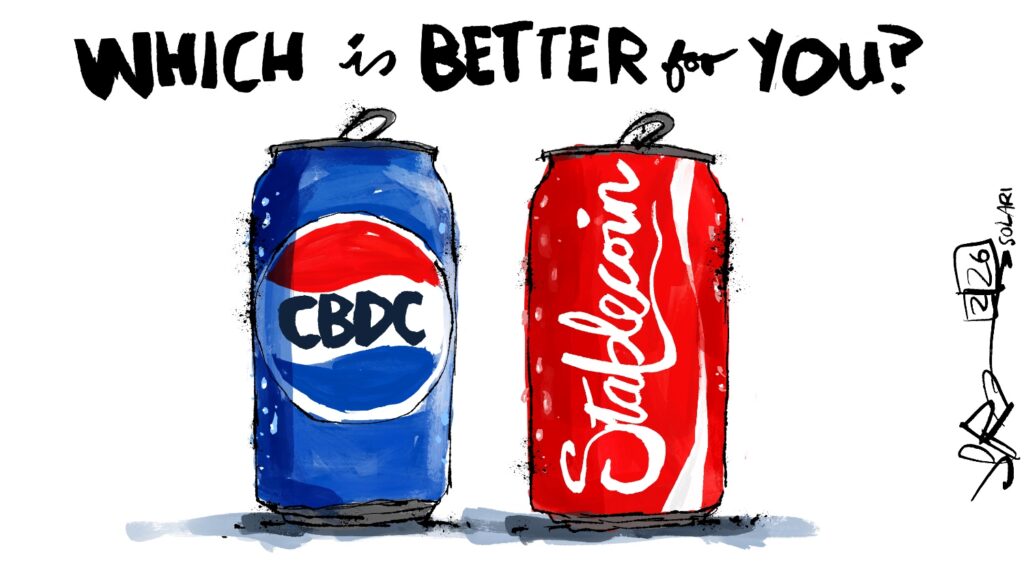
However, as nations seek to balance innovation with preparedness, the U.S. adoption of stablecoins and enabling legislation, and other digital currency developments worldwide, could tip the scales back in the other direction.
For example, though Sweden determined in 2023 that there was no societal need for an e-krona, Riksbank Governor Thedéen—closely eyeing digital currency developments in the U.S. and EU—stated in early December that Sweden might need to investigate the matter anew to avoid being left behind.
Thedéen said,
“In 2029, the digital euro will most likely be introduced. And if it has major effects on payment systems in Europe, there may be reason to take that into account, and then there may be reason to be a little more advanced than we are today…. Since [2021 and 2022], for example, stablecoins have gone from nothing to being quite a big thing, not least in US dollars. Five years from now it might be a very big change. The payment system is changing very quickly now.”
In Switzerland, with the upper house vote on constitutionally protected cash still months away, the national government continues to advance digital currency initiatives. Despite significant backlash from cash-friendly policymakers due to concerns over privacy and financial stability, the government aims to position Switzerland—home to “Crypto Valley” and over 1,000 fintech and blockchain companies—as a leader in the integration of digital currencies.
Turtling for Cash
As humanity courageously embraces a new year, it’s an important time to stop and gratefully reflect on the wins for cash in 2025. Although many hurdles lay ahead that require awareness and vigilance, it is the turtle who wins the race.
Happy New Year and Turtle Forth!