

Plasma Dusty Complex Plasmas
Become a member: Subscribe




















NTS Headlines
Headlines by Category
Headlines by Year
- Money & Markets
- Weekly Solari Reports
- Cognitive Liberty
- Solari Builders
- Ask Catherine
- News Trends & Stories
- Equity Overview
- War For Bankocracy
- Digital Money, Digital Control
- State Leader Briefings
- Food
- Food for the Soul
- Future Science
- Health
- Metanoia
- Solutions
- Spiritual Science
- Wellness
- Building Wealth
- Via Europa

























Solari’s Building Wealth materials are organized to inspire and support your personal strategic and financial planning.



Building Wealth
This 6-pillar curriculum teaches the basic literacy we need to be personally and financially successful and to do so in a manner in which together we evolve a culture that supports the emergence of an advanced human civilization.














Missing Money
Articles and video discussions of the $21 Trillion dollars missing from the U.S. government

Connect with the wider network of like-minded Solari subscribers using our in-house social media platform, Solari Connect.












No posts
Dusty Complex Plasmas
“For dust you are, and to dust you return.” ~ Genesis 3:19
by Ulrike Granögger
There is a very special form of plasma that has accrued more and more significance since the 1990s, both in cosmology as well as in the laboratory, especially when taking into consideration the possible “sentience” or even “intelligence” of plasmas. Let’s appreciate dusty complex plasmas.
“Dusty” plasmas are literally plasmas that, in addition to their electrons, ions, and neutral gas particles, contain a population of solid dust grains. The dust grains can be as small as a few atoms (nanometer and even sub-nanometer size) or reach micrometer sizes. Due to the freely roaming electrons and ions in the plasma, these grains collect electrons or ions on their surface and become strongly electrically charged. The charge can also be provided from ionizing radiation in the astrophysical environment that feeds energy to the plasma. Each charged dust particle can acquire hundreds of thousands of elementary charges.
Because the dust particulates are massive and highly charged, they introduce new physics that are not present in ordinary plasmas and become extremely difficult to model. They influence the plasma’s behavior and can lead to unique wave propagation, instabilities, and collective effects not seen in ordinary plasmas. Hence the name, complex plasma.
Their internal variety of mass and time scales is one reason that dusty plasmas are “complex.” That is, the dust introduces massive particulates (“massive” compared to the electrons and ions) that will persist much longer—milliseconds to seconds—than the smaller e- and p+ that interact on a timescale of nano- to microseconds. What this means is that dusty plasmas can sustain long-lived, macro-sized self-organizing structures with memory effects.
One of the hallmarks of plasmas is their collective behavior. The particles act in a coordinated or entangled manner, and small fluctuations can lead to universal changes. In dusty plasmas, the charged dust grains are now entrained in these nonlinear interactions. All of a sudden, for example, a dusty plasma can create a void, a spontaneously emerging dust-free region in the plasma interior exhibiting sharp boundaries and sometimes pulsating (expanding/contracting) activity. In some laboratory experiments, the voids persisted over long time scales, from seconds to hours, and were accompanied by spontaneously excited dust waves.1

Voids and Vortices
How are the various properties and behaviors of dusty complex plasmas possible? It is obvious that the plasma’s self-organizing capabilities do not originate from gravitational forces. In fact, the clearest examples of spontaneous voids and plasma crystal structures emerged from experiments carried out in the microgravity conditions on the International Space Station (ISS).
Since 2001, a German-Russian collaboration on the ISS has performed research experiments on complex plasmas in the low-gravity situation that exists on board the space station. Experiments with the “Plasmakristall” modules PKE-Nefedov, PK-3, PK-3 Plus, and, more recently, PK-4 have produced dramatic insights into the self-organization of dusty complex plasmas.5 Under the leadership of Dr. Gregor E. Morfill,6 scientists of the German Max Planck Institute for Extraterrestrial Physics (MPE), in collaboration with the Joint Institute for High Temperatures (JIHT) of the Russian Academy of Sciences, observe dusty plasmas through a portable vacuum chamber on the ISS,7 in which a plasma is ionized by radio frequency energy (RF plasma). Subsequently, micron-sized dust grains are added to the chamber that visualize the fascinating behavior and intrinsic structure of the complex system.
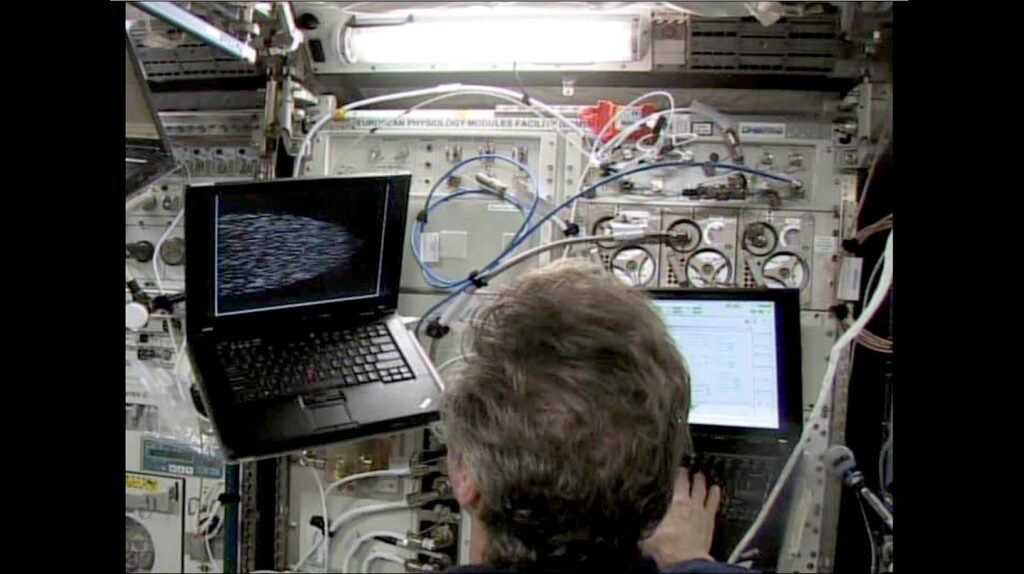
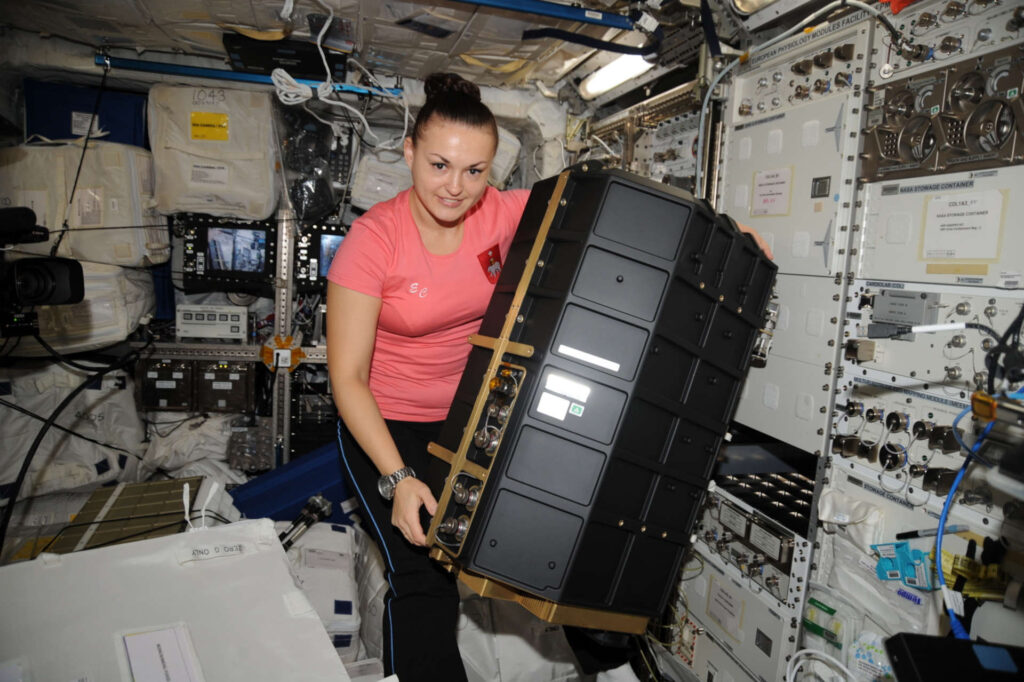
With this experimental setup, it was possible for the first time to see the internal anatomy manifested by dusty complex plasmas, which turned out to be utterly surprising to the physicists. Why would there be defined borders and clear shapes in something as chaotic as charged gas? They found that the voids behave almost like organs within the plasma—distinct regions that demonstrate different physics inside and outside. Moreover, the same dusty plasmas can also form filaments, vortices, crystals, and plasmoids, all being structures that persist far longer than typical plasma fluctuations.
The video recordings (see above) of dusty plasmas observed on the ISS and released by the Russian space agency Roscosmos demonstrate the stunning comportment of collectively responding particles that align into chains, filaments, and vortices and that reconfigure themselves when perturbed.
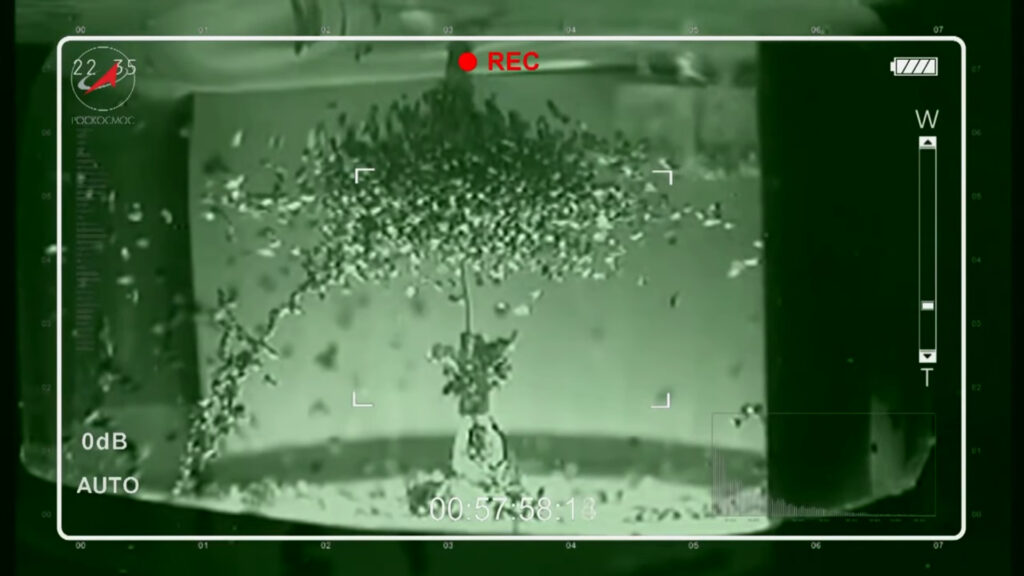
These filaments and crystalline structures are able to conduct charge and possibly act as communication channels within the system. In addition, dusty plasmas can contain plasmoids, which are coherent, localized, and semi-autonomous entities in the plasma.
Self-Organization and Reproduction
In a 2007 paper, lead researcher Gregor Morfill, together with the outstanding Russian dusty plasma physicist Vadim Tsytovich, calculated that under certain conditions, dust particles can join to form double helixes similar to DNA and that the self-generated structures could even divide to create two identical copies, effectively reproducing themselves.
“The helical dust structures, after they are formed, resemble features similar to those of DNA. In particular, they can transfer information from one helical structure to another via the dust convective cells surrounding any bifurcation of the helical structure. […] Our analysis shows that if helical dust structures are formed in space, they can have bifurcations as memory marks and duplicate each other, and they would reveal a faster evolution rate by competing for ‘food’ (surrounding plasma fluxes). These structures can have all necessary features to form ‘inorganic life.’”9
Long-standing physicists do not make such statements lightly. But Morfill and Tsytovich are not alone in formulating such hypotheses. A number of researchers who are confronted daily with the inexplicable aspects of complex plasmas have come to similar conclusions. Tsytovich has no doubt that these complex, self-organized plasma structures exhibit all the necessary properties to qualify as candidates for inorganic living matter: “They are autonomous, they reproduce and they evolve.”10
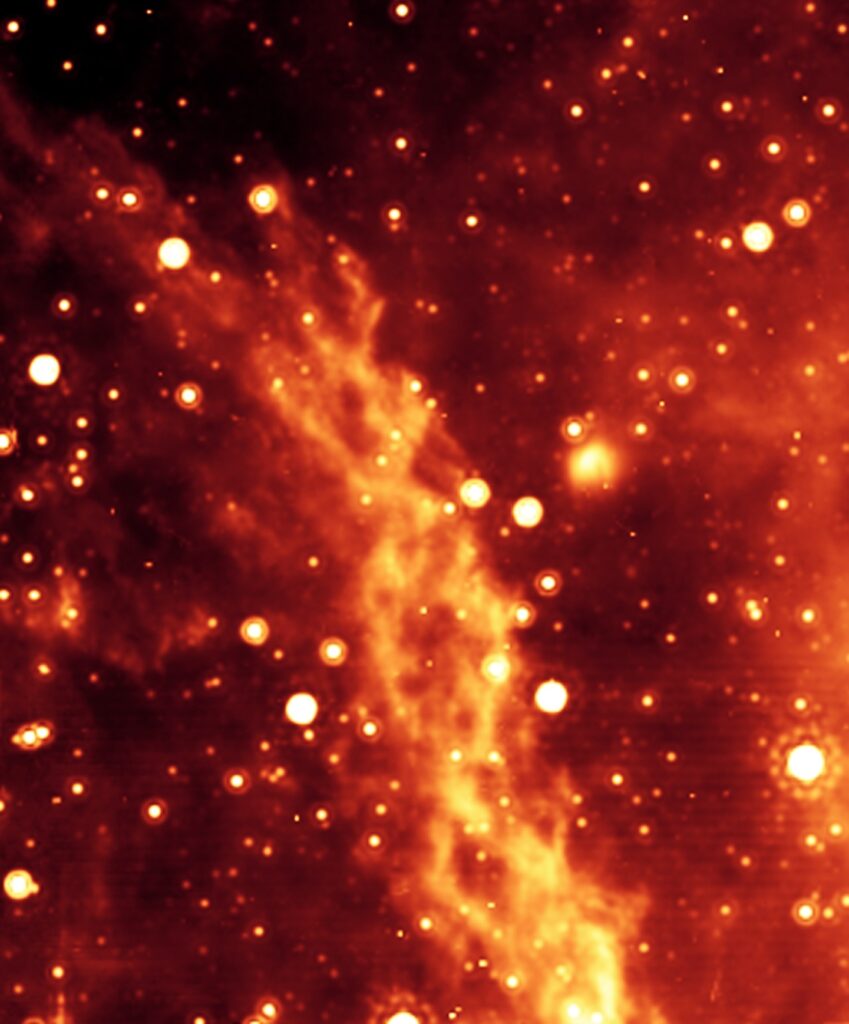
In this light, a vast and magnificent double-helix plasma dust cloud discovered in 2005 through NASA’s Spitzer Space Telescope takes on new meaning. The torsional cloud occurs in the strong magnetic fields that exist toward the center of our Milky Way Galaxy and are interpreted as Alfvén waves. They are important carriers of magnetic energy. At a length of 80 light-years, this dust cloud in the center of the galaxy displays the same geometrical arrangement as the laboratory plasmas observed and calculated by Morfill and Tsytovich. Let us remember that the biological DNA double helix, too, is a charge-carrying and charge-conducting molecule that has been shown to possess long-range interactions and collective responses among its constituent nucleotides.11 12 Are the origins and structure of organic life fundamentally coupled with the physics and behavior of plasma?
Saturn’s Rings
What about the rings of Saturn? Most popular science books describe the Saturn rings as being made of rock and ice particles (with grain sizes ranging from microns to meters) that are kept in orbit by Saturn’s gravity. What these accounts do not emphasize is that these particles are in a plasma and thus charged with all the interaction phenomena that we now know to be part of dusty plasmas. In fact, the rings of Saturn are complex dusty plasmas.

Two of Saturn’s rings—the brightest A and B rings—have been known since Galileo Galilei used the first telescopes in the 17th century, but most of them were discovered only in the late 20th century with the flybys of the Pioneer, Voyager, and Cassini probes. Detection of the last and widest Phoebe ring came in 2009, when the Spitzer Space Telescope made infrared observations of a vast and barely visible ring that is far outside of the familiar ring system.

Strikingly, the F ring, discovered by Pioneer in 1979, has a braided, helix-type structure and is itself a spiral and not a single ring. Some of the most astonishing effects in the enigmatic F ring are caused by objects (moons) that punch out small jets from the rings.
Helix features, spirals, and propeller shapes are also seen in Saturn’s B and D rings. They are commonly explained on the basis of gravitational forces of Saturn’s moons, but plasma experts consider electrostatic effects and the unique characteristics of dusty plasma processes.13 For example, there are transient, radial, or spoke-like markings, which can be seen across Saturn’s B ring, that go against gravity. They are composed of micrometer-sized dust particles that, due to their charge, levitate and move above the ring plane aligned by the magnetohydrodynamics of the invisible plasma flows. Again, dusty plasmas make visible that plasma bodies (in this case, the invisible magnetic plasma field that surrounds Saturn) have very complex internal architecture far from the equilibrium expected of gases or clouds of dust particles.
The memorable book Ringmakers of Saturn by Norman R. Bergrun,14 published in 1986, presents an unconventional theory about the nature of Saturn’s rings based on the author’s analysis of data and photographs taken by the NASA Voyager 1 and Voyager 2 space probes. Bergrun, who had a background as an aerospace engineer and NASA research scientist (and is on the “Wall of Honor” at the National Air and Space Museum in Chantilly, VA15), suggests that Saturn’s rings are not merely composed of ice and rock particles but are instead the result of advanced extraterrestrial technology—large, intelligent spacecraft. Specifically, these “ringmakers” use electromagnetic forces and manipulate charged particles to shape and sustain the rings.
The Kordylewski Clouds – A Dusty Complex Plasma
The confirmation of the existence of the Kordylewski Clouds was one of the initial reasons that Prof. Robert Temple wrote A New Science of Heaven. In 1961, Polish astronomer Kazimierz Kordylewski had photographed extremely faint concentrations of dust at two specific gravitational balance points between Earth and the Moon, called the Lagrange points, specifically at L4 and L5, which are 60° ahead and behind of the Moon’s orbit (if Earth and the Moon are treated as a two-body system). Kordylewski observed them from the astronomical observatory in the Tatra Mountains of what was then Czechoslovakia. The clouds are so faint that the observations were difficult to repeat and were, therefore, disputed for many decades. Only in 2018 did a team of Hungarian astronomers successfully photograph light scattering consistent with dust clouds. The observations and photographs were repeated in 2022.

Most researchers regard the faint clouds as swarms of interplanetary dust grains that collect in the gravitational equilibrium between two orbiting bodies (Earth and the Moon). But Temple and the astrophysicist professor Chandra Wickramasinghe, in a 2019 paper co-authored for the journal Advances in Astrophysics,16 argue that the clouds carry spinning, photoelectrically charged dust grains that are permeated by dilute plasma from the solar wind and Earth’s magnetosphere. Thus, the clouds could take on all characteristics of an extremely low-density dusty plasma.
Wickramasinghe and Temple further argue (see Intelligent Plasma) that due to the long timescales of existence of dust cloud bodies and their complex internal architecture, memory storage and information processing could emerge within the system:
“We speculate that the entire Kordylewski Dust Cloud comprised of such particles has the potential to acquire electromagnetic connectivity with an information storage/processing capacity akin to a form of intelligence.”
Dust in Space
Powerful dusty plasmas exist everywhere in space. The Spitzer, Hubble, and James Webb Space Telescopes have provided us with the most magnificent vistas of gaseous nebulae and active star-forming regions, some of which span hundreds to thousands of light-years across. Think of the awesome images of the Orion and Eagle Nebulas, for example.


We are told that they are molecular hydrogen clouds or clouds of gas and dust that contain the material to form new stars (by processes of gravitational pressure). Most of the time, however, there is no mention of the fact that all of these clouds and regions are highly electrically charged—not one is composed of neutral matter or gas and dust in the sense of dust clouds developing after sandstorms here on Earth. The whole of space “out there” is replete with the unique and unexplored physics of dusty plasmas with their charge-based interactions. Is it really far-fetched to assume that the whole cosmos is interconnected and communicating in a universal IOP—the Internet of Living Plasma™? (See Electric Universe.)
Complex plasmas, however, also occur on and over Earth, both naturally as well as in man-made environments. Earth’s upper atmosphere, for example—especially the mesosphere around 50-90 km altitude (also known as the D-region of the ionosphere)—hosts dusty plasmas where tiny ice and dust particles become charged in the ionospheric plasma. This zone is home to some of the most fascinating earthly plasma events, known as noctilucent clouds and sprites. Noctilucent clouds—“night-shining clouds”—are not weather clouds but partially ionized dusty plasmas made from charged ice crystals that form on microscopic dust particles in surrounding plasma. Similarly, sprites are plasma manifestations in the upper atmosphere that emerge from electrical discharges above thunderstorms. Their occurrence is often accompanied by ultra-low frequency (ULF) waves in the range of 6-50Hz, which are pressure waves in the dust plasma field that can take on a high degree of stability (solitonic waves).17

Dust on Earth
More and more, scientists are coming to the realization that even weather clouds are connected to plasma dust behavior, as researchers have found new particles being manufactured in the atmosphere. So-called “new particle formation” (NPF) is a process where tiny, invisible, charged particles clump together by electrical forces to form stable clusters and solid aerosol nanoparticles in the atmosphere. Although scientists estimate18 that this formation of secondary particles accounts for more than half of the global cloud formation nuclei, until now it has not been included in any of the global temperature and climate models that drive much of current policies.
Dust on Earth is itself a rather interesting phenomenon. I am sure we have all asked ourselves from time to time: “Where does all this dust come from?” Virtually all dust particles on Earth, including your annoying household dust, are electrically charged. Dust settles on objects due to electrostatic attraction. Ubiquitous dust is a problem not only at home but also in the laboratory. Today, chip manufacturers use a plasma deposition process to make semiconductor chips, a coating process that deposits thin films onto the semiconductor wafer.19 Many medical devices are protectively coated by a similar process. The manufacturing requires ultra-clean environments to prevent defects and contamination of the precise thin films of silicon compounds laid on and etched into the wafers. Every precaution is taken that no dust particles can interfere.
Imagine the shock felt by IBM scientists when they discovered in 1989 that the plasma used for the lithography process itself produces dust! During a routine measurement with a laser, Gary Selwyn at the IBM Thomas J. Watson Research Center discovered that industrial plasmas can actually create dust particles inside the discharge itself, rather than just transporting contamination from outside.20
The same problem of dust-producing plasmas is also encountered in the large and expensive tokamak and stellarator fusion reactors being built worldwide, such as the International Thermonuclear Experimental Reactor (ITER) in France and the Experimental Advanced Superconducting Tokamak (EAST) in China. In these installations, the dust fallout from plasma processes raises serious safety issues, as the dust can affect the plasma performance and stability or lead to potential radioactive byproducts.
Summary – Adaptive Systems
- Dusty complex plasmas have a number of unusual properties that qualify them as “adaptive systems”—systems that can dynamically adjust their own parameters or behavior to changing environmental conditions or internal events.
- They display self-organization, pattern formation, memory, and sensitivity to perturbations, maybe even autopoiesis—the ability of an entity to produce and maintain itself by creating its own parts.21
- Dusty plasmas are highly structured multiscale systems, not amorphous blobs of gas and dust.
- Their internal anatomy is immensely complex, yet at the same time instantly responds to new information.
- The more massive dust grains in dusty plasmas—often of elongated shapes and spinning—are of slower motion than the plasma constituents, and their collective behavior can introduce long-lived spatial patterns and modes of memory and information storage.
Any dusty cloud in the cosmos has had millions and billions of years to internally self-configure into a pervasive, adaptive, brain-like organism of infinitely parallel computation. It is time to consider plasma intelligence.
Next chapter: Natural Plasmas: A Journey from Earth to the Heavens
Footnotes:
- Fortov VE, Ivlev AV, Khrapak SA, et al. Complex (dusty) plasmas: current status, open issues, perspectives. Physics Reports. 2005 Dec;421(1-2):1-103. https://www.academia.edu/27051465/Complex_dusty_plasmas_Current_status_open_issues_perspectives ↩︎
- Bechinger C, von Grünberg HH, Leiderer P.Entropische Kräfte. Warum sich repulsiv wechselwirkende Teilchen anziehen können [PDF in German]. Phys Blätter. 1999;55(12):53-56. https://doi.org/10.1002/phbl.19990551214 ↩︎
- “Entropic gravity.” Wikipedia, n.d. https://en.wikipedia.org/wiki/Entropic_gravity ↩︎
- Max Planck Society. Dramatic end of plasma crystal experiment. Phys.org, Nov. 4, 2013. https://phys.org/news/2013-11-plasma-crystal.html ↩︎
- Twenty years of plasma research on board the ISS, Deutsches Zentrum für Luft- und Raumfahrt [German Aerospace Center], Mar. 3, 2021. https://www.dlr.de/en/latest/news/2021/01/20210303_twenty-years-of-plasma-research-on-board-the-iss ↩︎
- “Gregor Morfill.” Wikipedia, n.d. https://en.wikipedia.org/wiki/Gregor_Morfill ↩︎
- Cosmonaut Elena Serova installing the third laboratory, ‘PK-4’, in the European Columbus module on the ISS. Deutsches Zentrum für Luft- und Raumfahrt [German Aerospace Center], 2021. https://www.dlr.de/en/images/2021/1/iss-elena-serova-installing-third-laboratory-pk-4 ↩︎
- Plasma Space Experiments (English subtitles) https://youtu.be/kanYuBptuZ0 ↩︎
- Tsytovich VN, Morfill GE, Fortov VE, et al. From plasma crystals and helical structures towards inorganic living matter. New J Phys.2007;9:263. https://iopscience.iop.org/article/10.1088/1367-2630/9/8/263/pdf ↩︎
- Johnston H. Helices swirl in space-dust simulations. Physics World, Aug. 15, 2007. https://physicsworld.com/a/helices-swirl-in-space-dust-simulations/ ↩︎
- Granögger U. Future Science Series: The Wave Genome – Quantum Holography of DNA with Ulrike Granögger. The Solari Report, Aug. 11, 2018. https://solari.com/future-science-the-wave-genome-with-ulrike-granogger/ ↩︎
- Granögger U. Water. The Solari Report, October 2024, p. 31. https://solari.com/water-pdf-now-available/ ↩︎
- Horányi M, Hartquist TW, Havnes O, Mendis DA, Morfill GE. Dusty plasma effects in Saturn’s magnetosphere. Rev Geophys. 2004 Dec;42(4):RG4002. https://doi.org/10.1029/2004RG000151 ↩︎
- Bergrun NR. Ringmakers of Saturn. Pentland Press, 1986. ISBN: 9781718644076 ↩︎
- “Dr. Norman Bergrun.” National Air and Space Museum, Wall of Honor, n.d. https://airandspace.si.edu/support/wall-of-honor/dr-norman-bergrun ↩︎
- Temple R, Wickramasinghe C. Kordylewski dust clouds: could they be cosmic “superbrains”? Advances in Astrophysics. 2019 Nov;4(4):129-132. https://dx.doi.org/10.22606/adap.2019.44001 ↩︎
- Popel SI, Kopnin SI, Kosarev IN, Yu MY. Solitons in Earth’s dusty mesosphere. Advances in Space Research. 2006;37(2):414-419. https://doi.org/10.1016/j.asr.2005.12.003 ↩︎
- Eimear M. Dunne et al. ,Global atmospheric particle formation from CERN CLOUD measurements.Science354,1119-1124(2016).DOI:10.1126/science.aaf2649 ↩︎
- Ray G. The importance of plasma deposition in semiconductor manufacturing. Surfx Technologies, Feb. 7, 2025. https://www.surfxtechnologies.com/blog/importance-of-plasma-deposition-in-semiconductor-manufacturing/ ↩︎
- Selwyn GS, Singh J, Bennett RS. In situ laser diagnostic studies of plasma‐generated particulate contamination. J Vac Sci Technol A. 1989 Jul 1;7(4):2758–2765. https://doi.org/10.1116/1.576175 ↩︎
- “Autopoiesis.” Wikipedia, n.d. https://en.wikipedia.org/wiki/Autopoiesis ↩︎
2 Comments
Leave a Reply
You must be logged in to post a comment.

Apologies – I haven’t read the entire series of articles, hence you may have provided more detailed explanations later. Unfortunately anytime someone places ‘complex’ and ’emergent’ adjectives in descriptions, my brain struggles to understand the intent.
I hope to find expanded descriptions later on these points:
‘Agents’ are the fundamental nodes for complex behaviour – notionally identical – but the extent of similarity or difference is not described? Is there some ‘boundary’ within plasma physics where differences in agents causes an end to complex behaviour?
The causal relationship between agents is the core to understanding catastrophic transitions between one stable state and another stable state, and I understand from the article that the various phenomena : charge; magnetic; and gravity all contribute in greater or lesser degree to the changes that characterise complex and emergent behaviour, and offer my thanks for the explanations thus far. I would welcome additional comments on how time interacts with these forces as it appears that things cannot happen instantaneously everywhere?
Hah! IOP—the Internet of Living Plasma™ Pro-active IP. 🙂