

Plasma Natural Plasmas
Become a member: Subscribe
































NTS Headlines
Headlines by Category
Headlines by Year
- Money & Markets
- Weekly Solari Reports
- Cognitive Liberty
- Solari Builders
- Ask Catherine
- News Trends & Stories
- Equity Overview
- War For Bankocracy
- Digital Money, Digital Control
- State Leader Briefings
- Food
- Food for the Soul
- Future Science
- Health
- Metanoia
- Solutions
- Spiritual Science
- Wellness
- Building Wealth
- Via Europa








































Solari’s Building Wealth materials are organized to inspire and support your personal strategic and financial planning.




Building Wealth
This 6-pillar curriculum teaches the basic literacy we need to be personally and financially successful and to do so in a manner in which together we evolve a culture that supports the emergence of an advanced human civilization.



















Missing Money
Articles and video discussions of the $21 Trillion dollars missing from the U.S. government

Connect with the wider network of like-minded Solari subscribers using our in-house social media platform, Solari Connect.












No posts
Natural Plasmas: A Journey from Earth to the Heavens
by Ulrike Granögger
If more than 99% of matter in the universe is in the state of plasma, the two most important questions are: Where is it? And why are we so abjectly unaware of it? It is one of the objectives of this report to help overcome this lack of knowledge and initiate an informed perception of living plasma all around us.
One of the reasons that ubiquitous plasma is mostly overlooked is that it doesn’t exist as a binary state. We cannot say, “here is plasma, and here it is not.” That may work for artificial, high-energy laboratory plasmas, but natural plasma exists as a continuum crossing a multiplicity of scales:
- Plasmas can be hot or cold (or even almost absolute zero).
- They exist as weakly ionized (for example, the ionization fraction in fire flames can be as low as 10⁻⁸) or strongly ionized in the interior of stars.
- Plasma can be gaseous, liquid, or solid
- Plasma can exist in a vacuum, at atmospheric pressures, and under the most intense pressure inside a sun or planet.
- Plasmas can be nano-sized as well as stretch over a distance of light-years.
- Most importantly, plasma is invisible matter.
Because of these wide-ranging criteria, and because of plasma’s invisibility, what counts as a plasma and what doesn’t is not always straightforward. There are many cases of “borderline” plasma (such as combustion flames), which may not fulfill all plasma characteristics but will still pass as genuine plasmas. This also leads to nuances in nomenclature of a material’s behavior (“ionized,” “superionic,” “charged,” “collective,” “Coulomb crystal,” “fusion,” and so forth) that hide its plasma reality simply because of the different terminology. Therefore, a lot of plasma goes unnoticed by the casual observer, and most of us are not aware of just how much of our natural environment is really in a state of plasma.
The Superionic State in Earth’s Core
Starting on Earth, recent theories suggest that the core itself may be in a state of super-dense plasma1 —a superionic state2 —rather than the molten iron-nickel solid proposed until now. “Superionic” is an exotic phase of matter where solid and liquid properties coexist. In terms of the iron alloys of Earth’s core, the theory is that the iron atoms remain in an ordered, hexagonal, close-packed crystal lattice, while the lighter elements travel through this lattice like a liquid. A superionic inner core could also explain some unusual features of seismic waves and earthquakes.

Interestingly, a superionic state has also been found for water, again pointing to the close relationship between plasma and water. When, under certain conditions, water becomes superionic, the water turns into a solid that conducts electricity. The oxygen atoms (from H2O) move into a crystalline lattice, and the hydrogen ions can move freely between them. This is, in essence, the behavior of a plasma, creating an exceptional conductor of electricity.
“Plasmic” Lava
Lava (molten rock that breaks through Earth’s surface) and magma (underground molten rock) are not considered plasma because their temperature lacks the energy to dissociate electrons from their orbits, but it is possible that under specific conditions, the electrical activity associated with magma can produce temporary plasmas and even “fireballs.”
In highly interesting laboratory experiments,3 researchers used microwaves to heat basalt rock, producing the effects of a (small) volcanic eruption. In some cases, they observed the ejection of plasma from the molten basalts in shapes of fire-columns and fireballs.
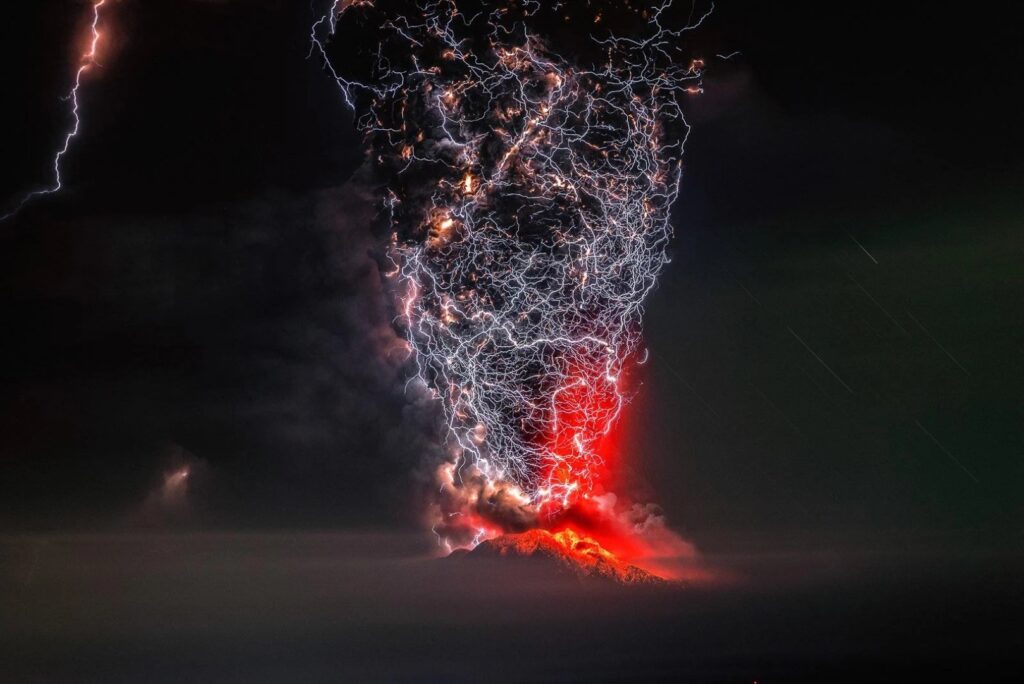
Such fireballs are also remarked occasionally alongside real volcanic eruptions, indicating that plasma is being generated by the electric conductivity of the ejected ashes (dusty plasma) and the heating or ionization of escaping gases. During strong volcanic eruptions, lightning4 is frequently observed. Some plasma physicists, like Anthony Peratt,5 describe magma as a plasma, being a medium with moving charges. Volcanoes, therefore, not only exhibit electrical behavior visible in the frequent lightning discharges seen during eruptions but may also be connected to the wider plasma environment of Earth’s atmosphere and magnetosphere—and, thus, part of a much larger electrical circuit.
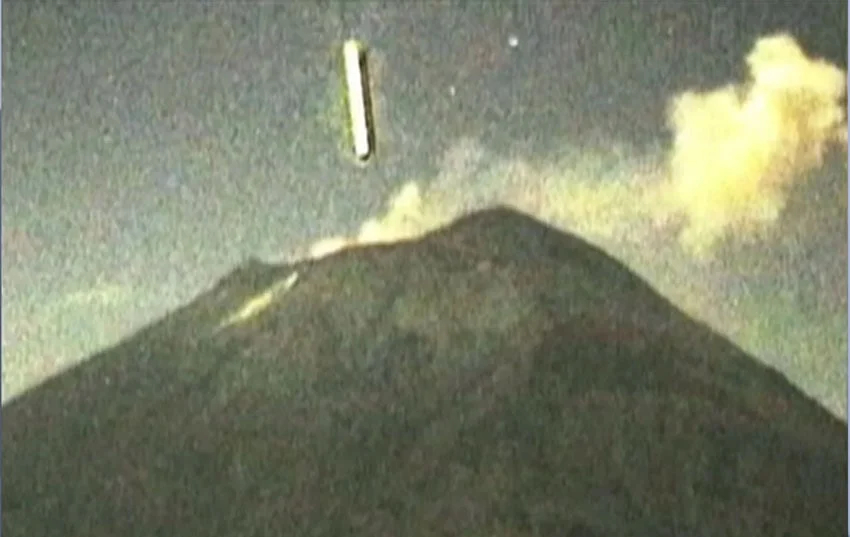
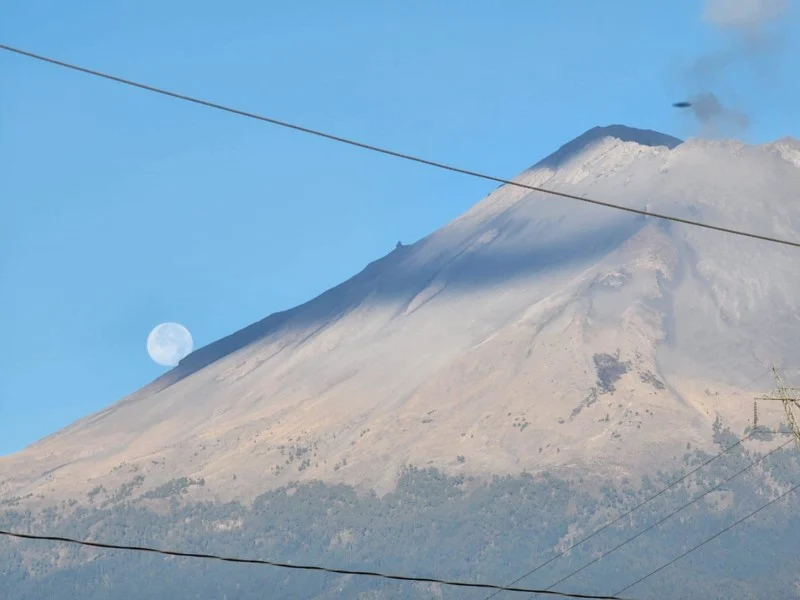
This may be one explanation for why unexplained aerial objects are occasionally seen entering and exiting volcanic throats, such as over Popocatepetl in Mexico—reported by Mexican TV in May 20136 as well as seen on the Tianguismanalco live webcam in August 2023.7 There have been similar sightings over Mount Merapi in Indonesia. Are the objects exchanging or recharging on plasma?
Lightning
Volcanic lightning is a special case because it is virtually created on the ground, while all other familiar lightning emerges from the troposphere, the lowest layer of the atmosphere where weather develops. Lightning is a discharge phenomenon between the atmosphere and the ground, or between two clouds in which, for brief moments, oxygen and nitrogen from the air are electrified to a highly ionized, hot plasma. Plasma is conductive, and the electrons flow between positive and negative charge regions. As plasma generated in the atmosphere, lightning, therefore, is one manifestation of the power of plasma in our immediate experience.
There is a natural atmospheric electrical circuit, a globe-wide current of charge carriers between Earth’s surface and the higher levels of the atmosphere such as the ionosphere. Lightning and thunderstorms act like a battery in the atmosphere and keep this circuit going. Without lightning, Earth’s atmospheric electrical balance would vanish in minutes. A consequence of this would be a drastically weakened ozone layer, because lightning creates nitric oxide and ozone in the air. Nitric oxide and nitrogen dioxide are both created by lightning from air, and then dissolved by rain to form nitrates, which are the most essential molecules for plants and crops to grow, proteins to be made, and even DNA to exist (see Technical and Industry Plasmas).
There are about 50 to 100 lightning flashes occurring in Earth’s atmosphere every second, and forty thousand thunderstorms each day. They provide a natural ionization of the air around us. Negative ions in the air are of great importance for health and breathing, as they can clear out pollutants and allergens from the atmosphere. The surface of Earth is negatively charged, which is why it is so beneficial to walk barefoot and practice “earthing.”
Fire
Fire is not entirely regarded as plasma, but parts of a flame behave like a weakly ionized gas or a “low-level” plasma (the degree of ionization is only one particle in a million). Everyday fire is mainly a chemical reaction where a fuel reacts rapidly with oxygen (combustion) and releases heat and light. But there are regions in a flame where temperatures are high enough to throw electrons off some of the molecules producing ions and free electrons. In this regard, flames can conduct electricity and will respond to electric fields. Amazingly, flames will also change shape under electromagnetic influences.8 (See also Fire, Ether, and the Fifth Element.)
Metals
A bold assertion—by no means ruled out completely—is that metals (sometimes) can be considered a plasma. Like magma, metals are a medium with moving charges. A metal is a lattice of positive ions with a “gas” of free-moving (conducting) electrons on the surface (sometimes called surface plasmons). In this sense, the electron-ion system inside a solid metal has many characteristics of a strongly coupled, very dense, low-temperature ionized medium, and can be modeled using plasma physics.
Think of this for a moment! Plasma physics is closely related to all electrically and thermally conducting metals, including gold, due to a thin layer of electron plasma that exists on the metal surfaces. It is this cloud or sea of surface conduction electrons in metals that interacts with external electromagnetic fields.
Atmospheric Layers
The true realm of plasma lies above us and begins with the more rarefied layers of Earth’s atmosphere. Although the currently accepted view of science is that anything below the ionosphere is not ionized enough to demonstrate plasma behavior, I have come to the conclusion that plasma also dominates the lower regions of the planetary habitat and reaches deep into the biosphere (see Living Plasma) and possibly into the noosphere (see Intelligent Plasma).
The Troposphere
Normal air around us, which exists in the troposphere—the first layer of Earth’s atmosphere reaching up to an average of about 9 km (with circa 18-20 km at the equator, and just 6 km at the poles)—has an ionization degree of 10-16; that means one cubic meter (m3) of air contains about one billion (109) charged particles within quadrillions (2 x 1025) of neutral particles. The particles receive their charge from cosmic rays that reach Earth’s surface. While there are charged particles present, the gas of the air does not exhibit the characteristic collective electromagnetic behavior of plasmas. Any plasma incidentally created will not last long before recombination (free electrons moving back into orbit around ions) neutralizes the region again. I wonder, though, if the metallic spraying that we have endured for 30 years (still ongoing)—in combination with powerful “over-the-horizon” radar9 (see “The Ionosphere – Where Air Becomes Plasma” below)—could facilitate localized plasma states even in the air?
The Stratosphere
After a transition region called the tropopause, the next atmospheric layer is the stratosphere, which reaches up to circa 50 km. Its ionization degree is only about 10-13 and again does not pass for plasma. However, it is here that the ozone shield is located, which absorbs most of the Sun’s ultraviolet radiation and thus protects life on Earth.

Scientists report concern about the depletion of the ozone layer by the effect of industrial chemicals and other compounds that are transported up into the stratosphere. The greatest depletion of this layer, however, was likely caused by the detonation of high-altitude nuclear bombs by the United States and the Soviet Union between 1958 and 1962. Nuclear explosions are powerful plasma events, and their presence in the stratosphere charged a large part of this atmospheric layer, producing artificial auroras and fireballs.10
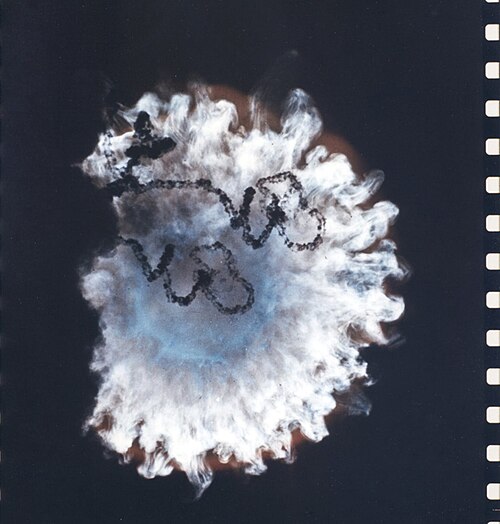
One of the 1962 detonations, called Starfish Prime (Operation Fishbowl), shows very interesting black filamentary features in the otherwise bright white and blue plasma ball created by the explosion. These black lines are not artifacts but ionized plasma streams that spiral along Earth’s magnetic field lines. The reason these lines are darker is that less recombination of particles occurs in these stretched-out channels. (Remember that it is the photon emissions from recombination that make plasma visible.) These filaments are essentially synthetically produced Birkeland currents.11
The “scientists” behind these experiments thought the effects of energetic electrons in the stratosphere would be brief and would dissipate within hours. Wrong. The injected electrons from Starfish Prime actually created a new man-made radiation belt that persisted for years and damaged satellites. This radiation belt was a plasma trapped by the geomagnetic field, similar to the Van Allen Belts (see below). It also perturbed the ozone layer and dramatically revealed how sensitive this near-Earth space is. In fact, it showed that space can be polluted and manipulated electromagnetically!
The Mesosphere
After the stratopause at a height of about 50 km, we reach the mesosphere, extending up to about 80 km into space. The gases (air) in this layer are extremely thin compared to the lower atmosphere but still dense enough to make meteoroids burn up as they enter and encounter friction and pressure from these particles (see “Asteroids, Comets, Meteoroids, and Meteors”). Even though the medium is so thin, the hypersonic speed at which a meteoroid enters produces a violent compression of the air in front of it, which heats that air to thousands of degrees kelvin. The meteoroid begins to melt, and the impact also breaks it apart into smaller fragments.
Asteroids, Comets, Meteoroids, and Meteors
There are myriads of asteroids and comets in our solar system orbiting the Sun. All of them are affected by plasma physics.

- Asteroids are small pieces of rock and metal of a diameter >1m mostly orbiting in the asteroid belt between Mars and Jupiter.12 Larger asteroids are called dwarf planets.
- Comets are also members of the solar system (except for very rare interstellar comets passing through, like 3I/ATLAS in 2025) but are larger and move in wide orbits around the Sun, in the outer solar system. Only occasionally will a comet’s path guide it into the inner solar system and past Earth (but never passing through our atmosphere). Comets are composed of dust and ice, which will vaporize when closer to the Sun. Their sizes range from a few hundred meters in diameter to >100 km, with their tails being millions of kilometers in length. They travel at speeds of up to 70 km per second. Observable comets are plasma events!13 The fast-moving comet has its own ionized atmosphere surrounding it, called a “coma,” which is a dusty plasma that interacts and communicates with the solar wind plasma. Comets are believed to come from the Oort cloud, an assumed sphere of icy bodies surrounding the whole heliosphere.
- Meteoroids are small pieces of a comet or an asteroid, and most of them burn up in the mesosphere, the glow of which we can sometimes see in the atmosphere. That glowing vaporizing meteoroid is then called a meteor.
- Finally, a meteorite is a small piece of meteoroid that didn’t fully burn up and made it down to Earth’s surface.
The meteoroid has a plasma sheath around it, especially in the front, as the air molecules heat up so much that the atoms get ionized. This makes the meteor electrically conductive. It is not unlike the Russian Oreshnik missiles (see Technical Plasmas), which travel at hypersonic speeds and create plasma upon reentry into the lower atmospheric layers. In addition, the tail, or wake, of the meteor is plasmatic when the meteoroid loses material through heat that will form an ionized vapor in its wake. That plasma trail or column behind the meteoroid can be hundreds of kilometers long. Several times a year, Earth passes through a swarm of meteoroids (so-called “meteor showers”) such as the Leonids, an annual passing through dusty remnants left from the passage of comet Tempel-Tuttle.
The mesosphere has its own lightning (plasma) phenomena, called red sprites.14 These are vast electrical discharges associated with thunderstorms that take place concurrently below in the troposphere. Red sprites are demonstrations of the direct connection between Earth’s surface and higher atmospheric regions through plasma. They manifest only when a strong lightning bolt strikes the earth, which then produces a powerful upward electric field into the mesosphere that forms the red sprite (see Dusty Complex Plasmas).
Another plasma aspect of the mesosphere is the appearance of noctilucent clouds, usually observable in upper latitudes between 50°-70° North and South. As mentioned in Dusty Complex Plasmas, noctilucent clouds are dusty plasmas, consisting of dust (often charged meteoric particles) and ice that is ionized by ultraviolet radiation from the Sun and by cosmic rays entering into the atmosphere. Their electromagnetic effect is demonstrated, for example, in their disturbance or reflection of radar waves creating unwanted radar echoes. So, the mesosphere (with an ionization degree of, on average, 10-10) is the first layer that harbors permanent, albeit very tenuous, (dusty) plasmas.
The Ionosphere – Where Air Becomes Plasma
Crossing the mesopause, we reach the large thermosphere that extends up to 600-800 km into space—the region that is also called the upper atmosphere. The thermosphere is a plasma region and forms part of the ionosphere. The ionosphere—so-called because of its overall ionization effects or plasma state—begins in the mesosphere, covers the thermosphere, and reaches out into the exosphere (see “The Magnetosphere” below). Its ionization—with an ionization degree of 10-9 to 10-3—comes primarily from ultraviolet radiation from the Sun and X-ray irradiance from solar flares and similar solar activity.
The ionosphere houses the most important plasma characteristics and electromagnetic phenomena in Earth’s immediate surroundings; it is Earth’s electrosensitive plasma mantle. It is electrically active and is involved in all modern global radio communications. Every time a radio signal skips over the horizon or a global positioning system (GPS) is at work, electromagnetic waves are interacting with the plasma sheet of the ionosphere. Communications satellites orbit in this region, as does the International Space Station. Due to its role for global radio signal transmission, the ionosphere is one of the most important commercial and military infrastructure zones off-planet. Vast antenna arrays and over-the-horizon radar systems—including HAARP,15 16 17 EISCAT,18 Arecibo,19 and Duga-1 and Duga-2 near Chernobyl20 —have been built to manipulate, study, and exploit the plasma properties of the ionosphere, like an enormous laboratory in space.
Aurorae
The most spectacular plasma feature of the thermosphere/ionosphere are the aurora borealis and aurora australis, the northern (and southern) lights. Even after thousands of years of observation and almost two centuries of scientific study, the causes of the aurorae are not fully understood.
At a basic level, the aurora is a plasma interaction of the solar wind—the stream of high-energy particles from the Sun and itself a plasma—and Earth’s magnetic field. When the solar wind flux is enhanced due to eruptions on the Sun, the arriving particles are no longer fully deflected by the magnetic field but follow the magnetic field lines down into the upper atmosphere, where they collide with air molecules and ionize them. It is a “plasma-within-plasma” reaction that becomes visible when the atoms recombine.
The aurora moves and morphs along the dramatically dynamic field lines of the magnetosphere (Birkeland currents), modulated by the solar storm, and will often appear as curtains and ripples. Those sheets and curtains correspond to boundaries between different plasma regions in the magnetosphere, and their undulations come from waves inside the plasmas themselves. The aurora shape, thus, maps invisible field structures in space.

Birkeland Currents
What are the Birkeland currents? As briefly mentioned in What Is Plasma?, it was in 1908 that aurora researcher Kristian Birkeland (see Biographies) predicted and discovered these spectacular streams of electrically charged particles that spiral along Earth’s magnetic field lines from space into the upper atmosphere of the polar regions. The total current flowing along these field-aligned Birkeland currents is an enormous 5 to 10+ million amperes per hemisphere, depending on solar wind conditions. The currents are not a single wire-like stream but are usually divided into many thin current sheets or filaments, each carrying on the order of tens to hundreds of thousands of amperes. The filaments can also twist and produce helical strands that spiral like a braided rope.21
In short, Birkeland currents are mighty electric currents that travel along invisible magnetic pathways, linking Earth with the Sun—and beyond. Birkeland currents are the fundamental way by which electricity moves through space plasmas, not only around Earth but throughout the universe. They are like the universe’s superhighway system and constitute one of the most significant cosmological discoveries of the 20th century!
Plasma Bubbles
A related phenomenon that appears in all space plasmas where magnetic fields are present is the formation of plasma bubbles. On Earth, they become particularly noticeable when they occur in the ionosphere. Like the aurorae, plasma bubbles are linked to increased space weather and subsequent electric activity. They are unpredictable pockets of low-density plasma that form over or within denser plasma regions, causing instabilities and electromagnetic dips that can have many disruptive effects on human radio transmissions and air traffic signals.22
As we know by now, plasma is not at all inert but highly volatile and sensitive, with its own internal dynamic geography. Small local disturbances may grow and allow low-density regions to rise and expand like bubbles within the denser plasma. As signals from GPS satellites or radio transmitters pass through these irregular plasma regions, they can be scattered or distorted, leading to navigation errors and communication dropouts.
The most advanced system for the detection and tracking of ionospheric plasma bubbles belongs to China—the Low Latitude Long Range Ionospheric Radar (LARID)23 on the island of Hainan in the South China Sea. Just as radio waves can bounce off the ionosphere, allowing for long-distance communications transmission, radar (microwaves) can be used in a similar way. LARID is a next-generation, over-the-horizon surveillance system for real-time observations—currently the only of its kind—with a detection range of a stunning 9,600 kilometers. (It can also detect stealth aircraft and drones.24) With it, the Chinese detected, in 2024, a huge plasma bubble over the Great Pyramids in Egypt,25 a location that should not have been visible by radar from Hainan due to Earth’s curvature. Plasma bubbles have military significance in modern warfare, and one wonders if they could be created artificially.
The Magnetosphere
Although there are many names for the classification of near-Earth plasma regions and observations, it also becomes obvious that all of these regions overlap and have no clear demarcation lines. That is due to the nature of plasma itself, which tends to refuse unequivocal categorizations.
At its upper limits and past the thermopause, the ionosphere (thermosphere) blends into the uppermost layer of the atmosphere—the exosphere—where it thins out and gradually merges into the outer space of the interplanetary solar system. The exosphere, therefore, has no proper upper boundary and extends outward to 10,000 km or more. It contains a very thin plasma ionized mainly from solar ultraviolet radiation and charge exchange with other magnetospheric particles. This region is in exchange with the plasma of Earth’s magnetosphere. Beyond the magnetopause, we enter interplanetary space, which is filled with solar wind plasma—a fully ionized but low-density plasma that is now affected by the Sun’s magnetic field, the heliosphere, and no longer that of Earth.

The magnetosphere defines the extent of the magnetic field that reaches from Earth’s interior to surrounding space. It is essentially a dynamic, plasma-filled bubble—with a size that is multiples of Earth’s own diameter—and acts as a giant magnetic container filled with charged particles (electrons and ions) that originate from the solar wind and from Earth’s ionosphere. The plasma here is magnetized.
Inside the cocoon of the magnetosphere, Earth is protected from strong solar particle flux, which is electromagnetically deflected away from Earth’s surface. In the process, the magnetosphere is compressed by solar wind plasma on the dayside (bow shock) and stretched into a long plasma tail—extending well beyond the Moon—on the nightside (magnetotail).
The plasma is trapped by the magnetic field and, like all plasmas, creates internal regions such as the plasmasphere, plasma sheets, and radiation belts:
- The plasmasphere: Engulfed by the magnetosphere, the plasmasphere is a plasma within the magnetospheric plasma, with significantly higher density.26 The plasmasphere has a doughnut shape centered around the equator, which rotates along with Earth.
- Plasma sheet: The magnetotail on the Earth’s nightside has two large tail lobes of opposite magnetic polarity that are separated by the plasma sheet which contains hot plasma. It is a dynamic region of plasma of yet unknown origin27 that extends for several million kilometers behind the Earth. It is the area where magnetic field lines pinch and reconnect uring magnetic storms (magnetic reconnection28) fueling the appearance of aurorae.
- Van Allen radiation belts: Concentrically associated with the plasmasphere are the two (sometimes more) Van Allen radiation belts of highly energetic electrons and protons, which follow the magnetic field lines and also travel around Earth (see “Nuclear Experiments and the Van Allen Radiation Belts”). The inner belt, which overlaps the upper exosphere, captures mostly protons and is positively charged, while the outer belt contains mainly negatively charged electrons. Being such highly charged regions, the Van Allen radiation belts constitute a natural barrier to human interplanetary travel. Their radiation is harmful to DNA as well as to electronics. It is claimed that when the Apollo missions brought humans to the Moon, the trajectory had to be well chosen to move through the thinnest and shortest path across these belts. To this day, most satellites and spacecraft orbit below the inner Van Allen belt to avoid the fierce radiation effects.
“Earth,” therefore, is not primarily a rocky planet; rather, most of Earth is a living plasma system, floating and bobbing in a ubiquitous plasma sea exuded by the Sun and generated by the other planets as well. Effectively, Earth can be seen as a huge charged “dust grain” within the dusty plasma of the whole solar system that has its own sheaths (surrounding layers) in the solar wind.
Nuclear Experiments and the Van Allen Radiation Belts
In 1958, a secret U.S. experiment that involved the Van Allen radiation belts was the beginning of military exploration and exploitation of the charged regions around Earth.29 Project Argus involved the detonation of three small nuclear bombs at high altitude over the South Atlantic. This is the region known as the South Atlantic Anomaly, where the inner Van Allen belt dips closest to the earth, and which is conveniently remote from public view.
The “scientists” behind the experiment, including James Van Allen, wanted to verify whether high-altitude nuclear explosions would create an artificial radiation belt in the atmosphere, much like the Van Allen belts themselves. The belts were eyed for possible tactical use in war, potentially interfering with radar tracking and communications. The tests successfully created artificial electron shells that persisted for weeks and provided crucial data. Some later described the top-secret endeavor as one of the greatest scientific experiments ever conducted.30 It emboldened the military to carry out more dramatic high-altitude tests such as Operation Fishbowl (mentioned above in “Atmospheric Layers: The Stratosphere”). Those subsequent tests had unforeseen consequences, however, and led to a ban on nuclear testing in space—or so it is claimed.
The Heliosphere and Solar Wind
The larger space of the solar system, the heliosphere itself, is yet another ballon of various plasma spaces shaped by the solar wind and its interaction with planetary bodies. In it sits the magnetosphere of Earth and all magnetospheric bubbles of the other planets, like organs inside a solar system body anatomy. Of course, the Sun itself is entirely made of plasma.
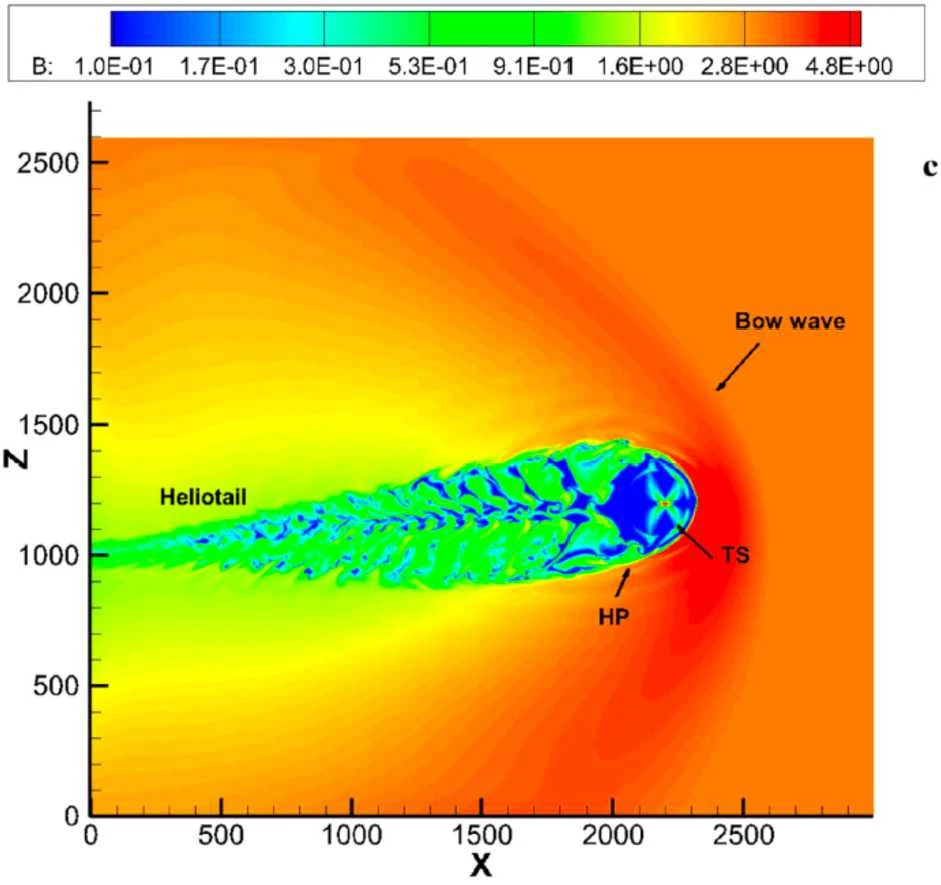
The solar wind blows past all of the planets and moons at supersonic speed until it reaches a limit, making a transition and slowing down to subsonic speed at the boundary called the termination shock.31 At this point, plasma behavior changes, but the solar system does not terminate here. The heliosphere “ends” much further out at the heliopause, which is the outermost boundary of the heliosphere. Here, the solar wind pressure is balanced by the pressure from the interstellar medium—which is also a plasma. It is the end of the reach of the solar magnetic field.
Just as the magnetosphere is compressed on the dayside and elongated on the nightside, the heliosphere is compressed on the side facing the direction of the Sun’s motion through interstellar space. The Sun and heliosphere travel through the local interstellar medium at a speed of circa 25 kilometers per second toward the Hercules constellation. The compressed zone at the “nose” side forms the turbulent region of heated and compressed plasma called the heliosheath.
Two human space probes—Voyager 1 and Voyager 2—have now flown past this sheath and beyond the heliopause into the local interstellar medium. Surprisingly, the plasma outside of the heliosphere is not thinner than the solar wind plasma, but 40 times denser.32 That’s because, similar to Earth’s magnetosphere, the solar magnetosphere (heliosphere) deflects the interstellar wind.

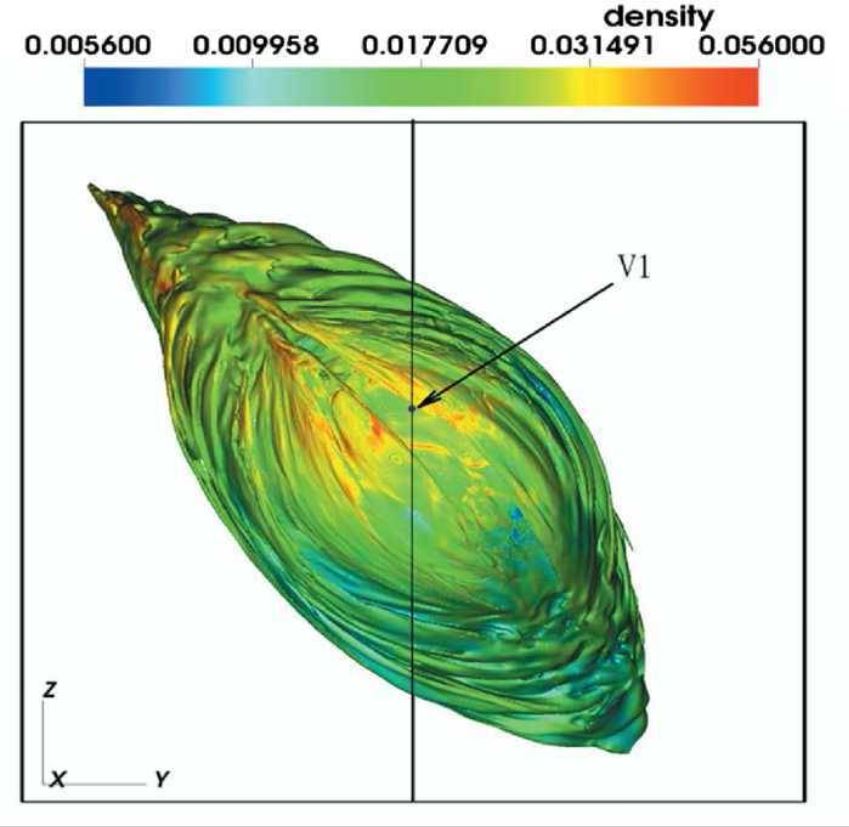
The tail side of the heliosphere is vast and has a complex structure. Its width is modeled to be 1,000-2,000 AU (astronomical units), and its length, while unknown, is estimated to be 5000 AU. If one astronomical unit is approximately the distance between Earth and the Sun, that means the heliotail is 5,000 times that length. The actual shape of the heliosphere, therefore, is not round but more like a seed pod or a jellyfish.
The Heliosphere seen from outside:
The Interstellar Medium
Once we are outside of the heliosphere, we sail in the interstellar medium—a low-density plasma that is, like everything else from here on, embedded in the galactic magnetic field. The field of the interstellar medium is not uniform but layered into cosmic plasma strata. It is a tenuous plasma (0.01-0.1 particles cm⁻³) that carries interstellar Birkeland currents and can also contain pockets or bubbles of hot plasma with high conductivity. This medium permeates the Milky Way, reaching out as far as the galactic halo plasma, a vast, diffuse plasma region surrounding the galaxy. The halo is optically invisible and interacts with the intergalactic space.
The center of the galaxy itself is, of course, also plasma, characterized by strong magnetic fields and high temperatures. Throughout the galaxy we find the star-forming regions and interstellar clouds of plasma, gas, and dust. While it is believed that stars form from dense regions in molecular clouds under gravitational pressure, there are also plasma models of star formation where the driving force is electromagnetism—not gravity—and electric Birkeland currents in cosmic plasma. According to the plasma model, stars form along large-scale Birkeland currents or filaments in locations where the filaments are electromagnetically “pinched” (called a “Z-pinch”35 ), which compresses plasma and dust and ignites a new star (see Electric Universe).
The Intergalactic Medium, Filaments, and the Cosmic Web

These mega-scale, field-aligned Birkeland currents are like electric plasma cables that also connect the galaxies into what has come to be known as the cosmic web. According to plasma cosmology, these filamentary currents can transport plasma, power galaxies, and determine the structure of the universe without requiring dark matter to explain certain gravitational effects around galaxies. The cosmic web is real and also acknowledged by standard cosmology, albeit on the basis of dark matter. These galaxy filaments constitute the largest structure in the cosmos, forming whole “walls” of clusters of galaxies that form along the currents. There is no denying that they consist of >99.99% plasma.
It is always amazing to see how similar the cosmic network of galactic clusters is to the neuronal network of the human brain. This is more than a visual analogy. Scientists at the University of Bologna have calculated the structural, morphological, and network properties as well as the memory capacity of both systems—the cosmic web of filaments and the network of brain neurons—and found a convincing similarity.36
“Our analysis showed that the distribution of the fluctuation within the cerebellum neuronal network on a scale from 1 micrometer to 0.1 millimeters follows the same progression of the distribution of matter in the cosmic web but, of course, on a larger scale that goes from 5 million to 500 million light-years.”37
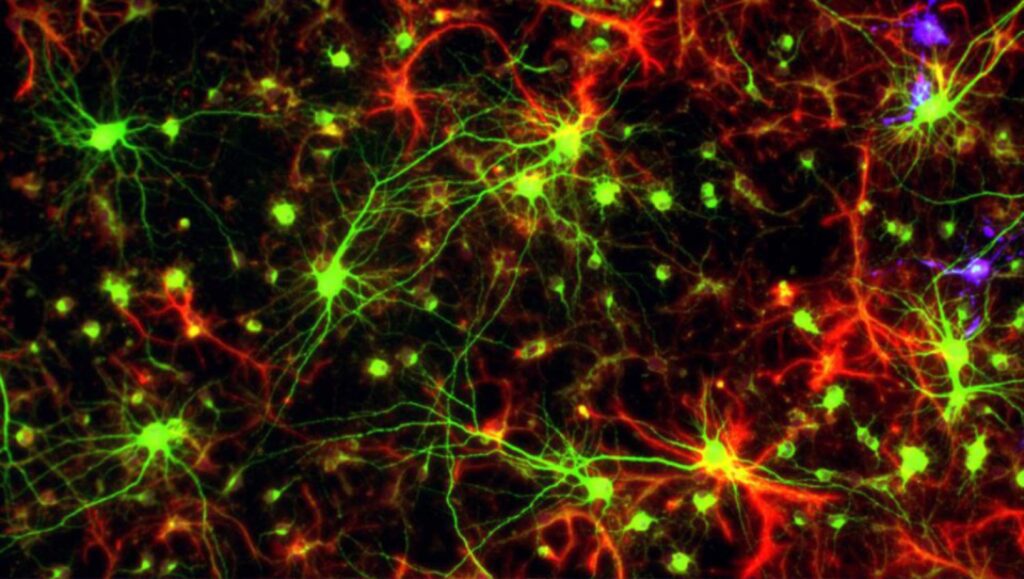
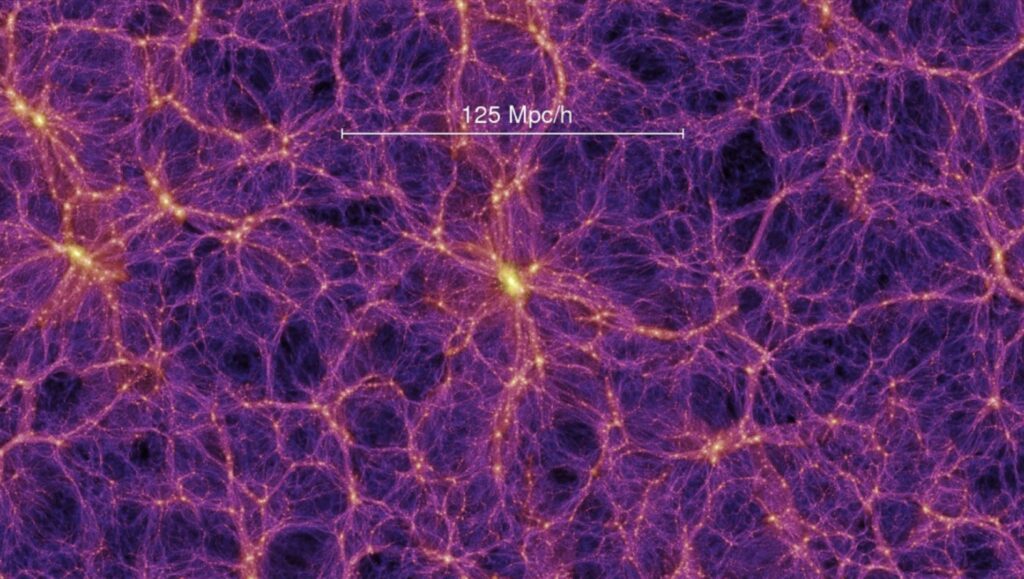
Could the plasma-filled cosmos be an active, processing, perceptive brain?
I have purposefully spent a lot of detail on the description of the continuum of natural plasmas from Earth to the farthest regions of the universe, hoping to bring home to the reader how much and how intimately we are enfolded in this magical state of matter-energy. May this journey from Earth to Sky inspire the appreciative reader to spend more time and thought on becoming aware of plasma all around us, so we can develop better knowledge—an actual perception—of our literal, physical, and charge-carried interlinkage with the cosmos and its vast body of plasma.
Next Chapter: The Electric Universe: Big Bang or Plasma Cosmology?
Footnotes:
- Evers J [Ed.]. Core. National Geographic, last updated Jun. 5, 2025. https://education.nationalgeographic.org/resource/core/ ↩︎
- Science China Press. Seismic mystery solved: scientists find a new state of matter at Earth’s center. SciTechDaily, Dec. 1, 2025. https://scitechdaily.com/seismic-mystery-solved-scientists-find-a-new-state-of-matter-at-earths-center/ ↩︎
- Jerby E, Shoshani Y. Localized microwave-heating (LMH) of basalt – Lava, dusty-plasma, and ball-lightning ejection by a “miniature volcano.” Sci Rep. 2019 Sep 10;9(1):12954. https://doi.org/10.1038/s41598-019-49049-5 ↩︎
- “Volcanic lightning.” Wikipedia, n.d. https://en.wikipedia.org/wiki/Volcanic_lightning ↩︎
- Peratt AL. Physics of the Plasma Universe. New York: Springer-Verlag, 1992. https://ia600804.us.archive.org/12/items/AnthonyPerattPhysicsOfThePlasmaUniverse_201901/Anthony-Peratt–Physics-of-the-Plasma-Universe.pdf ↩︎
- “May 31 2013 UFO flies into Popocatepetl volcano Mexico amazing ovni.” YouTube, uploaded by TheLifebeyondearth, May 31, 2013. https://youtu.be/cZdP_49FlIQ ↩︎
- “UFO fleet leaves Popocatepetl volcano.” YouTube, uploaded by UFOmania, Aug. 25, 2023. https://youtu.be/VSKmMGMysBo ↩︎
- Fukuyama T, Mukai N, Togawa G. Dynamic behaviours of a flame as plasma in a strong electric field. Sci Rep. 2019 Nov 1;9(1):15811. https://doi.org/10.1038/s41598-019-50537-x ↩︎
- “Over-the-horizon radar.” Wikipedia, n.d. https://en.wikipedia.org/wiki/Over-the-horizon_radar ↩︎
- Farrell JP. The Demon in the Ekur: Angels, Demons, Plasmas, Patristics, and Pyramids. Adventures Unlimited Press, 2023, pp. 68-78. ↩︎
- “Birkeland current.” Wikipedia, n.d. https://en.wikipedia.org/wiki/Birkeland_current ↩︎
- “Asteroid belt.” Wikipedia, n.d. https://en.wikipedia.org/wiki/Asteroid_belt ↩︎
- Götz C. Cometary Plasma Science: A White Paper in response to the Voyage 2050 Call by the European Space Agency. Braunschweig University, 2019. https://www.cosmos.esa.int/documents/1866264/3219248/GoetzC_wp_comet_plasma_goetz.pdf ↩︎
- “Red sprites and blue jets explained – new discovery!” YouTube, uploaded by Pecos Hank, May 26, 2020. https://youtu.be/tGPQ5kzJ9Tg ↩︎
- “High-frequency Active Auroral Research Program.” Wikipedia, n.d. https://en.wikipedia.org/wiki/High-frequency_Active_Auroral_Research_Program ↩︎
- Fitts CA. Dr. Nick Begich on HAARP. The Solari Report, Jul. 22, 2010. https://solari.com/dr-nick-begich-on-haarp/ ↩︎
- “Technology to control the weather | Nick Begich.” YouTube, uploaded by GlobalBEM, Sep. 17, 2013. https://youtu.be/9FRrX6EWb0g ↩︎
- “EISCAT.” Wikipedia, n.d. https://en.wikipedia.org/wiki/EISCAT ↩︎
- “Arecibo Observatory.” Wikipedia, n.d. https://en.wikipedia.org/wiki/Arecibo_Observatory ↩︎
- “Duga radar.” Wikipedia, n.d. https://en.wikipedia.org/wiki/Duga_radar ↩︎
- “Birkeland current.” Plasma Universe, n.d. https://www.plasma-universe.com/birkeland-current/ ↩︎
- Humphrey N. Equatorial plasma bubbles and their effect on air travel. EarthSky, Jan. 3, 2025. https://earthsky.org/earth/equatorial-plasma-bubbles-threat-to-aviation/ ↩︎
- Sun W, Li G, Ning B, et al. Monitoring of ionospheric variability using the low latitude long range ionospheric radar (LARID): capabilities, advantages and limitations. Space Weather. 2024 Nov;22(11). https://doi.org/10.1029/2024SW004134 ↩︎
- “China’s LARID radar unveiling the world’s most powerful tracking system!” YouTube, uploaded by PR PrimeTalks, Sep. 22, 2024. https://youtu.be/SsEsgDYWpuo ↩︎
- China’s super radar detects plasma bubbles above the pyramids over thousands of kilometers. China-Arms, Sep. 7, 2024. https://www.china-arms.com/2024/09/chinas-super-radar-detects-plasma-bubbles/ ↩︎
- “Plasmasphere.” Wikipedia, n.d. https://en.wikipedia.org/wiki/Plasmasphere ↩︎
- Hill, T. W. (1974), Origin of the plasma sheet, Rev. Geophys., 12(3), 379–388, doi:10.1029/RG012i003p00379. ↩︎
- Zastrow, M. (2017), Plasma waves pinpointed at the site of magnetic reconnection, Eos, 98, https://doi.org/10.1029/2017EO067735. Published on 17 February 2017. ↩︎
- Wolverton M. How the world learned about the Pentagon’s sky-high nuclear testing. The Atlantic, Nov. 24, 2018. https://www.theatlantic.com/science/archive/2018/11/operation-argus-how-cold-war-secret-new-york-times/575983/ ↩︎
- Declassifying Operation Argus (JSTOR Daily, October 2014) [https://daily.jstor.org/operation-argus/] ↩︎
- Jokipii JR. The heliospheric termination shock. Space Sci Rev. 2013;176:115-124. https://doi.org/10.1007/s11214-012-9914-0 ↩︎
- NASA spacecraft embarks on historic journey into interstellar space. NASA, Sep. 12, 2013. https://www.nasa.gov/news-release/nasa-spacecraft-embarks-on-historic-journey-into-interstellar-space/ ↩︎
- Kleimann J, Dialynas K, Fraternale F, et al. The Structure of the Large-Scale Heliosphere as Seen by Current Models. Space Sci Rev. 2022;218(4):36. doi:10.1007/s11214-022-00902-6 ↩︎
- Reisenfeld, D.B., Allegrini, F., Christian, E.R. et al. Exploring the Outer Heliosphere Through ENA Observations from IMAP. Space Sci Rev 222, 7 (2026). https://doi.org/10.1007/s11214-025-01258-3 ↩︎
- “Pinch (plasma physics).” Wikipedia, n.d. https://en.wikipedia.org/wiki/Pinch_(plasma_physics) ↩︎
- Vazza F, Feletti A. The quantitative comparison between the neuronal network and the cosmic web. Front Phys. 2020 Nov 15;8. https://doi.org/10.3389/fphy.2020.525731 ↩︎
- Starr M. Study maps the odd structural similarities between the human brain and the universe. Science Alert, Nov. 17, 2020. https://www.sci.news/astronomy/human-brain-cosmic-web-similarities-09066.html ↩︎
One Comment
Leave a Reply
You must be logged in to post a comment.

Awesome, well done, magical and stunning. So very grateful for your knowledge and for sharing. The seen and the unseen….