This 6-pillar curriculum teaches the basic literacy we need to be personally and financially successful and to do so in a manner in which together we evolve a culture that supports the emergence of an advanced human civilization.
“Truth and love have been smacked down, so many more times in history before today. Truth, because it’s often inconvenient, and love because it is vulnerable.… We can’t save everything all at once, but it’s still worth saving something. Because there are so many of us to do it.”
The multipolar world has arrived—along with a reconfiguration of U.S. plans for acquiring and protecting strategic resources and trade routes. At the outset of this “rock n’ roll” year, Dr. Joseph Farrell and Catherine discuss Stories 6-8 and Unanswered Questions and Inspiration.
I would focus in on Chabad Lubavitch, rather than Jews.
From CLaude:
Chabad-Lubavitch is a Hasidic Jewish movement that has become one of the most influential and visible branches of Orthodox Judaism worldwide.
Origins and basics:
Chabad was founded in 1775 in Liozna, Belarus, by Rabbi Schneur Zalman of Liadi. The name “Chabad” is a Hebrew acronym for Chochmah, Binah, Da’at (Wisdom, Understanding, Knowledge)—three intellectual attributes in Kabbalistic thought. “Lubavitch” refers to the town in Russia where the movement was headquartered for over a century.
The Rebbe:
The movement’s modern expansion is largely attributed to Rabbi Menachem Mendel Schneerson (1902–1994), known simply as “the Rebbe,” who led Chabad from 1951 until his death. Under his leadership, Chabad transformed from a relatively small Hasidic sect into a global outreach organization. Some followers believed he was the Messiah, and a subset still maintain he will return in that role—a source of tension with other Orthodox Jewish groups.
Structure and reach:
Chabad operates through a network of thousands of emissaries (shluchim) who establish Chabad Houses—community centers offering religious services, education, and social programs. These exist in over 100 countries, on college campuses, in remote locations, and in major cities. The organization is known for welcoming Jews of all backgrounds, regardless of observance level.
Influence and connections:
Chabad maintains notable relationships with political leaders across the spectrum. In the US, the Rebbe met with every president from Nixon onward, and Chabad representatives have had access to recent administrations. The movement also has significant presence in Russia, Israel, and other countries, sometimes drawing attention for its political connections and real estate holdings.
It was from my friend who is the wife of a Chabad rabbi that I first learned about the Noahide Laws. I’d like to draw your attention to the Noahide Laws and their many sublaws, because I anticipate these laws will be imposed on us as part of the control grid. To a lay person like myself, their interpretation seems as though it could be very anti-Christian, and the system is tiered to privilege Jews.
If it is meant to privilege Jews, why are they being used to poison and disable Jews with the shots. My experience with these syndicates is they are depopulating Jews and destroying their brand to advantage themselves.
Allow me to parse what I understand your question to be, Catherine. Israelis were highly vaccinated. However, Jews belonging to Chabad requested and received religious exemptions.
The Noahide Laws are a separate issue. And I’d like to suggest it is an important one that tends to get lost in the huge topic of Zionism, as it may have here.
Ingrid – what sources would you recommend for people to educate ourselves?
Excellent point
Regarding the first story. The group of materialists really at the top is also a function of the inate psychopathy of these people. These are people who are broken, without a conscience, and missing a deeper part of their humanity.
If you have encountered any psychopaths in real life, you begin to understand the stories about vampires. They do have these odd rules, such as they don’t come into your house unless you invite them in, but once you do, their only goal is to control you while they take your life.
Because they are these hollow people, they have no sense of spirit or higher purpose so they also have this obsession to live forever. And it isn’t a spiritual forever, it is an undead forever. Whereas anyone that has any decent spirituality already feels a connection to a greater consciousness that transcends this earthly existence. But these people are cut off from that, hence they want an existence where everyone else is as well.
In story 6 you were asking why the dark occultists are acting this way, what is their intention and belief system; there is noone better to talk to than Mark Passio on this topic. He was featured in Derrick Broze’s Pyramid of Power and his presentations on Demystifying the Occult are fantastic, along with the Dark Occult Origins of Nazism.
He uses the phrase technocratic occultocracy. It’s the occult that can come to light through his work on Natural Law and objective morality. Would love to see him on here if you find it a good fit.
Thank you for yet another wonderful roundup, has been a staple for me over the last decade or so and my worldview is much better off for it.
Mark Passio- Natural Law seminar from 2016 or 2018 or so? Our friends Tragedy & Hope Media- Richard Grove were the ones filming that. I was finally able to meet Mark Passio last year in NH. So much work he has done for the cause of TRUTH. He also spells that word TRUTH with capital letters and shows us how we have been fooled by language. Dovetails with Dr. Farrell and his reminder that changing the words are part of neuro-linguistic programming. Highly recommend Marks early work especially on his website What on Earth is Happening.
Will check out Passio. Thanks.
Dear Catherine and Joseph,
If you allow the reflections below to fully sink in, it becomes clear that the human body and karma are not peripheral topics, but essential to the core of the discussion around:
The Control Grid: See the Game,
Change the Game The Information Crisis: Truth, Media, and Public Trust
The Great Poisoning
The Race to Engineer Life
The Going Direct Reset Grinds into Global Resistance
The Rise in Consciousness: Glorious Pushback
What connects all of these is that consciousness is not a side issue, but the ground layer of everything. For that reason, I would like to share the following reflections with you on Karma, Infrastructure, and the Legitimation of Life in an Age of Permanent War.
If we take karma as propagation, we are compelled to look closely at infrastructure, consciousness, and the legitimation of life in an age of permanent war.
Therefore, to speak honestly about war, we must first introduce consciousness as the ground from which everything else follows — not as a marginal or secondary layer.
Discussions about war, technology, AI, infrastructure, and power almost always remain confined to strategic, political, or economic levels. What is consistently missing is the most fundamental layer on which all of these domains rest: consciousness itself. Not as a vague spiritual notion, but as the ground through which experience, meaning, and human life become possible at all.
Without this layer, analyses may be technically sound, yet existentially but on some point hollow. What is truly at stake is not only security or stability, but the conditions under which consciousness can continue to unfold within biological life.
In older conceptual frameworks, this was captured by the notion of karma. Not as a system of punishment or reward, but as a description of propagation: how actions, structures, and conditions shape the order in which future experience, perception, and agency become possible.
In contemporary terms, this means:
What we build shapes the conditions under which consciousness can express itself tomorrow.
Infrastructure is not a neutral tool, but an architecture of future experience.
This should not be taken as a religious claim. Rather, it raises the question of whether we are dealing with a structural principle we have not yet learned to recognize.
What happens if we take a closer look at karma as a structure of propagation?
In its original sense, karma refers to action and effect. It points to the simple yet profound reality that every action, every structure, and every system does not only produce immediate outcomes, but also reshapes the space of possible experience for the future.
Karma, in this sense, is not a personal moral ledger. It is an architecture of possibility. It determines what becomes visible, what is excluded, what remains sensitive, what becomes numb, and which forms of experience remain accessible or are rendered structurally impossible.
Not what one “deserves,” but what becomes accessible through the limits and capacities of embodiment — what the body and its conditions make possible to experience.
In this way, karma is not spiritual folklore, but a description of how propagation accumulates in form, in systems, and in bodies.
What if the body is not merely a vessel, but the interface through which consciousness unfolds?
Consciousness never appears without form. Every biological being has a specific order through which consciousness can unfold. This applies not only across species, but also between human beings.
What if the body is not only a vehicle for consciousness, but a living interface? It determines how perception occurs, how feeling is registered, how meaning is formed, how stress and safety are encoded, and how time and space are subjectively experienced. In this sense, the body actively participates in “writing the code” through which consciousness becomes accessible.
Modern science understands fragments of this interface, but not the whole. Yet we design systems as if this process of embodiment were fully understood and standardized. This produces a fundamental distortion:
Much of today’s technology and infrastructure is designed under the assumption that consciousness has a standardized interface, while in reality it is embodied, differentiated, and form-dependent.
Here, one could begin to sense what might be described as a karmic misalignment: a structural misunderstanding of how life unfolds.
Let us take a closer look toward twelve layers of unfolding, the body as a multiple interface, as a way of exploring what the human body may be able to unlock in relation to consciousness.
Instead of seeing consciousness as a single “thing,” it can be understood as something that unfolds through multiple layers. Each layer is not a separate level, but a filter, frequency band, and translation system. Not hierarchical in power, but hierarchical in how life unfolds through the body.
1. Physical layer (biological carrier)
The body itself: cells, organs, nervous system.
Here consciousness is constrained and shaped by biology.
This is the first interface.
2. Sensory layer
Seeing, hearing, smelling, tasting, touch.
Here the world is translated into signals.
Not the world itself, but a biological interpretation.
3. Interoceptive layer
Inner perception: heartbeat, breath, tension, hunger, fatigue.
Here the basic sense of “I am here” emerges.
4. Emotional layer
Affect, mood, emotional resonance.
Here experience gains color and charge.
Not rational, but orienting.
5. Energetic / tonal layer
Tension, relaxation, vitality, exhaustion.
Not mystical: also visible in neurophysiology as arousal, regulation, vagal tone.
Here the body determines whether something is felt as safe.
6. Perceptual organization
How perception is structured: figure/ground, focus, filtering.
Here what one experiences as “reality” takes shape.
7. Semantic layer (meaning-making)
Words, symbols, interpretation.
Here experience is translated into meaning.
Here manipulation also takes place.
8. Narrative layer (story structure)
The story you tell about yourself and the world.
Identity, history, future expectation.
Here experience becomes “me.”
9. Relational layer
Attunement with others, resonance, mirroring.
Here consciousness is not individual, but co-created.
10. Cultural layer
Norms, values, language, ideology, unspoken rules.
Here culture determines what feels “normal.”
11. Existential layer
Meaning, life and death, moral boundaries.
Here consciousness touches what is no longer technically solvable.
12. Transpersonal / field layer (revised)
Here the experience arises of connection, continuity, and propagation that exceeds one individual life or even one generation. In this layer, karma manifests not as personal belief, but as a lived, collective inscription of trauma, meaning, and unresolved moral charge across time and bodies. What is carried here is not memory in a psychological sense, but structural imprint: patterns of suffering, normalization, and moral distortion that persist beyond individual awareness.
If our life on Earth is indeed larger than a single life or a single body, should we not become more conscious of this? And if so, should the military-industrial system not be required to reinvent itself accordingly — when its present logic is organized around the large-scale ending of life and the devastation of living worlds, often without accounting for what is carried forward biologically, psychologically, and across generations, and while its abstractions rarely register the full field-level consequences of this destruction?
Why this model is essential to understanding systemic failure?
This twelve-layer model clarifies how and why modern systems fail at a structural level.
Systems such as AI, infrastructure, military planning, and geopolitics operate primarily on abstract layers: semantics, narrative, culture, ideology, and data. Decisions are made in domains where meaning, story, and strategy dominate.
Biological life, however, is impacted primarily on embodied layers: the body, stress regulation, trauma, safety, emotional and energetic stability.
The rupture arises because systems decide on abstract layers, while the consequences land on embodied layers.
This is why people can decide “functionally,” while bodies pay the price. This is not a metaphor. This is literally trauma, dysregulation, illness, loss, and death.
This invites a rethinking of karma within this model. Within this framework, karma does not belong to a moral layer, but to propagation across all twelve layers.
Trauma inscribes itself in embodied layers.
Shifts in meaning reshape semantic and narrative layers.
Cultural normalization takes place on the level of values and ideology.
Existential shifts affect moral boundaries.
Field-level propagation accumulates beyond individual lifetimes and generations.
In this way, karma becomes not religion, but:
The cumulative imprint of systems across all layers of the unfolding of life. Infrastructure and war as karmic forces. In the modern world, the most powerful karmic forces are no longer individual actions, but infrastructures: technological systems, economic models, military apparatuses, information architectures, and AI systems.
These do not only determine what is possible. They determine what is thinkable, feelable, and legitimate.
In this sense, infrastructure is consciousness-architecture at scale.
What is often described as omniwar or 5th-generation warfare is not a temporary escalation, but a condition in which violence is structurally embedded. Boundaries between military and civilian, between war and peace, between battlefield and everyday life dissolve. Biological life becomes deployable within a system that legitimizes itself through necessity.
The deepest problem is not only that life is being destroyed, but that a framework has emerged in which the destruction of life becomes functional, rational, and necessary for the preservation of power, control, and scarcity.
What are we to make of a world in which a fundamental moral threshold is no longer recognized as such?
This invites us to take a closer look at why the system itself cannot see this.
Military, technological, and administrative systems operate primarily on abstract layers: data and semantics, narratives of threat and security, ideological frameworks, and geopolitical logic.
But the real damage unfolds on embodied and existential layers: in bodies, in trauma, in moral rupture, and in field-level propagation that spans generations.
This brings us to the visible core of the systemic crisis. The system legitimizes decisions on abstract layers, while it dysregulates biological life on embodied layers that the system itself can no longer perceive. This is not a political problem.It is a problem of the unfolding of consciousness.
What emerges, finally, is propagation as a civilizational question.
The fundamental question, therefore, is not how to make systems smarter or more efficient, but what order of propagation contemporary war, security, and infrastructural systems inscribe into human bodies, lives, and consciousness.
What is built does not remain external; it returns to shape those who live within it.
What is normalized does not stay neutral; it quietly reshapes how consciousness perceives and feels.
What is legitimized does not remain abstract; it comes to define what human life will be allowed to mean in the future.
In this sense, the current world order is not only politically unstable. It is existentially unstable — not only because systems malfunction, but because concentrated power has allowed certain actors to continue governing a radically transformed world with severely outdated mental models, treating life, land, and bodies through logics that no longer belong to this century.
Seen in this light, the crisis is not primarily technological; it is a crisis of inscription — of who and what is being written into the future of life itself.
And therefore not a crisis we can continue to delegate to systems, experts, or institutions alone — because what is being propagated is the very condition under which human life will be allowed to unfold.
Very much yes to your basic thesis. I hope you have listened to Ulrike’s Future Science series, including the Economy of the Energy Body. One of the goals of the Internet of Bodies is to control and harvest our energetic fields.
The internet of bodies harvesting our energetic fields may well be one of the biophysical reasons human core body temperature has dropped to 97.5F. There are biochemical reasons, too. But I suspect the biophysical causes will become more significant over time.
When the prophet Jeremiah looked into our present age, he saw everyone look pale (Jeremiah 30:6). Since pallor is subjective, we might use the drop in core body temperature as a marker. Your thoughts?
Yes — I’m familiar with Ulrike’s Future Science work, and that is precisely why I find this so concerning.
The fact is that many of the assumptions guiding these systems seem to be rooted in conceptual frameworks that are more than 200 years old — frameworks that were never designed for this level of biological, energetic, and perceptual integration.
That raises a deeper question:
What if the real risk is not just that new technologies are being applied, but that they are being applied through fundamentally outdated models of life, the unfolding of consciousness, and control?
Could it be that the most serious misalignment is not technical, but conceptual — where systems are being built by people who may not fully grasp how profoundly these technologies reshape the conditions for the unfolding of consciousness itself?
At the same time, I keep wondering whether what is often described as “energy harvesting” might, at a deeper level, also be understood as something else: not only the extraction of energy, but a systemic interference with the interfaces through which human consciousness is able to unfold in the first place.
And to be clear, I am not referring to anything extraterrestrial or interdimensional here, but to very real human actors and institutions: military instruments, technological infrastructures, and financial-industrial systems designed and deployed by people, often in the service of interests that already concentrate extraordinary power, resources, and strategic advantage.
Because if sensory, biological, emotional, relational, and perceptual layers are progressively stressed, poisoned, standardized, or distorted, it can appear as though something mystical is being taken — while what is actually being altered are the conditions that make experience, regulation, and meaning possible at all.
In that sense, I sometimes wonder whether we are partly in a kind of Plato’s cave situation: interpreting effects at the level of “energy,” while the deeper operation may be the reshaping of the architecture of perception, embodiment, and regulation itself.
If those interfaces are compromised, narrowed, dysregulated, or rendered chronically energy-depleted — experienced as fatigue, exhaustion, loss of vitality, and reduced capacity for regulation — it can keep almost everyone “in the wheelbarrow,” so to speak, not through something magical, but through very material changes to how consciousness is able to unfold through bodies, nervous systems, culture, and environment.
There is also a deeper, intergenerational dimension that concerns me. At times it almost seems as if those now shaping these systems have forgotten how deeply their own thinking was formed through intergenerational patterns of power and obedience — patterns originally designed to serve an earlier patriarchal order.
These inherited frameworks are now being carried forward into a world they were never meant to govern, while their continued application no longer produces genuine progress, but a slow form of systemic decay that even those in power may ultimately be unable to manage or contain.
In that sense, what is being defined at a systemic level may not only be infrastructure, but the future architecture of the unfolding of consciousness, regulation, and what it means to inhabit a human body at all.
At this point, it should be deeply concerning to anyone that the very means through which humans unfold their world — perception, sensing, and embodied experience — are themselves becoming objects of systemic steering and regulation.
Great thoughts here. One has to wonder if autism in humans is a result of what you describe…
Hi, love to listen to you too. Your talk felt heavier this time, more serious and for good reason. Gotta let Joseph know, that puppy product is fake, fraudulent advertising. The reviews tell us the toy is very much a wind-up type toy. Doesn’t look real at all. I was taken in for a moment, too.
Keep breaking down walls of denial. The future is here!
Thank you Catherine and Joseph for all that you do. I can’t express adequately how much I have learned from both of you. I particularly enjoy when the two of you share your views through a spiritual lens. Your knowledge, wisdom and experience shines through. It is your sharing of your spiritual knowledge that I think has helped me the most deal with all that is happening in the world today. It is food for the soul. I thank you both. Your foresight is unparalleled. With that said, I would like to ask a question that I know puts me way out on the speculation twig. When you ask “who” is behind this…. I sometimes wonder since it is so antihuman could it be “what” is behind all of this? For years now I have had an intuitive sense that whatever it is….it is not human. I know for some that is a crazy thought as there is no proof. I get it. It is just a gut intuition that I have had for years. Whatever it is….or whoever for that matter….it seems like a great deal of energy is being spent to keep truth hidden (deception reigns). I can’t help but think that the payoff to keep all of us in the dark must be huge.
IMO the ultimate powers are interdimensional – divine vs. satanic. Angels and demons are real and are operating all around. That is why want want to do everything to attract the divine and the protections of the angels and more and protect and NOT INVITE in the demonic. Righteousness is a widely undervalued risk management tools You want to attract the only real protection available.
Here here, as Joseph is want to say.
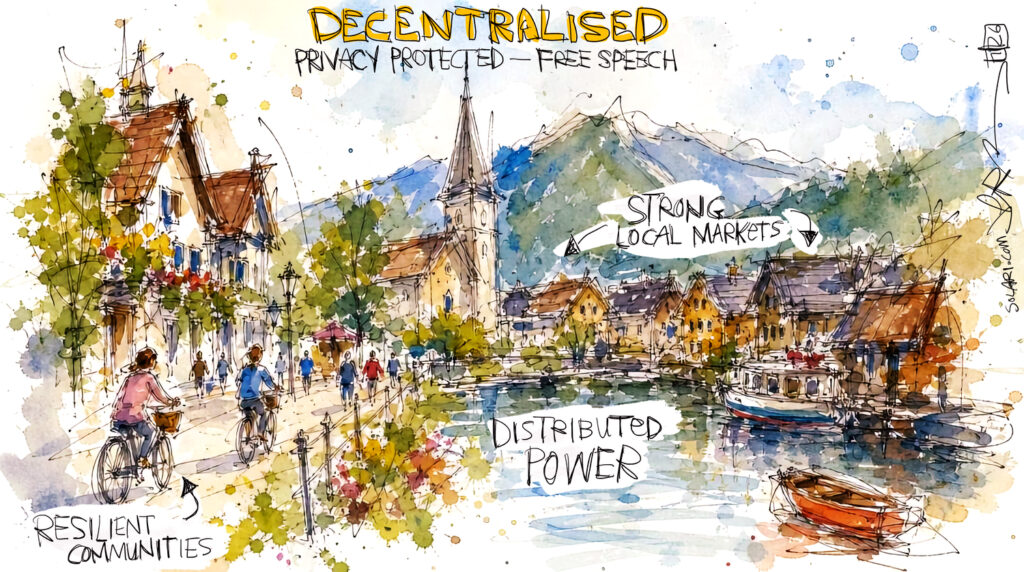
In regards to Catherine’s comment about how where you live and how jurisdiction matters, Rock Island county Illinois just altered its tax sale process for delinquent properties: “Rock Island County required tax buyers participating in the sale to certify that if they ultimately take ownership of a property, they must pay the former homeowner the value of the home above what was owed in back taxes. The requirement marks the first known instance of an Illinois county altering its tax sale process in response to federal court rulings declaring the state’s system unconstitutional.”







































































I would focus in on Chabad Lubavitch, rather than Jews.
From CLaude:
Chabad-Lubavitch is a Hasidic Jewish movement that has become one of the most influential and visible branches of Orthodox Judaism worldwide.
Origins and basics:
Chabad was founded in 1775 in Liozna, Belarus, by Rabbi Schneur Zalman of Liadi. The name “Chabad” is a Hebrew acronym for Chochmah, Binah, Da’at (Wisdom, Understanding, Knowledge)—three intellectual attributes in Kabbalistic thought. “Lubavitch” refers to the town in Russia where the movement was headquartered for over a century.
The Rebbe:
The movement’s modern expansion is largely attributed to Rabbi Menachem Mendel Schneerson (1902–1994), known simply as “the Rebbe,” who led Chabad from 1951 until his death. Under his leadership, Chabad transformed from a relatively small Hasidic sect into a global outreach organization. Some followers believed he was the Messiah, and a subset still maintain he will return in that role—a source of tension with other Orthodox Jewish groups.
Structure and reach:
Chabad operates through a network of thousands of emissaries (shluchim) who establish Chabad Houses—community centers offering religious services, education, and social programs. These exist in over 100 countries, on college campuses, in remote locations, and in major cities. The organization is known for welcoming Jews of all backgrounds, regardless of observance level.
Influence and connections:
Chabad maintains notable relationships with political leaders across the spectrum. In the US, the Rebbe met with every president from Nixon onward, and Chabad representatives have had access to recent administrations. The movement also has significant presence in Russia, Israel, and other countries, sometimes drawing attention for its political connections and real estate holdings.
It was from my friend who is the wife of a Chabad rabbi that I first learned about the Noahide Laws. I’d like to draw your attention to the Noahide Laws and their many sublaws, because I anticipate these laws will be imposed on us as part of the control grid. To a lay person like myself, their interpretation seems as though it could be very anti-Christian, and the system is tiered to privilege Jews.
If it is meant to privilege Jews, why are they being used to poison and disable Jews with the shots. My experience with these syndicates is they are depopulating Jews and destroying their brand to advantage themselves.
Allow me to parse what I understand your question to be, Catherine. Israelis were highly vaccinated. However, Jews belonging to Chabad requested and received religious exemptions.
The Noahide Laws are a separate issue. And I’d like to suggest it is an important one that tends to get lost in the huge topic of Zionism, as it may have here.
Ingrid – what sources would you recommend for people to educate ourselves?
Excellent point
Regarding the first story. The group of materialists really at the top is also a function of the inate psychopathy of these people. These are people who are broken, without a conscience, and missing a deeper part of their humanity.
If you have encountered any psychopaths in real life, you begin to understand the stories about vampires. They do have these odd rules, such as they don’t come into your house unless you invite them in, but once you do, their only goal is to control you while they take your life.
Because they are these hollow people, they have no sense of spirit or higher purpose so they also have this obsession to live forever. And it isn’t a spiritual forever, it is an undead forever. Whereas anyone that has any decent spirituality already feels a connection to a greater consciousness that transcends this earthly existence. But these people are cut off from that, hence they want an existence where everyone else is as well.
In story 6 you were asking why the dark occultists are acting this way, what is their intention and belief system; there is noone better to talk to than Mark Passio on this topic. He was featured in Derrick Broze’s Pyramid of Power and his presentations on Demystifying the Occult are fantastic, along with the Dark Occult Origins of Nazism.
He uses the phrase technocratic occultocracy. It’s the occult that can come to light through his work on Natural Law and objective morality. Would love to see him on here if you find it a good fit.
Thank you for yet another wonderful roundup, has been a staple for me over the last decade or so and my worldview is much better off for it.
Mark Passio- Natural Law seminar from 2016 or 2018 or so? Our friends Tragedy & Hope Media- Richard Grove were the ones filming that. I was finally able to meet Mark Passio last year in NH. So much work he has done for the cause of TRUTH. He also spells that word TRUTH with capital letters and shows us how we have been fooled by language. Dovetails with Dr. Farrell and his reminder that changing the words are part of neuro-linguistic programming. Highly recommend Marks early work especially on his website What on Earth is Happening.
Will check out Passio. Thanks.
Dear Catherine and Joseph,
If you allow the reflections below to fully sink in, it becomes clear that the human body and karma are not peripheral topics, but essential to the core of the discussion around:
The Control Grid: See the Game,
Change the Game The Information Crisis: Truth, Media, and Public Trust
The Great Poisoning
The Race to Engineer Life
The Going Direct Reset Grinds into Global Resistance
The Rise in Consciousness: Glorious Pushback
What connects all of these is that consciousness is not a side issue, but the ground layer of everything. For that reason, I would like to share the following reflections with you on Karma, Infrastructure, and the Legitimation of Life in an Age of Permanent War.
If we take karma as propagation, we are compelled to look closely at infrastructure, consciousness, and the legitimation of life in an age of permanent war.
Therefore, to speak honestly about war, we must first introduce consciousness as the ground from which everything else follows — not as a marginal or secondary layer.
Discussions about war, technology, AI, infrastructure, and power almost always remain confined to strategic, political, or economic levels. What is consistently missing is the most fundamental layer on which all of these domains rest: consciousness itself. Not as a vague spiritual notion, but as the ground through which experience, meaning, and human life become possible at all.
Without this layer, analyses may be technically sound, yet existentially but on some point hollow. What is truly at stake is not only security or stability, but the conditions under which consciousness can continue to unfold within biological life.
In older conceptual frameworks, this was captured by the notion of karma. Not as a system of punishment or reward, but as a description of propagation: how actions, structures, and conditions shape the order in which future experience, perception, and agency become possible.
In contemporary terms, this means:
What we build shapes the conditions under which consciousness can express itself tomorrow.
Infrastructure is not a neutral tool, but an architecture of future experience.
This should not be taken as a religious claim. Rather, it raises the question of whether we are dealing with a structural principle we have not yet learned to recognize.
What happens if we take a closer look at karma as a structure of propagation?
In its original sense, karma refers to action and effect. It points to the simple yet profound reality that every action, every structure, and every system does not only produce immediate outcomes, but also reshapes the space of possible experience for the future.
Karma, in this sense, is not a personal moral ledger. It is an architecture of possibility. It determines what becomes visible, what is excluded, what remains sensitive, what becomes numb, and which forms of experience remain accessible or are rendered structurally impossible.
Not what one “deserves,” but what becomes accessible through the limits and capacities of embodiment — what the body and its conditions make possible to experience.
In this way, karma is not spiritual folklore, but a description of how propagation accumulates in form, in systems, and in bodies.
What if the body is not merely a vessel, but the interface through which consciousness unfolds?
Consciousness never appears without form. Every biological being has a specific order through which consciousness can unfold. This applies not only across species, but also between human beings.
What if the body is not only a vehicle for consciousness, but a living interface? It determines how perception occurs, how feeling is registered, how meaning is formed, how stress and safety are encoded, and how time and space are subjectively experienced. In this sense, the body actively participates in “writing the code” through which consciousness becomes accessible.
Modern science understands fragments of this interface, but not the whole. Yet we design systems as if this process of embodiment were fully understood and standardized. This produces a fundamental distortion:
Much of today’s technology and infrastructure is designed under the assumption that consciousness has a standardized interface, while in reality it is embodied, differentiated, and form-dependent.
Here, one could begin to sense what might be described as a karmic misalignment: a structural misunderstanding of how life unfolds.
Let us take a closer look toward twelve layers of unfolding, the body as a multiple interface, as a way of exploring what the human body may be able to unlock in relation to consciousness.
Instead of seeing consciousness as a single “thing,” it can be understood as something that unfolds through multiple layers. Each layer is not a separate level, but a filter, frequency band, and translation system. Not hierarchical in power, but hierarchical in how life unfolds through the body.
1. Physical layer (biological carrier)
The body itself: cells, organs, nervous system.
Here consciousness is constrained and shaped by biology.
This is the first interface.
2. Sensory layer
Seeing, hearing, smelling, tasting, touch.
Here the world is translated into signals.
Not the world itself, but a biological interpretation.
3. Interoceptive layer
Inner perception: heartbeat, breath, tension, hunger, fatigue.
Here the basic sense of “I am here” emerges.
4. Emotional layer
Affect, mood, emotional resonance.
Here experience gains color and charge.
Not rational, but orienting.
5. Energetic / tonal layer
Tension, relaxation, vitality, exhaustion.
Not mystical: also visible in neurophysiology as arousal, regulation, vagal tone.
Here the body determines whether something is felt as safe.
6. Perceptual organization
How perception is structured: figure/ground, focus, filtering.
Here what one experiences as “reality” takes shape.
7. Semantic layer (meaning-making)
Words, symbols, interpretation.
Here experience is translated into meaning.
Here manipulation also takes place.
8. Narrative layer (story structure)
The story you tell about yourself and the world.
Identity, history, future expectation.
Here experience becomes “me.”
9. Relational layer
Attunement with others, resonance, mirroring.
Here consciousness is not individual, but co-created.
10. Cultural layer
Norms, values, language, ideology, unspoken rules.
Here culture determines what feels “normal.”
11. Existential layer
Meaning, life and death, moral boundaries.
Here consciousness touches what is no longer technically solvable.
12. Transpersonal / field layer (revised)
Here the experience arises of connection, continuity, and propagation that exceeds one individual life or even one generation. In this layer, karma manifests not as personal belief, but as a lived, collective inscription of trauma, meaning, and unresolved moral charge across time and bodies. What is carried here is not memory in a psychological sense, but structural imprint: patterns of suffering, normalization, and moral distortion that persist beyond individual awareness.
If our life on Earth is indeed larger than a single life or a single body, should we not become more conscious of this? And if so, should the military-industrial system not be required to reinvent itself accordingly — when its present logic is organized around the large-scale ending of life and the devastation of living worlds, often without accounting for what is carried forward biologically, psychologically, and across generations, and while its abstractions rarely register the full field-level consequences of this destruction?
Why this model is essential to understanding systemic failure?
This twelve-layer model clarifies how and why modern systems fail at a structural level.
Systems such as AI, infrastructure, military planning, and geopolitics operate primarily on abstract layers: semantics, narrative, culture, ideology, and data. Decisions are made in domains where meaning, story, and strategy dominate.
Biological life, however, is impacted primarily on embodied layers: the body, stress regulation, trauma, safety, emotional and energetic stability.
The rupture arises because systems decide on abstract layers, while the consequences land on embodied layers.
This is why people can decide “functionally,” while bodies pay the price. This is not a metaphor. This is literally trauma, dysregulation, illness, loss, and death.
This invites a rethinking of karma within this model. Within this framework, karma does not belong to a moral layer, but to propagation across all twelve layers.
Trauma inscribes itself in embodied layers.
Shifts in meaning reshape semantic and narrative layers.
Cultural normalization takes place on the level of values and ideology.
Existential shifts affect moral boundaries.
Field-level propagation accumulates beyond individual lifetimes and generations.
In this way, karma becomes not religion, but:
The cumulative imprint of systems across all layers of the unfolding of life. Infrastructure and war as karmic forces. In the modern world, the most powerful karmic forces are no longer individual actions, but infrastructures: technological systems, economic models, military apparatuses, information architectures, and AI systems.
These do not only determine what is possible. They determine what is thinkable, feelable, and legitimate.
In this sense, infrastructure is consciousness-architecture at scale.
What is often described as omniwar or 5th-generation warfare is not a temporary escalation, but a condition in which violence is structurally embedded. Boundaries between military and civilian, between war and peace, between battlefield and everyday life dissolve. Biological life becomes deployable within a system that legitimizes itself through necessity.
The deepest problem is not only that life is being destroyed, but that a framework has emerged in which the destruction of life becomes functional, rational, and necessary for the preservation of power, control, and scarcity.
What are we to make of a world in which a fundamental moral threshold is no longer recognized as such?
This invites us to take a closer look at why the system itself cannot see this.
Military, technological, and administrative systems operate primarily on abstract layers: data and semantics, narratives of threat and security, ideological frameworks, and geopolitical logic.
But the real damage unfolds on embodied and existential layers: in bodies, in trauma, in moral rupture, and in field-level propagation that spans generations.
This brings us to the visible core of the systemic crisis. The system legitimizes decisions on abstract layers, while it dysregulates biological life on embodied layers that the system itself can no longer perceive. This is not a political problem.It is a problem of the unfolding of consciousness.
What emerges, finally, is propagation as a civilizational question.
The fundamental question, therefore, is not how to make systems smarter or more efficient, but what order of propagation contemporary war, security, and infrastructural systems inscribe into human bodies, lives, and consciousness.
What is built does not remain external; it returns to shape those who live within it.
What is normalized does not stay neutral; it quietly reshapes how consciousness perceives and feels.
What is legitimized does not remain abstract; it comes to define what human life will be allowed to mean in the future.
In this sense, the current world order is not only politically unstable. It is existentially unstable — not only because systems malfunction, but because concentrated power has allowed certain actors to continue governing a radically transformed world with severely outdated mental models, treating life, land, and bodies through logics that no longer belong to this century.
Seen in this light, the crisis is not primarily technological; it is a crisis of inscription — of who and what is being written into the future of life itself.
And therefore not a crisis we can continue to delegate to systems, experts, or institutions alone — because what is being propagated is the very condition under which human life will be allowed to unfold.
Very much yes to your basic thesis. I hope you have listened to Ulrike’s Future Science series, including the Economy of the Energy Body. One of the goals of the Internet of Bodies is to control and harvest our energetic fields.
The internet of bodies harvesting our energetic fields may well be one of the biophysical reasons human core body temperature has dropped to 97.5F. There are biochemical reasons, too. But I suspect the biophysical causes will become more significant over time.
When the prophet Jeremiah looked into our present age, he saw everyone look pale (Jeremiah 30:6). Since pallor is subjective, we might use the drop in core body temperature as a marker. Your thoughts?
Yes — I’m familiar with Ulrike’s Future Science work, and that is precisely why I find this so concerning.
The fact is that many of the assumptions guiding these systems seem to be rooted in conceptual frameworks that are more than 200 years old — frameworks that were never designed for this level of biological, energetic, and perceptual integration.
That raises a deeper question:
What if the real risk is not just that new technologies are being applied, but that they are being applied through fundamentally outdated models of life, the unfolding of consciousness, and control?
Could it be that the most serious misalignment is not technical, but conceptual — where systems are being built by people who may not fully grasp how profoundly these technologies reshape the conditions for the unfolding of consciousness itself?
At the same time, I keep wondering whether what is often described as “energy harvesting” might, at a deeper level, also be understood as something else: not only the extraction of energy, but a systemic interference with the interfaces through which human consciousness is able to unfold in the first place.
And to be clear, I am not referring to anything extraterrestrial or interdimensional here, but to very real human actors and institutions: military instruments, technological infrastructures, and financial-industrial systems designed and deployed by people, often in the service of interests that already concentrate extraordinary power, resources, and strategic advantage.
Because if sensory, biological, emotional, relational, and perceptual layers are progressively stressed, poisoned, standardized, or distorted, it can appear as though something mystical is being taken — while what is actually being altered are the conditions that make experience, regulation, and meaning possible at all.
In that sense, I sometimes wonder whether we are partly in a kind of Plato’s cave situation: interpreting effects at the level of “energy,” while the deeper operation may be the reshaping of the architecture of perception, embodiment, and regulation itself.
If those interfaces are compromised, narrowed, dysregulated, or rendered chronically energy-depleted — experienced as fatigue, exhaustion, loss of vitality, and reduced capacity for regulation — it can keep almost everyone “in the wheelbarrow,” so to speak, not through something magical, but through very material changes to how consciousness is able to unfold through bodies, nervous systems, culture, and environment.
There is also a deeper, intergenerational dimension that concerns me. At times it almost seems as if those now shaping these systems have forgotten how deeply their own thinking was formed through intergenerational patterns of power and obedience — patterns originally designed to serve an earlier patriarchal order.
These inherited frameworks are now being carried forward into a world they were never meant to govern, while their continued application no longer produces genuine progress, but a slow form of systemic decay that even those in power may ultimately be unable to manage or contain.
In that sense, what is being defined at a systemic level may not only be infrastructure, but the future architecture of the unfolding of consciousness, regulation, and what it means to inhabit a human body at all.
At this point, it should be deeply concerning to anyone that the very means through which humans unfold their world — perception, sensing, and embodied experience — are themselves becoming objects of systemic steering and regulation.
Great thoughts here. One has to wonder if autism in humans is a result of what you describe…
Hi, love to listen to you too. Your talk felt heavier this time, more serious and for good reason. Gotta let Joseph know, that puppy product is fake, fraudulent advertising. The reviews tell us the toy is very much a wind-up type toy. Doesn’t look real at all. I was taken in for a moment, too.
Keep breaking down walls of denial. The future is here!
Thank you Catherine and Joseph for all that you do. I can’t express adequately how much I have learned from both of you. I particularly enjoy when the two of you share your views through a spiritual lens. Your knowledge, wisdom and experience shines through. It is your sharing of your spiritual knowledge that I think has helped me the most deal with all that is happening in the world today. It is food for the soul. I thank you both. Your foresight is unparalleled. With that said, I would like to ask a question that I know puts me way out on the speculation twig. When you ask “who” is behind this…. I sometimes wonder since it is so antihuman could it be “what” is behind all of this? For years now I have had an intuitive sense that whatever it is….it is not human. I know for some that is a crazy thought as there is no proof. I get it. It is just a gut intuition that I have had for years. Whatever it is….or whoever for that matter….it seems like a great deal of energy is being spent to keep truth hidden (deception reigns). I can’t help but think that the payoff to keep all of us in the dark must be huge.
IMO the ultimate powers are interdimensional – divine vs. satanic. Angels and demons are real and are operating all around. That is why want want to do everything to attract the divine and the protections of the angels and more and protect and NOT INVITE in the demonic. Righteousness is a widely undervalued risk management tools You want to attract the only real protection available.
Here here, as Joseph is want to say.
In regards to Catherine’s comment about how where you live and how jurisdiction matters, Rock Island county Illinois just altered its tax sale process for delinquent properties: “Rock Island County required tax buyers participating in the sale to certify that if they ultimately take ownership of a property, they must pay the former homeowner the value of the home above what was owed in back taxes. The requirement marks the first known instance of an Illinois county altering its tax sale process in response to federal court rulings declaring the state’s system unconstitutional.”
Jurisdiction matters.
https://www.illinoispolicy.org/illinois-county-updates-property-tax-sale-rules-after-court-warnings/
Michael, this is a wow. Thank you for letting us know.