
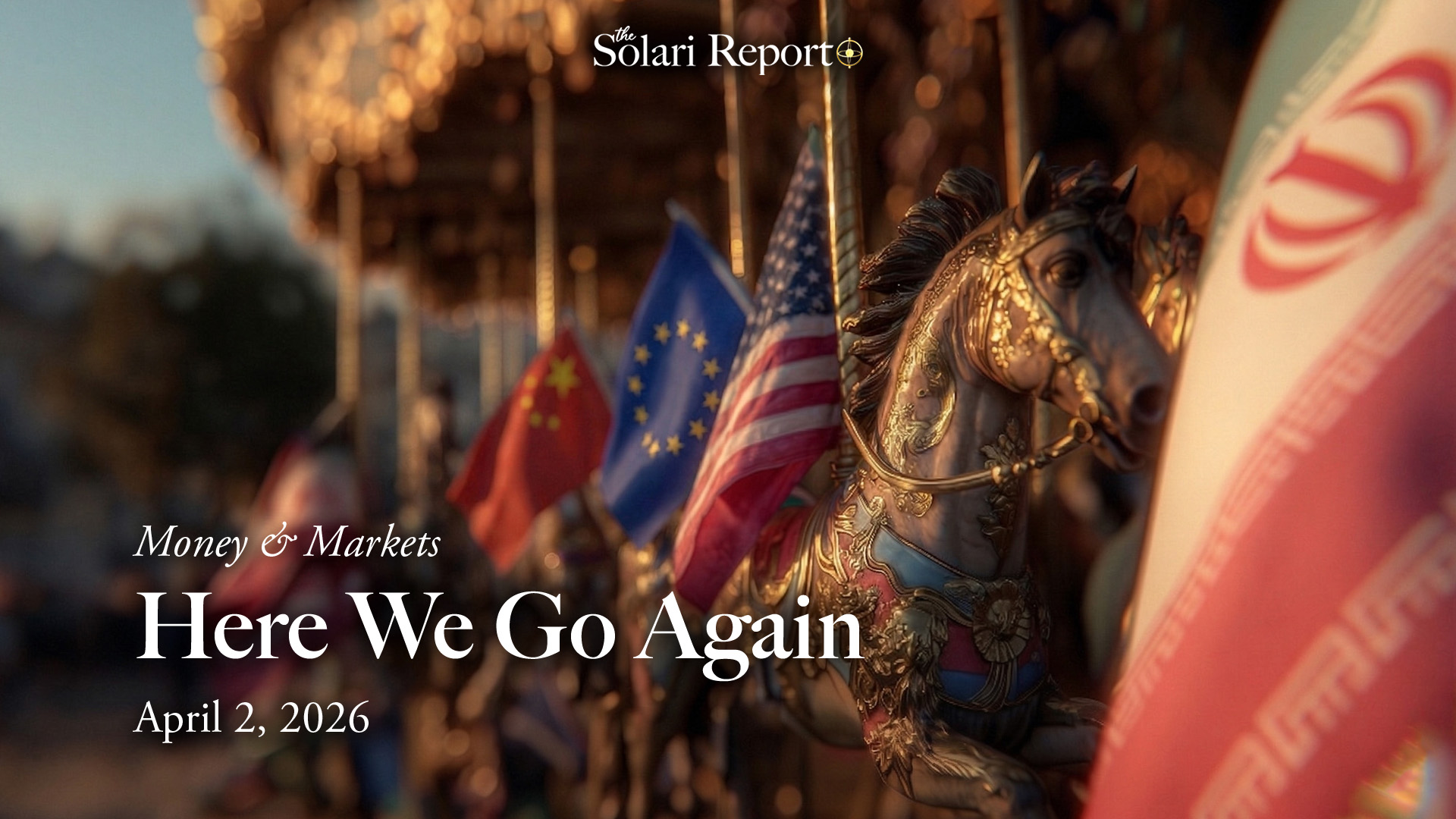
Money & Markets Report: April 2, 2026
Become a member: Subscribe

































NTS Headlines
Headlines by Category
Headlines by Year
- Money & Markets
- Weekly Solari Reports
- Cognitive Liberty
- Solari Builders
- Ask Catherine
- News Trends & Stories
- Equity Overview
- War For Bankocracy
- Digital Money, Digital Control
- State Leader Briefings
- Food
- Food for the Soul
- Future Science
- Health
- Metanoia
- Solutions
- Spiritual Science
- Wellness
- Building Wealth
- Via Europa






































Solari’s Building Wealth materials are organized to inspire and support your personal strategic and financial planning.




Building Wealth
This 6-pillar curriculum teaches the basic literacy we need to be personally and financially successful and to do so in a manner in which together we evolve a culture that supports the emergence of an advanced human civilization.














Missing Money
Articles and video discussions of the $21 Trillion dollars missing from the U.S. government

Connect with the wider network of like-minded Solari subscribers using our in-house social media platform, Solari Connect.











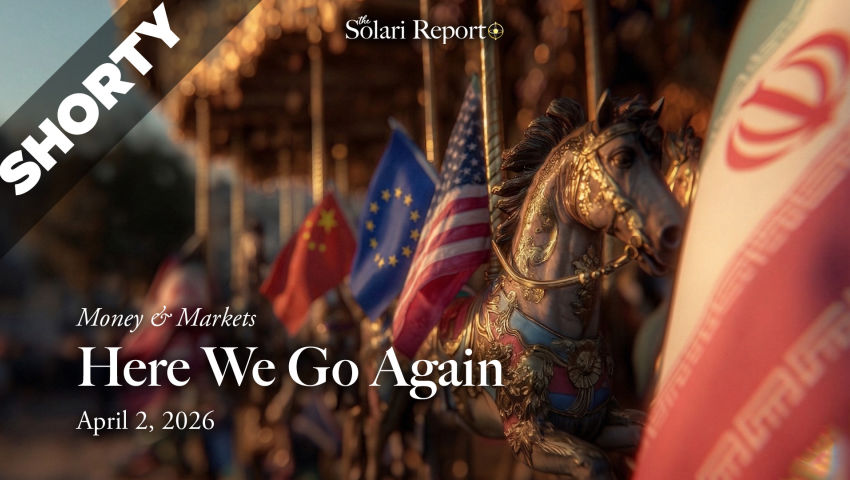

Catherine Austin Fitts and John Titus frame the expanding Iran conflict as “COVID 2.0,” arguing it follows a template seen in Ukraine and Gaza: destroy infrastructure, then rebuild conditionally to embed Western financial rails, digital ID, and transaction control. They discuss Iran’s threats against major tech firms in the Gulf, reports of US bases being made uninhabitable, hypersonic missile impacts, fuel shortages and inflation, and concerns about market manipulation and insider trading tied to war news. The episode connects US legislative pushes (e.g., Clarity/Genius Acts), stablecoins, and tokenized markets to a broader move toward programmable money and 24/7 blockchain trading. They question ICE’s warehouse detention buildout, note deportations of Ukrainian men into military service, and highlight pressure from Stephen Miller in Idaho’s 287(g) fight.
00:00 Welcome And Move Update
00:58 Theme COVID 2.0 Iran
01:24 Putin On Pandemic Parallel
02:45 Energy For Financial Rails
04:07 Iran Targets Big Tech
05:11 Flatten The Curve War
06:11 Hypersonics And Air Defense
07:39 Template Ukraine Gaza Iran
10:37 US Bases Hit Remote War
14:10 Fuel Shortages Travel Shock
16:18 Inflation Debt Trap Politics
18:09 Iran Mobilizes Ground Forces
20:56 Weekend Ceasefire Jawboning
22:15 Israel Proxy Narrative
25:15 Massey Primary Pushback
29:25 War Inflation And Polls
34:19 Fuel Price Charts LNG Squeeze
36:56 COVID Reset Control Grid
38:47 ICE Warehouses Draft Theory
42:06 Deport Ukrainians To Fight
44:30 ICE Chief Stress Whiplash
50:07 Insider Trading War Bets
54:22 Trump Signature On Cash
55:51 Israel Draft Strain Subplot
58:17 Israel War Costs
59:32 Ukraine Aid Rerouted
01:02:16 Kushner Saudi Money
01:03:22 Programmable Crisis Thesis
01:07:14 Tokenized Stock Exchange
01:09:26 Data Centers Cancer Fears
01:12:09 Big Tech Jury Reckoning
01:17:06 Healthcare QR Biometrics
01:22:52 ICE Idaho Power Grab
01:33:51 Gold Rates Dollar Charts
01:38:17 Solari In-House Updates
01:42:14 Imposters and AI Slop
01:48:11 Porn as Weapon
01:53:13 Detox and Wrap Up
Latest solari report & ask catherine
Log in or subscribe to the Solari Report to enjoy full access to exclusive articles and features.
Already a subscriber?

Hi Catherine,
Thought to submit a few thoughts about the Iran conflict.
For a variety of reasons (fog of war, truth is the first casualty, etc) it is reasonable to assume we’ve received a low assessment of causalities on the US side. Probably higher than we see in the media/official press briefings yet at the same time remarkably lower than one might expect against reportedly formidable resistance. Breathless accounts on mainstream news the other day about just 1 F-35 receiving shrapnel damage (and returning to base successfully) vs a total of some 10000 sorties flown to date is a thing that makes you go Hmm. Not much of an air defense capability in Iran apparently.
Another factor is the very public discussion about US Marines and Army troops being sent to the region. Combined with word from number of sources that heavier forces (which would require sea lift and longer lead time to build up) are not being sent. This mix of factors is not in keeping with historic contingency plans for Iran conflict. And sending a relatively small contingent of light/amphibious forces is much more publicly broadcast than one would expect. Seems to be mostly negotiating posture. Certainly not likely to be more than a very limited mission with some specific objectives.
Another factor to put into the mix that we’ve not seen much comment on is the fact that most of Iran’s population is in the North and most of the energy production and shipping is along the Gulf and to the South. The straits of Hormuz are far from the main population centers and separated on the ground by tall mountains with a limited road network. Easy to defend Bandar-e Abbas from ground reinforcements if necessary, for example.
Yet another is the common tendency to speak of “Iran” as if it is some sort of unified whole entity rather than some mixture of factions that have no doubt been deeply roiled by attacks on leadership and command and control. Is the IRGC really of the same mind as the Conventional military leadership about how to proceed with the conflict?
How much of an ability does Iran have to fire what type of ordnance with what degree of accuracy remains in question. Reportedly much was stored deep underground in Iran. And with 10000 air sorties completed, it is not unreasonable to assume that much that was stored deep underground is now sealed in – similar to reports of damage to the nuclear facilities in the 12 day war last year. At best it would take some time to dig out.
Put all that into the blender and add some assumptions about unwillingness to suffer large numbers of casualties by US leadership due to pending midterm elections, and a less pessimistic assessment about the conflict emerges.
It just might be “wrapped up” more quickly and cleanly than the pessimistic camp loudly proclaims at the moment. Of course, whether that result can be sustained longer term is another matter entirely! But by then US forces may have retreated into “Fortress Americas” after getting East Asia squared away as per the NSS…
I’ve an interest in how certain military hardware performs. My take on the present capabilities around the Persian Gulf : Most of the explosions within Iran are from guided standoff weapons, launched from 100km or so from Iran’s defensive capabilities. Accuracy is variable, and likely better than 30m from the target. I’s likely that the better ordanance is in short supply.
Iran’s air defence capability seems to be of the order of 10s of km, so this is assymetrical warfare.
The Gulf Coalition’s air defence weapons capability seems to be running out of munitions to the extent that incoming drones are being shot down by helicopters. The drones have the ability to transmit images and flight information, hence targeting can be very precise, and quantities are unlimited in the short term.
Deployment of more A-10s to the theatre beefs up defensive capabilities considerably, though supply is limited. The vindicated spirit of COL John Boyd lives on.
One of the key factors is finance. Iran’s currency is down sharply from 2/28 and it looks like Iran is dependent on building able to transact with China and a limited numbers of parties. So they are bleeding financially. Both sides are bleeding financially – with the US bleed including its allies – or former allies.
Agreed. It would not be surprising if a “deal” involves re-enforcement of petro dollar usage.
I saw this video about a week ago and strategy for the US to keep dollar hegemony by blowing up the world energy market by making the US the dominant energy supplier to world seems to ring true to me (at least as one of the main stacked functions of this war). What Medhurst put together seems like it has some deeper truth to it.
The intro is like 40min so this link skips it. You only need to hear the first 15-20min to get the point. He goes into other topics later.
https://www.youtube.com/live/QiYU92vCrCU?t=2383
“Ukraine” is now destroying all the Russian oil facilities after shutting off the gas piplines to Chezch and Hungary. After so much war, why now?
https://youtu.be/7rlzIUtNXao
Along that note I thought that by making energy more expensive in the Middle East, Asia and Europe, the US will have get an advantage in running energy hungry data centers. The age of those huge data centers in the Middle East is done or at least significantly delayed, and Asia/EU will be constrained by high fuel prices. That’s one way to win the AI race, by making it more expensive for everyone else. I feel like this is scenario planning with AI. Take out morality out of the equation and only focus on accomplishing the goal.
Yes, good point. There is no doubt that the US creating global shortages improves its relative advantage.
Thank you for the link. I watched part of the Medhurst podcast and it rings true. Not good news, but it explains a lot of things.
Pippa Malgram’s latest substack is interesting. She argues that US ability to now ship small nuclear fusion installations into military zones will be a game changer. She is arguing that the US is moving well ahead of the hard bifurcation.
Really hope you discuss these fireballs that almost the entire country is seeing right now. One thing I find particularly tragic about when things like this happen is that everyone in the government becomes untrustworthy. E.g., the national weather service saying they’re just asteroids/meteors, etc. I mean I guess they theoretically could be, but right now, really… quite scary.
Do you have a link for this story? Thank you/
Videos of the sightings have been all over Twitter the past week, tweet linked shows the intense frequency of sightings, article is a good summary of what the powers that be are saying
https://x.com/StefanBurnsGeo/status/2037310300420997394?s=20
https://www.space.com/stargazing/meteor-showers/fireball-sightings-are-surging-across-the-us-heres-whats-really-going-on
Thank you, Peter.
Most interesting questions about how health was achieved before 1850’s. Through acoustics, architectural, and environmental features that affected the human body.
Cathedrals Were Never Churches — They Were Healing Machines and They Turned Them
https://www.youtube.com/watch?v=vYJ1BEhfVOI
9,000 Church Bells Were Removed in a Single Generation — What Frequency Were They Tuned To?
https://www.youtube.com/watch?v=KJMOH0-3AHo
Why They Demolished Every Hospital Built Before 1900
https://www.youtube.com/watch?v=J-k5SKne2E4
Prof. Jiang on Tucker Carlson
https://m.youtube.com/watch?v=2K2nQsTTjQE&t=29s&pp=ygUZUHJvZiBqaWFuZyB0dWNrZXIgY2FybHNvbg%3D%3D
Worth watching the full interview.
I’m always suspicious of people who rise from nothing and then are on every podcast. After they get the message out they disappear, like that guy who promoted “Mass Formation”.
According to Corbett, Jiang is a high school teacher, who has a BA in English Literature. Not saying his views are not important, but how does a high school teach rise to get on every Alternative Media platform? I need to listen to hear what he is promoting.
I think too much value is placed upon academic degrees and white lab coats. What degrees did Jesus have? Or Buddha? Or Socrates?
I have met people who had little or no schooling and could barely read yet had more wisdom and insight than most PhDs.
I was not being negative on his education. I was just questioning why some people suddenly appear on every alternate media news site. It may just be as simple as the alternate media just get their ideas from other podcasters, from people sending in suggestions for guests or numerous other possibilities. For me it just rings a caution alarm.
I guess there is also the part about needing to be called Professor, when his title should be teacher.
Its good practice to always take everything with a grain of salt. He has been around for a while, but only recently got popular. But still worth a listen. After that, draw your own conclusions.
David Hughes calls this phenomenon “Sudden Darlings”
I watched the TC interview. I think Jiang describes interesting possible scenarios. Brings up interesting issues. The next person on my interview is Craig Tindale, the author of the Hard Bifurcation.
For a foreign teacher based in Beijing to become a youtube personality requires permission. I think what he does well is set out the way a lot of the world – including those in his hometown – see America and its trajectory. The analysis is always gloomy – collapse of the empire and dollar, civil war and rise of Israel as a substitute Middle East power. There are other possibilities – for example, that the US comes out on top of the Middle East chaos like post WW2. But the gloomy outlook is one of the possible scenarios which unfortunately seems to have gained speed recently. And that is the scenario, as well as the global consequences, he describes very well.
In the most damning analysis of Prof/Teacher/Mr. Jiang, he may be reading a script, say a foreign policy brief. Even so, it is still insightful to understand it.
This one is quite interesting and gets a bit deeper than the Tucker Carlson interview:
Game Theory #16: Pax Judaica Rising
https://m.youtube.com/watch?v=0aASxQrJYuo&pp=ygURSmlhbmcgcGF4IGp1ZGFpY2HSBwkJ2QoBhyohjO8%3D
Would love to see him interviewed on Solari!
Turns out he is not a Professor but a fraud.
A fraud who makes a lot of sense.
“You shall no longer take things at second or third hand, nor look through the eyes of the dead, nor feed on the spectres in books,
You shall not look through my eyes either, nor take things from me, You shall listen to all sides and filter them from your self.”
~ Walt Whitman
Sophisticated Drone Swarms Disrupt Operations At Barksdale Air Force Base
https://www.zerohedge.com/political/sophisticated-drone-swarms-disrupt-operations-barksdale-air-force-base
Barksdale AFB does not have air defenses, nor does it have fighter jets that can take down drones.
The airbase does have some electronic countermeasures that were designed to disable GPS and the datalinks between the drones and their remote operators. The electronic countermeasures failed to work.
This is Lame.
My guess: fake news, or they are flying drones over their own base and claiming a mystery. Wag the doggy
Re 2025 Annual Wrap up:
Since the likely scenarios were written before the recent Iran events, specifically the altercations between Middle East BRICS members, would it be accurate to say that Scenario 1 / 2 is most likely in the near term?
I was looking at those as well and wondered if we are somewhere between 2 &4
High disruption makes sense
We are in the high disruption scenarios. The US dollar debt trap is protecting the dollar for now – no way to tell how long that may or may not work. I some pockets that have prepared for resources it may feel like plunder.
https://solari.com/plasma-get-ready-scenarios/
They are clearly heading into Covid 2.0