This 6-pillar curriculum teaches the basic literacy we need to be personally and financially successful and to do so in a manner in which together we evolve a culture that supports the emergence of an advanced human civilization.
Those Who Are Prepared Will Be Able to Sail Through It
with Michael Yon
“If you see famine coming and take action, you can sail right through. Your boat will get pushed around during the rough times, but you will get through and live to tell the tale.”
~ Michael Yon
There Are Many Ways to Wage War without Guns, Famine Included
I enjoy hearing Michael and his well-traveled perspective. Do you remember the Technate North America? I want to recall this includes USA, Inc, Canada, Greenland, Venezuela, Cuba and minor other islands.
Some good news on the pushback front. Amazon Fresh is closing all of its 72 stores nationwide. Gee, I wonder why this concept never caught on?
“Amazon Go was known for allowing shoppers to pick up what they wanted and “Just Walk Out” instead of individually scanning items at a traditional checkout counter. That system relied on sensors and overhead cameras to track what shoppers purchased, and linked it to their accounts digitally. ”
That is good news. Creepy control grid does not sell.
Dear Elze and Michael,
Regarding the Netherlands and the question about how to reverse the progression you observe toward a more inhumane living environment, it begins with a fundamental question: what is the Netherlands as a form of state?
The Kingdom of the Netherlands is a constitutional monarchy, of which the Netherlands is a constituent country. This means that the position of the King is enshrined in the Constitution. The King and the ministers together form the government The King is therefore the head of state of the Kingdom of the Netherlands and operates within a Realm-level constitutional structure that takes precedence in Kingdom affairs. In the Netherlands, the King and the ministers together form the government.
In addition, the Netherlands has a representative democracy and Article 120 of the Constitution, which states that the judiciary may not review the constitutionality of Acts of Parliament and treaties.
As a result, the Netherlands is one of the very few countries in Europe without constitutional review of formal legislation against its own Constitution. This means that an internal, independent correction mechanism based on constitutional protection of human and civil rights is absent.
Within the Kingdom of the Netherlands, however, a constitutional court does exist in the country of Sint Maarten, established in 2010. This court is geographically and legally located in Sint Maarten. Proceedings can only be initiated by the Ombudsman of Sint Maarten. Although the court does not have jurisdiction over the Netherlands, its composition and operation are embedded within the Kingdom’s legal framework, and its rulings are integrated into the broader Kingdom and Dutch legal infrastructure. (https://uitspraken.rechtspraak.nl/resultaat?zoekterm=Constitutioneel%20Hof%20Sint%20Maarten&inhoudsindicatie=zt0&publicatiestatus=ps1&sort=Relevance)
For Dutch citizens in the Netherlands, this means there is no direct access to constitutional review of formal legislation against the Constitution. In practice, a significant part of legal correction has therefore shifted to international courts, such as the European Court of Human Rights. This is a strongly political trajectory, in which legal and diplomatic interests often outweigh direct individual legal protection.
This means that a great deal of responsibility structurally rests on the attitude, moral compass, and vigilance of the Dutch citizens and their representatives in relation to the government. Precisely because there is no direct constitutional brake, this requires that politicians possess the capacity not only to follow the government’s agenda, but also to genuinely constrain it in the interest of human dignity, legal protection, and societal continuity. The question, however, is who in the Netherlands today still truly fulfills that role.
In addition, there is a symbolic and moral layer that is rarely made explicit, yet does influence how power and legitimacy are experienced. The fact that within this monarchical tradition there are symbols that legitimize leadership not only legally but also morally and spiritually — such as the staff of divine command given by the Pope to the King — makes visible that authority here is not derived solely from democratic or legal foundations, but also from an older, sacral legitimization of power. (https://www.koninklijkhuis.nl/onderwerpen/staatsbezoeken/uitgaande-staatsbezoeken/staatsbezoek-italie-en-vaticaanstad/donderdag-22-juni-2017)
In combination with the military infrastructure and international positioning of the Kingdom, this symbolism takes on a broader meaning: it not only legitimizes authority internally, but also supports external exercises of power within alliances and international structures. Precisely for that reason, strong and independent corrective mechanisms are all the more essential. When these are absent, symbolically legitimized power can withdraw from direct human accountability, while the consequences — military, economic, and humanitarian — are nevertheless felt globally.
What underlies this is that this state structure is not only a legal construction, but also a moral architecture. When legislation, treaties, international obligations, and economic models remain outside direct constitutional review, a situation arises in which systems can legitimize themselves without a structural, independent correction based on human consequences.
This makes policy formally lawful, but not necessarily humane.
In this context, what I would describe as ultra-utilitarianism becomes increasingly visible: a phase in which not only efficiency and utility are leading, but in which complete human, social, and ecological realities are subordinated to abstract optimization models. In such a system, preserving the order itself becomes more important than the people for whom that order was originally intended.
Here the system reaches a dangerous threshold. Power becomes increasingly concentrated in a relatively closed administrative and technocratic bubble, in which feedback from outside becomes less and less genuinely corrective.
This is also where the parallel with hunger and famine becomes visible. Famine today rarely arises because there is literally no food, but because access, distribution, financing, and political priorities are organized in such a way that certain groups are structurally excluded from the protection of the system. It is not a natural disaster, but an administrative and moral consequence of ultra-utilitarian thinking.
In that sense, famine is not a separate problem, but a symptom of the same mechanism: where abstract models, geopolitics, and system continuity weigh more heavily than the concrete, physical lives of people.
For this reason, I do not see the current phase only as a social or ecological crisis, but as a moment in which societies can literally move toward a cliff — not through a single catastrophe, but through an accumulation of policies, rationalizations, and closed decision-making, in which the image of the human being becomes increasingly impoverished.
What this requires — also in a country like the Netherlands — is more than technical reform. It requires a fundamental change of course, in which not only limits are placed on ultra-utilitarianism, but in which a different model is actively built.
In that light, I see it as necessary that the peace model itself is not only defended morally, but also structurally and economically supported. In other words, peace, human dignity, and the protection of human continuity must no longer be treated as a cost item within the system, but as a core value that is anchored organizationally, financially, and culturally.
As long as war, conflict, exclusion, and systemic pressure generate more economic and geopolitical return than peace, ultra-utilitarianism will continue to reinforce itself. Truly reversing direction requires that peace, stability, and human protection themselves become part of what is socially and economically sustained.
So perhaps the question is not only for those standing outside the system, but equally for those living and working within it. What does it ask of us, when we begin to sense how close this trajectory may come to an abyss? If there is something that could still unite us, whether we stand outside the corridors of power or occupy them, could it be that human dignity must remain an absolute: not a variable, not a trade-off? And if so, how do we carry that recognition into our handling of power, loyalty, and the emerging technologies?
I live in Alaska and just learned that Canada is a constitutional republic, represented by King Charles III, and the crown legally owns 89% of Canada’s land. Here in Alaska 87% is public land – 322 million acres. Over 50% owned by the federal govt and one third by the State of Alaska.
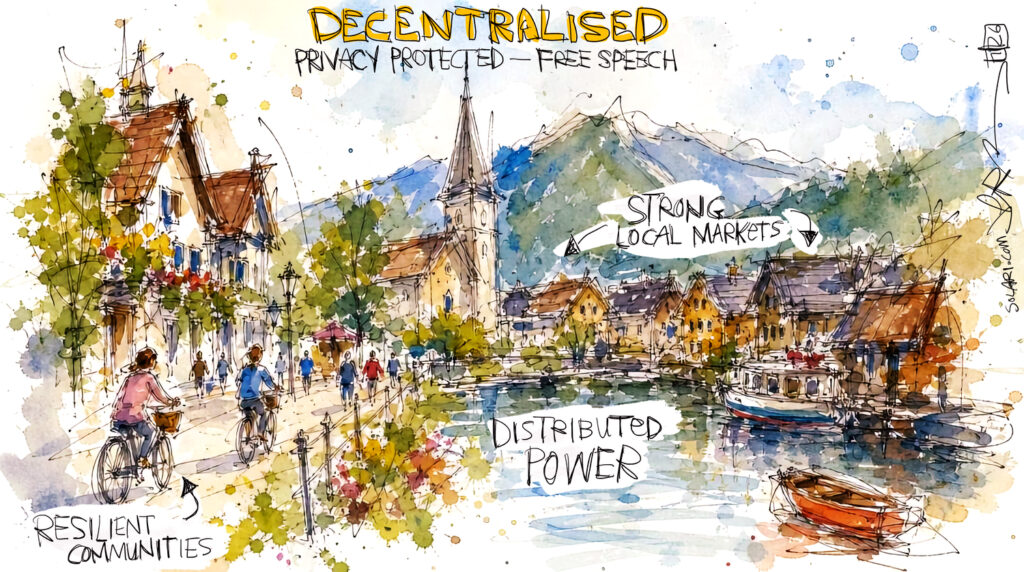
If you read Axelrod’s Evolution of Cooperation on how to create a peace economy, this is why it is essential that we shift our time and attention from the people pushing and profiting from war to those who push for peace, including decentralization of power. As long as most people want to put their time and mone on the people they perceive are the ones with current power, are the winners, instead of financing and following those who lead to increased peace and family wealth, we are working for the people who are killing us. We have the power to shift.
Yes. Yes. And Yes.
We need a roadmap that is decentralized and accessible to every human globally. And I sense how fragile the social fabric has become under the pressure of the War Economy.
It would now only take a few pulled threads for the work of peace to feel like pushing a huge stone uphill.
That is why it feels so important that we carry this together
Amen!
Recently, I came across this quotation:
“The law of nations is in reality the law of cultures”
~ Charles Malik
In the end, the system is carried by the people. As dr. Farrell stresses, we have to save the culture. The inflection point will not come from systems reform. Something much more fundamental needs to change, and then the system will shift.
This video on game theory, that Axelrod used to develop his theory on cooperation, gives much ground for hope. If you don’t have the time, start looking at the 17minute mark: https://www.youtube.com/watch?v=mScpHTIi-kM
Once we live the culture and shun and call out those who don’t, a healthy culture will spread. It requires individual responsibility, conscious active participation from all of us.
Dear Elze, I don’t disagree that culture matters.
My concern is what happens when culture is asked to compensate for missing structural safeguards.
In asymmetric systems, calls for “individual responsibility” often end up protecting the system rather than the people within it.
This interview is exemplary in how it stays positive and hopeful, while exposing apocalyptic reality. I want my college student to watch this and think it would be great for your “Young Builders”
Thank you for the compliment!
It will be great to use an interview like this for class discussion, adding recommended readings, giving follow up assignments.
Michael’s passing comment about the initials BBB was timely and helpful. Last night I began watching a video on what I thought was Biblical archeology. It contained seemingly tangential pro-Zionist comments. Who is this group I asked myself. Then I saw the initials BBB – the Bearded Bible Brothers. Thanks Michael for giving me what I needed to spot the evangelical BBBs.
It has been pointed out that bbb (the reset, the bill, the party) in small case letters looks similar to 666.
I didn’t know the word ‘fnords’. According to Wikipedia: To “see the fnords” means to be unaffected by the supposed hypnotic power of the word or, more loosely, of other fighting words.
Agreed. Now I’m going to be spotting even more fnords, to use a somewhat obscure reference.
Thanks for the vocabulary word! Fnords is obscure but very relevant today. It seems to describe how demonic forces act.
Perhaps Michael could make a list of books that would be of use in learning the history of famine. I would be very appreciative.
Great interview guys. Thank you.
The posts on Michael’s substack on the fish ponds are very interesting. They provide food when there is little sunlight.
Mushrooms als need little sunlight, they grow fast, and can have high nutritional value: https://fungi.com/products/growing-gourmet-and-medicinal-mushrooms
The book ‘Mass Starvation’ by Alex the Waal is recommended. It is also discussed on page 76 and 77 in the ‘Farmers and Fishermen’ wrap up.
Thank you, Elze.
I’ve followed Michael since Catherine interviewed him and his perspective provides an outstanding map with which to navigate today’s world. His Substack posts are highlights of my week.
Thanks to Michael and Elze for the conversation, and to Catherine for bringing him to my attention!




























I enjoy hearing Michael and his well-traveled perspective. Do you remember the Technate North America? I want to recall this includes USA, Inc, Canada, Greenland, Venezuela, Cuba and minor other islands.
Some good news on the pushback front. Amazon Fresh is closing all of its 72 stores nationwide. Gee, I wonder why this concept never caught on?
“Amazon Go was known for allowing shoppers to pick up what they wanted and “Just Walk Out” instead of individually scanning items at a traditional checkout counter. That system relied on sensors and overhead cameras to track what shoppers purchased, and linked it to their accounts digitally. ”
https://www.fastcompany.com/91481811/amazon-is-closing-its-grocery-stores-heres-what-its-building-instead
That is good news. Creepy control grid does not sell.
Dear Elze and Michael,
Regarding the Netherlands and the question about how to reverse the progression you observe toward a more inhumane living environment, it begins with a fundamental question: what is the Netherlands as a form of state?
The Kingdom of the Netherlands is a constitutional monarchy, of which the Netherlands is a constituent country. This means that the position of the King is enshrined in the Constitution. The King and the ministers together form the government The King is therefore the head of state of the Kingdom of the Netherlands and operates within a Realm-level constitutional structure that takes precedence in Kingdom affairs. In the Netherlands, the King and the ministers together form the government.
In addition, the Netherlands has a representative democracy and Article 120 of the Constitution, which states that the judiciary may not review the constitutionality of Acts of Parliament and treaties.
As a result, the Netherlands is one of the very few countries in Europe without constitutional review of formal legislation against its own Constitution. This means that an internal, independent correction mechanism based on constitutional protection of human and civil rights is absent.
Within the Kingdom of the Netherlands, however, a constitutional court does exist in the country of Sint Maarten, established in 2010. This court is geographically and legally located in Sint Maarten. Proceedings can only be initiated by the Ombudsman of Sint Maarten. Although the court does not have jurisdiction over the Netherlands, its composition and operation are embedded within the Kingdom’s legal framework, and its rulings are integrated into the broader Kingdom and Dutch legal infrastructure. (https://uitspraken.rechtspraak.nl/resultaat?zoekterm=Constitutioneel%20Hof%20Sint%20Maarten&inhoudsindicatie=zt0&publicatiestatus=ps1&sort=Relevance)
For Dutch citizens in the Netherlands, this means there is no direct access to constitutional review of formal legislation against the Constitution. In practice, a significant part of legal correction has therefore shifted to international courts, such as the European Court of Human Rights. This is a strongly political trajectory, in which legal and diplomatic interests often outweigh direct individual legal protection.
This means that a great deal of responsibility structurally rests on the attitude, moral compass, and vigilance of the Dutch citizens and their representatives in relation to the government. Precisely because there is no direct constitutional brake, this requires that politicians possess the capacity not only to follow the government’s agenda, but also to genuinely constrain it in the interest of human dignity, legal protection, and societal continuity. The question, however, is who in the Netherlands today still truly fulfills that role.
In addition, there is a symbolic and moral layer that is rarely made explicit, yet does influence how power and legitimacy are experienced. The fact that within this monarchical tradition there are symbols that legitimize leadership not only legally but also morally and spiritually — such as the staff of divine command given by the Pope to the King — makes visible that authority here is not derived solely from democratic or legal foundations, but also from an older, sacral legitimization of power. (https://www.koninklijkhuis.nl/onderwerpen/staatsbezoeken/uitgaande-staatsbezoeken/staatsbezoek-italie-en-vaticaanstad/donderdag-22-juni-2017)
In combination with the military infrastructure and international positioning of the Kingdom, this symbolism takes on a broader meaning: it not only legitimizes authority internally, but also supports external exercises of power within alliances and international structures. Precisely for that reason, strong and independent corrective mechanisms are all the more essential. When these are absent, symbolically legitimized power can withdraw from direct human accountability, while the consequences — military, economic, and humanitarian — are nevertheless felt globally.
What underlies this is that this state structure is not only a legal construction, but also a moral architecture. When legislation, treaties, international obligations, and economic models remain outside direct constitutional review, a situation arises in which systems can legitimize themselves without a structural, independent correction based on human consequences.
This makes policy formally lawful, but not necessarily humane.
In this context, what I would describe as ultra-utilitarianism becomes increasingly visible: a phase in which not only efficiency and utility are leading, but in which complete human, social, and ecological realities are subordinated to abstract optimization models. In such a system, preserving the order itself becomes more important than the people for whom that order was originally intended.
Here the system reaches a dangerous threshold. Power becomes increasingly concentrated in a relatively closed administrative and technocratic bubble, in which feedback from outside becomes less and less genuinely corrective.
This is also where the parallel with hunger and famine becomes visible. Famine today rarely arises because there is literally no food, but because access, distribution, financing, and political priorities are organized in such a way that certain groups are structurally excluded from the protection of the system. It is not a natural disaster, but an administrative and moral consequence of ultra-utilitarian thinking.
In that sense, famine is not a separate problem, but a symptom of the same mechanism: where abstract models, geopolitics, and system continuity weigh more heavily than the concrete, physical lives of people.
For this reason, I do not see the current phase only as a social or ecological crisis, but as a moment in which societies can literally move toward a cliff — not through a single catastrophe, but through an accumulation of policies, rationalizations, and closed decision-making, in which the image of the human being becomes increasingly impoverished.
What this requires — also in a country like the Netherlands — is more than technical reform. It requires a fundamental change of course, in which not only limits are placed on ultra-utilitarianism, but in which a different model is actively built.
In that light, I see it as necessary that the peace model itself is not only defended morally, but also structurally and economically supported. In other words, peace, human dignity, and the protection of human continuity must no longer be treated as a cost item within the system, but as a core value that is anchored organizationally, financially, and culturally.
As long as war, conflict, exclusion, and systemic pressure generate more economic and geopolitical return than peace, ultra-utilitarianism will continue to reinforce itself. Truly reversing direction requires that peace, stability, and human protection themselves become part of what is socially and economically sustained.
So perhaps the question is not only for those standing outside the system, but equally for those living and working within it. What does it ask of us, when we begin to sense how close this trajectory may come to an abyss? If there is something that could still unite us, whether we stand outside the corridors of power or occupy them, could it be that human dignity must remain an absolute: not a variable, not a trade-off? And if so, how do we carry that recognition into our handling of power, loyalty, and the emerging technologies?
I live in Alaska and just learned that Canada is a constitutional republic, represented by King Charles III, and the crown legally owns 89% of Canada’s land. Here in Alaska 87% is public land – 322 million acres. Over 50% owned by the federal govt and one third by the State of Alaska.
If you read Axelrod’s Evolution of Cooperation on how to create a peace economy, this is why it is essential that we shift our time and attention from the people pushing and profiting from war to those who push for peace, including decentralization of power. As long as most people want to put their time and mone on the people they perceive are the ones with current power, are the winners, instead of financing and following those who lead to increased peace and family wealth, we are working for the people who are killing us. We have the power to shift.
Yes. Yes. And Yes.
We need a roadmap that is decentralized and accessible to every human globally. And I sense how fragile the social fabric has become under the pressure of the War Economy.
It would now only take a few pulled threads for the work of peace to feel like pushing a huge stone uphill.
That is why it feels so important that we carry this together
Amen!
Recently, I came across this quotation:
“The law of nations is in reality the law of cultures”
~ Charles Malik
In the end, the system is carried by the people. As dr. Farrell stresses, we have to save the culture. The inflection point will not come from systems reform. Something much more fundamental needs to change, and then the system will shift.
This video on game theory, that Axelrod used to develop his theory on cooperation, gives much ground for hope. If you don’t have the time, start looking at the 17minute mark:
https://www.youtube.com/watch?v=mScpHTIi-kM
Once we live the culture and shun and call out those who don’t, a healthy culture will spread. It requires individual responsibility, conscious active participation from all of us.
Dear Elze, I don’t disagree that culture matters.
My concern is what happens when culture is asked to compensate for missing structural safeguards.
In asymmetric systems, calls for “individual responsibility” often end up protecting the system rather than the people within it.
This interview is exemplary in how it stays positive and hopeful, while exposing apocalyptic reality. I want my college student to watch this and think it would be great for your “Young Builders”
Thank you for the compliment!
It will be great to use an interview like this for class discussion, adding recommended readings, giving follow up assignments.
Michael’s passing comment about the initials BBB was timely and helpful. Last night I began watching a video on what I thought was Biblical archeology. It contained seemingly tangential pro-Zionist comments. Who is this group I asked myself. Then I saw the initials BBB – the Bearded Bible Brothers. Thanks Michael for giving me what I needed to spot the evangelical BBBs.
It has been pointed out that bbb (the reset, the bill, the party) in small case letters looks similar to 666.
I didn’t know the word ‘fnords’. According to Wikipedia: To “see the fnords” means to be unaffected by the supposed hypnotic power of the word or, more loosely, of other fighting words.
Agreed. Now I’m going to be spotting even more fnords, to use a somewhat obscure reference.
Thanks for the vocabulary word! Fnords is obscure but very relevant today. It seems to describe how demonic forces act.
Perhaps Michael could make a list of books that would be of use in learning the history of famine. I would be very appreciative.
Great interview guys. Thank you.
The posts on Michael’s substack on the fish ponds are very interesting. They provide food when there is little sunlight.
Mushrooms als need little sunlight, they grow fast, and can have high nutritional value:
https://fungi.com/products/growing-gourmet-and-medicinal-mushrooms
The book ‘Mass Starvation’ by Alex the Waal is recommended. It is also discussed on page 76 and 77 in the ‘Farmers and Fishermen’ wrap up.
Thank you, Elze.
I’ve followed Michael since Catherine interviewed him and his perspective provides an outstanding map with which to navigate today’s world. His Substack posts are highlights of my week.
Thanks to Michael and Elze for the conversation, and to Catherine for bringing him to my attention!