How'd George Washington
get paid the first time?
It wasn't with coins.
The Mint didn't open until 1792, and
Washington's presidency started in 1789.
So how'd he get paid early on?
The answer is George Washington got
paid the same way all US presidents have
gotten paid, with bankers' fingers in
his pockets, skimming money from the
entire country in one huge banking scam.
That huge banking scam did not start
in 1913 with the Federal Reserve.
It didn't start in 1863 with
the National Banking Act.
It didn't even start in 1791 with the
first Bank of the United States, which
is the first central bank in US history.
It started on Alexander Hamilton's third
day in office in 1789, when he had the
country borrow funny money from a fake
bank in which Hamilton owned shares.
He then paid George Washington and
other US creditors and employees of
the government with that funny money.
Now, Hamilton didn't actually
invent the scam himself.
He copied it from the Bank of
England system set up in 1694.
But Hamilton fixed its one big flaw,
and that flaw is what caused the Bank
of England to default in 1696 when
its funny money got exposed as a sham.
Hamilton simply found a way to
prevent a default from happening.
Otherwise, the two scams are identical.
If George Washington knew the truth
about his early paychecks, there would
be a sequel to the hatchet story where
what gets chopped to bits is a Treasury
Secretary rather than a cherry tree.
Thanks to Alexander Hamilton, George
Washington got paid with paper IOUs, with
bank notes issued by the Bank of New
York, in which Hamilton owned shares.
What prevented exposure of those bank
notes as paper Chuck E. Cheese tokens
worth 35 cents on the dollar was the first
bailout in the United States' history
in which Hamilton converted the Chuck E.
Cheese tokens into full US dollars, and
then had us pay his fake bank interest
on the full US dollars rather than the
fake bank paying the United States.
For every dollar-denominated paper
Chuck E. Cheese token that Alexander
Hamilton upgraded into a full legal
US dollar, the United States paid
the Bank of New York six cents.
We transformed dumpsters full
of its junk paper IOUs into full
money, and we paid the bank.
This is crystal clear from the official
record, as you are about to see.
If you understand this scam, and in
particular, if you understand how Hamilton
fixed the flaw with the Bank of England
system, you will understand the scam that
is modern central banking throughout the
West, which is hands down the biggest
scam in the history of the world By way of
that background, welcome to Best Evidence.
My name is John Titus.
This video marks this channel's return
to the War for Bankocracy series after
a very long break corresponding to a sea
change in my thinking about how and when
the cabal of globalist criminals that's
currently running the US came into power.
How and when did they take sovereignty
and divest us of agency, take
the power from we, the people?
Like a lot of other people, I
believed it was by a coup d'état
at some point in American history.
And originally in this episode, I was
gonna argue that the coup took place
during the global financial crisis.
Other people, of course, have
pointed to other events in
US history as marking a coup.
The JFK assassination is a big one.
Creation of the Fed in 1913 is one.
9/11 is a biggie.
And originally, episode four was gonna
pile on to that list and say, " no, it
was the global financial crisis." But
the more I researched, and really the
more I analyzed, the more I understood
that the coup theory doesn't really work.
Not because there hasn't been
a sovereign power transfer.
For sure there's been a
sovereign power transfer.
We the people have not been the real
sovereign in the US for a very long time.
I don't think very many thinking
people would argue that point.
The coup theory fails because a
coup d'état is a criminal act.
It's pretty much the
worst crime on the books.
Whereas the sovereign power transfer
that took place in the US did
so through legal tran- channels.
There was nothing criminal or
illegal about it, and it wasn't
at some point in US history.
It was within two days of
Alexander Hamilton taking
office on September 11, 1789.
That's when, two days later, he handed
the keys to the nation's sovereignty,
which is the power over national
credit, over to private bankers.
He did that, like I said, by
copying and improving the Bank
of England system set up in 1694.
Now, in episode two, we saw that the
establishment of the Bank of England
was a pivotal event in world history
because that's what propelled the private
power of, over national credit past
the military to become the number one
sovereign power in sovereign nations.
Remember, Machiavelli said
in the early 1520s that the
military was the greatest power.
But by the early 1800s, Thomas Jefferson
said, "No, banking institutions are
more dangerous than standing armies."
That's really not so much a difference
of opinion as it is a difference of era.
Machiavelli simply didn't live to see
the Bank of England created in 1694,
and that's when standing armies yielded
to banking institutions as top dog.
And one very important reason for
that was that in the Bank of England
system and in systems that follow
it, power over national credit wasn't
just private, it was anonymous.
And that latter feature is what
enables people, private individuals,
to wield enormous power over a nation
with no democratic safeguards, no
restraints, and no transparency at all.
You don't even know who they are.
With the military, at least you
know the names of the top brass.
In this episode, I'm gonna walk through
that scam again, but this time I'm
gonna use the US as an example and show
you how Hamilton perfected the scam by
eliminating the biggest risk faced by the
bankers I'm also gonna talk about another
feature of the private credit system
which ensures that the power wielded
by bankers is permanent, and that's the
fact that the private power over national
credit behaves exactly like an addiction.
It replicates an addiction perfectly
where the country is the addict, the
private bankers are the drug dealers,
and the private credit, the money,
what we think of as money, is the drug.
Actually, I'm gonna show you that the
private power over national credit
is worse than a drug addiction.
I'll get to that But make no mistake about
it, private credit addiction went into
the veins of the US, into its money supply
at birth, and it's the apex ancestor
of every addiction that came after it.
Insofar as a coup d'état is
concerned, though, there wasn't one.
When Alexander Hamilton perfected the
Bank of England, the system of addiction
here in the US, he didn't do anything
illegal, and he was never challenged.
He might have been near the limits of his
discretion as US Treasury Secretary, but
no one ever challenged him, not Congress,
not the President, not the courts.
So private credit addiction has
raged in this country for 250 years.
The public debt is now $40 trillion.
The interest payment is absolutely
out of control, and now the drug
dealer's got to harvest the addict's
organs because siphoning blood out
of our veins is no longer enough.
In financial terms, the debtor can't
service the interest payment anymore,
not the real interest payment at
any rate, so the creditor has got to
start pocketing collateral, and we're
experiencing that in real time right now.
That's a short form of US history.
Private credit addiction was created
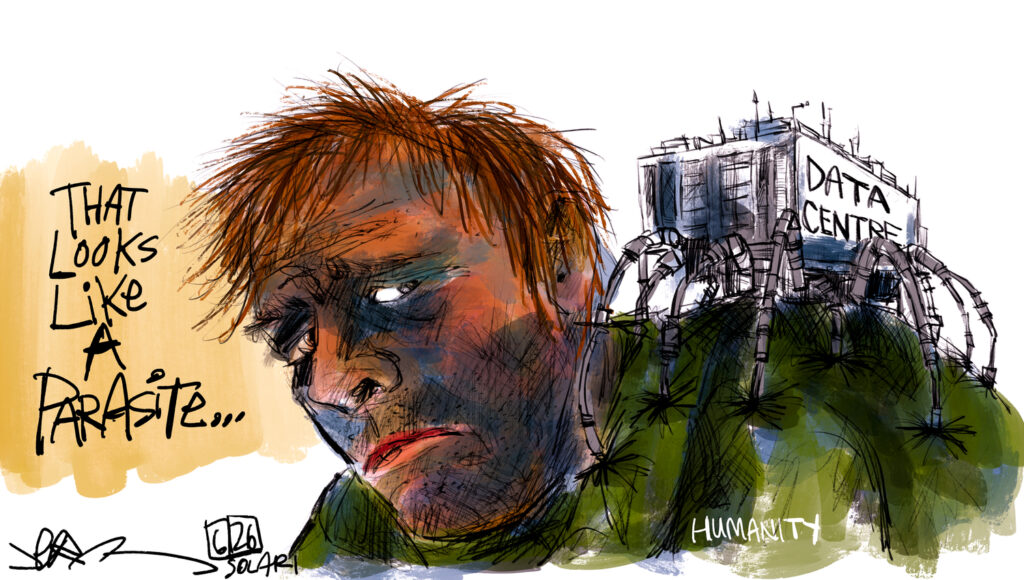
in 1789 in order to feed parasites.
It got worse for 250 years, and now
the parasites are bleeding the nation
dry before they move on to their next
host, where whoever that might be.
But there was never a coup.
If you want to take over a country, a coup
is actually dangerous because it exposes
you to prison, it exposes you to death.
It's a hanging offense.
The much smarter play is to get
the nation addicted to your credit
and then control the credit.
That's what's going on.
Doing it that way gives you the upside
of a coup d'état, gives you sovereign
control without the downside, the
risk of prosecution, jail or death.
That's because the private power
over national credit is a voluntary
and legal transfer of power from
the nation to private individuals.
The trick, of course, is getting
the nation to hand over its power
like that, which in the US was
done by way of an inside job, as
you're gonna see in this video.
There wasn't some outside enemy, in other
words, who jabbed a nee- needle of private
credit addiction into the nation's arm.
It was our first United States Treasury
Secretary, and no one said peep.
So even if it was of dubious
constitutionality what Hamilton did, and
I think it was questionable at a minimum
it was not illegal, and thus there was
no, there was never a coup in the US.
That is a major reversal for me and for
this channel because for over 10 years,
I've been saying there was a coup at
some point that at some point in US
history, a gang of criminals took over,
took control of the US- And my number one
piece of evidence on that score was and is
to this day extremely solid, very solid.
It's never-- no one's ever challenged
it, and that's the decision made at
the highest levels of government not
to prosecute any executive at any
global too-big-to-fail bank, even
when the banks admitted their crimes.
That decision, as I have shown repeatedly
on this channel, was ultimately made
by the banks themselves by installing
attorneys at the Department of Justice who
refused to investigate crimes by banks.
That outcome is absolutely shocking
because it reveals that private
bankers enjoy sovereign immunity
far beyond what the United States
president has under the Constitution.
Remember, Nixon had to answer a subpoena.
That's what got him out of office.
He was subject to investigation, but
not the global too-big-to-fail banks.
And what that reveals, the fact that
they're not being investigated, is
that the sovereign power under the
Constitution, we the people, isn't
really the sovereign power in the US.
I still stand by that.
In fact, I did two long
videos on that very point.
One was "The Veneer of Justice and
the Kingdom of Crime" in 2016, and
then "All the Plenary's Men" in 2017.
This video, in a lot of ways, is
a prequel to those, but those said
there was a coup, and that's wrong.
Otherwise those videos stand as is.
They're good videos.
However, it does not follow from the
loss of sovereignty that a coup is what
caused the loss of that sovereignty.
That's where those videos go wrong.
In reality, our loss of sovereignty starts
with a bank in which Alexander Hamilton
owned shares and which is absolutely
remarkable for its absence from so many
accounts of early US monetary history.
The vast majority of accounts of
early US monetary history focus
exclusively on the Bank of North America.
But the US actually borrowed
from two banks back then.
One was the Bank of North America,
and the other is Hamilton's
bank, the Bank of New York.
And of those two, the Bank of New
York is obviously the real ancestor
of today's too-big-to-fail banks,
not the Bank of North America.
And that's based on several abuses that
were simply not true of the Bank of North
America, the more popular rival than the
Bank of New York I'll just kinda run
through what makes, distinguishes Bank
of New York over Bank of North America.
One, the Bank of New York was
born on the wrong side of the law.
We're gonna see that later.
And it operated without a
bank charter for seven years.
Didn't get its charter in 1791, and
it didn't have a charter because the
people of New York didn't trust it.
The Bank of New York was in Philadelphia.
It had its charter in 1781.
Number two, the Bank of New York's
encroachment on the sovereign
money-issuing prerogative under
Article 1 of the Constitution was
done with 100% private ownership,
just like the New York Fed today.
Bank of North America was 60%
publicly owned at least
early on, at least at first.
Number three, Hamilton owned shares in
the Bank of New York while he was U.S.
Treasury Secretary, borrowing money from
his own bank So the financial graft of
public servants that's so commonplace
today started with the Bank of New York.
Just those precedents make it a far
better case for studying the private
power over national credit scam.
Now, briefly, where am I getting
my information about the Bank of
New York and Alexander Hamilton?
And the answer is I'm getting
it from the Bank of New York's
official history, 1784 to 1884.
So let's take a look at it.
This is my corkboard for this episode,
where I can see all my source materials
in one place, and I can get to them.
On the leftmost item you see
here is appendix seven from
the book I just mentioned, The
History of the Bank of New York.
And you can see the page over
there, the list of stockholders
of the Bank of New York at the
time of its incorporation in 1791.
So in 1789, the Bank of New York, it
doesn't have a charter at all, but
that doesn't stop it from issuing
banknotes and lending them out to
borrowers like the United States, nor
does it prevent it from issuing stock,
including, you see here, one and a half
shares to Alexander Hamilton and three
shares to his good buddy Aaron Burr.
And even a share to their pal Oliver
Cromwell, who died in the mid-1600s.
Huh.
Anyway, who knows?
Whatever.
If you flip to the end of the appendix
seven, that there are 723 total shares
in the company, which made Hamilton
the 0.2% owner of the Bank of New York
while he is sitting Treasury Secretary.
One and a half shares is,
it's kinda curious to me.
The subscription price for
a share was $500 per share.
Hamilton was more than
a, an investor, though.
He wrote the articles of incorporation
for the bank in 1794 and was
one of its 12 directors before
he became Treasury Secretary.
I'll get to that in a bit.
But he was knee-deep,
Hamilton, in this bank.
One and a half shares is curious 'cause
it's, it seems kinda small But it's
certainly enough to create the good
old-fashioned aroma of self-dealing.
This is a good point
to mention, by the way.
The War for Bankocracy series is 100%
backed up by solari.com and Catherine
Austin Fitts, meaning not only can
you watch and download the War for
Bankocracy series at solari.com, in
case YouTube and BitChute and Odysee
take it down, you could always,
there's an archival copy at Solari.
But in addition, you can also at
Catherine's site, download and
the research materials and sources
that you see here like the Bank
of New York's official history.
There's a PDF of that you
can just download yourself.
Catherine Austin Fitts, incidentally,
gets huge props for this episode
in particular and supporting it.
She is a major Alexander Hamilton
fan so her support of this
episode is being provided at
great personal pain, rest assured.
But support it she will because
Catherine is first and foremost a
woman of great personal integrity.
She's also been magnificent as a
mentor, doing a weekly show with her
together called Money and Markets
on Solari for the last five years.
Thank you, Catherine Austin Fitts.
I don't say that enough.
In any case, let's move on, and let's
now explore the scam called the private
power over national credit by comparing
the nation's early dealings with the
Bank of New York with England's dealings
with the Bank of England in 1694.
So to set the stage, it's 1789 the
US has just started to operate
under the Constitution, and it
needs money for salaries, and it
could get that money either by
borrowing money or by issuing money.
Congress have both of those powers
under the new Constitution, specifically
under Article One, Section Eight.
Paragraph two of that section gives
Congress the power to borrow money on the
credit of the United States, and under
Paragraph five, Congress can coin money.
Now, upfront Did coining money
under the Constitution include the
right to issue paper money like
greenbacks almost 100 years later?
A lot of people will tell you
no, the term coining money only
means gold and silver coins.
But hold that thought.
We'll see if that position really
boils down to no more than a ruse by
private bankers to filch the right
to issue paper money from we the
people and keep it for themselves.
For now, let's stipulate though that
coining money is indeed limited to gold
and silver coins, and we'll see where
that stipulation takes our analysis.
So it's 1789, and the US can coin
money or borrow money on US credit to
pay the salaries for new government
employees like George Washington.
But rather than coining money or
borrowing money, the US borrows IOUs.
It borrows paper notes from private
banks in order to pay George Washington's
lavish $25,000 a year salary, and the more
reasonable salary of Vice President Adams
at $5,000, and on down to the Senate and
the House But what does that look like?
What does it look like, a
paper note from a private bank?
Let me just show you.
Let's just drill right down on this
note from the Bank of New York.
The U.S. borrowed this privately
issued funny money instead of
borrowing real money, instead
of borrowing gold and silver.
But how do we know that this
note isn't actually money itself?
The note tells you that.
It tells you it's not money
right there on its face.
You can see that.
"The President and Directors of the Bank
of New York promise to pay $1 on demand
to whoever." If this were real money,
there'd be no need to demand anything
unless the demand amounted to taking your
$1 Bank of New York note to the bank,
demanding your dollar, and being told by
the teller that you're holding a dollar
and that your demand is thereby satisfied.
That's ridiculous.
That doesn't make any sense.
So you can see this note
isn't actually money.
It's a promise to pay money, to pay $1.
So in 1789, money in the U.S. was,
by custom, silver and gold coins.
A lot of them were Spanish doubloons,
silver dollars, pieces of eight and
that's consistent with our stipulation.
So when the Bank of New York says
it'll pay $1 on demand, what that
means is that the holder of this
note could walk into the Bank of
New York and demand, in exchange
for the note, one ounce of silver,
probably Spanish or the equivalent
amount of gold, probably a coin.
But the point is, either way, when you
ask the Bank of New York for your $1
in exchange for its $1 IOU here, you're
probably gonna get your silver dollar.
Probably.
If the bank has it on hand, then yeah.
But that's not guaranteed, and
that's why the $1 Bank of New York
note, like all bank notes, is worth
less than the face value of the
note, worth less than a dollar.
Think of it like a coat claim check
at a restaurant Yeah, you're probably
gonna get your coat back, but the
ticket is worth less than the coat
itself, to be sure, due to risk.
We'll talk about what percentage
of their face value the Bank of New
York notes were worth in a minute.
For now, we know what the
bank note is, it's an IOU, and
what it's not, which is money.
Now, the US borrowed $80,000 of notes
from the Bank of New York in 1789.
Alexander Hamilton chose that.
He went that way.
That was his choice.
And up until that point, that's
exactly the same route that England
took in 1694 with the Bank of England.
It borrowed $1.2 million.
Sorry, it borrowed 1.2 million pounds of
notes from the private Bank of England.
The problem was the Bank of
England stopped paying on its
notes just two years later in 1696.
It was a total disaster.
And it stopped paying 'cause it lacked
the gold to back its notes, and there
was a run on the Bank of England, and
it was forced to admit, "Yeah, we don't
have the, we don't have the gold to back
the IOUs." We saw this in episode two.
The question is: Was the Bank
of New York any different?
We know, 'cause we just saw it,
that the bank issued at least
$80,000 in notes just to the US.
Plus, it issued other notes.
Plus, it had deposits.
And depositors can demand gold and
silver, too, just like note holders.
And also, this is very important, the
Bank of New York lacked a charter.
Didn't have a charter in 1789.
That's a big problem.
The question is: Did the Bank of
New York face the risk of a bank run
like the Bank of England did in 1696?
And the answer is, yeah, it faced
a ru- it faced the risk big time.
Not only did the Bank of New York lack
sufficient gold to pay out all the demands
out there, but its lack of a charter made
it especially susceptible to a bank run.
How do we know that?
Because the Bank of New York's
own official history tells us
that in very clear language.
Let's go back to our
corkboard and see here.
Look at the Bank of New
York official history again.
Let's just look at chapter four of the
bank's history, page 36, second paragraph.
"The following is a statement of the
assets and liabilities of the Bank
at the time it commenced business
under the charter May 1st, 1791."
And then the actual balance
sheet is shown on the next page.
Here we go.
We are interested in the Bank of New York
specie bank, its precious metal bank.
That's in US dollars.
The paper bank you see there that's
a holdover for when, from when New
York State as a colony, issued
notes denominated in British pounds,
which it actually did up until 1787.
W- so we're gonna bypass that and just
look at the specie bank, the dollar bank.
So on the right side there, capital
stock, and that is gold and silver paid
in by investors like Hamilton, $318,000.
Now, normally, that money,
that 318 grand, would not be
subject to a demand for return.
But it is here because the New York,
Bank of New York didn't have a charter.
I'll talk about that in a minute,
about why that's the case.
But let's keep moving through liabilities.
Next, notes at 181,000, and
then deposits of $774,000.
Both of those liabilities are,
without a doubt, subject to
demands for redemption on the spot.
So the Bank of New York, if we--
w- let's include the capital.
I'll get to why you have
to include it in a minute.
It has $1.27 million of liability
subject to demands for conversion
into gold and silver coins, if I'm
right about its capital stock being
subject to demands for return.
Now, let's pause for a minute.
Let's look at assets on the left side.
Gold there at $516,000, but you notice
that it gets reduced down to $463,000
because there's $53,000 of notes that
are already laying claim to that gold.
So it's only 463 grand.
So the actual value of Bank of New
York notes isn't 100 cents on the
dollar, it's 35 cents on the dollar.
Because it's only-- 'cause, because
the bank has only got 463 grand to back
up over $1.27 million of liabilities.
And that figure, like I
said, that's for 1791.
It's not gonna be that much
different in 1789, unless it's worse.
Now- Let's talk about why I say the
capital stock is subject to demands for
gold, just just note holders and
depositors can demand their gold so
could investors in the Bank of New York.
Normally, investors in companies like
Hamilton investing in the Bank of New
York, they can get their money back.
They can get their gold back out of the
company by selling shares to a second
investor willing to buy those shares.
In other words, if they want their
gold back, they gotta find a buyer.
The company or the bank isn't just gonna
hand the gold back to the investor in
exchange for the investor's shares.
But the Bank of New York's articles
of incorporation, which were written
by Hamilton in 1784, as we saw, told
investors that their legal liability was
limited to the amount that they invested.
So it was a limited liability company.
In other words, if you invested $10
in the Bank of New York, your total
liability, your total exposure for
the acts of the bank would be $10.
But it turns out that's false.
Without the bank charter, investors
are on the hook for every act done
in the Bank of New York's name.
So if you invested, back to $10, if
you invested $10 in that bank and the
Bank of New York then loses, let's say,
a wrongful death lawsuit for 10, $10
million, a court issuing that judgment can
reach your assets to the extent necessary
to pay that $10 million judgment.
You see why a charter is important now?
So if an investor asks the Bank of New
York for its gold, to get their gold
back, the Bank of New York has gotta
be ready to hand it back on the spot,
because if it doesn't, the investor's
just gonna say, "Fine, I'll sue you
for fraud in court, and I'll tell my
publicist and my other investor friends
about my lawsuit based on the fraud
of your articles of incorporation."
And then you really will have a
bank run, no question about it.
And again, I know this because the Bank
of New York's official history says so.
Let me just read it.
It's here.
I got the book in front of me.
It's on page 18 and 19 of the book.
You can download the PDF and
take a look at it and verify
what I'm reading is accurate.
This guy writes a letter to the bank.
He's an investor.
"I am a subscriber to the bank.
I cannot consider myself under any
obligation to pay my subscription.
When the regulations were published
and agreed upon, it was stipulated
that no subscriber should be liable
for more than his stock," for more
than his investment This, however,
presupposes the grant of a charter.
Without the charter stockholders become
liable, however small their investment,
for all the engagements of the bank
to the extent of his whole fortune.
So if investors ask you, ask for their
gold back, the Bank of New York's gotta
cough up pronto, and Alexander Hamilton
damn well knows that because he's the
guy who got investors gold in the first
place by telling them that the Bank of New
York was a limited liability corporation.
Now, Hamilton was smart enough to
recuse himself as a bank director when
he became US Treasury Secretary, but
there's no getting out of being the
author of those articles of incorporation.
And in 1787, Hamilton, as we saw from
the Bank of New York's own official
history, he still had stock in his own
bank, which George Washington is going
to learn when he destroys the bank with
a hatchet for refusing to honor his bank
notes that he's earned as US president.
Now Given everything you've heard about
Alexander Hamilton before, does he strike
you as the kind of guy who's gonna leave
a loose end like a potential bank run
just hanging out, whipping around in
the wind, looking for something to hit?
That's what William Paterson did
with the Bank of England in 1694.
But William Paterson was a pirate.
He was a retired buccaneer.
Hamilton was a lawyer.
He was not a sloppy guy.
He did what he had to do to conceal
the bank's massive gold shortage.
How did he do that?
Let's take a look.
Let's go to the official record.
As you can see, this is the history
of national loans of the US, July
4th, 1776, to June 30th, 1880.
It's from the Treasury Department for
the Tenth Census of the United States.
The part we're interested in is in on,
it's on page 29, which shows exactly
how Hamilton solved the problem he
created by paying people like George
Washington and other US creditors with
paper IOUs printed up by willy-nilly
by a private bank without enough gold
in its vault to cover a potential run.
Let's go top of the page.
Look at, look there, talking about
arrangements with Bank of New York and
Bank of North America for temporary
loans in the earliest days of the US.
Specifically, it says, "Money received
from these banks paid the first
installment of salary due to President
Washington, senators, representatives,
and officers of Congress during the
first session of the Constitution."
So temporary loans from these two banks
paid George Washington, and we know
that what the Bank of New York lent
to the US government was paper notes.
We also know that the Bank of
New York can't come even close to
honoring all of its liabilities.
So what does Hamilton do?
He, to get out of this, he's
got a problem on his hands.
What does he do?
He writes an official Treasury circular
and sends it around to creditors
of the United States who are both
owed money by the US and who, in
addition, sooner or later owe or
will owe money to the US themselves.
The circular quoted here was
sent to customs collectors.
Customs, remember, were the main source
of US revenue back then more than 100
years before income taxes got started.
And this is how Hamilton headed off
the Bank of England problem, how
he prevented a bank run that caused
the Bank of England to default.
Here's what Hamilton says to
his, to the creditors.
"Sir, it is my desire that the notes of
these banks, payable either on demand or
at no longer a period than 30 days, should
be received in payment of the duties as
equivalent to gold and silver, and that
they will be received from you as such
by the Treasurer of the United States.
This measure," he says, "will facilitate
remittances, facilitate payments
from the states without drawing
away their specie," meaning without
drawing down their gold and silver.
Signed Alexander Hamilton,
Secretary of the Treasury.
So that's how Hamilton fixed the problem
he caused when he had the US borrow
banknotes worth 35 cents and pass them
off as full dollars, a gamble that had
burned the Bank of England and William
Patterson, but wasn't about to burn the
Bank of New York and Alexander Hamilton.
Treasury Secretary Hamilton converted the
Bank of New York IOU paper from notes into
full US dollars by making them acceptable
to the US government in payment of taxes.
That's how you create money.
And notice that he also expressly
decreed those notes to be
equivalent to gold and silver.
England did not do that with the
Bank of England in 1694, and
it defaulted two years later.
There was no bailout over
there, at least not in 1694.
But let's return to the issue
of paper money, and let's
think about what happened here.
With one piece of paper Hamilton's
circular, the letter to the
creditors, Hamilton converted other
pieces of paper, notes worth 35
cents, into money, into dollars.
That is absolutely identical to a
two-step money-printing process.
Step one, the Bank of New York prints
some angels on a bunch of paper.
Step two, Hamilton puts the US
seal of approval on the angel
paper, converting it into money.
The Bank of New York angel paper
started out as a 35-cent asset.
The official US seal added 65 cents,
turning it into $1 of legal money.
So why is the US paying a
percentage of the dollar when
it added the vast majority, 65
cents, of that dollar's value?
The better question, though, is why
the US didn't cut out the Bank of
New York altogether, pay it nothing,
and simply print the paper itself.
It could print eagles instead of angels.
Obviously, the US had the ability
to issue paper money from day one.
Hamilton's letter, that circular, proves
that even without the Supreme Court
decision 80 years later holding as much.
That was Knox versus Lee the series of
what's called the legal tender cases.
And Knox versus Lee said, "Yeah, no,
green, greenbacks are constitutional.
They're valid." The point here
now though is that no one has ever
complained about Hamilton's letter
purporting to turn confetti from
the Bank of New York into gold.
So why don't… Tell me this, why don't
the people who insist that the US can
never, ever be allowed to print money
vilify Hamilton for doing exactly that,
for violating their precious commandment?
And the answer is their real problem
isn't with the US printing money.
Their real problem is with the US
printing money and not handing a
percentage of it to private banker
parasites like the Bank of New York.
Remember, you gotta remember, the Bank
of New York's demand for a percentage of
the money came after the US upgraded the
parasite's trash IOUs into full dollars,
which saved the bank from a bank run.
And all these demands that the Bank
of New York made, the upgrade, the
bailout, the percentage cut, they're
being made despite the painfully obvious
fact that the US does, absolutely
does not need the parasites at any
stage of the money-printing process.
The Bank of New York drew
angels on Post-It Notes.
That's it.
That's all it did.
Angels on Post-It Notes.
That's it.
And the bankers want a
percentage of GDP for that?
You gotta be, you gotta be kidding me How
much did the US pay the parasites anyway,
pay the Bank of New York, for them to just
suck interest payments out of the country,
whose labor is what enabled the conversion
of their 35 cent junk paper into full
silver dollars in the first place?
Remember, the US borrowed 80,000, $80,000
face of Bank of New York paper IOUs.
But how much did that cost us?
Let's take a look.
Here you go, center of the page.
"For payment of interest on $80,000
borrowed from the Bank of New York,
$1,934.82." And you can see just below
that, that the 80 grand loan from the Bank
of New York d- wasn't made all at once.
The US government borrowed 20 grand on
Hamilton's third day in office, September
13 30 grand the next day, 20 grand
on October 1st, and a final 10 grand
installment on December 1st, all in 1789.
And you can see from above those entries
that Hamilton is computing the interest
payment on the loan as of March 1st the
next year, 1790, so it's less than a year.
The bottom line math on these installments
works out to a single blended rate on the
aggregate $80,000 loan of 6% annually.
And I am here to tell
you, that is pure usury.
That $1,935 interest
payment, that is pure skim.
You just saw it's Hamilton's blessing
in his role as Treasury Secretary,
as a public servant, that makes
those notes worth 100% of their
face value makes them money rather
than a paper asset worth 65% less.
So again, if it's the country's blessing
of private bank notes that confer status
as money on those notes, why are we
paying private bankers a percentage of
our own money when we could simply have
the Treasury issue 80 grand ourselves
and be completely free of any debt?
Hands down, this is the biggest
scam of all time anywhere.
But let's ask this question: How
does 6% interest, though, for the
Bank of New York parasites compare
with the Bank of England parasites?
When England borrowed its gold-backed
notes it paid the Bank of England 8%,
so the inf- interest rate was different.
The bottom line here is that American
revolutionaries ended up getting a whole
whopping 2% discount for their troubles.
Other than that, the scam of the US
borrowing private bank notes in 1789
is identical to the scam of England
borrowing private bank notes in 1694.
This transatlantic scam, in other
words, is what launched the public
debt as an operating expense, both in
England in 1694 and in the US in 1789.
For just let all this
sink in for a minute.
We won the American Revolution.
The American Revolution was won in 1781.
But eight years later, the private
bankers in London who'd been fleecing
the rebel colonies, indebting the rebel
colonies at a r- at an 8% interest rate,
had been replaced by private banker
parasites in New York who were indebting
the United States at 6% interest.
Private anonymous bankers control
each country by controlling
its national currency.
The country pays interest to private
bankers to use their IOUs instead
of simply issuing their own money,
issuing the country's own money.
The tragedy is that both countries destroy
themselves with debt rather than just
issuing money with no debt at all, and
you can thank Alexander Hamilton for that.
You can thank Hamilton for reducing
the American Revolution to a shift
change in bank managers who enslave
nations in debt wherever they go.
In other words, the United States
might have beat King George III's
army, but it didn't beat his bosses.
Alexander Hamilton saw to it that
the bankers stayed in command.
When Thomas Jefferson, when the author of
the Declaration in 1776, 40 years later
said that banking institutions are more
dangerous than standing armies, this
is exactly what he was talking about.
And this is why Alexander Del
Mar complained about the American
Revolution Actually, he didn't
complain about the American Revolution.
He loves the American
Revolution like I do.
He complains about what happened
just after the Revolution.
And this is in his History of Money
in America, which he wrote in 1899.
Let's turn to page 109, where
Delmar goes on about how great
the American Revolution is before
revealing his massive disappointment
with the immediate aftermath.
Listen to his reason here.
"Never was a great historical event
followed by a more feeble sequel.
A nation arises to claim for
itself liberty and sovereignty.
It gains both of these ends by an
immense sacrifice of blood and treasure.
Then, when victory is secured, it hands
the national credit, that is to say,
a national treasure, over to private
individuals to do as they please with it."
So Delmar says the US wins sovereignty
when it wins the Amer- Revolutionary
War, but then it immediately
hands the win over by handing
national credit over to bankers.
The question, though, really is, so what?
If you hand over the national credit, as
Delmar calls it, to private individuals,
are you also surrendering your
sovereignty like I've been saying here?
Delmar answers that question yes.
He comes down on my side of that
issue, which he makes clear when
he completes his thought that
he started there on page 109.
He goes on.
So let's go back and I'll
finish that passage off.
Here's Delmar's impact assessment
of handing over the national
credit to private individuals.
"The colonists had practically an
entire continent to themselves.
They had only to take care
that the seed they planted was
genuine and uncontaminated.
Nature was certain to do the rest.
They planted, and now, 1899,
look at the fruit and see
what it is that they planted.
They planted financial corporations,
a rotten seed that Rome had trampled
underfoot nearly 2,000 years before.
They planted private money, in which
successively both Greece and Rome had
found the germs of social decay, and
they planted financial exemptions from
public burdens, whose offspring has
already become a tree so mighty that it
cast a threatening shadow over the land.
In a word, they planted
another revolution."
So there you have it.
Now, why do you need a revolution?
Why so extreme, guy?
Is what you're asking.
A revolution is what you need
in order to replace a king with
some form of representative
government run in accordance
with the will of we, the people.
In theory, we, the people,
gained our sovereignty from the
Revolution, at least here in the US.
So the question really boils down to,
first, why is it that a handover of
national credit amount to a much broader
handover of national sovereignty?
And second more specifically, why
don't we, the people, simply use the
sovereign powers that we didn't hand
over, like lawmaking, law enforcement,
the right to raise standing armies?
Why don't we use those sovereign powers
to take the national credit issuance
power back out of private hands?
What is it about private and anonymous
people issuing national credit that
gives them sovereignty and dominion
over an entire country, despite the fact
that their ability to issue that credit
only because the country gave them that
permission to do so in the first place?
The answer is that a debt-based
monetary system, as launched by
Hamilton on his third day in office,
amounts to an addiction in which
the drug dealer/lender has total
power over the drug user/borrower.
When bankers wrote IOUs for $80,000
and lent them to the US, which then
had to pay back $82,000, private
credit addiction was born in the US.
The real cost to the country for
that $80,000 hit wasn't $80,000.
It was $82,000.
And the hit after that is
gonna be $84,000, and so on.
That's your basic addiction.
You need more and more drugs to get
the same high, and you need more and
more money to buy the same stuff.
Debtor nations in debt-based
monetary systems are addicted
in two distinct senses.
Number one, they pay ever larger prices
to their dealer for yesterday's high.
And second, if they don't
get enough dope, they crash.
The dealer's power over addicts comes
from the control of the dope supply.
And actually, private credit addiction
is worse than a drug addiction
due to what happens after a crash.
When drug addicts and alcoholics crash,
aftercare is managed by people outside
of the cycle of addiction, doctors,
family, friends, people who see that
the real problem is alcohol and drugs,
and urge the addict to stop using dope
and using drugs altogether in order to
help the addict kick the addiction When
a debt-based monetary system crashes,
by contrast, aftercare is managed by the
drug dealers, by the bankers, because
they're the experts, and their job is
to keep the cycle of addiction going.
And to do that, they've got to
convince the addict that his
problem's been fixed, that the
cause of the crash is all gone now.
The entire debt-based monetary system,
in other words, rests on selling
huge lies as truth to all of society.
You actually believe that Dodd-Frank fixed
the causes of the global financial crisis?
Dodd-Frank is the brainchild of the
leading drug dealer in the United States.
I'm gonna show you that in
the next episode using the
drug dealer's own handwriting.
You think the Banking Act of 1933
or Glass-Steagall eliminated the
causes of the Great Depression?
You gotta be kidding me.
They might've been good laws, but
they played footsie with the real
problem, which is private credit
addiction on a national scale.
But the high priest experts of
finance and economics, who are
rich from the system that they work
under, aren't gonna tell you that.
They will never identify
any real solution.
The entire industry, the entire finance
and economics industry, is a huge
PR firm working for and owned by the
people who get to create money out of
thin air and lend it to the rest of us.
That system, by the way, can
sustain itself for only so long.
Eventually what happens is the interest
payment gets so big that the dealer's
gotta start seizing the addict's
collateral, seizing the nation's assets.
That process is actually
underway right now in the US.
You see all these different schemes
going about, tokenization is one, that
have all boiled down to one thing.
They're harvesting national assets before
the parasites move on to their next host.
And there's no voting your
way out of this either.
There's no buying your way out.
Ne- neither one's really an option,
voting or buying your way out.
And the reason for that is
that no matter how much money
you've got- Dope man's got more.
Dope man prints money.
You gotta earn your money.
To get out of this, you need
assets that aren't for sale.
You need people who aren't for sale.
You need their spirit, you need their
anger, and the willingness to act.
You need a revolution, in other words,
exactly like Alexander Del Mar said.
And you're never gonna get there as
long as you're looking for scapegoats
like coup d'etat perpetrators,
and that's true for two reasons.
Number one, it's a waste of time.
Let's just say you're right.
Let's say you're right and
there was a coup at some point.
Okay, now what?
What are you gonna do,
round up all the perps?
Most of them are dead, and if what you
say is true, they're above the law anyway.
So even if you're right about a
coup, you're wasting your time
because there's nothing you can do.
The second reason to stop looking for
perpetrators of some coup d'etat is that
blaming your problems, your here meaning
a country's problems, but blaming problems
on some hobgoblin, like a coup d'etat
perpetrator, without ever asking if you
yourself did something to cause your own
misery, is a go-to behavior of addicts in
order to rationalize their own suffering.
Addicts blame every person, place, and
thing under the sun except for their own
behavior, which never changes as a result
because it's never identified as being
a problem, as anyone in any drug and
alcohol recovery program can tell you.
Alcoholics Anonymous, Narcotics Anonymous,
Rational Recovery, Women for Sobriety,
Recovery Dharma, all of them, any
program to stop addiction, it is not
until the addict gets honest about the
role he's played in his own misery that
addiction can start coming to an end.
Until the addict gets honest, he's
gonna hide behind fake villains and
never take matters into his own hands.
The problems in the US are
rooted in its monetary system.
That system is open to inspection.
It's on the books.
It's in Treasury circul- circulars.
It's in statutes.
It's in case law.
The problem is not hidden away in
some dark cloak-and-dagger mystery.
And look I'm not saying the people
in charge haven't committed crimes.
They damn sure have.
I've documented a lot of them
at length on this channel.
But the reason those crimes go unpunished
isn't that there was some coup.
The reason those crimes go unpunished
is that the criminals can use national
credit to buy their way out of problems,
to stay in power and stay out of jail.
Blaming your problems on
a coup gains you nothing.
Actually, the people who control the
system by lending money into existence
are all too happy to watch you vanish
down rabbit holes searching for some coup
rather than searching for things that
we can do to end our own debt servitude.
Now, in case you still doubt me
that handing over national credit to
private banks amounts to a handover
of sovereignty, in the next episode,
we're going to look at America's leading
drug dealer, the New York Fed, at the
height of the global financial crisis
and see how it controls the political
process and election outcomes and
watch it break every law in its path
to prop up its bank lieutenants just
to keep the private credit addiction
system alive and well in the U.S.
There were eight people in the room
that night in the New York Fed, and
one of them was a junior guy from
the Treasury named Kevin Warsh.
How about that?
So your new Fed chairman is a material
witness to the Fed decision that night
to break all the rules, including, by the
way, the cardinal rule of central banking.
Warsh's lease has been short ever
since, and it's going to stay short
when the next crash materializes
into an absolute nightmare.
So stay tuned.
Thanks so much for watching.
I'll see you next time.
It is good to be back.