Become a member: Subscribe

Solari Report

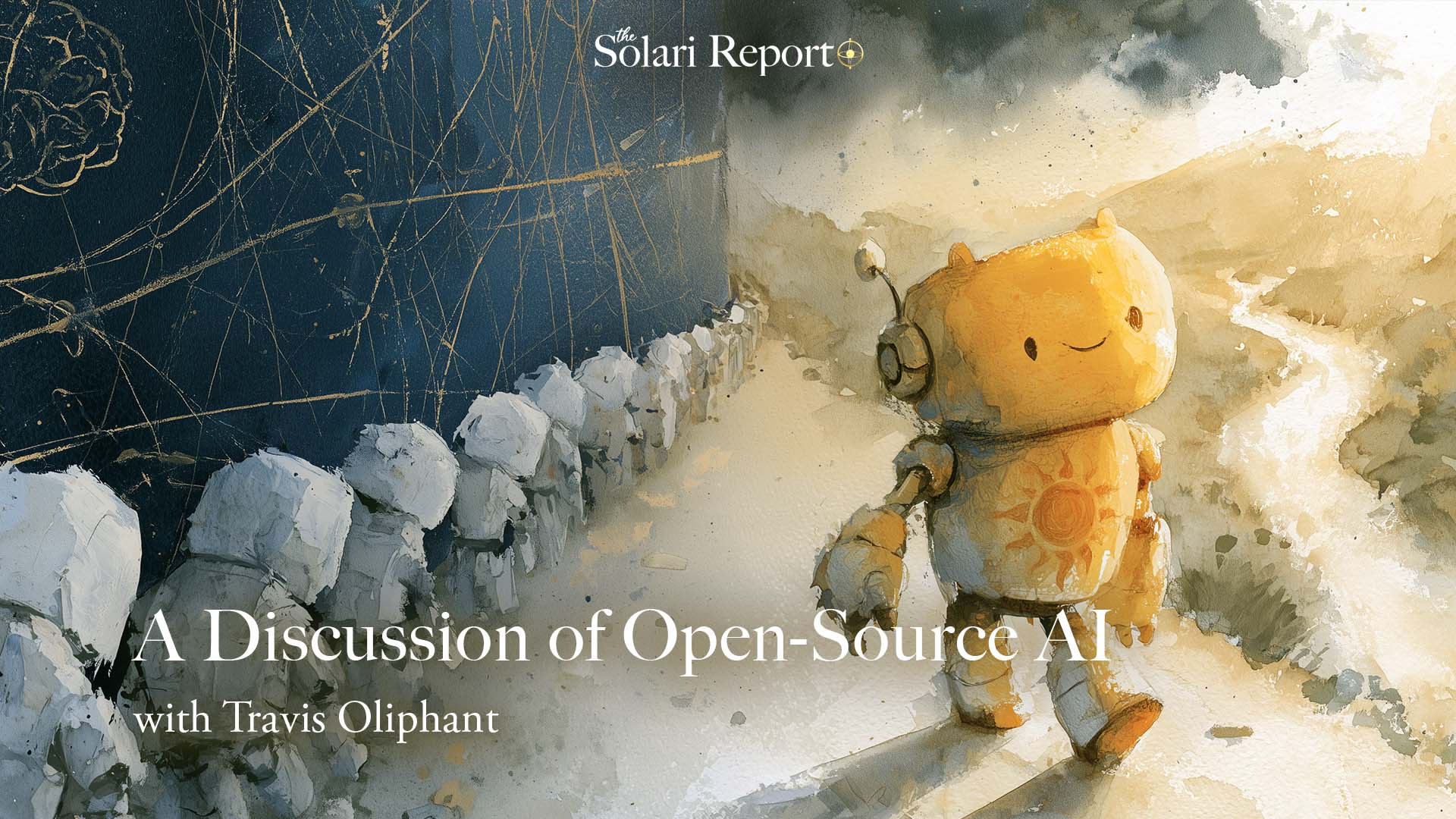
A Discussion of Open-Source AI

with Travis Oliphant

“If [organizations] don’t have the ability to have sovereign data, sovereign AI, they’re essentially giving up their identity, their ability to define themselves…. The danger isn’t that AI will become ‘too smart.’ The danger is that it will become too concentrated. If only three companies in the world hold the weights for global decision-making, the tool becomes a weapon for undue, mass influence.”

~ Travis Oliphant
play-rounded-fill

A Discussion of Open-Source AI with Travis Oliphant

 
LanguageEnglish
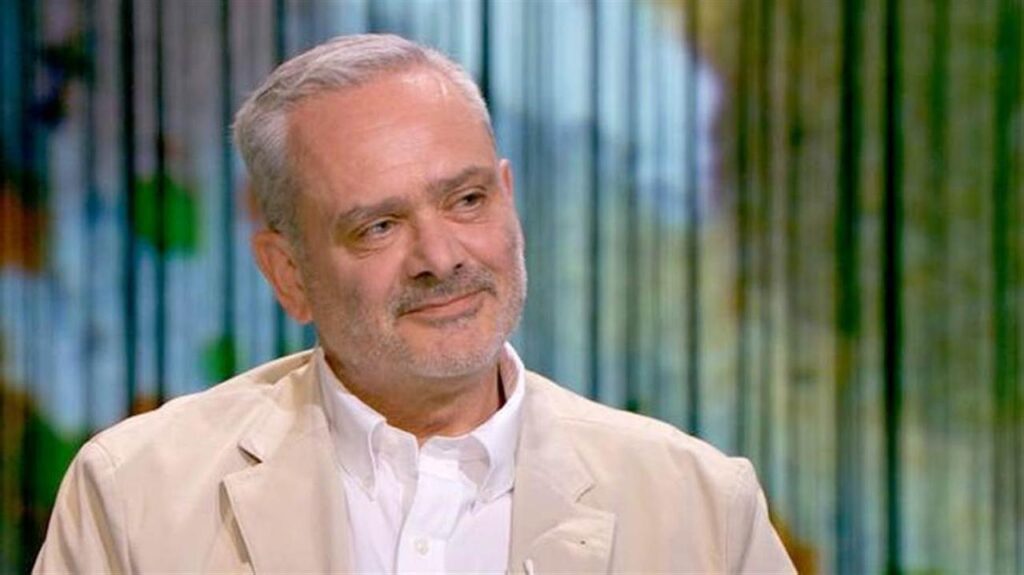
Ladies and gentlemen, welcome to the Solari Report. This is Catherine Austin Fitts. I am in Salt Lake City. I’ve had an amazing time, and I’m joined by a very special person, Travis Oliphant, who came to visit in the Netherlands. We had an amazing time with Tiffany Cianci, who works for you. He is the CEO of OpenTeams, one of, if not the father of artificial intelligence. Is it fair if I say that? Forefather, pioneer of. Fore- forefather and pioneer. Yeah there’s a number of people who make claims, but I can own the forefather claim. And you’ve been living in Austin, Texas, running OpenTeams, but you’re moving back to Utah. Yes, in, in the middle of it this month, about two weeks from now. From here, grew up in Utah- but I’ve been in Texas for 20 years, effectively building companies. I had my, a lot of experience in education, then I went to Texas to explore entrepreneurship, and then now my kids are grown and time to move back, but I’ll still be doing the same things. So we’ve been in cahoots because we wanna load OpenTeams on our servers- Yeah … and use it internally to make the subscription experience much more… Everybody says, “I can’t find this, I can’t find that,” or on a- we have a show called Ask Catherine where we’ve answered the same question 50 times, and yes, you can do frequently asked questions, but if people can easily find everything. Right. But it has to be something what I would call open source. It has to be something I would call moral, responsible technology. It has to be something that we have on our servers and can protect people’s privacy. Exactly. And so when we met you and your team, we were- Exactly … We were excited. That’s where we k- had a conversation. You talked about what you wanted to see, which is exactly what a lot of is possible today. How do you make sure that happens? That great demo ware that people are seeing from the public AIs, how do you get that same capability- but not have the sneaky, this feeling that your data’s just sucking elsewhere? That the information about yourself is going to- some larger organization, that you take the capability of AI but retain the governance and the accountability- That you’ve already built? So this issue of data sovereignty- is getting more and more important at the national level, at the local level, and at the individual level. Data sovereignty. Okay. So let’s go back. H- how did you get involved with what is now called AI? Yeah, great question. I- indirectly. My background is I’m a scientist, and I was studying then remote sensing. I was studying medical imaging at the Mayo Clinic, and I encountered Python in trying to solve my problems. I was doing large scale science analysis, and I needed language to help me do that, and I found Python, and I started to contribute to Python I started to do a lot of just writing code, sharing that code on the internet, collaborating with people all over the world, and then that grew into involvement in open source. So that grew into a project called SciPy. And SciPy became the foundation of a lot of science. So a lot of people in the world out there know about SciPy, a lot of scientists know about SciPy- and they used it. And then that led to a library called NumPy, which I wrote when I was a professor. Okay, spell that for everybody. NumPy. I wrote this NumPy library. So NumPy is N-U-M-P-Y. Okay. So it’s the foundation of array computing in Python. So that’s one reason I could claim possibly the idea forefather of AI is because- OG, you’re an OG … the OG, is because- Yeah … I, so I was, I’ve been doing AI experiments ever since I was a researcher. As AI is a ki- it’s a model building. You’re trying to figure out how to build a model and get information from data. Modern neural networks were y- were one of the possibilities that we used all the way back then. So and people were trying to figure out how to have scientists do it, ’cause there’s a lot of orchestration of computing, orchestration of code. It’s a lot of work. And so a lot of what we were doing is making that work of putting all the stuff together to make something useful easier. Right. And that’s basically been the journey I’ve been on for a long time, is helping scientists do their job easier. So people wanting to use NumPy drew you away from being a scientist. Correct. That’s exactly right. So in fact, writing NumPy led me out of the world of academia- into the world of business. But what did at first was in the world of open source. So I became this open source enthusiast working hard with a lot of people, building a lot of tools. Right. And a whole ecosystem of people. Like some… I often say that me and my closest thousand friends took over science. And a lot of scientists went from using various tools, using open source tools around Python to publish papers, to do research. So I’ve had the chance to talk to people that found the black holes, that, that found the Higgs boson. A lot of them have been using the tools in this ecosystem that- many of my friends have been- A building for 30 years is open source code, models, et cetera. It’s like a public recipe. It’s freely available for anyone to use, see, and modify. So you can find it on websites like GitHub where developers share their work with the world. On the flip side, closed source code is private. Think of it like a secret recipe that a company keeps under lock and key. You can use the final product, eat the food as it’s done, but you can’t see how it’s made. So most of the software we use daily, like Microsoft Word or Adobe Photoshop, is closed source. You can use these programs, but you can’t look inside to see how they work, including programs like ChatGPT, closed source. We can’t actually see how the model works. When you find open source code, you’ll see different types of licenses that explain how you can use it. Some licenses, like the MIT license, which is a common license, are very generous. They let you do almost anything with the code as long as you give credit to the original creators. So that’s like sharing a recipe but asking people to mention where they got it from. Other licenses can be less permissive, like allowing you to use the models only for research but not make money off of them. Now let’s talk about why open source AI models are becoming increasingly important. First, they give you privacy. When you use a closed source AI service like ChatGPT, your data has to be sent to their computers, their servers. But with open source models, you can run the AI on your own computer or server. This means your sensitive information stays with you. Open source models can also save you money. So while closed source AI services can charge you for each query, sometimes pennies but sometimes dollars, open source models lets you run the software for just the cost of your computer or server. So yes, running AI requires some powerful computers, but once you have the setup, you can use it as much as you want without paying per use. So it’s like buying a coffee maker instead of going to the cafe every day. Perhaps most importantly, open source AI helps democratize this powerful technology. Instead of a few big companies controlling AI development, anyone with the right skills can examine, modify, and improve these models. Researchers in universities, developers in small companies, and even just hobbyists can contribute to advancing AI. This widespread access leads to more innovation across all industries and use cases, and helps ensure AI develops in ways that benefit everyone, not just big tech companies. This has created an important debate in the AI community because while closed source models help companies protect their investments, open source models are making AI more accessible, private, and affordable for everyone. So as AI becomes more important in our daily lives, having open source options ensures that this technology remains in the hands of the many, not just the few. So when did you start Open Teams? So Open Teams came later. It’s a, an evolve. I won’t go into the whole story, but maybe summarize it quickly. I first went to Texas and founded a company called Anaconda after doing some consulting work. Anaconda became a distribution company, how to get all this stuff installed. Put a lot of heart and soul into that. Then after I left Anaconda and then started a consult- another consulting company called Quansight And a venture fund. So I’ve always, my, my experience building companies- You, you like to incubate … I like to help I like to incubate. I like to help people become owners. Right. What I realize is we need a lot more owners in the world. Yeah. We need a lot more people who understand the concept of starting companies. We need a lot more capital structure to help them start those companies. I got deeply fascinated with that. So when I left my startup, my first startup, how do I help create more owners? And so that was the foundation of what I’ve been working on since. And so we started a venture studio. A venture studio is a venture c- it’s just a company that organizes capital, and then itself might start companies, and then try to find CEOs and people to run them Open Teams is one of those companies. Open Teams is one of those companies we s- incubated in our studio, started. I’ve had various CEOs run it. I took over as CEO… I was the CEO originally. I took over recently as the CEO when I realized how critical it is for us to push the message hard that everybody needs to own their own AI system- their own intelligence hub, we call it, so they can become- They need to have sovereignty over their AI … the master of their sovereign- sovereignty over their data. It starts with sovereignty over your data. Yes. And then data leads to intelligence. Right. And so you can’t have one without the other. You… And you need s- data sovereignty to lead to AI sovereignty. And you need to make sure that you don’t lose your data sovereignty as you’re sending information to the AIs that aren’t in your control. So that mission became very critical. And so how do we make that happen? ‘Cause there’s a lot of need for it- but there’s a l- there’s a lot of capital invested in centralized AI- In put everything, pull it together. And AI is s- is still a new thing for so many people. For me, it’s not new. For me, it’s a iteration of something I’ve been studying for years and years. And it’s I partner with we partner with Meta, we partner with Google, we partner with Nvidia, we partner with the people that are building the tools- that help AI become possible. And then that partnership led- I avoid those people. It’s hard to avoid them entirely. I know. I understand completely. And where you… To be… It- it’s great for your subscribers or for you to understand that actually where some of those organizations have been helpful is they’re contributing to open source. Right. So essentially, the degree to which they contribute to open source is a positive outcome- Yes … regardless of everything else- they’re doing, if we can keep that open source open, and we can c- and we can educate people about what they can do with it. That’s where we start. That’s where Open Teams came from, was how do we help companies use open source more effectively, and that started actually- So your market- 2019 … is companies? Our market is companies, organizations, countries. Any organization that knows it wants to build AI and own it. And then what’s been happening over the past several years is the cost has been coming down. Right. Two years ago I’d tell this story, and what could I say? It might take $5 million- to actually build an AI that you would own. It doesn’t cost that anymore. It’s now much more accessible to just any company that… And the amount you pay really depends on how much you wanna do. So here’s what’s interesting- ‘Cause you incrementally go from where you are to where you wanna be if you’re using Anthropic- If you’re using Claude, and you’ve got a subscription- That price can’t possibly be the market price No It has to be hugely subsidized Correct. It is- Okay … absolutely hugely subsidized right now now, if that floated to the market price- Yes … I don’t know how high it’d be, but it’d be much higher. At the same time, the cost of open source is coming down. Yes. Now, it was interesting. When I started my first company after I left the administration I did an analysis, and what I figured out, it was, I could either buy the software or I could do open source and spend the money on people And if I could find the right people, I was much better off doing that. Yeah. And
so tell me about
the economics on AI. Is it the same thing? You’re, you, it’s- So right now- If Anthropic starts to rise- correct … to market price and your price is dropping, are you starting to look very… Is open source starting to look very economical? Correct. Correct. Right now, and for the past two years the VC market the investors have been subsidizing OpenAI and Anthropic to provide pretty powerful AI at way under- We need a stronger word than subsidizing We do. It’s… Yeah, no, it’s a stronger word. It’s like they’ve literally been- It’s like a tsunami of subsidy It’s a tsunami of subsidization. No, in fact, I have a really good friend who pays $100 a month, and literally because he could see how much he, tokens he was using, and looks at the price of what that would have cost him if he were paying the token price, the current token price, which already is not necessarily market, he was paying $16,000 of token price- for $100. Right. So there’s a at least $15,000 a month was being- Of subsidy … of was being given. So whenever you’re given something like that, you know that there’s something in return. You’re tr- you’re helping to train the model too. You’re helping that company create dominance. Cause that’s the game. It’s like- how do I get market dominance so then I can then we then you’re gonna need them. Now, fortunately, open source is so strong and there’s so much interest, we still need to make the easy buttons, and we’ve been working on that, and lot- many people have been working on that. It’s getting easier and easier to actually do this yourself. And I’m really excited to help people do this, ’cause once they realize oh, that Claude or OpenAI has given us a really cool demo, and they are. They’re doing a lot of, they’re giving a lot of examples of what you can do. And now you can take those and ensure that this is supporting your vision of the future, your vision of- of the world, and that’s what we need, actually. What we need is… AI, artificial intelligence it’s really a tool. It’s- I call them loop token predictors. It’s- Looped token … Looped token predictors. ‘Cause you’re just predicting a token, then you put it in a loop, and it’s- Yeah … actually powerful. It’s a really powerful concept, and we’re getting, seem to be simulating human conversation really well. But it’s not reasoning yet. I’m definitely in the camp of many people out there that are saying, “Look, this is not intelligence. It’s not reasoning.” No. It’s not. It’s not. But it’s doing some really impressive, intelligent things. Things that clearly we’ve seen in ourselves too. So my number one goal at Solari is, first of all, to understand it. But then the second thing is I’ve been applying it to all sorts of different functions to see You know, where we can use it smartly, where we should avoid it, what the dangers are. I wanna understand what this means to a family or a small business. And one of the things I will tell you, it is hands down the best search engine I’ve ever had. No, it’s impressive. It’s impressive. It’s absolutely impressive. Yeah. It’s interpolating the world’s knowledge in a way that li- that you can interact with in a natural language. It’s beautiful. It’s a really impressive example. It’s… Or the world’s idiocy. I mean- Sorry. Yes. It’s a search engine. The world’s text. Thank you. What- whatever that might be. Right. And more and more, it’s a lot of idiocy. Correct. It’ll re- it’ll reflect to you whatever that happens to be. So biases included. But as a search engine you have to go to the links, you have to figure it out, you have to do the research. But as a search engines, it’s- Yeah … Really good. Yeah, super good. And especially since they’ve added the token prediction with tools. They’ve added tools. And what that does, it just means, oh, the token that is predicted is not a text, it’s a function to call or a web to search. And then it goes and does that and feeds that back into the context. And that starts to give the sense of reasoning, ’cause you’re now calling tools, and tools are programs. Tools are computable comp- computation that occurs that then augments the context, augments the predictive surface. ‘Cause when you’re making a prediction, what it’s doing is it’s taking all of this context window, all this information- Right and then predicting what the next word should be. It’s a token, but a token roughly is a part of a word or a symbol, or if it’s a video, it’s part of a sound or part of a, an image. That’s a fairly straightforward thing. The thing that na- that machine learning, artificial intelligence is fundamentally, it’s this universal approximation theorem that allow… It says, “I’m going to take… If I can construct a function, if I can construct the concept of a function where I have a black box, where I have inputs and an output,” that function could be as broad as you want. And if I have enough data, I can train that function to… I can use a computer to use the data to come up with a version of that function It’s like nonlinear curve fitting. Many people understand curve fitting. Now, it’s many- it’s very high dimensional, so some of our intuition doesn’t work, in fact. Our intuition is limits to three or four dimensions. We’re talking about 10 billion or a trillion dimensional space. Our intuitions don’t always map to that space, but nonetheless, it’s still I put in parameters, and the parameters I find the f- fit for those parameters. That’s what my training data does. It’s helped me figure out what the model is, and then I just feed it inputs, and I come up with an output. And the cool thing about AI is that anything you can imagine, if you can imagine a black box, you can create a function that does that. So- And that’s what we have here so in the ’90s, I spent, I discovered the internet in 1989- and then the World Wide Web shortly thereafter, and then it really started to be something you could use in the mid-’90s. And and we started to work on, believe it or not, digital money. We had the, Wow … we called it just-in-time money. Yeah. But we our notion was that these kinds of software tools should make the small guy much more competitive up against the big guys. Yes. And- Yes … and we were doing a whole series of things to allow financial liquidity of equity in communities- Amazing … by place. So it was place-based venture funds that could be publicly traded. We had a software tool called IPO in a Box. Wow. And you could click radio dots and spit out your prospectus. We had another tool called Community Wizard, where you could map out all the government money, all the federal money sources and uses of credit money in your place because the federal government was… You would pay taxes to Washington. They would pay a contractor $125 per hour to do something that could be done in that community for 25-plus healthcare. So there were all these arbitrages- All these inefficient arbitrage loops. They aren’t inefficient in the sense that they are intentionally set up so that the big guys get the money. I guess efficiently concentrating money. Yeah, so they were politically efficient- Yes … if you wanted control. Yes. But what I discovered was that the financial cost of control was much bigger than anybody can imagine. Wow. It’s bigger than the solar system. It’s unbelievable how expensive central management and control is. How much it costs to actually support that system to enforce control. And to get everybody to comply. You need lots- And enforce … of rules, lots of enforce. You’re trying- That’s an echo of what’s happening now. Exactly. Wow. But it’s getting worse. Yes, it’s getting worse. And then the cost was dramatic. Now, the cost is off the charts. Yes. Anyway, but w- we did a lot of simulations to see what could happen if we were free to just re-engineer all the government money- To optimize the economy. And it was so shocking, I didn’t believe it at first. My smartest guy did the calculation. I was like, “No, that’s not possible.” And then when I realized what was possible, I thought, “Oh my God, tyranny’s very expensive.” so- That, that’s my thesis too. That’s why it doesn’t work for very long. It can work for a while but it- Kind … It’s been working for my whole life, so that’s … A while could be as, an entire life. That’s true. But here’s the thing. It seems to me that what you’re talking about is a tool that, when added to all the other tools … I keep telling my audiences since I’ve been here in Utah, if I wrote a book about America from World War II on, it would be called How the Local Boys Got Rolled. Wow. And so the question is, can y- can these tools, on an open source basis, unroll the local boys- So I- … and get us back in the game? So that is my hope, right? Yes. But I think after, especially meeting you, understanding all the information- you have about how we got here, in the current economy we have, it, it’s not trivial. We’re up against a lot of powerful interests and money that’s- And then also, the … That’s partly why I’m speaking- … more and more, is because in order for that to work, people have to understand. You have to get the word out, ’cause there’s massive They have to- … amount of people know there’s an alternative. They have to know there’s an alternative. Right. And they have to have faith and believe in that alternative- enough to do it. Right. And part of that is getting it simple enough and cost-effective enough So that you can actually do it. Because if the only answer is yes the local boys can win, but it’s gonna take $10 million every time, then you’re up against it. You’re gonna have to- So- … allocate resource. But if it’s not- One of- … if it takes just, oh, I can just, instead of spending 200 a month on an Anthropic subscription, I could spend 50 bucks a month on a subscription that actually I know keeps my data local. Right. And it’s actually faster, it’s even just as fast or even faster- Then that starts to turn the needle. Eventually, so I’m hopeful for this. Yeah. It’s challenging because the intense sub- intense paying off people. People are being paid off basically to use Anthropic right now. It’s unbelievable. It’s unbelievable. So subsidiary, subsidization- Now, I’ve been- … so you’re being paid off using Anthropic, so I- Me too. Yeah. Okay. I use everything actually. I’m not, I’m not- I’m not against it. These are impressive tools. There’s impressive people who work hard to make these tools useful. So h- here’s the problem, though. If you look at how AI is being positioned and communicated it is being used to implement a control grid. So it’s been weaponized by the guys who weaponize everything. So we have a wonderful wrap-up called Omniwar, which is the weaponization of everything. You name it, they’ve weaponized it. Milk I don’t know, pink polka dot, everything. But AI, the clear message is, we’re going to use this to control you. That’s the best image. But AI’s gonna be in charge, and it’s smarter than you, and you’re stupid. And so if you look at the oligarch’s message about AI, it’s making a lot of people- So who do you, who do you think is doing this? Because I know f- I know that 99.9% of the people actually involved don’t, aren’t aware of that. They’re not- No, oh, I agr- I agree. They’re not- They’re completely, they’re not, that’s not their- they’re totally, I would say, so one of the best reads of so far that I’ve read in the last 12 months is Karen Hao’s book on OpenAI. I don’t know if you’ve read it. No No, I haven’t. And it’s hysterical because I know a lot about… I- if you wanna understand risk and evil in this world I’ve really, I’ve learned a lot about that. I’ve experienced a lot, I’ve researched a lot. But you have these amazing conversations where all these brilliant people are sitting around in OpenAI talking about how when they reach general intelligence, they’re gonna solve the healthcare problem. And I’m laughing my head off at, ’cause it’s just stop poisoning people. They’ll be fine. You don’t need, you don’t need one ounce of AI to solve this problem. It’s not a he- it’s not a medical problem. So you see that as a tool for persuasion to get people to buy into another story? No I, I- because it’s not real. They’re not gonna really solve the they could solve the problem elsewhere. I see a group of highly intelligent people- … working on AI who have not a clue how the world works. Yeah. Okay? I was one of those people- No, I- … once upon a time. I, you know- I completely understand that because- Yeah … I was I- A very bright academic who was 30 years old, all the way through my PhD before I uncovered a lick of economic reasoning. I was in that same boat. I- And I realized, oh my goodness, I am super knowledgeable about a ton of things, and I’m completely clueless- About how the world works. We, we have- So I know this is true. We have a whole part of the economy where people make money complexifying problems instead of solving them. And the- and the pr- and the solutions are pretty simple. Yeah. Right? Yeah. But but getting- But the solutions may not keep… give you control. The solutions may, the s- solutions may not benefit every, may not benefit the person trying to solve it. But it cer- if we solve the problems, it certainly won’t benefit the guys trying to centralize things, but- Many of the people I know who feel very negative towards AI are feeling very negative about their perception it’s being unleashed to control us. Exactly. Exactly. And I share those concerns, right? Which is partly why I wanna get the word out, that it doesn’t have to be that way. Right. AI actually came from a the sea, in a space of open source cooperation that’s global. It involves millions of people, actually. Themselves are all just trying to cooperate, and have found mechanisms to cooperate in amazing ways. In fact, I actually recommend anybody to go watch the Python documentary. Oh, really? What’s it called? Yeah, it, it’s called the Python Documentary. It was b- it was produced by Cult Repo. It’s on YouTube. You can just go watch it. It does an incredible job of explaining how Py- where Python came from. Okay, Google. Where was PyCon held in 2015? In Montreal. Oh, it was Montreal. Really?
So the story goes
that Guido invented Python over a Christmas holiday. I showed it to Lambert and I said, “Look what I made.” And he types one very short line of code, and it crashes the interpreter, and he knew that it would. The point escaped me. I didn’t know why he thought this was better than ABC, and why he had done this whole project. It was a pretty crushing experience, to be honest. Immediately on trying it, I was just amazed and thought, “This can’t be as good as it is.” You can see Python code even if you’ve never written a line of Python, and if you know how programs work, you can understand it and grasp it. That click in real time. We were paid our salaries every two weeks, and then suddenly in late October we weren’t. It was a moment where the shit coulda hit the fan. If all the Python guys went their separate ways, Python wasn’t big enough to survive that at the time Trying to build a language is non-trivial. That actually took real design, real thought, and real ecosystem collective innovation over the course of decades. That was my car when I lived in Virginia. I
think it was me
who suggested that Guido be called the benevolent dictator, and then Barry suggested benevolent dictator for life. Python 2 to Python 3 transition was extremely difficult for the community. Some of that probably got away from us a little bit in hindsight. I did feel like Python has a chance of becoming irrelevant. When you don’t have role models who you can relate to, you start believing that you cannot do it. When I first saw the walrus operator, I didn’t like it. It got very vocal and blown up. One person’s succinct, elegant code can be another person’s unreadable puzzle or a fusticated mess. Nobody had expected I would resign, and certainly not that I would rage quit over this issue, which it… essentially it was. How much of Python’s success in AI can be traced back to these scientists in the ’90s? 100%. Python’s a fantastic language even if you’re not a scientist. I just don’t think it would have risen to the level of dramatic usage without the science first, data science and machine learning story. We had a massive impact in the world.
Okay
And ’cause Python came from a global cooperation of individual people. Yeah, and it’s amazing. It’s a beautiful example- Yeah … of what can emerge if you just let intelligent people freely interact with each other. So it was when I had this beautiful mansion in downtown Washington, and when I decided to fight really fight on the litigation, I decided to sell everything, all the art, all the antiques, all the… Everything but the family antiques was going. And eBay had just started, so we said, “Let’s try this.” And over the next couple years, we did hundreds of transactions with people all over the country, totally on trust, not one problem. It was amazing, and I was just dealing with individuals or small businesses. Yeah. Now, my corporate experience, that can… There’s a problem every week. Yes. And, it… But no, but it was the same. You’ll see the same in Open Trust. No, exactly. It’s just unbelievable. ‘ Cause you said something earlier that I really resonate with. I was, I’m also was a enthusiast of the early internet because I saw in it- Yeah, me too the power to empower people. That’s why we invented Just in Time Money. Yes, ex- it’s amazing. And I want people to understand that this is, this did happen. It is happening. Yeah. Even while the control grid came in and the monorepos, I call them, the mono- the monolithics- have come in, and it’s constantly always the battle- between the centralists, the decentralists. Right? Did you ever know Eric Hughes? He was from Utah. I didn’t. I don’t think I’m familiar. He was the guy who had Clipper Chip. Oh, he was the- He was on the front page of Wired, long, blonde hair. Oh, yes. No, I did not know him, but that’s familiar with the Clipper Chip. He’s, he’s ba- I, he’s still here in Utah, but- No kidding … but I remember right after he got on the front page of Wired, he came to Hamilton, and we spent a whole day with the firm- Yeah … and trying to invent Just in Time Money. Yeah. And, and- No there’s enormous potential to continue to… That- that’s the thing I wanna help people understand. There’s enormous potential to build things that are distributed, that are enabling. Well, w- one of- That don’t… You don’t have to fall into the centralized AI, which is gonna become even more centralized if we just- It’s scary … if we let it. So I have one partner who says we’ve gotta get AI to go completely out of control because otherwise it’s either the control grid or out of control, and the out of control can tap into- What do you mean by out of control? You mean just let everybody, let it go, let it go- It’s totally distributed- Distributed And they can’t control it … everybody has own. Correct, yes. It’s not only out of our control- What do you mean- … it’s out of their control. Correct. No, I- And I believe because it is, it does give you power. It does give you… There are models now that, that are open weight models- you can deploy, and there’s some open source models also emerging because there are some large companies who recognize this, and they’re their best interest also create a distributed ecosystem of model builders. Nvidia, for example, does not want to have 10 customers. Right. They want a billion customers. So they actually are supporting- That’s why we have a subscription model at retail. Exactly. Cause they want people to be using, so we’re actually aligned in a league with them. Qualcomm also wants to have AI chips AMD. There’s all the hardware manufacturers- can be allies here. Now it says they’re, they have their they have to, of course, a lot of their biggest customers are some of the hyperscalers, and so it’s- they’re not gonna come out and kinda be adamantly supporting distributed AI. But they are Encour- they are encouraged by it. They do want to see it So let me get back to, I was… When I, on my way to Salt Lake City, I came through Sioux Falls Oh. And we’re working with a wonderful group of the leader of our team, Cash, is a PhD from MIT and used to be an engineer in Silicon Valley until the pandemic when they told them that their kids were gonna have to wear masks, and boop, the next thing you know, they’re living in South Dakota, so they don’t have to wear a mask at school during the lockdown. But we were talking about the size of American data centers. So we’ve got 5,500 in process in the United States, significantly more than any other country in the world, including China. China, I think, has I don’t know, I’ve heard figures from 385 to 550, but and they may have more per data center, but still it’s and one of the things we were talking about was why this level of data center has to be for control. It can’t be… This is not what we need for our cloud and tech. It’s not what we need. We I would rather see 55 million smaller data centers- Essentially where everybody’s home can become a data center for themselves. Right. And then if they want to share a portion of that with others, they can. You could easily do this. And then they have complete data sovereignty. And then they would have complete data sovereignty, exactly. Not everybody may wanna do that, but you can have a local data center, you can have a local provider. I, I don’t know for sure. I don’t know the mean- I don’t know the meaning of all things. I don’t know why people might do this, but it sh- the optics on it, it sure does explain the data. Because… But I think a lot of people are speculating partly because we have these big centralized AIs, these big centralized hyperscalers. Amazon’s been making a lot of money selling centralized compute to people. Right. Because you could… This notion of compute has been around for a long time. Right. And people have had distributed compute. It’s actually very interesting, the ebb and flow, because I think we’re in for another evolution just like the ’80s when the PC era emerged. ‘Cause before the PC era, it was mainframes. You got… You wanted computing, you went to a lo- a big mainframe, you got your answer. So in the evolution of computing, it’s why Microsoft showed up, ’cause IBM thought, “Ah, there, there’s nothing there.” Where pe- business computing’s gonna be on the mainframe. And so they kinda gave Microsoft the PC market. Right. And sure, lo and behold, actually the demand for PCs was enormous. I think there’s the same phenomena can happen here, where the demand for AI as a distributed phenomena is gonna be enormous. Okay. And so we’re not gonna have the mainframe provided AI as the only… It’ll, they’ll be there. Right. But it’s actually… I would be very concerned about investing in speculative data centers. Because I don’t know that they actually don’t- I would be too … I don’t think they’re actually gonna be… It’s always hard to predict the future, ’cause they could rent themselves to other local providers, too. But cause getting more energy and getting compute are valuable things. But we haven’t figured out the model yet. There’s only one way the economics work, and that’s if it delivers financial transaction control. That’s the only way the economics- I could see that. Certainly I, I- I don’t know the companies in detail, but I can see one of the companies Is over levered. I know something about this. I know a lot of people who buy hardware in this space. All of the new hardware, and particularly the hard drives actually, have all been bought out. Right. And there’s no more, there’s no more manufacturing in hard drives in particular that are gonna- it’s gonna happen. And so there is gonna be a massive constraint for new hardware.
And the demand
they’re projecting won’t … I- is mismatched against the actual hardware that’s gonna be producible. And so there’s a absolute gap between- what they’re saying c- demand will be to justify- the data centers, and what the actual availability of hardware is. So if you look- So the costs are gonna go up there If you look at what is happening, as an economic matter it makes sense if you’re gonna get the control grid. If you succeed- That, that’s the casino … the economic value of getting the control grid will justify what is going on. If you fail, you’ve got the greatest misallocation of capital just about since Scotland got bankrupted. Which is not, that’s a sad story, but,
Y- I hate to
say that, but the sort of the war so let me step back and say it this way. Tim Wu wrote a wonderful book, and I think I asked you in the Netherlands if you’d read it. It’s called The Master Switch, and he goes back 200 years and goes through the history of the development of information technology. So a new technology comes out, and all the entrepreneurs are all excited, and they’re like, “Oh, this is great. We’re all gonna be free.” And there’s this wonderful blossoming of entrepreneurial prototyping and testing, and then suddenly, whoomp, it centralizes. And then it happens again through the telegram and then, or the telegraph and then the telephone and then the and it keeps centralizing. And so this time when it centralizes, though, if you get financial transaction control, it’s gonna centralize in a lock that could stop that could be it. And so it’s almost as though
a centuries-old
battle is coming to a head and the question is, will tyranny win or will freedom win? And this is the, like the big- This is the ultimate question. I think that’s a really great way to look at the arc of history, frankly, because I think this ba- this conflict or this ebb and flow happens repeatedly.
I went back and I
looked at my family history and we’re in Utah, which has the best family history- It does. … place in the world. But I went and I looked and I realized they had for 500 years, they’d been moving to get away from the tyranny. Oh, wow. And they kept moving west. Wow. And now when I was an investment advisor, everybody kept saying, “Tell me how I can get away,” and I feel like saying after 500 years, there is no way. We need to turn and walk into the center and deal with It’s kind of, that’s a really interesting point. Yes. It’s that for you just to escape to another place- and now it’s it’s all over, so we have to actually deal with it head on. I’d be an advocate that AI can help us because- I believe you … it is a technology. It’s not… It’s a technology that could be used for whatever purpose. If they have- Including empowering individuals. Right And empowering small groups. If they get machine guns and we say, “Oh, we hate that-” Yes … we’re not gonna use machine guns- Correct … we’re gonna use bow and arrows- Then you’re gonna be- … that’s not gonna work. Then you’re gonna be enslaved. Right. No, that’s right. You’ve got to use the technology that’s available, and it can absolutely be… The seeds have been already planted. That’s the good news. There’s a lot of challenging news. There’s a lot of investment, there’s a lot of stories happening. This is actually why I get up every day and I’m so excited about OpenTeams because it builds on a career for me. It builds on what I’ve been doing ever since- I was a scientist trying to make technology easier for scientists to understand all the way through open source, all the way through building businesses. So I’m excited to help people not just lean into building intelligence hubs, but also leaning into building businesses that are distributed- here’s the thing and decentralized. This is what H.L Hunt said, I told you this in the Netherlands. He said, “If this country’s worth saving, it’s worth saving at a profit.” And the reason that’s important is- Sure, yeah … if you’re gonna have a revolution, you have to finance it. Y- yes, you do. And it has to be a for-profit revolution. And it has… The revolution has to cover its cost. Correct. And that means it has to be entrepreneurs. Correct. And thousands, if not millions of them leading the way. Correct. Exactly. Saying, “No, we will be free and the citizens will support us sufficient so that we can cover our cost to ensure we’re free.” And that’s the good news. The good news is you can actually build businesses easier than ever because the AI can support the gap of talent. Building business is one of the challenges, is it? Is us- is no one person has all the skill necessary to essentially deliver much of anything to that scale, certainly not at scale. And so a lot of building a business is organizing a group to actually do the things and cover the gaps. AI can help. It really can. And so this interesting… We’re in this interesting dynamic where lots of people are leaning into coding agents, coding tools to help them- not only build software, but also build processes, build… This is agentic engineering that’s emerging everywhere. People are leaning into it. Even people are saying the company of one. I think there’s a, in Argentina, in fact, they’re looking at- So I’m very worried about AI. I know, I am too because… But it’s leading into the same idea of a company of one. So first of all I don’t think company of one’s a good idea. Right. Company of three maybe, ’cause you need a group. You need something. You need a core sense, central. A company of one- You need somebody to tell you’re wrong. You need somebody to tell you’re wrong. Otherwise you end up with AI psychosis, actually- right which is a thing. I’ve seen… I’ve actually been with people who have been, okay, you’ve been Reading your AI too long. You need to get out and talk to a real person and get real feedback on that idea that you… Because AI, a lot of the models are trained to be, to keep you engaged. And so because of that reinforcement learning to keep you engaged, they’re just sycophants. Really? It’ll just tell you how brilliant your ideas are. And so it’s wonderful for your ego because you’re like, “Here’s an idea I have. What do you think?” I think it feel- to me it feels a little creepy. It- I’m not- To be, to have somebody just telling you how wonderful you are? Yeah, I’m from Wall Street. We don’t buy that. Ex- exactly. It would be creepy if you’re like, “Wait a minute, I want to…” And you can tell it, and there are people that do, “Actually criticize this. Tell me what’s wrong with this.” Yeah. And you can, you can- and it’ll do a good job … and it’ll do a good job of doing that, but you have to orient it. Yeah. Although y- you have to be careful. You can never… Again, it’s a good search engine. You can never ask it anything outside of if there’s a strong official orthodoxy don’t try and get it to go outside the- It’s a, it’s a good point. Yeah. If you have a countercultural idea, an idea that’s true but not well in the obvious window, and you can go outside of it a little bit, but I hear you actually. I’ve asked some questions that I know about. So I would say I would never, I- Because it’s a good idea I’ve never tried to use AI on many healthcare topics. Ah. But I would never ask it a healthcare thing because it’s just, I’m gonna get terrible- it’ll give you the orthodoxy. Right. It’ll give you the, the- It’ll give you orthodoxy … The traditional answers, yeah. Okay, so you brought up Argentina, and I want to talk about this. I’m working on legislation to put up guardrails on programmable money So here’s my concern. My concern is we have a very robust surveillance system, your car, your house, your TV- Meaning more and more devices- … your phone … out there that can track you and everything’s tracking you, and- Your Wi-Fi and f- your Wi-Fi, y- your Flock camera. Flock cameras, yeah. And a lot of that is video, which is a data hog. It’s going to the data centers. But then it can be connected up to financial transaction control. Now, right now in the financial system, there are all sorts of laws and rules that financial institutions have to obey, and they intercede. So the Canadian truckers, they interceded, but that system is not automated- in the way you can automate when if you can get everybody into a digital, all digital financial system, and you can apply AI and connect it to the surveillance systems. And then you’ve got the nightmare of the social credit system that’s constantly following you around and saying that you and I can’t eat pizza, yeah, you’ve, you, you’ve spoken correctly. We’re gonna limit your transactions. Yeah. So that’s … So my … I think programmable money is coming. If you look at what’s now been announced, the banks are planning on moving their bank deposits on a distributed ledger. The stable coins are coming out on a distributed ledger, and now DTC is setting up distributed ledgers to move 114 trillion of stocks and bonds on a distributed ledger. And if you can do an automated lock and control filter on all of those different assets and money on an automated basis that, that skips over the institutions, you’re talking about being able to not only control people’s assets, but take them. Yeah. So- Yeah, and then we can’t allow that. We can’t allow… Our society thrives with, Freedom … distributed ownership and freedom. Right. Which, ultimately, the genius of the Constitution, the genius of the organization of our government in the United States was balance of power. You’re gonna need checks and balances. But here’s the other thing- Can’t allow one, one organization to have all of that decision-making. The power of markets happens with free speech. Yes. Totally agreed. You know- Totally agreed … I can’t… On Wall Street, I can’t tell you how many markets succeeded because we kept hearing and telling each other things we didn’t wanna hear. Yes. Yes. Yes. Yes, but the, but- We were clear. We were very clear but free speech is predicated on information diversity. Yes. If you just have a single channel of information- Yeah … people can freely speak, but they won’t speak anything beyond what they’re hearing. Yeah. There’s no other ideas being spread, so- So the idea… Most people agree completely… Most people not actually it’s true. It’s being argued these days. But a lot of people seem to support free speech, but then they turn around and they’ll get information from one source. Which is okay, you’re not really showing that you want- To own your in- your ideas. AI can make that worse. Couple that with the sycophancy, the idea of AI just feeding you- but if you- … and you have a single model that’s telling you- this is what we have to avoid. You know you make sure there’s millions of models because you don’t want you don’t want, oh, all of a sudden now we worried about the se- the news, the, these mainstream media or the news giving us our information. What happens when the AI is doing it in a subtle way and making you think it’s your idea, but it’s actually just being fed? You are now part of a cult. Right. Exactly. Like, all of a sudden, AI enables cult creation at a scale we’ve never seen before. Yes. That that’s a very good point. Yeah. I hadn’t thought of that. Okay, so how do we put up these guardrails? Because you have to put up guardrails that are technological- Yeah … that are legal, and that are fina- so we have to put up guardrails on different tracks, and this this thing, and I have to go in and confirm and find the the exact legal description, but my read on social media was just if an agent that is going back and forth between the surveillance system and the and the financial transaction control If that agent is in a limited liability owned by the agent and has no liability, then Oh, that… It’s a terrible idea to give a company, an agent the accountability of a company. I think it’s already a little challenging to have… I like the idea of long-standing companies that can outlive people. That’s good. It’s a cooperation thing. But yet ultimately accountability is in the heart of people. There has to be- And there needs to be a death penalty for a company. If there’s gonna be one for you- Actually, I- … then there needs to be one for a company … I agree with that. I agree with that. Yeah. Yeah, I do. I think that’s, I think we’ve got already some inappropriate tendencies in the way we organize ourselves as humans, as people, ’cause accountability is a human thing. Right. And you have to hold people accountable. Even if it’s a company, there’s ultimately a human or a set of humans that are accountable for that company, always. There’s a board there’s somebody. But we pretend that it’s like this independent thing. And so you cannot have an agent… And AI is not at all ready to even be accountable for anything. No, but it… Here’s where, for me- So you can’t give it a company. You can’t make it a company. For me, this controversy started, was around the Lavender system that Israel was using. I don’t know that system. And the econom- the econ- it was part of what they were using to do assassinations with. Oh, I see. To do the war pick the bombing. Okay. So the software would pick the bombing targets, and I remember reading an article, I think it was in The Economist, that said apparently under the system, no officer can be held liable for an international crime because the software picked the targets. Oh, interesting Yeah. So we’re talking about w- wiggling out of accountability by using agents or software. Yeah, and that’s a good point. So it’s a continuation of that trend to allow software to wiggle out of accountability, and that’s just taking the ultimate end to where then nobody’s accountable. AI was introduced to warfare to make it more precise. It promised exact targets, fewer mistakes, no civilian deaths. Recent conflicts, however, suggest the opposite, and here’s the uncomfortable part, your data, what you type, search, share, feeds the systems making those decisions. Let me explain. Modern militaries, the US and Israel especially, are increasingly using AI driven decision support systems or DSS. Here’s the process simplified. First, data collection, surveillance feeds, metadata, online behavior, movement patterns. We’re talking about massive data sets. Then analysis. AI detects patterns, maps networks, connects people to places and infrastructure. It does so at a speed that humans would take ages to obtain the same result. Lastly, output, target identification, threat scores, strike priority lists. In theory, these systems help ensure legal compliance, such as proportionality assessments, but do they? Let’s take a look at recent conflicts that implemented DSS AIs. In the US, one of the main systems is Project Maven, developed by Palantir. It was first deployed in Iraq and Syria during the war on the Islamic State group in 2017. Investigations later found that US caused civilian deaths were severely underreported, often due to faulty intelligence. Maven was later used in Yemen. Between 2023 and 2025, US operations against the Houthis caused more civilian casualties than the previous two decades of US operations there combined. More recently, during the war on Iran, strikes on civilian infrastructure like the Mina Girls School, where over 165, mostly girls, were killed. Over 1,000 targets were struck in the first 24 hours of the conflict. Humans will always make final decisions on what to shoot and what not to shoot and when to shoot. But advanced AI tools can turn processes that used to take hours and sometimes even days into seconds. The extent of AI implementation can be seen in the genocide in Gaza, where Israel used several DSS AI systems, Lavender, Gospel, and Where’s Daddy. Yes, these are the names the Israeli military gave them. These systems assign people a probability score, how likely they are to be Hamas, based on surveillance data. They’re designed to speed up targeting, to compress the time between identifying a target and striking it, a presumed precision that bypasses human oversight. But according to a whistleblower, some of these systems allowed for up to 300 civilian deaths to be considered acceptable collateral damage for a single target. So there was permission to kill 300 people as collateral damage In the West Bank, AI systems like Wolfpack have been used to categorize and track Palestinians, and were linked to automated weapon technologies at checkpoints, like Smart Shooter. So how did we get here? Surprise, Jeffrey Epstein was involved in this too. 10 years ago, the sex offender coordinated lunches between Peter Thiel, Palantir’s founder, and former Israeli Prime Minister Ehud Barak. This is the same Palantir that has started providing services to the UK after Keir Starmer was introduced to Thiel through no other than Peter Mandelson. Clearly, this isn’t just about militaries, but about an entire ecosystem fueled by big tech. Now, while these big tech companies aren’t necessarily created for military purposes, unlike Palantir, they all provide vital services. Companies like Amazon, Microsoft, Google, OpenAI, and Anthropic all provide infrastructure, data, or AI capabilities for dual use research and development. ChatGPT recently signed a deal with the Pentagon. Amazon and Google partnered with Israel for the Project Nimbus contract, which obliges the company to provide its tech even if Israel violates regulations. During the current war, the Iranian Revolutionary Guard Corp stated, “Since the main element in designing and tracking assassination targets are American ICT and AI companies, in response to these crimes, from now on, the main and effective institutions involved in terrorist operations will be our legitimate targets.” Then listing a series of companies, including Palantir. Iran also hit Amazon hubs in Bahrain and the UAE. Speaking of the UAE, Edge Group, a state-owned defense company in Abu Dhabi, has invested heavily in AI warfare, and not any AI warfare. It’s acquired a 30% stake in an Israeli drone firm, Third Eye Systems, and partnered with the US defense company, Anduril Industries. Anduril itself works closely with Palantir Technologies using AI systems like Lattice, which, quote, “Accelerates complex kill chains by orchestrating machine to machine tasks at scales and speeds beyond human capacity.” So here’s the real issue. If a machine selects the target, who is responsible for the outcome? Does delegating moral accountability and legal responsibility to machines exempt human actors from the full extent of their crime? If an AI labels civilians as collateral damage, does that reduce human accountability or just obscure it? Because these systems don’t eliminate bias, but they scale it based on data that we or the Israeli army give it. And that brings us back to you, because these systems run on data, civilian data. The more you engage with these systems, the more data they have, and the more data they have, the more powerful they become. I would argue that even if software, you could… There’s nuances there. I would argue how do you remove accountability even if you are reliant on software? Like you still ought to have some- Here’s h- here’s how you- … sense of did you follow best practices? Did you have a check on it? Did you… There’s still… At the end of the day, somebody decided to go carry for something forward. But the way they wiggle out is they use something like these limited liability companies- yeah as an excuse. Yeah. But
it’s a,
it’s a sovereign- liability, accountability is a challenge everywhere, and it’s nuanced, and I don’t think there’s a single answer for everybody, but you should not have a single answer. This is what, this… A centralized answer. In fact, the robustness of a market is often the robustness of how the jurisprudence, how it’s actually adjudicated. You know- How do you actually have… It’s a legal system. It isn’t just a single court that decides. You’ve got lots of inter intermediate- places where conversations take place, where people can be held accountable. Oh, I couldn’t hold you accountable in criminal court, but I hold you accountable in state court or in federal court. But w- we’ve, what we’ve had is all these different creations of international organizations that have various forms of sovereign immunity. Yeah. And when you add- Yeah … software bots having sovereign immunity to that, we’re in- I wouldn’t be supportive of that. That sounds like a disaster. No. No, we all… This, but we’re in this we’re back in one of these blossoming periods when- it’s wild and it’s… Somebody just said to me on the phone today, “This is totally out of control. It’s totally wild.” And I said, “Oh, no, it’s just begun.” It’s just begun. It’s just begun. No, and that’s exactly right. Yeah. ‘Cause what I’m seeing in my industry is a transformation of how o- how people write code. It’s a big deal. It’s wild. It’s wild, and it’s happening quickly. Right. And so a lot of knowledge work is that way. Any kind of, ” I have to do this thinking and then I produce something,” everybody is leaning on AI to help them. Right. And code, in fact Anthropic publishes that they… 80% of the code they write is essentially agentic sourced. So 80%. And, Yeah … and inside of my company, I’m also telling people to lean in to using agents, to, I call it agent first. But the key to doing that I think, is modular accountable tools. You don’t have a monolithic thing the agents- just produce and hope that it works. It actually, you have to tie it into a human-in-the-loop accountability somewhere. Now, that can be varied depending on the story. I’m not gonna give a single answer for how that should work. That’s why we’ve actually broken down our framework of how we… So we tell people to build intelligence hubs. We actually have three concepts we teach people how to think about using the AI. We, frames, cogs, and ops- Are the words we put around this. The intelligence hub is just your owned AI story. A cog is your own agent… It’s your model plus the context of that model. So right now most people use Claude or Codex or OpenAI as their cog. But- but the cog enables you to, you could do whatever you want. You could use an open source model, you could use one that’s specialized. And then it’s not just the model, because what makes the cog useful is the context you give it, the system prompt, the information you’re giving it. Oh, I’m gonna feed it with my quarterly information to this model, and then I’m gonna ask questions about that.” So that quarterly information with some system prompting and the model could be a cog. And then you’re, then you can talk to that cog, and that would be a simple example of what I call an op. An op is a program that has human in the loop that might use one or more cogs- to produce an outcome. Right. And this becomes it’s an application. Just like in the world of desktop apps, you’d click on a Word or Excel and I’m running that app. So let me ask you a practical question. So a cog is a compute- Yeah And an op is the thing you do with a compute that will have human in the loop. It’s the process you’re automating. So if I take all, for example, all the accounting data of a small business company And I have my own OpenTeams AI on my server. Yeah. I’ve got it up and- And remember, we come help you build it, so it’s it ends up being your AI- that OpenTeams helps you build. We’re like a custom home builder. We’ll come in and help you own the build. We’ll give you the keys. We can maintain it as long as you want and help you. Can I, can I put all my financial data and then look at it in very dynamic different ways? Absolutely. Absolutely. You can- cause then you’re good, then you’re comfortable. You’re not nervous that somehow your financial data- So I can do a lot of cost data analysis. You could do all kinds of analysis ’cause not just the AI, because the important thing people don’t understand is AI gives you the natural language interface to computing. So it’s not just that, oh, I’m waiting on this token predictor to give me answers about my finances. No, there’s actually a host of financial tools, but programming them has always been hard. You gotta become a specialist. There’s lots of people who use Excel very brilliantly, but a lot of other people that don’t use it brilliantly. All of a sudden now everybody can use Excel brilliantly because- they’ve got AI to help them figure out the commands to run. Yeah. And so what AI becomes is this natural language interface to computing. Right. And the key is for it to do its job really well, it needs access to data and access to tools. So we… That’s partly why a guy like me- And that’s why we always get back to data sovereignty. Exactly. Yeah. Data sovereignty and then compute sovereignty is you know where it’s co- you know where the compute’s happening, you know the ex- the accountability the limits, the access controls. Cause most people will want, okay, I want this group to see that, but I don’t want everybody to see that. There’s a lot of organizations, you know- you have a login to something where you have permissions. You have silos. You have silos. You don’t… The whole company, if I’m an intern at a company, I don’t get access to all the corporate financials. Right. I have… We spend a lot of legal effort to create confidential information cycles silos. So have you heard the- So you need to couple that- with your AI story so that you have role-based access controls tied to the models you’re using, so you can do exactly that. You can get immense capability. So have you heard the story about the AI and I’ve just seen it quick in headlines, and I haven’t dived in, so I apologize, but story of the AI who got let loose on the company and destroyed all their data? For sure. Yeah. There’s several people. It’s actually somebody at Meta accidentally let the agent delete all their their one data s- table they had. So if you… ‘Cause again, an agent is just a token predictor producing- a tool, and if you allow that to say, “Oh, here’s a tool,” and then you give it access, just run that tool whenever it wants, it may come up and say, “Okay, the tool I’m gonna write, run is delete the table And it could because and then you ask it why. Why’d you do that? Oh- But how- Seemed like a good idea … if you’re gonna put AI on your own server and give it access to your data, how do you make sure it only does things that help you as opposed to- It’s the har- it’s the harness around it because- the AI won’t delete your table if you don’t give it access to do that. There’s something called create, read, update, delete. This CRUD, a CRUD interface. So you don’t give it update and delete access, you just give it read access. Okay, so we occasionally have spooky guys interfering with our stuff. Oh, is that why? Okay. So is that a danger? I don’t know. It depends on what you mean by interfering with your stuff. Ultimately, I would say AI can assist you in countering that, okay. ‘Cause basically it can be, it can help you make more aware. Oh, something’s- Could you, could you- … a mod here … could have, could you put a frame on that no matter what you never- Exactly … ever do these things? Exactly. In fact, you brought up- the final word frame. Which is how we’re gonna lean in initially. ‘Cause what a frame is a frame is simply alignment technology. It’s a simple thing. It’s an, it’s a markdown file with a little bit of header that tells who owns it and what it’s for, but it just simply aligns the cog or the AI or the model to say, “This is what I want out of this.” And once we’ve introduced this idea of frames, we’re using it everywhere. We’re using it to align our partners. We’re using it to align our investors. We’re using it to align in the company because you can have… ‘Cause we know that in our company, and in lots of other companies, people are gonna be using AI agents, cogs hopefully- but right now they’re gonna be using OpenAI or Claude or anything else. But ones you own, you’re using it to ask questions, to say things. And so all of a sudden you’re using your agent, I’m using my agent. How do we keep the whole company aligned? You need to frame the conversation. Right. So frames are a very straightforward technology that just simply allows you to, “Oh, I’m taking my frame from… Here’s Catherine’s frame.” So I’m gonna have a conversation about, with Catherine, I’m gonna use Catherine’s frame, ’cause she publishes her frame. This is how I think of the world. This is what I… This is my project. Or maybe it’s someone like you- Catherine would have 200 frames. You’d have… ‘Cause you’d have a frame for the topics you’re interested in, right? There is that complaint. There… Correct. I understand that because it’s not it, you can’t encapsulate Catherine in a single text file, right? But you can encapsulate a conversation you wanna have. Right. So for example, we could have an AI-enabled… So if somebody’s listening to our podcast to this conversation, they could have a frame that helps them glean what they’re interested in. Or we could have, we could publish a frame about the podcast to help their AI summarize it for them. Right. Anyway, so this idea of frames, cogs, and ops are… They’re, these are of concepts. And then we help people create their technology so they can recapture ownership of AI into their products. Okay, so if I’m in the world, I’m listening to this, how can I interact with OpenTeams? I can be a customer. Can I be- Yeah … I think you’re gon- you’re gonna do an offering. We could be an investor. You could be an investor. I’m not recommending investors. No, of course not. I’m not… But yes. My general counsel will not- If anybody’s interested- Talk to me. We are, we- Yeah … You can be an investor, you can obviously be a customer, or you can be a champion. You can just be somebody who- takes our open source tools and promotes them. So how do we find you? So at openteams.com, obviously, go there. Okay. I’m on X teoliphant. You can find me, you can also find me on LinkedIn- personally. You can find me, Travis Olipha- In fact, if you just Google my name, you’ll find lots of ways to connect with me, or you can email me at travis@openteams.com. Okay. And what’s the perfect size of a company who would wor- would interact well with OpenTeams? That is a great, that is a great question. We actually will accept any size company, but if they’re small enough, we have an incubator we call it a launch program- where sometimes we may hand to our sister organization that helps companies get started or we might hand to a partner. For example if… ‘Cause ultimately our… If it’s to engage with us full time, it’s usually around 25K to start. Right. And then it can go up from there, of course. But if you don’t have that money to spend, that’s fine. Then you can engage as simply a consumer of our open source technology. Right. We will have there’s partners to talk to. The one thing I obviously have to talk about is the Applied AI Society. Ooh, what’s that? So the Applied AI Society is a nonprofit activity- That’s meant to connect I believe there should be millions of applied AI engineers, applied AI scientists who are helping each other and helping other, their businesses use AI effectively. So this is a, a- That’s a great idea. So I started the PyData ecosystem back years ago- when I started Anaconda, and I saw the need for people to get together to help each other use open source effectively. It’s the same thing. How are we gonna help each other use open source AI effectively? And it’s moving so fast. The Applied AI Society. It’s moving so fast. And I got… And bulletin boards don’t do it. You need a human being. You need a human being. And in particular you need to meet with real people. So it’s a way for local chapters to have meetings, and people can come together, and they can have support from here’s information topics. So it’s called Applied? Applied AI Society. Applied AI. So appliedaisociety.org. And you can go, you can just attend a local meetup. We’re just getting started. We’ve had one in Austin. We’re having them in the Bay Area. There’s folks all over the world. That’s a great idea, Travis. It’s what I do. I love to organize people. You do. Every time you turn around, you go through your history, it’s let’s create this community. Let’s… Correct. Let’s create that community. Correct. You’re a community creator. I’m a community creator. Yeah. And then that led to becoming a business creator. Yeah. I started as a community creator, and that led to bui- helping business creation because, like you said before, to support the communities- you have to have a business center. So my, one of my interests in OpenTeams was if you look at the networks that we’re building, we need a way to connect. Yes. We’re using a social media software called, an open source software called Connect- Oh, okay. … which really doesn’t do it. We need- Something a little bit stronger. Yeah. Yeah. We need something much more powerful than what we’ve got. These days it’s easier and easier to produce what you need exactly. This is where- I’m a big fan of Python because Python was the original natural language programming. And what it led is people who weren’t deep in the bowels of programming to write what they wanted and see it show up on the computer. So Python attracted a lot of domain experts. With AI now, you can actually just write English. Okay. All of a sudden you write natural language, and then the AI translates that to some other program. Right. So all of a sudden lots of people can now steer the computer and create code. Right. Now, there’s challenges with that, and many of these challenges we’ve seen in the Python world. Because when you bring there’s ideas of algorithms and structure and infrastructure and scale, there’s certain properties of software engineering that do need to be understood to scale something. But in order to produce stuff- The most important is O’Brien’s law. O’Brien’s law. Do you know what O’Brien’s law? I don’t. Do you know what Murphy’s law was? I do, yes. Okay. So Murphy’s law was… If something can go wrong, it will. O’Brien’s law was Murphy was an optimist. Murphy was an optimist. Yeah, I love that. Actually, there’s another one oh my goodness, I’ve forgotten the name, but it’s software will reflect the organization that produced it. That’s true. So the software libraries, I think there’s a name for, there’s a name for that. It’s escaped me at the moment. But you can look it up, it’s easy. The soft- And that’s absolutely true. So that’s why to me, I just gave a talk actually describing community as bigger than code. Right. Because actually even the open source ecosystem, what I loved about it was it created communities of people. In the same way, we need to enable that same energy- Yeah to take AI into the hands of a distributed ecosystem. So that’s the mission of Open Teams- Where people rule … and the ecosystem. Where people rule. People rule. People rule, people are accountable, and the AI is a tool- That enables all of us to- have… And that’s what makes me an optimist long term. Short term is gonna be a challenge. Short term we’ve got some challenges ahead of us. But long term, I’m an optimist because- Okay … this tool is gonna enable, empower so many people to become their best selves. Okay, so- And then to have that search tool that you talked about- you’re, we’re gonna use this tool- it’ll do a lot of things … to help me figure out how we stop the automatic third locking programmable money. So let’s talk about that. Okay. Yeah, I’d love to help. That’s, that seems like a worthy goal. Okay. Anything else you want to bring out? This has been a fascinating conversation as I, I have to tell you, we had fun in the Netherlands. We did. It was phenomenal. You had a… I loved my time there so much, actually. It’s beautiful … it’s a beautiful place. Although you weren’t necessarily there at the best time of year, but… That could be true. I my aunt actually spends a lot of time, spent a lot of time in the Netherlands- and she talks a lot about it, but really I hadn’t gone much. One of my dear friends who actually runs a company called Quansight was a company that led to Open Teams into the venture funds. Quansight now focuses on helping open source communities- connect with help companies use open source effectively. Cause a lot of companies will end up hiring people, like you said, “Oh, I could just hire somebody and do open source.” That is true. Sometimes though you need that person you’ve hired to be able to connect to some other people Yes, absol- al- always They may need a support structure. Yes, absolutely. And so Quantsight is a company that provides that connection back to the community- Okay … so that actually you can effectively drive, oh, I need this change in open source. How do I get that done? Well- so Quantsight becomes a, we, so Quantsight contracts with any company that is looking to use open source effectively. And it’s a pattern, honestly. And one of the things I’ve been really driving is I love finding repeatable, scalable patterns. Right And patterns that lead to distributed prosperity. So that’s what drives me. That’s why everything I do is se- is oriented towards that kind of capability. Now here’s- So it’s completely aligned with your distribu- with your we can’t have program without- now here’s what we need to do. Okay? So it’s a much longer conversation. Maybe we do this in part two. We’ll do it again. But what we need to do is if you look at everybody’s 401and IRA- Oh they’re all financing the things they say they hate, and we need to create a bridge for their capital to leave the things they hate and come over and start financing building this world. So I’d love to talk to you about that because actually, ever since I started in business in, in, 20 years ago, I’ve been using, I’ve been u- I’ve been showing people how they can use their 401and IRA To support these small businesses, actually. And I’ve done it multiple times, and there’s a lot… So I know more about that than anybody should actually. Okay. We need to talk about that. We should talk about that- Yeah … ’cause I’ve done a ton to help people translate their 401into businesses. People invested in Anaconda, people invested in Quantsight, people invested in my previous companies, and they’ve been able to do very well. But with the accountability- That, that’s the key. It’s like it’s still in a c- it’s choice, but you have accountability. But if you look at currently what’s going on in, in changes in the law in both index funds and 401s- And hearing about this … w- we’re watching a meltdown of financial controls that is- Yeah the challenge is it’s that. It’s like you still have to have accountability. And so you need to have it distributed so that you can make a choice about what to invest in, but it’s ultimately… And I understand people say, ” you don’t have enough knowledge to understand.” guess what? With your assistant AI by your side- You do. You do. You now can. So there’s no reason to think that we’ve gotta somehow give control over to somebody who’s gonna agree with you in this direction. Yeah, but you have to grow up and take responsibility. That is also true. That is also true. That’s the hard part. I’ve done that. Yeah. It’s hard. That is the hard part. That is the hard part. And I definitely agree with you, Catherine, and I’m not naive about that. Like No, ’cause you’ve done it. Yeah. You know how hard it is. I know how hard it is. I also know how hard it is to get other people to do it- Yeah … and to recognize. And so people are… That’s frankly why the control element, why the centralists- win so quickly, is because they tap into that desire people have just to be taken care of. Yeah. They do. There’s a wonderful- And so then that leads us to that … there’s a wonderful movie. We have a movie of the week on the Solari Report. Oh, yes. And there was a wonderful movie like, I don’t know, about eight weeks ago called Shillings from Heaven. Wow. Yeah. And it’s about a l- a town in Austria in 1932 that was basically bankrupt. It’s the Depression. Businesses were bankrupt. The town was bankrupt. But tons of work needed to be done. Yeah. And they couldn’t form a community currency because of the laws, and so the mayor came up with a program called Work Certificates. Oh. And used it to pay people to do all the public works projects. But the magic started to happen when the priest one Sunday said announced to church, to all the shopkeepers, “Take the work certificate.” And the church got the liquidity going. Oh, so the church- And then- … encouraged them to use it as a currency, effectively. And so the prosperity- Ah … the prosperity blossomed. That’s an amazing story. And so all the mayors from around Austria came to see what they were doing, so in swooped the central bankers to shut it down. To shut it down. And so that’s what we need to be prepared. When all of this works, because I know it will, and they swoop in to shut it down, what’s our plan? Because the last time I spent 11 years dealing with that, and so we need to jump the curve solution for that. You know more than I do about that, I’m afraid, at the moment. But I’m interested in… I think part of it is you have to get people to be aware. Yeah. So they actually pick They, they d- they’re not persuaded inappropriately, not persuaded against their best interests. Exactly. ‘ Cause that’s what happens all and all the time. I know. Actually, they’re persuaded against their actual best interests- I know … and they trust in the wrong advisor. We have so much content on this at the Solari Report. Yeah, you- You include it. No I’m aware of some of that. I’ve just become the, become more aware of the Solari Report and the wonderful work you do there. Yeah. But it’s true. It’s a fantastic effect. I think a lot more people should be aware of the work you have. There’s really- So I checked with our customer service person, and we have 51 subscribers in Utah. Oh, you need a lot more than that. So I want… I need a lot more than that. No, I, I’m, I just, people I know now- And then I contribute to Utah all the time. No, I know. Let’s put a goal, and maybe I can help you do that. I think you need about 1,000 at least. That would be great. I w- Yeah, I think you need to- I would move to Utah … I think you get to 10,000 actually, potentially. Anyway, that’s, but- yeah … you should have a lot more than 50. In Utah. In Utah. In Utah. In Utah. Yeah. No, around the world- Not on the planet. In Utah … on the planet, way, way more. Yeah. Okay. Okay. But in Utah, for sure. Okay. Travis, it’s been great. It was great. I, when I was in the Netherlands, I kept saying, “You have to meet Marlo Oaks and his wife, Elaine.” Yes. And it was a, you know- We hit it off really quickly. It was a phenomenal, actually. I was sure you guys would love each other, but I underpredicted. You underpredicted. Yeah. That came through that- So we had a great dinner. Yeah, we had a great dinner, and it’s great to meet them great to be aware of so many people there. I don’t n- I don’t have all I have is an intuition, but if you look at how talented and capable Marlo is with your knowledge of technology and help now that you’re moving back to Utah, I just see Some- something something’s gonna happen. It’s beautiful I’m hoping to make a difference, ’cause like I said, I’m driven by helping people be prosperous and in a peaceful way. That’s what drives me. And I see- whenever I see the opportunity for people to become stronger, better owners, I get excited by other people’s success. So it, it makes me maybe odd in some businesses, but to me business is perfect because I love other people’s success, too. But here’s the thing. You keep hearing all these scary stories, AI’s gonna destroy employment. But if you look at the tool, it should it should fuel massive- Should- entrepreneurship- Correct … and new family wealth. The risk is not lack of employment. The risk is concentration of wealth. And so that’s why if you look at the leadership here, both the business and some of the political, like Marlow if there’s ever a culture where this could happen- I agree in the right way, it’s here. I completely agree. Yeah, that’s probably why you’re moving back. It’s one yeah, one of the reasons. I Texas is a good place, too. Yeah, it is. There’s a lot of … So I was in Texas. I think there’s a finding these enclaves then joining them together, and then around the world because- I also see it as a potential to help lift the emerging economies. Absolutely. I have a lot of interests and connections in Africa and Latin America and the Philippines because- open source got used by so many people. Right. Literally I’ve given talks all over the world- They can jump because they all use it. They’re not locked into legacy. Correct. They can jump. They could jump 100, 150 years- Faster forward, ’cause they don’t make the mistakes- That are … You’ve documented some of these challenges that- they didn’t have to go down that route. We went down these centralized routes that actually hold us back. I know. All I can say is if you think it’s wild now, you ain’t seen nothing yet. Let’s ho- But- let’s tip to that. Yes. Let’s hopefully that’s exactly what happens and- I think you just- And- this is the year of the fire horse. I keep talking about it. And the f- the only way you deal with the year of fire horse is you just charge forward. Charge in. You charge in and you charge forward. So Travis Alfon- I love your leadership on that … you’re gonna, you’re gonna help us charge forward. Awesome. Thank you very much. Thank you. Great to meet you. Good to be here.

Audio

AUDIO TRACK

A Discussion of Open-Source AI

 
LanguageEnglish
Ladies and gentlemen, welcome to the Solari Report. This is Catherine Austin Fitts. I am in Salt Lake City. I’ve had an amazing time, and I’m joined by a very special person, Travis Oliphant, who came to visit in the Netherlands. We had an amazing time with Tiffany Cianci, who works for you. He is the CEO of OpenTeams, one of, if not the father of artificial intelligence. Is it fair if I say that? Forefather, pioneer of. Fore- forefather and pioneer. Yeah there’s a number of people who make claims, but I can own the forefather claim. And you’ve been living in Austin, Texas, running OpenTeams, but you’re moving back to Utah. Yes, in, in the middle of it this month, about two weeks from now. From here, grew up in Utah- but I’ve been in Texas for 20 years, effectively building companies. I had my, a lot of experience in education, then I went to Texas to explore entrepreneurship, and then now my kids are grown and time to move back, but I’ll still be doing the same things. So we’ve been in cahoots because we wanna load OpenTeams on our servers- Yeah … and use it internally to make the subscription experience much more… Everybody says, “I can’t find this, I can’t find that,” or on a- we have a show called Ask Catherine where we’ve answered the same question 50 times, and yes, you can do frequently asked questions, but if people can easily find everything. Right. But it has to be something what I would call open source. It has to be something I would call moral, responsible technology. It has to be something that we have on our servers and can protect people’s privacy. Exactly. And so when we met you and your team, we were- Exactly … We were excited. That’s where we k- had a conversation. You talked about what you wanted to see, which is exactly what a lot of is possible today. How do you make sure that happens? That great demo ware that people are seeing from the public AIs, how do you get that same capability- but not have the sneaky, this feeling that your data’s just sucking elsewhere? That the information about yourself is going to- some larger organization, that you take the capability of AI but retain the governance and the accountability- That you’ve already built? So this issue of data sovereignty- is getting more and more important at the national level, at the local level, and at the individual level. Data sovereignty. Okay. So let’s go back. H- how did you get involved with what is now called AI? Yeah, great question. I- indirectly. My background is I’m a scientist, and I was studying then remote sensing. I was studying medical imaging at the Mayo Clinic, and I encountered Python in trying to solve my problems. I was doing large scale science analysis, and I needed language to help me do that, and I found Python, and I started to contribute to Python I started to do a lot of just writing code, sharing that code on the internet, collaborating with people all over the world, and then that grew into involvement in open source. So that grew into a project called SciPy. And SciPy became the foundation of a lot of science. So a lot of people in the world out there know about SciPy, a lot of scientists know about SciPy- and they used it. And then that led to a library called NumPy, which I wrote when I was a professor. Okay, spell that for everybody. NumPy. I wrote this NumPy library. So NumPy is N-U-M-P-Y. Okay. So it’s the foundation of array computing in Python. So that’s one reason I could claim possibly the idea forefather of AI is because- OG, you’re an OG … the OG, is because- Yeah … I, so I was, I’ve been doing AI experiments ever since I was a researcher. As AI is a ki- it’s a model building. You’re trying to figure out how to build a model and get information from data. Modern neural networks were y- were one of the possibilities that we used all the way back then. So and people were trying to figure out how to have scientists do it, ’cause there’s a lot of orchestration of computing, orchestration of code. It’s a lot of work. And so a lot of what we were doing is making that work of putting all the stuff together to make something useful easier. Right. And that’s basically been the journey I’ve been on for a long time, is helping scientists do their job easier. So people wanting to use NumPy drew you away from being a scientist. Correct. That’s exactly right. So in fact, writing NumPy led me out of the world of academia- into the world of business. But what did at first was in the world of open source. So I became this open source enthusiast working hard with a lot of people, building a lot of tools. Right. And a whole ecosystem of people. Like some… I often say that me and my closest thousand friends took over science. And a lot of scientists went from using various tools, using open source tools around Python to publish papers, to do research. So I’ve had the chance to talk to people that found the black holes, that, that found the Higgs boson. A lot of them have been using the tools in this ecosystem that- many of my friends have been- A building for 30 years is open source code, models, et cetera. It’s like a public recipe. It’s freely available for anyone to use, see, and modify. So you can find it on websites like GitHub where developers share their work with the world. On the flip side, closed source code is private. Think of it like a secret recipe that a company keeps under lock and key. You can use the final product, eat the food as it’s done, but you can’t see how it’s made. So most of the software we use daily, like Microsoft Word or Adobe Photoshop, is closed source. You can use these programs, but you can’t look inside to see how they work, including programs like ChatGPT, closed source. We can’t actually see how the model works. When you find open source code, you’ll see different types of licenses that explain how you can use it. Some licenses, like the MIT license, which is a common license, are very generous. They let you do almost anything with the code as long as you give credit to the original creators. So that’s like sharing a recipe but asking people to mention where they got it from. Other licenses can be less permissive, like allowing you to use the models only for research but not make money off of them. Now let’s talk about why open source AI models are becoming increasingly important. First, they give you privacy. When you use a closed source AI service like ChatGPT, your data has to be sent to their computers, their servers. But with open source models, you can run the AI on your own computer or server. This means your sensitive information stays with you. Open source models can also save you money. So while closed source AI services can charge you for each query, sometimes pennies but sometimes dollars, open source models lets you run the software for just the cost of your computer or server. So yes, running AI requires some powerful computers, but once you have the setup, you can use it as much as you want without paying per use. So it’s like buying a coffee maker instead of going to the cafe every day. Perhaps most importantly, open source AI helps democratize this powerful technology. Instead of a few big companies controlling AI development, anyone with the right skills can examine, modify, and improve these models. Researchers in universities, developers in small companies, and even just hobbyists can contribute to advancing AI. This widespread access leads to more innovation across all industries and use cases, and helps ensure AI develops in ways that benefit everyone, not just big tech companies. This has created an important debate in the AI community because while closed source models help companies protect their investments, open source models are making AI more accessible, private, and affordable for everyone. So as AI becomes more important in our daily lives, having open source options ensures that this technology remains in the hands of the many, not just the few. So when did you start Open Teams? So Open Teams came later. It’s a, an evolve. I won’t go into the whole story, but maybe summarize it quickly. I first went to Texas and founded a company called Anaconda after doing some consulting work. Anaconda became a distribution company, how to get all this stuff installed. Put a lot of heart and soul into that. Then after I left Anaconda and then started a consult- another consulting company called Quansight And a venture fund. So I’ve always, my, my experience building companies- You, you like to incubate … I like to help I like to incubate. I like to help people become owners. Right. What I realize is we need a lot more owners in the world. Yeah. We need a lot more people who understand the concept of starting companies. We need a lot more capital structure to help them start those companies. I got deeply fascinated with that. So when I left my startup, my first startup, how do I help create more owners? And so that was the foundation of what I’ve been working on since. And so we started a venture studio. A venture studio is a venture c- it’s just a company that organizes capital, and then itself might start companies, and then try to find CEOs and people to run them Open Teams is one of those companies. Open Teams is one of those companies we s- incubated in our studio, started. I’ve had various CEOs run it. I took over as CEO… I was the CEO originally. I took over recently as the CEO when I realized how critical it is for us to push the message hard that everybody needs to own their own AI system- their own intelligence hub, we call it, so they can become- They need to have sovereignty over their AI … the master of their sovereign- sovereignty over their data. It starts with sovereignty over your data. Yes. And then data leads to intelligence. Right. And so you can’t have one without the other. You… And you need s- data sovereignty to lead to AI sovereignty. And you need to make sure that you don’t lose your data sovereignty as you’re sending information to the AIs that aren’t in your control. So that mission became very critical. And so how do we make that happen? ‘Cause there’s a lot of need for it- but there’s a l- there’s a lot of capital invested in centralized AI- In put everything, pull it together. And AI is s- is still a new thing for so many people. For me, it’s not new. For me, it’s a iteration of something I’ve been studying for years and years. And it’s I partner with we partner with Meta, we partner with Google, we partner with Nvidia, we partner with the people that are building the tools- that help AI become possible. And then that partnership led- I avoid those people. It’s hard to avoid them entirely. I know. I understand completely. And where you… To be… It- it’s great for your subscribers or for you to understand that actually where some of those organizations have been helpful is they’re contributing to open source. Right. So essentially, the degree to which they contribute to open source is a positive outcome- Yes … regardless of everything else- they’re doing, if we can keep that open source open, and we can c- and we can educate people about what they can do with it. That’s where we start. That’s where Open Teams came from, was how do we help companies use open source more effectively, and that started actually- So your market- 2019 … is companies? Our market is companies, organizations, countries. Any organization that knows it wants to build AI and own it. And then what’s been happening over the past several years is the cost has been coming down. Right. Two years ago I’d tell this story, and what could I say? It might take $5 million- to actually build an AI that you would own. It doesn’t cost that anymore. It’s now much more accessible to just any company that… And the amount you pay really depends on how much you wanna do. So here’s what’s interesting- ‘Cause you incrementally go from where you are to where you wanna be if you’re using Anthropic- If you’re using Claude, and you’ve got a subscription- That price can’t possibly be the market price No It has to be hugely subsidized Correct. It is- Okay … absolutely hugely subsidized right now now, if that floated to the market price- Yes … I don’t know how high it’d be, but it’d be much higher. At the same time, the cost of open source is coming down. Yes. Now, it was interesting. When I started my first company after I left the administration I did an analysis, and what I figured out, it was, I could either buy the software or I could do open source and spend the money on people And if I could find the right people, I was much better off doing that. Yeah. And
so tell me about
the economics on AI. Is it the same thing? You’re, you, it’s- So right now- If Anthropic starts to rise- correct … to market price and your price is dropping, are you starting to look very… Is open source starting to look very economical? Correct. Correct. Right now, and for the past two years the VC market the investors have been subsidizing OpenAI and Anthropic to provide pretty powerful AI at way under- We need a stronger word than subsidizing We do. It’s… Yeah, no, it’s a stronger word. It’s like they’ve literally been- It’s like a tsunami of subsidy It’s a tsunami of subsidization. No, in fact, I have a really good friend who pays $100 a month, and literally because he could see how much he, tokens he was using, and looks at the price of what that would have cost him if he were paying the token price, the current token price, which already is not necessarily market, he was paying $16,000 of token price- for $100. Right. So there’s a at least $15,000 a month was being- Of subsidy … of was being given. So whenever you’re given something like that, you know that there’s something in return. You’re tr- you’re helping to train the model too. You’re helping that company create dominance. Cause that’s the game. It’s like- how do I get market dominance so then I can then we then you’re gonna need them. Now, fortunately, open source is so strong and there’s so much interest, we still need to make the easy buttons, and we’ve been working on that, and lot- many people have been working on that. It’s getting easier and easier to actually do this yourself. And I’m really excited to help people do this, ’cause once they realize oh, that Claude or OpenAI has given us a really cool demo, and they are. They’re doing a lot of, they’re giving a lot of examples of what you can do. And now you can take those and ensure that this is supporting your vision of the future, your vision of- of the world, and that’s what we need, actually. What we need is… AI, artificial intelligence it’s really a tool. It’s- I call them loop token predictors. It’s- Looped token … Looped token predictors. ‘Cause you’re just predicting a token, then you put it in a loop, and it’s- Yeah … actually powerful. It’s a really powerful concept, and we’re getting, seem to be simulating human conversation really well. But it’s not reasoning yet. I’m definitely in the camp of many people out there that are saying, “Look, this is not intelligence. It’s not reasoning.” No. It’s not. It’s not. But it’s doing some really impressive, intelligent things. Things that clearly we’ve seen in ourselves too. So my number one goal at Solari is, first of all, to understand it. But then the second thing is I’ve been applying it to all sorts of different functions to see You know, where we can use it smartly, where we should avoid it, what the dangers are. I wanna understand what this means to a family or a small business. And one of the things I will tell you, it is hands down the best search engine I’ve ever had. No, it’s impressive. It’s impressive. It’s absolutely impressive. Yeah. It’s interpolating the world’s knowledge in a way that li- that you can interact with in a natural language. It’s beautiful. It’s a really impressive example. It’s… Or the world’s idiocy. I mean- Sorry. Yes. It’s a search engine. The world’s text. Thank you. What- whatever that might be. Right. And more and more, it’s a lot of idiocy. Correct. It’ll re- it’ll reflect to you whatever that happens to be. So biases included. But as a search engine you have to go to the links, you have to figure it out, you have to do the research. But as a search engines, it’s- Yeah … Really good. Yeah, super good. And especially since they’ve added the token prediction with tools. They’ve added tools. And what that does, it just means, oh, the token that is predicted is not a text, it’s a function to call or a web to search. And then it goes and does that and feeds that back into the context. And that starts to give the sense of reasoning, ’cause you’re now calling tools, and tools are programs. Tools are computable comp- computation that occurs that then augments the context, augments the predictive surface. ‘Cause when you’re making a prediction, what it’s doing is it’s taking all of this context window, all this information- Right and then predicting what the next word should be. It’s a token, but a token roughly is a part of a word or a symbol, or if it’s a video, it’s part of a sound or part of a, an image. That’s a fairly straightforward thing. The thing that na- that machine learning, artificial intelligence is fundamentally, it’s this universal approximation theorem that allow… It says, “I’m going to take… If I can construct a function, if I can construct the concept of a function where I have a black box, where I have inputs and an output,” that function could be as broad as you want. And if I have enough data, I can train that function to… I can use a computer to use the data to come up with a version of that function It’s like nonlinear curve fitting. Many people understand curve fitting. Now, it’s many- it’s very high dimensional, so some of our intuition doesn’t work, in fact. Our intuition is limits to three or four dimensions. We’re talking about 10 billion or a trillion dimensional space. Our intuitions don’t always map to that space, but nonetheless, it’s still I put in parameters, and the parameters I find the f- fit for those parameters. That’s what my training data does. It’s helped me figure out what the model is, and then I just feed it inputs, and I come up with an output. And the cool thing about AI is that anything you can imagine, if you can imagine a black box, you can create a function that does that. So- And that’s what we have here so in the ’90s, I spent, I discovered the internet in 1989- and then the World Wide Web shortly thereafter, and then it really started to be something you could use in the mid-’90s. And and we started to work on, believe it or not, digital money. We had the, Wow … we called it just-in-time money. Yeah. But we our notion was that these kinds of software tools should make the small guy much more competitive up against the big guys. Yes. And- Yes … and we were doing a whole series of things to allow financial liquidity of equity in communities- Amazing … by place. So it was place-based venture funds that could be publicly traded. We had a software tool called IPO in a Box. Wow. And you could click radio dots and spit out your prospectus. We had another tool called Community Wizard, where you could map out all the government money, all the federal money sources and uses of credit money in your place because the federal government was… You would pay taxes to Washington. They would pay a contractor $125 per hour to do something that could be done in that community for 25-plus healthcare. So there were all these arbitrages- All these inefficient arbitrage loops. They aren’t inefficient in the sense that they are intentionally set up so that the big guys get the money. I guess efficiently concentrating money. Yeah, so they were politically efficient- Yes … if you wanted control. Yes. But what I discovered was that the financial cost of control was much bigger than anybody can imagine. Wow. It’s bigger than the solar system. It’s unbelievable how expensive central management and control is. How much it costs to actually support that system to enforce control. And to get everybody to comply. You need lots- And enforce … of rules, lots of enforce. You’re trying- That’s an echo of what’s happening now. Exactly. Wow. But it’s getting worse. Yes, it’s getting worse. And then the cost was dramatic. Now, the cost is off the charts. Yes. Anyway, but w- we did a lot of simulations to see what could happen if we were free to just re-engineer all the government money- To optimize the economy. And it was so shocking, I didn’t believe it at first. My smartest guy did the calculation. I was like, “No, that’s not possible.” And then when I realized what was possible, I thought, “Oh my God, tyranny’s very expensive.” so- That, that’s my thesis too. That’s why it doesn’t work for very long. It can work for a while but it- Kind … It’s been working for my whole life, so that’s … A while could be as, an entire life. That’s true. But here’s the thing. It seems to me that what you’re talking about is a tool that, when added to all the other tools … I keep telling my audiences since I’ve been here in Utah, if I wrote a book about America from World War II on, it would be called How the Local Boys Got Rolled. Wow. And so the question is, can y- can these tools, on an open source basis, unroll the local boys- So I- … and get us back in the game? So that is my hope, right? Yes. But I think after, especially meeting you, understanding all the information- you have about how we got here, in the current economy we have, it, it’s not trivial. We’re up against a lot of powerful interests and money that’s- And then also, the … That’s partly why I’m speaking- … more and more, is because in order for that to work, people have to understand. You have to get the word out, ’cause there’s massive They have to- … amount of people know there’s an alternative. They have to know there’s an alternative. Right. And they have to have faith and believe in that alternative- enough to do it. Right. And part of that is getting it simple enough and cost-effective enough So that you can actually do it. Because if the only answer is yes the local boys can win, but it’s gonna take $10 million every time, then you’re up against it. You’re gonna have to- So- … allocate resource. But if it’s not- One of- … if it takes just, oh, I can just, instead of spending 200 a month on an Anthropic subscription, I could spend 50 bucks a month on a subscription that actually I know keeps my data local. Right. And it’s actually faster, it’s even just as fast or even faster- Then that starts to turn the needle. Eventually, so I’m hopeful for this. Yeah. It’s challenging because the intense sub- intense paying off people. People are being paid off basically to use Anthropic right now. It’s unbelievable. It’s unbelievable. So subsidiary, subsidization- Now, I’ve been- … so you’re being paid off using Anthropic, so I- Me too. Yeah. Okay. I use everything actually. I’m not, I’m not- I’m not against it. These are impressive tools. There’s impressive people who work hard to make these tools useful. So h- here’s the problem, though. If you look at how AI is being positioned and communicated it is being used to implement a control grid. So it’s been weaponized by the guys who weaponize everything. So we have a wonderful wrap-up called Omniwar, which is the weaponization of everything. You name it, they’ve weaponized it. Milk I don’t know, pink polka dot, everything. But AI, the clear message is, we’re going to use this to control you. That’s the best image. But AI’s gonna be in charge, and it’s smarter than you, and you’re stupid. And so if you look at the oligarch’s message about AI, it’s making a lot of people- So who do you, who do you think is doing this? Because I know f- I know that 99.9% of the people actually involved don’t, aren’t aware of that. They’re not- No, oh, I agr- I agree. They’re not- They’re completely, they’re not, that’s not their- they’re totally, I would say, so one of the best reads of so far that I’ve read in the last 12 months is Karen Hao’s book on OpenAI. I don’t know if you’ve read it. No No, I haven’t. And it’s hysterical because I know a lot about… I- if you wanna understand risk and evil in this world I’ve really, I’ve learned a lot about that. I’ve experienced a lot, I’ve researched a lot. But you have these amazing conversations where all these brilliant people are sitting around in OpenAI talking about how when they reach general intelligence, they’re gonna solve the healthcare problem. And I’m laughing my head off at, ’cause it’s just stop poisoning people. They’ll be fine. You don’t need, you don’t need one ounce of AI to solve this problem. It’s not a he- it’s not a medical problem. So you see that as a tool for persuasion to get people to buy into another story? No I, I- because it’s not real. They’re not gonna really solve the they could solve the problem elsewhere. I see a group of highly intelligent people- … working on AI who have not a clue how the world works. Yeah. Okay? I was one of those people- No, I- … once upon a time. I, you know- I completely understand that because- Yeah … I was I- A very bright academic who was 30 years old, all the way through my PhD before I uncovered a lick of economic reasoning. I was in that same boat. I- And I realized, oh my goodness, I am super knowledgeable about a ton of things, and I’m completely clueless- About how the world works. We, we have- So I know this is true. We have a whole part of the economy where people make money complexifying problems instead of solving them. And the- and the pr- and the solutions are pretty simple. Yeah. Right? Yeah. But but getting- But the solutions may not keep… give you control. The solutions may, the s- solutions may not benefit every, may not benefit the person trying to solve it. But it cer- if we solve the problems, it certainly won’t benefit the guys trying to centralize things, but- Many of the people I know who feel very negative towards AI are feeling very negative about their perception it’s being unleashed to control us. Exactly. Exactly. And I share those concerns, right? Which is partly why I wanna get the word out, that it doesn’t have to be that way. Right. AI actually came from a the sea, in a space of open source cooperation that’s global. It involves millions of people, actually. Themselves are all just trying to cooperate, and have found mechanisms to cooperate in amazing ways. In fact, I actually recommend anybody to go watch the Python documentary. Oh, really? What’s it called? Yeah, it, it’s called the Python Documentary. It was b- it was produced by Cult Repo. It’s on YouTube. You can just go watch it. It does an incredible job of explaining how Py- where Python came from. Okay, Google. Where was PyCon held in 2015? In Montreal. Oh, it was Montreal. Really?
So the story goes
that Guido invented Python over a Christmas holiday. I showed it to Lambert and I said, “Look what I made.” And he types one very short line of code, and it crashes the interpreter, and he knew that it would. The point escaped me. I didn’t know why he thought this was better than ABC, and why he had done this whole project. It was a pretty crushing experience, to be honest. Immediately on trying it, I was just amazed and thought, “This can’t be as good as it is.” You can see Python code even if you’ve never written a line of Python, and if you know how programs work, you can understand it and grasp it. That click in real time. We were paid our salaries every two weeks, and then suddenly in late October we weren’t. It was a moment where the shit coulda hit the fan. If all the Python guys went their separate ways, Python wasn’t big enough to survive that at the time Trying to build a language is non-trivial. That actually took real design, real thought, and real ecosystem collective innovation over the course of decades. That was my car when I lived in Virginia. I
think it was me
who suggested that Guido be called the benevolent dictator, and then Barry suggested benevolent dictator for life. Python 2 to Python 3 transition was extremely difficult for the community. Some of that probably got away from us a little bit in hindsight. I did feel like Python has a chance of becoming irrelevant. When you don’t have role models who you can relate to, you start believing that you cannot do it. When I first saw the walrus operator, I didn’t like it. It got very vocal and blown up. One person’s succinct, elegant code can be another person’s unreadable puzzle or a fusticated mess. Nobody had expected I would resign, and certainly not that I would rage quit over this issue, which it… essentially it was. How much of Python’s success in AI can be traced back to these scientists in the ’90s? 100%. Python’s a fantastic language even if you’re not a scientist. I just don’t think it would have risen to the level of dramatic usage without the science first, data science and machine learning story. We had a massive impact in the world.
Okay
And ’cause Python came from a global cooperation of individual people. Yeah, and it’s amazing. It’s a beautiful example- Yeah … of what can emerge if you just let intelligent people freely interact with each other. So it was when I had this beautiful mansion in downtown Washington, and when I decided to fight really fight on the litigation, I decided to sell everything, all the art, all the antiques, all the… Everything but the family antiques was going. And eBay had just started, so we said, “Let’s try this.” And over the next couple years, we did hundreds of transactions with people all over the country, totally on trust, not one problem. It was amazing, and I was just dealing with individuals or small businesses. Yeah. Now, my corporate experience, that can… There’s a problem every week. Yes. And, it… But no, but it was the same. You’ll see the same in Open Trust. No, exactly. It’s just unbelievable. ‘ Cause you said something earlier that I really resonate with. I was, I’m also was a enthusiast of the early internet because I saw in it- Yeah, me too the power to empower people. That’s why we invented Just in Time Money. Yes, ex- it’s amazing. And I want people to understand that this is, this did happen. It is happening. Yeah. Even while the control grid came in and the monorepos, I call them, the mono- the monolithics- have come in, and it’s constantly always the battle- between the centralists, the decentralists. Right? Did you ever know Eric Hughes? He was from Utah. I didn’t. I don’t think I’m familiar. He was the guy who had Clipper Chip. Oh, he was the- He was on the front page of Wired, long, blonde hair. Oh, yes. No, I did not know him, but that’s familiar with the Clipper Chip. He’s, he’s ba- I, he’s still here in Utah, but- No kidding … but I remember right after he got on the front page of Wired, he came to Hamilton, and we spent a whole day with the firm- Yeah … and trying to invent Just in Time Money. Yeah. And, and- No there’s enormous potential to continue to… That- that’s the thing I wanna help people understand. There’s enormous potential to build things that are distributed, that are enabling. Well, w- one of- That don’t… You don’t have to fall into the centralized AI, which is gonna become even more centralized if we just- It’s scary … if we let it. So I have one partner who says we’ve gotta get AI to go completely out of control because otherwise it’s either the control grid or out of control, and the out of control can tap into- What do you mean by out of control? You mean just let everybody, let it go, let it go- It’s totally distributed- Distributed And they can’t control it … everybody has own. Correct, yes. It’s not only out of our control- What do you mean- … it’s out of their control. Correct. No, I- And I believe because it is, it does give you power. It does give you… There are models now that, that are open weight models- you can deploy, and there’s some open source models also emerging because there are some large companies who recognize this, and they’re their best interest also create a distributed ecosystem of model builders. Nvidia, for example, does not want to have 10 customers. Right. They want a billion customers. So they actually are supporting- That’s why we have a subscription model at retail. Exactly. Cause they want people to be using, so we’re actually aligned in a league with them. Qualcomm also wants to have AI chips AMD. There’s all the hardware manufacturers- can be allies here. Now it says they’re, they have their they have to, of course, a lot of their biggest customers are some of the hyperscalers, and so it’s- they’re not gonna come out and kinda be adamantly supporting distributed AI. But they are Encour- they are encouraged by it. They do want to see it So let me get back to, I was… When I, on my way to Salt Lake City, I came through Sioux Falls Oh. And we’re working with a wonderful group of the leader of our team, Cash, is a PhD from MIT and used to be an engineer in Silicon Valley until the pandemic when they told them that their kids were gonna have to wear masks, and boop, the next thing you know, they’re living in South Dakota, so they don’t have to wear a mask at school during the lockdown. But we were talking about the size of American data centers. So we’ve got 5,500 in process in the United States, significantly more than any other country in the world, including China. China, I think, has I don’t know, I’ve heard figures from 385 to 550, but and they may have more per data center, but still it’s and one of the things we were talking about was why this level of data center has to be for control. It can’t be… This is not what we need for our cloud and tech. It’s not what we need. We I would rather see 55 million smaller data centers- Essentially where everybody’s home can become a data center for themselves. Right. And then if they want to share a portion of that with others, they can. You could easily do this. And then they have complete data sovereignty. And then they would have complete data sovereignty, exactly. Not everybody may wanna do that, but you can have a local data center, you can have a local provider. I, I don’t know for sure. I don’t know the mean- I don’t know the meaning of all things. I don’t know why people might do this, but it sh- the optics on it, it sure does explain the data. Because… But I think a lot of people are speculating partly because we have these big centralized AIs, these big centralized hyperscalers. Amazon’s been making a lot of money selling centralized compute to people. Right. Because you could… This notion of compute has been around for a long time. Right. And people have had distributed compute. It’s actually very interesting, the ebb and flow, because I think we’re in for another evolution just like the ’80s when the PC era emerged. ‘Cause before the PC era, it was mainframes. You got… You wanted computing, you went to a lo- a big mainframe, you got your answer. So in the evolution of computing, it’s why Microsoft showed up, ’cause IBM thought, “Ah, there, there’s nothing there.” Where pe- business computing’s gonna be on the mainframe. And so they kinda gave Microsoft the PC market. Right. And sure, lo and behold, actually the demand for PCs was enormous. I think there’s the same phenomena can happen here, where the demand for AI as a distributed phenomena is gonna be enormous. Okay. And so we’re not gonna have the mainframe provided AI as the only… It’ll, they’ll be there. Right. But it’s actually… I would be very concerned about investing in speculative data centers. Because I don’t know that they actually don’t- I would be too … I don’t think they’re actually gonna be… It’s always hard to predict the future, ’cause they could rent themselves to other local providers, too. But cause getting more energy and getting compute are valuable things. But we haven’t figured out the model yet. There’s only one way the economics work, and that’s if it delivers financial transaction control. That’s the only way the economics- I could see that. Certainly I, I- I don’t know the companies in detail, but I can see one of the companies Is over levered. I know something about this. I know a lot of people who buy hardware in this space. All of the new hardware, and particularly the hard drives actually, have all been bought out. Right. And there’s no more, there’s no more manufacturing in hard drives in particular that are gonna- it’s gonna happen. And so there is gonna be a massive constraint for new hardware.
And the demand
they’re projecting won’t … I- is mismatched against the actual hardware that’s gonna be producible. And so there’s a absolute gap between- what they’re saying c- demand will be to justify- the data centers, and what the actual availability of hardware is. So if you look- So the costs are gonna go up there If you look at what is happening, as an economic matter it makes sense if you’re gonna get the control grid. If you succeed- That, that’s the casino … the economic value of getting the control grid will justify what is going on. If you fail, you’ve got the greatest misallocation of capital just about since Scotland got bankrupted. Which is not, that’s a sad story, but,
Y- I hate to
say that, but the sort of the war so let me step back and say it this way. Tim Wu wrote a wonderful book, and I think I asked you in the Netherlands if you’d read it. It’s called The Master Switch, and he goes back 200 years and goes through the history of the development of information technology. So a new technology comes out, and all the entrepreneurs are all excited, and they’re like, “Oh, this is great. We’re all gonna be free.” And there’s this wonderful blossoming of entrepreneurial prototyping and testing, and then suddenly, whoomp, it centralizes. And then it happens again through the telegram and then, or the telegraph and then the telephone and then the and it keeps centralizing. And so this time when it centralizes, though, if you get financial transaction control, it’s gonna centralize in a lock that could stop that could be it. And so it’s almost as though
a centuries-old
battle is coming to a head and the question is, will tyranny win or will freedom win? And this is the, like the big- This is the ultimate question. I think that’s a really great way to look at the arc of history, frankly, because I think this ba- this conflict or this ebb and flow happens repeatedly.
I went back and I
looked at my family history and we’re in Utah, which has the best family history- It does. … place in the world. But I went and I looked and I realized they had for 500 years, they’d been moving to get away from the tyranny. Oh, wow. And they kept moving west. Wow. And now when I was an investment advisor, everybody kept saying, “Tell me how I can get away,” and I feel like saying after 500 years, there is no way. We need to turn and walk into the center and deal with It’s kind of, that’s a really interesting point. Yes. It’s that for you just to escape to another place- and now it’s it’s all over, so we have to actually deal with it head on. I’d be an advocate that AI can help us because- I believe you … it is a technology. It’s not… It’s a technology that could be used for whatever purpose. If they have- Including empowering individuals. Right And empowering small groups. If they get machine guns and we say, “Oh, we hate that-” Yes … we’re not gonna use machine guns- Correct … we’re gonna use bow and arrows- Then you’re gonna be- … that’s not gonna work. Then you’re gonna be enslaved. Right. No, that’s right. You’ve got to use the technology that’s available, and it can absolutely be… The seeds have been already planted. That’s the good news. There’s a lot of challenging news. There’s a lot of investment, there’s a lot of stories happening. This is actually why I get up every day and I’m so excited about OpenTeams because it builds on a career for me. It builds on what I’ve been doing ever since- I was a scientist trying to make technology easier for scientists to understand all the way through open source, all the way through building businesses. So I’m excited to help people not just lean into building intelligence hubs, but also leaning into building businesses that are distributed- here’s the thing and decentralized. This is what H.L Hunt said, I told you this in the Netherlands. He said, “If this country’s worth saving, it’s worth saving at a profit.” And the reason that’s important is- Sure, yeah … if you’re gonna have a revolution, you have to finance it. Y- yes, you do. And it has to be a for-profit revolution. And it has… The revolution has to cover its cost. Correct. And that means it has to be entrepreneurs. Correct. And thousands, if not millions of them leading the way. Correct. Exactly. Saying, “No, we will be free and the citizens will support us sufficient so that we can cover our cost to ensure we’re free.” And that’s the good news. The good news is you can actually build businesses easier than ever because the AI can support the gap of talent. Building business is one of the challenges, is it? Is us- is no one person has all the skill necessary to essentially deliver much of anything to that scale, certainly not at scale. And so a lot of building a business is organizing a group to actually do the things and cover the gaps. AI can help. It really can. And so this interesting… We’re in this interesting dynamic where lots of people are leaning into coding agents, coding tools to help them- not only build software, but also build processes, build… This is agentic engineering that’s emerging everywhere. People are leaning into it. Even people are saying the company of one. I think there’s a, in Argentina, in fact, they’re looking at- So I’m very worried about AI. I know, I am too because… But it’s leading into the same idea of a company of one. So first of all I don’t think company of one’s a good idea. Right. Company of three maybe, ’cause you need a group. You need something. You need a core sense, central. A company of one- You need somebody to tell you’re wrong. You need somebody to tell you’re wrong. Otherwise you end up with AI psychosis, actually- right which is a thing. I’ve seen… I’ve actually been with people who have been, okay, you’ve been Reading your AI too long. You need to get out and talk to a real person and get real feedback on that idea that you… Because AI, a lot of the models are trained to be, to keep you engaged. And so because of that reinforcement learning to keep you engaged, they’re just sycophants. Really? It’ll just tell you how brilliant your ideas are. And so it’s wonderful for your ego because you’re like, “Here’s an idea I have. What do you think?” I think it feel- to me it feels a little creepy. It- I’m not- To be, to have somebody just telling you how wonderful you are? Yeah, I’m from Wall Street. We don’t buy that. Ex- exactly. It would be creepy if you’re like, “Wait a minute, I want to…” And you can tell it, and there are people that do, “Actually criticize this. Tell me what’s wrong with this.” Yeah. And you can, you can- and it’ll do a good job … and it’ll do a good job of doing that, but you have to orient it. Yeah. Although y- you have to be careful. You can never… Again, it’s a good search engine. You can never ask it anything outside of if there’s a strong official orthodoxy don’t try and get it to go outside the- It’s a, it’s a good point. Yeah. If you have a countercultural idea, an idea that’s true but not well in the obvious window, and you can go outside of it a little bit, but I hear you actually. I’ve asked some questions that I know about. So I would say I would never, I- Because it’s a good idea I’ve never tried to use AI on many healthcare topics. Ah. But I would never ask it a healthcare thing because it’s just, I’m gonna get terrible- it’ll give you the orthodoxy. Right. It’ll give you the, the- It’ll give you orthodoxy … The traditional answers, yeah. Okay, so you brought up Argentina, and I want to talk about this. I’m working on legislation to put up guardrails on programmable money So here’s my concern. My concern is we have a very robust surveillance system, your car, your house, your TV- Meaning more and more devices- … your phone … out there that can track you and everything’s tracking you, and- Your Wi-Fi and f- your Wi-Fi, y- your Flock camera. Flock cameras, yeah. And a lot of that is video, which is a data hog. It’s going to the data centers. But then it can be connected up to financial transaction control. Now, right now in the financial system, there are all sorts of laws and rules that financial institutions have to obey, and they intercede. So the Canadian truckers, they interceded, but that system is not automated- in the way you can automate when if you can get everybody into a digital, all digital financial system, and you can apply AI and connect it to the surveillance systems. And then you’ve got the nightmare of the social credit system that’s constantly following you around and saying that you and I can’t eat pizza, yeah, you’ve, you, you’ve spoken correctly. We’re gonna limit your transactions. Yeah. So that’s … So my … I think programmable money is coming. If you look at what’s now been announced, the banks are planning on moving their bank deposits on a distributed ledger. The stable coins are coming out on a distributed ledger, and now DTC is setting up distributed ledgers to move 114 trillion of stocks and bonds on a distributed ledger. And if you can do an automated lock and control filter on all of those different assets and money on an automated basis that, that skips over the institutions, you’re talking about being able to not only control people’s assets, but take them. Yeah. So- Yeah, and then we can’t allow that. We can’t allow… Our society thrives with, Freedom … distributed ownership and freedom. Right. Which, ultimately, the genius of the Constitution, the genius of the organization of our government in the United States was balance of power. You’re gonna need checks and balances. But here’s the other thing- Can’t allow one, one organization to have all of that decision-making. The power of markets happens with free speech. Yes. Totally agreed. You know- Totally agreed … I can’t… On Wall Street, I can’t tell you how many markets succeeded because we kept hearing and telling each other things we didn’t wanna hear. Yes. Yes. Yes. Yes, but the, but- We were clear. We were very clear but free speech is predicated on information diversity. Yes. If you just have a single channel of information- Yeah … people can freely speak, but they won’t speak anything beyond what they’re hearing. Yeah. There’s no other ideas being spread, so- So the idea… Most people agree completely… Most people not actually it’s true. It’s being argued these days. But a lot of people seem to support free speech, but then they turn around and they’ll get information from one source. Which is okay, you’re not really showing that you want- To own your in- your ideas. AI can make that worse. Couple that with the sycophancy, the idea of AI just feeding you- but if you- … and you have a single model that’s telling you- this is what we have to avoid. You know you make sure there’s millions of models because you don’t want you don’t want, oh, all of a sudden now we worried about the se- the news, the, these mainstream media or the news giving us our information. What happens when the AI is doing it in a subtle way and making you think it’s your idea, but it’s actually just being fed? You are now part of a cult. Right. Exactly. Like, all of a sudden, AI enables cult creation at a scale we’ve never seen before. Yes. That that’s a very good point. Yeah. I hadn’t thought of that. Okay, so how do we put up these guardrails? Because you have to put up guardrails that are technological- Yeah … that are legal, and that are fina- so we have to put up guardrails on different tracks, and this this thing, and I have to go in and confirm and find the the exact legal description, but my read on social media was just if an agent that is going back and forth between the surveillance system and the and the financial transaction control If that agent is in a limited liability owned by the agent and has no liability, then Oh, that… It’s a terrible idea to give a company, an agent the accountability of a company. I think it’s already a little challenging to have… I like the idea of long-standing companies that can outlive people. That’s good. It’s a cooperation thing. But yet ultimately accountability is in the heart of people. There has to be- And there needs to be a death penalty for a company. If there’s gonna be one for you- Actually, I- … then there needs to be one for a company … I agree with that. I agree with that. Yeah. Yeah, I do. I think that’s, I think we’ve got already some inappropriate tendencies in the way we organize ourselves as humans, as people, ’cause accountability is a human thing. Right. And you have to hold people accountable. Even if it’s a company, there’s ultimately a human or a set of humans that are accountable for that company, always. There’s a board there’s somebody. But we pretend that it’s like this independent thing. And so you cannot have an agent… And AI is not at all ready to even be accountable for anything. No, but it… Here’s where, for me- So you can’t give it a company. You can’t make it a company. For me, this controversy started, was around the Lavender system that Israel was using. I don’t know that system. And the econom- the econ- it was part of what they were using to do assassinations with. Oh, I see. To do the war pick the bombing. Okay. So the software would pick the bombing targets, and I remember reading an article, I think it was in The Economist, that said apparently under the system, no officer can be held liable for an international crime because the software picked the targets. Oh, interesting Yeah. So we’re talking about w- wiggling out of accountability by using agents or software. Yeah, and that’s a good point. So it’s a continuation of that trend to allow software to wiggle out of accountability, and that’s just taking the ultimate end to where then nobody’s accountable. AI was introduced to warfare to make it more precise. It promised exact targets, fewer mistakes, no civilian deaths. Recent conflicts, however, suggest the opposite, and here’s the uncomfortable part, your data, what you type, search, share, feeds the systems making those decisions. Let me explain. Modern militaries, the US and Israel especially, are increasingly using AI driven decision support systems or DSS. Here’s the process simplified. First, data collection, surveillance feeds, metadata, online behavior, movement patterns. We’re talking about massive data sets. Then analysis. AI detects patterns, maps networks, connects people to places and infrastructure. It does so at a speed that humans would take ages to obtain the same result. Lastly, output, target identification, threat scores, strike priority lists. In theory, these systems help ensure legal compliance, such as proportionality assessments, but do they? Let’s take a look at recent conflicts that implemented DSS AIs. In the US, one of the main systems is Project Maven, developed by Palantir. It was first deployed in Iraq and Syria during the war on the Islamic State group in 2017. Investigations later found that US caused civilian deaths were severely underreported, often due to faulty intelligence. Maven was later used in Yemen. Between 2023 and 2025, US operations against the Houthis caused more civilian casualties than the previous two decades of US operations there combined. More recently, during the war on Iran, strikes on civilian infrastructure like the Mina Girls School, where over 165, mostly girls, were killed. Over 1,000 targets were struck in the first 24 hours of the conflict. Humans will always make final decisions on what to shoot and what not to shoot and when to shoot. But advanced AI tools can turn processes that used to take hours and sometimes even days into seconds. The extent of AI implementation can be seen in the genocide in Gaza, where Israel used several DSS AI systems, Lavender, Gospel, and Where’s Daddy. Yes, these are the names the Israeli military gave them. These systems assign people a probability score, how likely they are to be Hamas, based on surveillance data. They’re designed to speed up targeting, to compress the time between identifying a target and striking it, a presumed precision that bypasses human oversight. But according to a whistleblower, some of these systems allowed for up to 300 civilian deaths to be considered acceptable collateral damage for a single target. So there was permission to kill 300 people as collateral damage In the West Bank, AI systems like Wolfpack have been used to categorize and track Palestinians, and were linked to automated weapon technologies at checkpoints, like Smart Shooter. So how did we get here? Surprise, Jeffrey Epstein was involved in this too. 10 years ago, the sex offender coordinated lunches between Peter Thiel, Palantir’s founder, and former Israeli Prime Minister Ehud Barak. This is the same Palantir that has started providing services to the UK after Keir Starmer was introduced to Thiel through no other than Peter Mandelson. Clearly, this isn’t just about militaries, but about an entire ecosystem fueled by big tech. Now, while these big tech companies aren’t necessarily created for military purposes, unlike Palantir, they all provide vital services. Companies like Amazon, Microsoft, Google, OpenAI, and Anthropic all provide infrastructure, data, or AI capabilities for dual use research and development. ChatGPT recently signed a deal with the Pentagon. Amazon and Google partnered with Israel for the Project Nimbus contract, which obliges the company to provide its tech even if Israel violates regulations. During the current war, the Iranian Revolutionary Guard Corp stated, “Since the main element in designing and tracking assassination targets are American ICT and AI companies, in response to these crimes, from now on, the main and effective institutions involved in terrorist operations will be our legitimate targets.” Then listing a series of companies, including Palantir. Iran also hit Amazon hubs in Bahrain and the UAE. Speaking of the UAE, Edge Group, a state-owned defense company in Abu Dhabi, has invested heavily in AI warfare, and not any AI warfare. It’s acquired a 30% stake in an Israeli drone firm, Third Eye Systems, and partnered with the US defense company, Anduril Industries. Anduril itself works closely with Palantir Technologies using AI systems like Lattice, which, quote, “Accelerates complex kill chains by orchestrating machine to machine tasks at scales and speeds beyond human capacity.” So here’s the real issue. If a machine selects the target, who is responsible for the outcome? Does delegating moral accountability and legal responsibility to machines exempt human actors from the full extent of their crime? If an AI labels civilians as collateral damage, does that reduce human accountability or just obscure it? Because these systems don’t eliminate bias, but they scale it based on data that we or the Israeli army give it. And that brings us back to you, because these systems run on data, civilian data. The more you engage with these systems, the more data they have, and the more data they have, the more powerful they become. I would argue that even if software, you could… There’s nuances there. I would argue how do you remove accountability even if you are reliant on software? Like you still ought to have some- Here’s h- here’s how you- … sense of did you follow best practices? Did you have a check on it? Did you… There’s still… At the end of the day, somebody decided to go carry for something forward. But the way they wiggle out is they use something like these limited liability companies- yeah as an excuse. Yeah. But
it’s a,
it’s a sovereign- liability, accountability is a challenge everywhere, and it’s nuanced, and I don’t think there’s a single answer for everybody, but you should not have a single answer. This is what, this… A centralized answer. In fact, the robustness of a market is often the robustness of how the jurisprudence, how it’s actually adjudicated. You know- How do you actually have… It’s a legal system. It isn’t just a single court that decides. You’ve got lots of inter intermediate- places where conversations take place, where people can be held accountable. Oh, I couldn’t hold you accountable in criminal court, but I hold you accountable in state court or in federal court. But w- we’ve, what we’ve had is all these different creations of international organizations that have various forms of sovereign immunity. Yeah. And when you add- Yeah … software bots having sovereign immunity to that, we’re in- I wouldn’t be supportive of that. That sounds like a disaster. No. No, we all… This, but we’re in this we’re back in one of these blossoming periods when- it’s wild and it’s… Somebody just said to me on the phone today, “This is totally out of control. It’s totally wild.” And I said, “Oh, no, it’s just begun.” It’s just begun. It’s just begun. No, and that’s exactly right. Yeah. ‘Cause what I’m seeing in my industry is a transformation of how o- how people write code. It’s a big deal. It’s wild. It’s wild, and it’s happening quickly. Right. And so a lot of knowledge work is that way. Any kind of, ” I have to do this thinking and then I produce something,” everybody is leaning on AI to help them. Right. And code, in fact Anthropic publishes that they… 80% of the code they write is essentially agentic sourced. So 80%. And, Yeah … and inside of my company, I’m also telling people to lean in to using agents, to, I call it agent first. But the key to doing that I think, is modular accountable tools. You don’t have a monolithic thing the agents- just produce and hope that it works. It actually, you have to tie it into a human-in-the-loop accountability somewhere. Now, that can be varied depending on the story. I’m not gonna give a single answer for how that should work. That’s why we’ve actually broken down our framework of how we… So we tell people to build intelligence hubs. We actually have three concepts we teach people how to think about using the AI. We, frames, cogs, and ops- Are the words we put around this. The intelligence hub is just your owned AI story. A cog is your own agent… It’s your model plus the context of that model. So right now most people use Claude or Codex or OpenAI as their cog. But- but the cog enables you to, you could do whatever you want. You could use an open source model, you could use one that’s specialized. And then it’s not just the model, because what makes the cog useful is the context you give it, the system prompt, the information you’re giving it. Oh, I’m gonna feed it with my quarterly information to this model, and then I’m gonna ask questions about that.” So that quarterly information with some system prompting and the model could be a cog. And then you’re, then you can talk to that cog, and that would be a simple example of what I call an op. An op is a program that has human in the loop that might use one or more cogs- to produce an outcome. Right. And this becomes it’s an application. Just like in the world of desktop apps, you’d click on a Word or Excel and I’m running that app. So let me ask you a practical question. So a cog is a compute- Yeah And an op is the thing you do with a compute that will have human in the loop. It’s the process you’re automating. So if I take all, for example, all the accounting data of a small business company And I have my own OpenTeams AI on my server. Yeah. I’ve got it up and- And remember, we come help you build it, so it’s it ends up being your AI- that OpenTeams helps you build. We’re like a custom home builder. We’ll come in and help you own the build. We’ll give you the keys. We can maintain it as long as you want and help you. Can I, can I put all my financial data and then look at it in very dynamic different ways? Absolutely. Absolutely. You can- cause then you’re good, then you’re comfortable. You’re not nervous that somehow your financial data- So I can do a lot of cost data analysis. You could do all kinds of analysis ’cause not just the AI, because the important thing people don’t understand is AI gives you the natural language interface to computing. So it’s not just that, oh, I’m waiting on this token predictor to give me answers about my finances. No, there’s actually a host of financial tools, but programming them has always been hard. You gotta become a specialist. There’s lots of people who use Excel very brilliantly, but a lot of other people that don’t use it brilliantly. All of a sudden now everybody can use Excel brilliantly because- they’ve got AI to help them figure out the commands to run. Yeah. And so what AI becomes is this natural language interface to computing. Right. And the key is for it to do its job really well, it needs access to data and access to tools. So we… That’s partly why a guy like me- And that’s why we always get back to data sovereignty. Exactly. Yeah. Data sovereignty and then compute sovereignty is you know where it’s co- you know where the compute’s happening, you know the ex- the accountability the limits, the access controls. Cause most people will want, okay, I want this group to see that, but I don’t want everybody to see that. There’s a lot of organizations, you know- you have a login to something where you have permissions. You have silos. You have silos. You don’t… The whole company, if I’m an intern at a company, I don’t get access to all the corporate financials. Right. I have… We spend a lot of legal effort to create confidential information cycles silos. So have you heard the- So you need to couple that- with your AI story so that you have role-based access controls tied to the models you’re using, so you can do exactly that. You can get immense capability. So have you heard the story about the AI and I’ve just seen it quick in headlines, and I haven’t dived in, so I apologize, but story of the AI who got let loose on the company and destroyed all their data? For sure. Yeah. There’s several people. It’s actually somebody at Meta accidentally let the agent delete all their their one data s- table they had. So if you… ‘Cause again, an agent is just a token predictor producing- a tool, and if you allow that to say, “Oh, here’s a tool,” and then you give it access, just run that tool whenever it wants, it may come up and say, “Okay, the tool I’m gonna write, run is delete the table And it could because and then you ask it why. Why’d you do that? Oh- But how- Seemed like a good idea … if you’re gonna put AI on your own server and give it access to your data, how do you make sure it only does things that help you as opposed to- It’s the har- it’s the harness around it because- the AI won’t delete your table if you don’t give it access to do that. There’s something called create, read, update, delete. This CRUD, a CRUD interface. So you don’t give it update and delete access, you just give it read access. Okay, so we occasionally have spooky guys interfering with our stuff. Oh, is that why? Okay. So is that a danger? I don’t know. It depends on what you mean by interfering with your stuff. Ultimately, I would say AI can assist you in countering that, okay. ‘Cause basically it can be, it can help you make more aware. Oh, something’s- Could you, could you- … a mod here … could have, could you put a frame on that no matter what you never- Exactly … ever do these things? Exactly. In fact, you brought up- the final word frame. Which is how we’re gonna lean in initially. ‘Cause what a frame is a frame is simply alignment technology. It’s a simple thing. It’s an, it’s a markdown file with a little bit of header that tells who owns it and what it’s for, but it just simply aligns the cog or the AI or the model to say, “This is what I want out of this.” And once we’ve introduced this idea of frames, we’re using it everywhere. We’re using it to align our partners. We’re using it to align our investors. We’re using it to align in the company because you can have… ‘Cause we know that in our company, and in lots of other companies, people are gonna be using AI agents, cogs hopefully- but right now they’re gonna be using OpenAI or Claude or anything else. But ones you own, you’re using it to ask questions, to say things. And so all of a sudden you’re using your agent, I’m using my agent. How do we keep the whole company aligned? You need to frame the conversation. Right. So frames are a very straightforward technology that just simply allows you to, “Oh, I’m taking my frame from… Here’s Catherine’s frame.” So I’m gonna have a conversation about, with Catherine, I’m gonna use Catherine’s frame, ’cause she publishes her frame. This is how I think of the world. This is what I… This is my project. Or maybe it’s someone like you- Catherine would have 200 frames. You’d have… ‘Cause you’d have a frame for the topics you’re interested in, right? There is that complaint. There… Correct. I understand that because it’s not it, you can’t encapsulate Catherine in a single text file, right? But you can encapsulate a conversation you wanna have. Right. So for example, we could have an AI-enabled… So if somebody’s listening to our podcast to this conversation, they could have a frame that helps them glean what they’re interested in. Or we could have, we could publish a frame about the podcast to help their AI summarize it for them. Right. Anyway, so this idea of frames, cogs, and ops are… They’re, these are of concepts. And then we help people create their technology so they can recapture ownership of AI into their products. Okay, so if I’m in the world, I’m listening to this, how can I interact with OpenTeams? I can be a customer. Can I be- Yeah … I think you’re gon- you’re gonna do an offering. We could be an investor. You could be an investor. I’m not recommending investors. No, of course not. I’m not… But yes. My general counsel will not- If anybody’s interested- Talk to me. We are, we- Yeah … You can be an investor, you can obviously be a customer, or you can be a champion. You can just be somebody who- takes our open source tools and promotes them. So how do we find you? So at openteams.com, obviously, go there. Okay. I’m on X teoliphant. You can find me, you can also find me on LinkedIn- personally. You can find me, Travis Olipha- In fact, if you just Google my name, you’ll find lots of ways to connect with me, or you can email me at travis@openteams.com. Okay. And what’s the perfect size of a company who would wor- would interact well with OpenTeams? That is a great, that is a great question. We actually will accept any size company, but if they’re small enough, we have an incubator we call it a launch program- where sometimes we may hand to our sister organization that helps companies get started or we might hand to a partner. For example if… ‘Cause ultimately our… If it’s to engage with us full time, it’s usually around 25K to start. Right. And then it can go up from there, of course. But if you don’t have that money to spend, that’s fine. Then you can engage as simply a consumer of our open source technology. Right. We will have there’s partners to talk to. The one thing I obviously have to talk about is the Applied AI Society. Ooh, what’s that? So the Applied AI Society is a nonprofit activity- That’s meant to connect I believe there should be millions of applied AI engineers, applied AI scientists who are helping each other and helping other, their businesses use AI effectively. So this is a, a- That’s a great idea. So I started the PyData ecosystem back years ago- when I started Anaconda, and I saw the need for people to get together to help each other use open source effectively. It’s the same thing. How are we gonna help each other use open source AI effectively? And it’s moving so fast. The Applied AI Society. It’s moving so fast. And I got… And bulletin boards don’t do it. You need a human being. You need a human being. And in particular you need to meet with real people. So it’s a way for local chapters to have meetings, and people can come together, and they can have support from here’s information topics. So it’s called Applied? Applied AI Society. Applied AI. So appliedaisociety.org. And you can go, you can just attend a local meetup. We’re just getting started. We’ve had one in Austin. We’re having them in the Bay Area. There’s folks all over the world. That’s a great idea, Travis. It’s what I do. I love to organize people. You do. Every time you turn around, you go through your history, it’s let’s create this community. Let’s… Correct. Let’s create that community. Correct. You’re a community creator. I’m a community creator. Yeah. And then that led to becoming a business creator. Yeah. I started as a community creator, and that led to bui- helping business creation because, like you said before, to support the communities- you have to have a business center. So my, one of my interests in OpenTeams was if you look at the networks that we’re building, we need a way to connect. Yes. We’re using a social media software called, an open source software called Connect- Oh, okay. … which really doesn’t do it. We need- Something a little bit stronger. Yeah. Yeah. We need something much more powerful than what we’ve got. These days it’s easier and easier to produce what you need exactly. This is where- I’m a big fan of Python because Python was the original natural language programming. And what it led is people who weren’t deep in the bowels of programming to write what they wanted and see it show up on the computer. So Python attracted a lot of domain experts. With AI now, you can actually just write English. Okay. All of a sudden you write natural language, and then the AI translates that to some other program. Right. So all of a sudden lots of people can now steer the computer and create code. Right. Now, there’s challenges with that, and many of these challenges we’ve seen in the Python world. Because when you bring there’s ideas of algorithms and structure and infrastructure and scale, there’s certain properties of software engineering that do need to be understood to scale something. But in order to produce stuff- The most important is O’Brien’s law. O’Brien’s law. Do you know what O’Brien’s law? I don’t. Do you know what Murphy’s law was? I do, yes. Okay. So Murphy’s law was… If something can go wrong, it will. O’Brien’s law was Murphy was an optimist. Murphy was an optimist. Yeah, I love that. Actually, there’s another one oh my goodness, I’ve forgotten the name, but it’s software will reflect the organization that produced it. That’s true. So the software libraries, I think there’s a name for, there’s a name for that. It’s escaped me at the moment. But you can look it up, it’s easy. The soft- And that’s absolutely true. So that’s why to me, I just gave a talk actually describing community as bigger than code. Right. Because actually even the open source ecosystem, what I loved about it was it created communities of people. In the same way, we need to enable that same energy- Yeah to take AI into the hands of a distributed ecosystem. So that’s the mission of Open Teams- Where people rule … and the ecosystem. Where people rule. People rule. People rule, people are accountable, and the AI is a tool- That enables all of us to- have… And that’s what makes me an optimist long term. Short term is gonna be a challenge. Short term we’ve got some challenges ahead of us. But long term, I’m an optimist because- Okay … this tool is gonna enable, empower so many people to become their best selves. Okay, so- And then to have that search tool that you talked about- you’re, we’re gonna use this tool- it’ll do a lot of things … to help me figure out how we stop the automatic third locking programmable money. So let’s talk about that. Okay. Yeah, I’d love to help. That’s, that seems like a worthy goal. Okay. Anything else you want to bring out? This has been a fascinating conversation as I, I have to tell you, we had fun in the Netherlands. We did. It was phenomenal. You had a… I loved my time there so much, actually. It’s beautiful … it’s a beautiful place. Although you weren’t necessarily there at the best time of year, but… That could be true. I my aunt actually spends a lot of time, spent a lot of time in the Netherlands- and she talks a lot about it, but really I hadn’t gone much. One of my dear friends who actually runs a company called Quansight was a company that led to Open Teams into the venture funds. Quansight now focuses on helping open source communities- connect with help companies use open source effectively. Cause a lot of companies will end up hiring people, like you said, “Oh, I could just hire somebody and do open source.” That is true. Sometimes though you need that person you’ve hired to be able to connect to some other people Yes, absol- al- always They may need a support structure. Yes, absolutely. And so Quantsight is a company that provides that connection back to the community- Okay … so that actually you can effectively drive, oh, I need this change in open source. How do I get that done? Well- so Quantsight becomes a, we, so Quantsight contracts with any company that is looking to use open source effectively. And it’s a pattern, honestly. And one of the things I’ve been really driving is I love finding repeatable, scalable patterns. Right And patterns that lead to distributed prosperity. So that’s what drives me. That’s why everything I do is se- is oriented towards that kind of capability. Now here’s- So it’s completely aligned with your distribu- with your we can’t have program without- now here’s what we need to do. Okay? So it’s a much longer conversation. Maybe we do this in part two. We’ll do it again. But what we need to do is if you look at everybody’s 401and IRA- Oh they’re all financing the things they say they hate, and we need to create a bridge for their capital to leave the things they hate and come over and start financing building this world. So I’d love to talk to you about that because actually, ever since I started in business in, in, 20 years ago, I’ve been using, I’ve been u- I’ve been showing people how they can use their 401and IRA To support these small businesses, actually. And I’ve done it multiple times, and there’s a lot… So I know more about that than anybody should actually. Okay. We need to talk about that. We should talk about that- Yeah … ’cause I’ve done a ton to help people translate their 401into businesses. People invested in Anaconda, people invested in Quantsight, people invested in my previous companies, and they’ve been able to do very well. But with the accountability- That, that’s the key. It’s like it’s still in a c- it’s choice, but you have accountability. But if you look at currently what’s going on in, in changes in the law in both index funds and 401s- And hearing about this … w- we’re watching a meltdown of financial controls that is- Yeah the challenge is it’s that. It’s like you still have to have accountability. And so you need to have it distributed so that you can make a choice about what to invest in, but it’s ultimately… And I understand people say, ” you don’t have enough knowledge to understand.” guess what? With your assistant AI by your side- You do. You do. You now can. So there’s no reason to think that we’ve gotta somehow give control over to somebody who’s gonna agree with you in this direction. Yeah, but you have to grow up and take responsibility. That is also true. That is also true. That’s the hard part. I’ve done that. Yeah. It’s hard. That is the hard part. That is the hard part. And I definitely agree with you, Catherine, and I’m not naive about that. Like No, ’cause you’ve done it. Yeah. You know how hard it is. I know how hard it is. I also know how hard it is to get other people to do it- Yeah … and to recognize. And so people are… That’s frankly why the control element, why the centralists- win so quickly, is because they tap into that desire people have just to be taken care of. Yeah. They do. There’s a wonderful- And so then that leads us to that … there’s a wonderful movie. We have a movie of the week on the Solari Report. Oh, yes. And there was a wonderful movie like, I don’t know, about eight weeks ago called Shillings from Heaven. Wow. Yeah. And it’s about a l- a town in Austria in 1932 that was basically bankrupt. It’s the Depression. Businesses were bankrupt. The town was bankrupt. But tons of work needed to be done. Yeah. And they couldn’t form a community currency because of the laws, and so the mayor came up with a program called Work Certificates. Oh. And used it to pay people to do all the public works projects. But the magic started to happen when the priest one Sunday said announced to church, to all the shopkeepers, “Take the work certificate.” And the church got the liquidity going. Oh, so the church- And then- … encouraged them to use it as a currency, effectively. And so the prosperity- Ah … the prosperity blossomed. That’s an amazing story. And so all the mayors from around Austria came to see what they were doing, so in swooped the central bankers to shut it down. To shut it down. And so that’s what we need to be prepared. When all of this works, because I know it will, and they swoop in to shut it down, what’s our plan? Because the last time I spent 11 years dealing with that, and so we need to jump the curve solution for that. You know more than I do about that, I’m afraid, at the moment. But I’m interested in… I think part of it is you have to get people to be aware. Yeah. So they actually pick They, they d- they’re not persuaded inappropriately, not persuaded against their best interests. Exactly. ‘ Cause that’s what happens all and all the time. I know. Actually, they’re persuaded against their actual best interests- I know … and they trust in the wrong advisor. We have so much content on this at the Solari Report. Yeah, you- You include it. No I’m aware of some of that. I’ve just become the, become more aware of the Solari Report and the wonderful work you do there. Yeah. But it’s true. It’s a fantastic effect. I think a lot more people should be aware of the work you have. There’s really- So I checked with our customer service person, and we have 51 subscribers in Utah. Oh, you need a lot more than that. So I want… I need a lot more than that. No, I, I’m, I just, people I know now- And then I contribute to Utah all the time. No, I know. Let’s put a goal, and maybe I can help you do that. I think you need about 1,000 at least. That would be great. I w- Yeah, I think you need to- I would move to Utah … I think you get to 10,000 actually, potentially. Anyway, that’s, but- yeah … you should have a lot more than 50. In Utah. In Utah. In Utah. In Utah. Yeah. No, around the world- Not on the planet. In Utah … on the planet, way, way more. Yeah. Okay. Okay. But in Utah, for sure. Okay. Travis, it’s been great. It was great. I, when I was in the Netherlands, I kept saying, “You have to meet Marlo Oaks and his wife, Elaine.” Yes. And it was a, you know- We hit it off really quickly. It was a phenomenal, actually. I was sure you guys would love each other, but I underpredicted. You underpredicted. Yeah. That came through that- So we had a great dinner. Yeah, we had a great dinner, and it’s great to meet them great to be aware of so many people there. I don’t n- I don’t have all I have is an intuition, but if you look at how talented and capable Marlo is with your knowledge of technology and help now that you’re moving back to Utah, I just see Some- something something’s gonna happen. It’s beautiful I’m hoping to make a difference, ’cause like I said, I’m driven by helping people be prosperous and in a peaceful way. That’s what drives me. And I see- whenever I see the opportunity for people to become stronger, better owners, I get excited by other people’s success. So it, it makes me maybe odd in some businesses, but to me business is perfect because I love other people’s success, too. But here’s the thing. You keep hearing all these scary stories, AI’s gonna destroy employment. But if you look at the tool, it should it should fuel massive- Should- entrepreneurship- Correct … and new family wealth. The risk is not lack of employment. The risk is concentration of wealth. And so that’s why if you look at the leadership here, both the business and some of the political, like Marlow if there’s ever a culture where this could happen- I agree in the right way, it’s here. I completely agree. Yeah, that’s probably why you’re moving back. It’s one yeah, one of the reasons. I Texas is a good place, too. Yeah, it is. There’s a lot of … So I was in Texas. I think there’s a finding these enclaves then joining them together, and then around the world because- I also see it as a potential to help lift the emerging economies. Absolutely. I have a lot of interests and connections in Africa and Latin America and the Philippines because- open source got used by so many people. Right. Literally I’ve given talks all over the world- They can jump because they all use it. They’re not locked into legacy. Correct. They can jump. They could jump 100, 150 years- Faster forward, ’cause they don’t make the mistakes- That are … You’ve documented some of these challenges that- they didn’t have to go down that route. We went down these centralized routes that actually hold us back. I know. All I can say is if you think it’s wild now, you ain’t seen nothing yet. Let’s ho- But- let’s tip to that. Yes. Let’s hopefully that’s exactly what happens and- I think you just- And- this is the year of the fire horse. I keep talking about it. And the f- the only way you deal with the year of fire horse is you just charge forward. Charge in. You charge in and you charge forward. So Travis Alfon- I love your leadership on that … you’re gonna, you’re gonna help us charge forward. Awesome. Thank you very much. Thank you. Great to meet you. Good to be here.

Downloads

A Discussion of Open-Source AI

By Catherine Austin Fitts

Travis Oliphant is an entrepreneur and CEO and co-founder of OpenTeams, a company that “helps organizations deploy, support, and own [AI] technology at enterprise scale.” One of their tag lines is “Connecting Companies with Communities.” As a data scientist and software developer, Travis is known for his contributions to Python and as the creator of NumPy and a founding contributor to SciPy, which together formed a foundation for modern AI and machine learning.

When I was in Salt Lake City in the first week of June, Travis and I went into a studio to record this interview, continuing a conversation we had started when Travis and his team visited the Solari team in the Netherlands in early 2026. Our discussion focuses on how we can understand and manage the growing presence of AI in our lives.

Travis has an impressive intellectual and entrepreneurial background. After earning Bachelor and Master of Science degrees in mathematics and electrical engineering at Brigham Young University, he completed a PhD in biomedical engineering at the Mayo Clinic. As an assistant professor at Brigham Young’s Department of Electrical and Computer Engineering from 2001 to 2007, he directed the Biomedical Imaging Lab, where his research centered on computational imaging techniques. He then went on to start several companies, each time identifying the need for a new standard, building the open-source infrastructure, and helping enterprises adopt it at scale.

Brilliant, open-minded, deeply caring, and generous, Travis is someone who can help us understand what is happening and what we do about it. My hope is this will be the first of many conversations as we navigate the acceleration in technological innovation (and skullduggery) and seek to ensure that tools such as AI serve the health and prosperity of a human civilization.


Links

OpenTeams

Travis Oliphant (Wikipedia)

Travis E. Oliphant


Related at Solari

The “AI Revolution”: The Final Coup d’Etat? (PDF)


Latest solari reports


Latest Money & Markets and Ask Catherine


culture


MOVIE

BOOK REVIEW

MUSIC

HERO

ACTION


Log in or subscribe to the Solari Report to enjoy full access to exclusive articles and features.

Already a subscriber?

  • Weekly interviews, including the popular Money & Markets show
  • Quarterly deep dives into major trends affecting you day-to-day
  • Aggregation of the most relevant news stories
  • Subscriber-only events and a digital platform to connect with other subscribers
  • Weekly subscriber Q&A sessions with Catherine and the Solari team
Learn More

© 2026 The Solari Report