

















































































































VI. Deuterium-Depleted Water

“The cell is immortal. It is merely the fluid in which it floats that degenerates. Renew this fluid at regular intervals, give the cells what they require for nutrition, and as far as we know, the pulsation of life can go on forever.”
~ Nobel laureate Dr. Alexis Carrel
Deuterium (hydrogen-2) is one of the three naturally occurring isotopes of hydrogen, along with protium (hydrogen-1) and tritium (hydrogen-3). (Isotopes of an element differ in the number of neutrons in their atomic nucleus.) The nuclei of deuterium atoms carry a proton and a neutron and, therefore, have (a little more than) twice the mass of a normal hydrogen atom—hence its denotation as “heavy” hydrogen. The larger molecular mass makes D2O (deuterium oxide) behave vastly different from H2O; it is much denser than ordinary water, which affects its properties and behavior in biological systems.
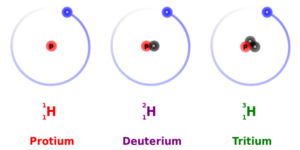
Source: Wikipedia
Only about 0.0150% (on average) of hydrogen atoms on Earth occur as deuterium, and so our normal water will have tiny amounts of D2O (heavy water) and HDO (semi-heavy water) mixed into the common H2O. Heavy water is also produced industrially and militarily for use in nuclear reactors and nuclear weapons, which may contribute to an increase of D2O in the environment.
Heavy water looks and tastes the same as normal water, so on a macroscale its presence in drinking water and daily water intake goes unnoticed. But on the nanoscale of the fine-tuned biochemical and biophysical processes in our cells, even minute amounts of deuterium can change the balance.
Hydrogen bonding, for example, which is critical in cell division and numerous protein formations, can be destabilized or over-stabilized. Considering the enormous importance of biological water and its ordered structure in all biochemical processes, heavy water is in fact toxic to almost all organisms. It has been shown that D2O interferes with DNA replication and DNA repair, it can alter the shape of molecules and change enzyme function, and it can “clog” the proton channels of cellular membranes and disrupt the ATP production by the mitochondria.
Water and ATP
Source: Wikipedia
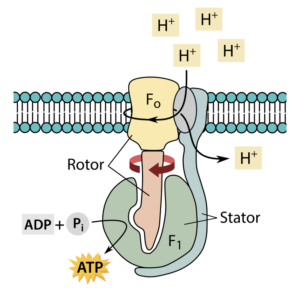
ATP is created in the mitochondria of our cells, a process which produces some 300g of endogenous metabolic water. (Yes, the body makes its own water!) The effect of deuterium on ATP synthase—the enzyme complex that catalyzes ATP production—is a critical area of study.1
ATP synthase works like a little nano-motor, rotating up to 100,000 times per minute and transferring protons from the inner membrane of the mitochondria into the mitochondrial matrix where the protons interact with oxygen. Some 1,500 protons per second are transported across the membrane by these spinning nano-motors, which makes it obvious that the much heavier deuterium can cause damage and sputtering in the engines. Cells that cannot produce ATP by their mitochondrial function turn to glycolysis, an anaerobic process of energy production from glucose by means of fermentation. ATP production by glycolysis is a much less adept mechanism that quickly leads to excess lactic acid in the cells and thus facilitates tumor growth (known as the Warburg effect2). At the same time, the nutrients we take in are no longer fully processed and metabolized by the highly efficient ATP process and are deposited instead in excess body fat.3
Effects on the Brain
Increased levels of deuterium in the water we drink have been shown to be related to depression and imbalance of serotonin levels, one of the key neurotransmitters used by the pineal gland. Researchers in the U.S. were able to correlate the geographical distribution of deuterium with the rate of depression.4 In addition, it has been shown that after stress, the adult neurogenesis (growth of new neurons) of the hippocampus can be rescued by deuterium-depleted water.5 Currently, the European Union is funding a research project, “Aqua-Synapse,” that is looking at the positive health effects of deuterium-depleted water.6
Sources of Deuterium-Depleted Water
Deuterium was only discovered in 1931, yet by 1960 Russian scientists had carried out extensive studies about its effects on living organisms. Very soon it became clear that heavy water rich in deuterium was detrimental to health.
When heavy water is created for use in uranium reactors, a side product of the process is “ultralight water,” water depleted of deuterium. Russian institutions used the leftover deuterium-depleted water for cancer research and to gain new insights into the metabolic water cycle.7,8 Today, with the growing recognition of the detrimental effect of heavy water in the body’s metabolism, deuterium-depleted water has become a sought-after product. The original research and patented production method comes out of East Europe (Hungary and Romania) and Russia. However, the method to produce deuterium-depleted water for drinking is still a complex and costly procedure, which makes these waters rather pricey.
Russian space research has recognized the extraordinary health benefits of deuterium-depleted water as a protection from radiation effects of cosmic ray bombardment that space crews experience outside of the Earth’s atmosphere. Portable drinking water generators for deuterium-depleted water have been suggested for longer space journeys.9
Naturally Deuterium-Depleted Water
“Cold water is merciless, but righteous.”
~ Wim Hof
Due to the chemical and physical properties of deuterium, naturally occurring “deuterium-depleted water,” that is, water with less than 140ppm of deuterium, can be found in spring water at high altitudes and in cold climates far from the equator. For example, glacial water, water from melted ice in Antarctica, or water from high mountain areas contains less deuterium than average drinking water. This could be one explanation for the beneficial effects of the famous Hunza water from a remote Karakoram mountain valley in Northern Pakistan.

Links about Deuterium and Deuterium-Depleted Water
Disclaimer: Solari has no special affiliation with or recommendation for any particular vendor of deuterium-depleted water.
- Professor László G. Boros (homepage)
- Dancing with Water (M.J. Pangman and Melanie Evans)
- Deuterium Depletion: The Most Powerful Health Hack You’ve Never Heard Of #165 (Luke Storey, Life Stylist Podcast on YouTube)
Footnotes
- Olgun A. Biological effects of deuteronation: ATP synthase as an example. Theor Biol Med Model. 2007;4:9. doi: 10.1186/1742-4682-4-9 ↩︎
- See Warburg Effect (Wikipedia) ↩︎
- Deshcherevskaya NP, Deshcherevskaya N. Two sources for the endogenous water and their possible role in the fat metabolism in the human organism. ResearchGate, May 2014. Full text available. ↩︎
- Strekalova T, Evans M, Chernopiatko A, Couch Y, Costa-Nunes J, Cespuglio R, Chesson L, Vignisse J, Steinbusch HW, Anthony DC, Pomytkin I, Lesch K-P. Deuterium content of water increases depression susceptibility: the potential role of a serotonin-related mechanism. Behav Brain Res. 2015;277:237-244. doi: 10.1016/j.bbr.2014.07.039 ↩︎
- Ibid. ↩︎
- Aqua-Synapse: The health benefits of deuterium depletion on synaptic function, regional metabolism, and behaviour. European Commission, Jan. 1 2023 – Dec. 31, 2026. https://cordis.europa.eu/project/id/101086453 ↩︎
- Destination: Romania/Valcea – Research in chemistry and physics, pomology and viticulture national vector. Agerpres, Aug. 14, 2014. https://www.agerpres.ro/engleza-destinatie-romania/2014/08/14/destination-romania-valcea-research-in-chemistry-and-physics-pomology-and-viticulture-national-vector-11-46-44 ↩︎
- Sagalovsky V. A brief history of deuterium depleted water. Foundation for Alternative and Integrative Medicine, Jul. 31, 2019. https://www.faim.org/a-brief-history-of-deuterium-depleted-water ↩︎
- Sinyak Y, Grigoriev A, Gaydadimov V, et al. Deuterium-free water (1H2O) in complex life-support systems of long-term space missions. Acta Astronaut. 2003;52(7):575-580. doi: 10.1016/s0094-5765(02)00013-9 ↩︎