


















































































IV. Water with a Mind of Its Own
“You will always find an answer in the sound of water.”
~ Zhuangzi
Water is full of mystery. It has its own will and spirit. Somehow, water also has its own laws and does not compliantly obey the established laws of physics. Science may have discovered and found explanations for some of its secrets, but all too often these discoveries lead to a new mystery that water guards.
That water has memory—or, as I believe, even consciousness—is by now irrefutable; too many and repeated are the experiments and results that prove water’s capacity to hold and convey information. The universe is alive and conscious, and water is one of its prime witnesses.
Nobel laureate Luc Montagnier provided the most dramatic and consequential proof of an information storage capacity in water. Dr. Jacques Benveniste had been the first, in 1988, to propose that water has memory,1 and Montagnier was fascinated by the idea.
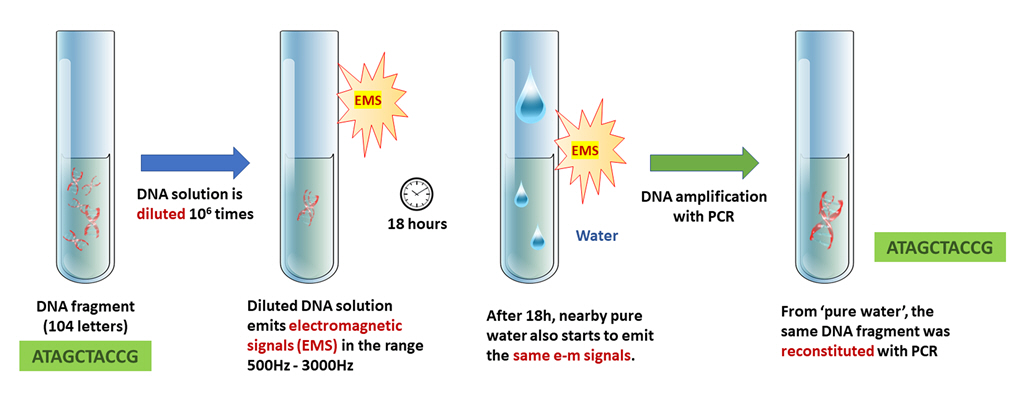
Montagnier’s work with water and the electromagnetic signals emitted from DNA was ridiculed at Western universities; instead, he was welcomed to continue his experiments in China. In one of the experiments, a bacterial DNA sequence was placed in a test tube next to a second test tube containing pure water. Both were exposed to a coil generating an extremely low frequency (ELF) field in the range of 7-8 Hz (the Schumann resonance). After several hours, a polymerase chain reaction (PCR) that was carried out on the pure water was able to reconstitute the DNA; the polymerase enzyme built the replica seemingly from nothing.2 Was the water able to store a memory of the genetic information in its own structure?
Source: Ulrike Granögger
“What We Know Is a Drop…”
Dr. Bernd-Helmut Kröplin (1944–2019) was a distinguished professor for Astronautics and Aerospace Engineering at the University of Stuttgart. During the Cold War period, he was designing rockets and satellites, and observed that when Russian cosmonauts came back from space trips, they did not seem to be affected by cosmic radiation as much as their Western spacefaring counterparts.
Knowing that the human body is made up of 70% water in terms of body weight, Prof. Kröplin became interested in water as a soft material with “shape memory.” The discoveries made by Kröplin and his assistant Regine Henschel about water’s memory are extraordinary.3
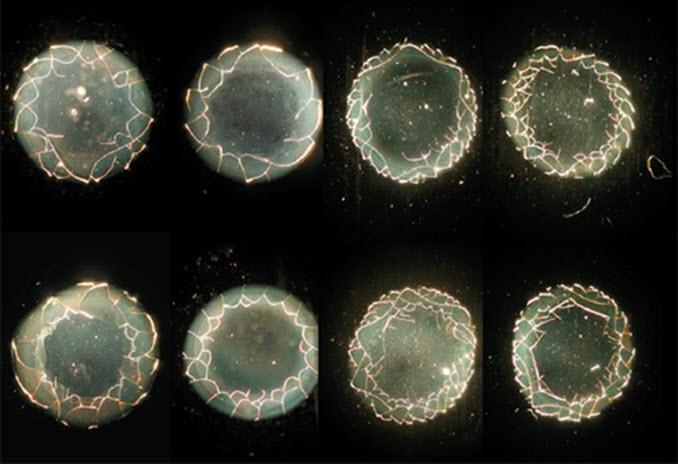
The team analyzed the patterns that appear in water after evaporation, placing several drops of a water sample onto a microscope slide and photographing them under a dark field microscope (magnification 40 to 400). On the one hand, they found, each water sample showed very typical patterns that literally made the water identifiable. Water taken from the same source on different days dried in a recognizably similar shape. On the other hand, they showed that objects placed into the water before evaporation, or radiation of the water by electromagnetic frequencies or acoustic waves, created recognizable changes in the water’s signature.
Here, you can see drops of water into which an herb (myrrh) had been placed. Each drop has a similar outer ring structure.
Source: Regine Henschel, World in a Drop, used with kind permission
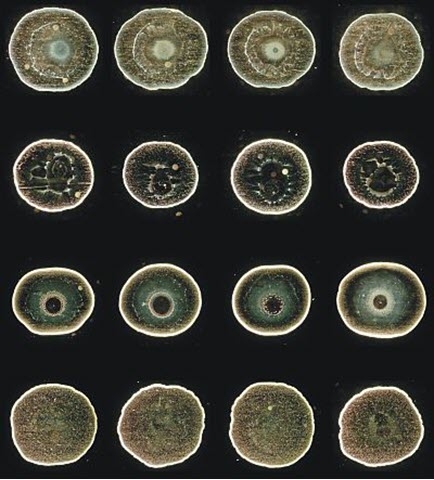
Most astonishing was the fact that the water seemed to memorize who handled it. When different individuals held vials of water from the same spring in their hand, each drop showed a signature of the person who held it. Below are images of water drops from the same source handled by different individuals (each row of four drops was handled by a different person). The comparison shows that the pictures of the drops placed by one-and-the-same test individual resemble each other clearly in structure and color, while the pictures of varying test subjects differ greatly. It can be concluded that the test subject substantially influences the respective structures within the drops.
Source: Regine Henschel, World in a Drop, used with kind permission
Liquid Crystal Language
The results from the Stuttgart laboratory are similar to the work of Veda Austin,4 who shows that water can “talk” in images, responding intelligently—and even with humor—to photographs, objects, words, and human thought. Water literally uses “pictographic communication” to convey its message to the human beholder who is patient and attentive enough to watch its response form in ice.
Austin, a water researcher and crystallographer from New Zealand, first noticed the phenomenon of water’s communication abilities when she projected the thought of her hand onto a petri dish of water and then let the water freeze. Upon examination of the structure of the earliest phase of ice crystals forming on the dish, the unmistakable architecture of a hand was visible.
Since that first experience, Austin has gone about systematically recording thousands of photos of water’s unambiguous responses to thoughts, photos, music, or other objects with which it is put in touch. The responses are mind-blowingly precise, and sometimes will even include words written as the shapes of letters forming in the ice.
It seems like water can pictographically manifest anything it has experienced before. Water may literally be a globe-sized liquid computer with a memory storage capacity going back (and forward) billions of years.
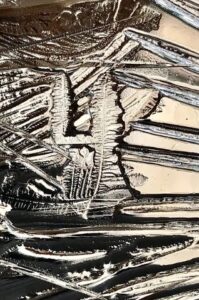
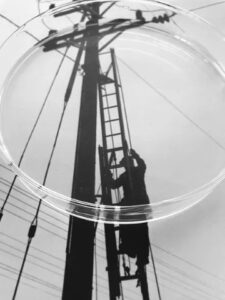
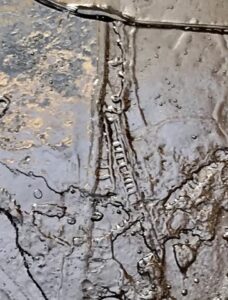

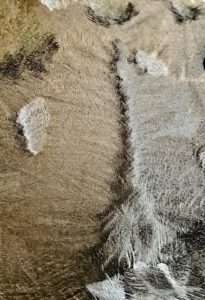
Water’s communication abilities: three examples – Source: Veda Austin
“Waterformatics”
The work of the late Prof. Eshel Ben-Jacob (1952–2015) is of the utmost significance, and we have to go a bit further afield to put it into context.
Ben-Jacob was a highly decorated scientist who made several breakthroughs in physics and complex systems. In addition to his tenure at Tel Aviv University and service as the president of the Israel Physical Society and advisor to Israel’s Ministry of Education, he also worked as a senior researcher at the Center for Theoretical Biological Physics at Rice University. Among the awards he received for outstanding scientific contributions were the Landau Prize in 1986, the Siegle Prize of the Israel Academy of Sciences and Humanities in 1996, and the Weizmann Prize in Exact Sciences in 2013. In 2014, he was also elected to the American Philosophical Society.
Like most water researchers, Ben-Jacob did not start out with an interest in water. In his studies of the physics of living systems, and in particular the self-organization of bacterial colonies, he discovered that bacteria use a chemical language for distributed information processing and decision-making.5 Colonies of bacteria act like a brain network or swarm intelligence, without themselves carrying a single neuron. Each colony is actually a multicellular superorganism with its own self-identity.6
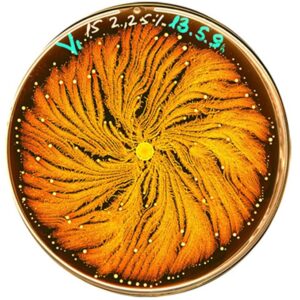
There are more bacteria on this petri dish than people on planet Earth. Source: Wikipedia
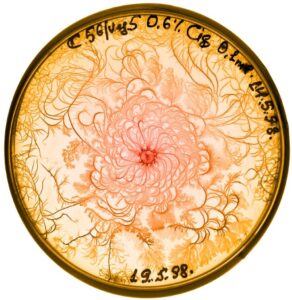
Source: Eshel Ben-Jacob
The research on bacteria ultimately led Ben-Jacob to start work in brain research and the development of a neural memory chip. Ben-Jacob and his doctoral student Itay Baruchi showed for the first time that it is possible to “recharge” some simple memories in a culture of brain nerves in a dish. The researchers created a prototype of a neural chip built from networks of living cells connected to a computer.7,8 For this work, Ben-Jacob received the Scientific American Award for the 50 most important achievements in all fields of science and technology in 2007.
Of course, today we know that there is a direct link between the bacteria in our bodies and the functioning and well-being of the brain—the gut-brain axis that works via the vagus nerve and gut neurons. We have multiple times more bacteria in our bodies than “human” cells, and there are some 40,000 different bacterial strains, each with billions of members. All of our mitochondria—the “power plants” of the cells—are original bacteria that have come into eucaryotic symbiosis.
Prof. Ben-Jacob’s research helped show that bacteria are far from primitive but live off a shared intelligence and can learn from collective experience. When Ben-Jacob introduced artificial conditions (such as changes in temperature, altered availability of nutrients, or the presence of poisons) into bacterial colonies on petri dishes, he could watch the colonies take different spatial pathways of growth. In short, bacteria employ strategies of collective survival and growth based on chemical intercommunication.9,10
So, what is the connection to water?
One of the “conditions” that Ben-Jacob changed for the bacteria to proliferate on an agar food substrate was the water. When he used water that had first been treated with low-intensity electromagnetic waves, the growth dynamics of the bacteria changed considerably. The bacteria in the petri dish literally became the measuring device or biosensors for the information content of the water.
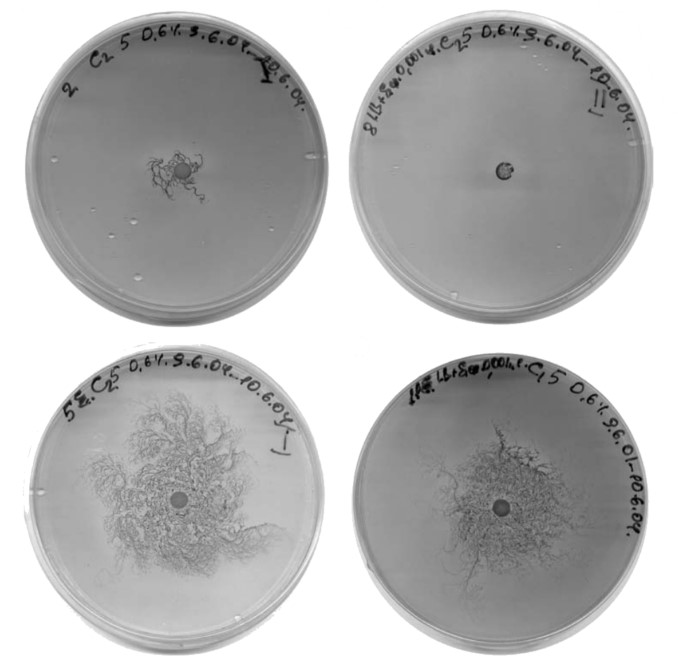
Source: Eshel Ben-Jacob11
After the water was radiated, it was kept alone for about three hours before the bacteria were added and allowed to grow overnight. This was done to effectively exclude any physical presence of radiation in the water, which would have dissipated long before. Yet the colonies in the electromagnetically treated water showed much higher growth rates as well as a reversed chirality in the direction of their growth, as compared to the control population in untreated, distilled water.
Based on years of theoretical and experimental studies of self-organization in living systems (bacteria colonies) and nonliving systems (snowflake formation and electrochemical deposition),12 Ben-Jacob concluded that water actively interacts with cellular processes. Bacteria respond to treated water in a way that reflects the possibility that water can store biologically relevant information.
Using the bacteria as biosensors also showed that water treated by very weak radiofrequency (RF) radiation induces long-range order in the water in which information can be stored (see “Structured Water Communication in the Biological Cell” in Section III). The bacteria react with acute sensitivity to the presence of electromagnetic radiation. Such extremely weak radiofrequencies also occur innately in the biology of the cell.
In short, for Eshel Ben-Jacob, phenomena like “water order,” “water memory,” and “water information” were real—not artifacts or mysticism—which calls for a complete rethinking of water and its power. Ben-Jacob died prematurely and unexpectedly on June 5, 2015 at the age of 63.
Footnotes
- Davenas E, Beauvais F, Amara J, … Benveniste J, et al. Human basophil degranulation triggered by very dilute antiserum against IgE. Nature. 1988;333(6176):816-818. doi: 10.1038/333816a0 ↩︎
- Montagnier L, Del Giudice E, Aïssa J, et al. Transduction of DNA information through water and electromagnetic waves. Electromagn Biol Med. 2015;34(2):106-112. doi: 10.3109/15368378.2015.1036072. Full text available at Researchgate.net. ↩︎
- The World in a Drop: The ability of water functioning as memory and mirror. ↩︎
- www.vedaaustin.com ↩︎
- Learning from Bacteria about Social Networks. Google TechTalk, Sep. 30, 2011. https://youtu.be/yJpi8SnFXHs ↩︎
- See also the 2016 documentary, In Search of Balance: The Human Microbiome. Gravitas Ventures. Ken Lee (producer) and Adam Pfleghaar (director and cinematographer). https://youtu.be/6FNIJwgXIgQ?t=2858 ↩︎
- Baruchi I, Ben-Jacob E. Towards neuro-memory-chip: imprinting multiple memories in cultured neural networks. Phys Rev E Stat Nonlin Soft Matter Phys. 2007;75(5 Pt 1):050901. doi: 10.1103/PhysRevE.75.050901 ↩︎
- Swaminathan N. A step toward a living, learning memory chip. Scientific American, Jun. 6, 2007. https://www.scientificamerican.com/article/step-toward-neuro-memory-chip/ ↩︎
- Finkelshtein A, Roth D, Ben Jacob E, Ingham CJ. Bacterial swarms recruit cargo bacteria to pave the way in toxic environments. mBio. 2015;6(3):e00074-15. doi: 10.1128/mBio.00074-15 ↩︎
- Gambino M. Colonies of growing bacteria make psychedelic art. Smithsonian Magazine, Aug. 2, 2013. https://www.smithsonianmag.com/science-nature/colonies-of-growing-bacteria-make-psychedelic-art-22351157/ ↩︎
- Jacob EB, Aharonov Y, Shapira Y. Bacteria harnessing complexity. Biofilms. 2004;1(4):239-263. https://doi.org/10.1017/s1479050505001596 ↩︎
- Katsir Y, Miller L, Aharonov Y, Ben Jacob E. The effect of rf-irradiation on electrochemical deposition and its stabilization by nanoparticle doping. J Electrochem Soc. 2007;154(4):D249-D259. Doi: 10.1149/1.2437055. Full text available as PDF. ↩︎