



































































































V. Liquid Crystalline Water
“Many are searching for a wonder drug of the 21st century…. It could be water!”
~ Prof. Gerald Pollack
We all know that our body volume is made up of some 70% of water. But if we look at the number of molecules that compose the body, we actually consist of 99% water because the H2O is so small. Most of cell biology does not ascribe specific function to 99% of our molecules!
The classic view of water in cells is that it has more or less the same structure as pure water, with proteins and filaments (that define the skeleton or shape of the cell) swimming around in this aqueous solution. Clearly, though, our organisms are not “walking water bags” with macromolecules in random motion.
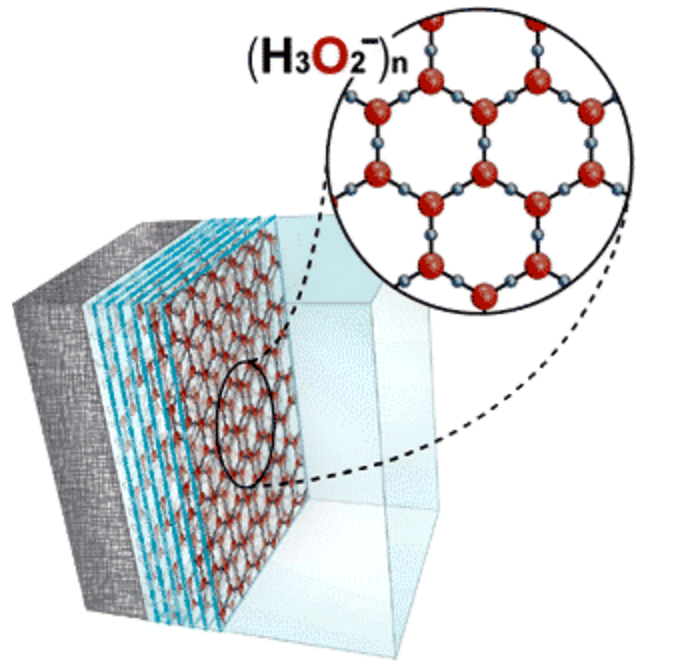
One of the capital lessons derived from the Wave Genome is that biological processes are field-like, highly ordered, and based on ultrafast communication. The molecules oscillate in coherence like a wave (soliton). This is in large part due to a surprisingly ordered state of the cellular water, which provides both the energy as well as the lattice structure for the information waves to “travel.” The water in the cell is found to be in the state of a liquid-crystal hexagonal gel that forms at the many tiny interfaces of cellular membranes.1
Ordered Cellular Water
Exactly this is the discovery of Dr. Gerald H. Pollack, professor of Bioengineering at the University of Washington, who has discovered a completely new form of water—dubbed the “fourth phase of water”—consisting of polarized and ordered layers of water molecules with special properties.
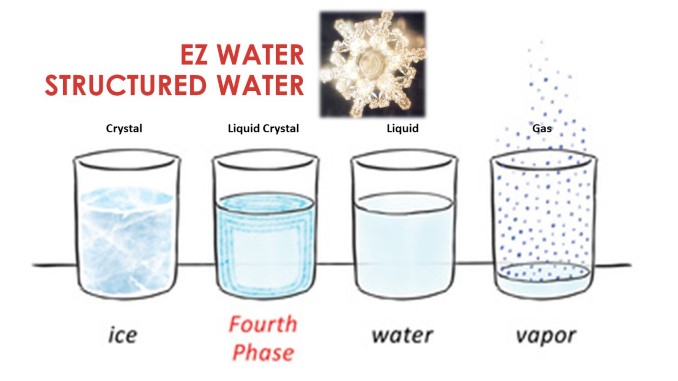
Source: Based on Gerald Pollack
For example, this ordered biological water is negatively charged and lends its negative charge to the cell itself. It has a gel-like viscosity and altered electrical resistance compared to normal water, and it has an alkaline pH. Healthy cells function in the alkaline range, whereas diseased cells (such as cancer cells) are predominantly acidic.2
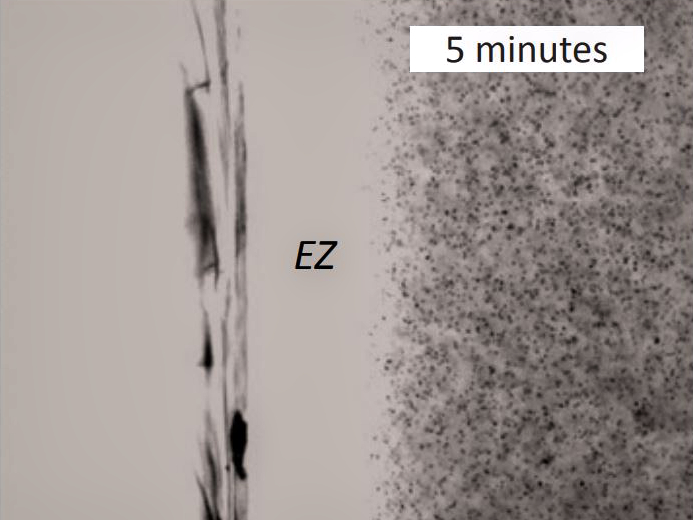
The liquid crystalline state of water in the living cell is self-organizing and thus self-purifying and filtering. Dr. Pollack calls the biological water “EZ water” because an exclusion zone (EZ) is formed in which impurities in the water are displaced.
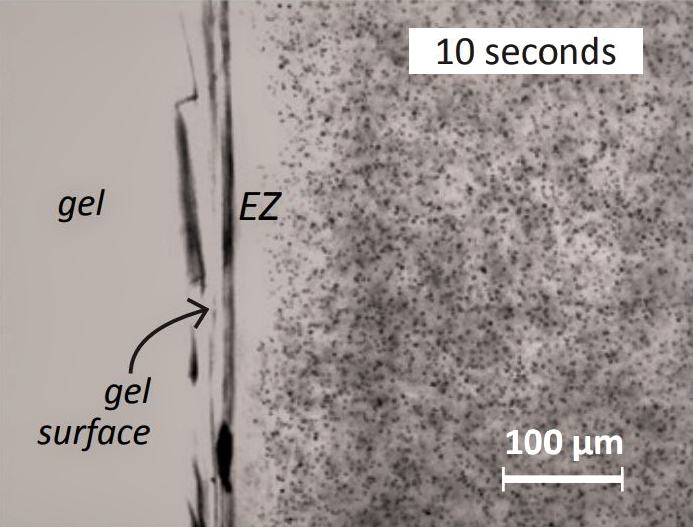
(EZ) next to a gel surface.
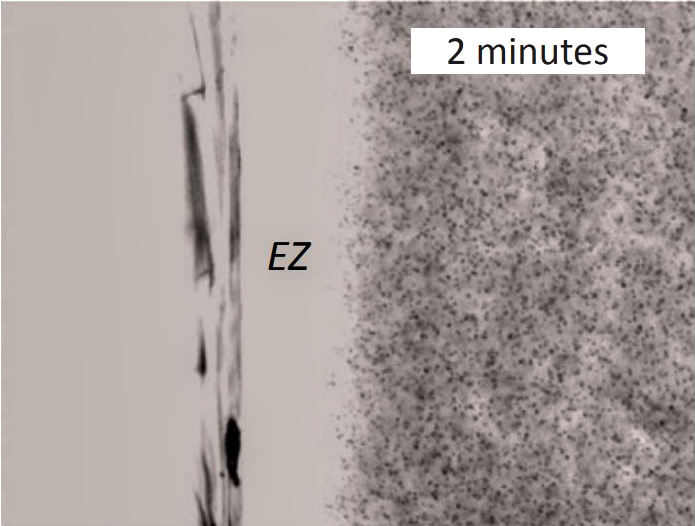
relatively stable after about 5 minutes.
The Fourth Phase of Water Bonus PDF.
The energy that builds this charged zone of ordered water is derived from light, including ordinary sunlight, but also light radiation from inside the cell in the form of biophotons. (Biophotons are the cell’s own emissions of coherent light.) With the charged zone, a battery effect is established where current flows from the charge separation.
Through the use of special mirrors, German energy healer and biophoton researcher Renzo Celani was able to expand on the experiments from the Pollack Lab and, in 2017, created two exclusion zones in the same water sample,3 which had not been seen before.
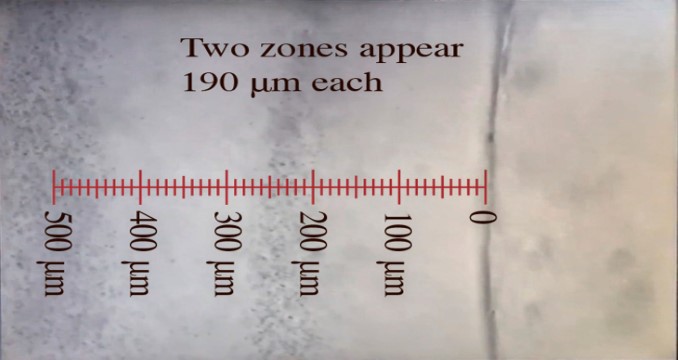
Source: Renzo Celani4
It is generally assumed that the biological energy for the organism is chemically stored in the ATP (adenosine triphosphate) molecule. However, some of its energy may be present in the exclusion zone due to biophoton energy and the battery effect of the structured water. The electrical potential of a healthy cell is almost -100 mV (millivolts). Diseased cells have a much lower potential (only -10 mV) and significantly less order in their cytoplasmic water.
Electrified Water and Coherence
Source: Elmar C. Fuchs
Water exhibits remarkable and as yet unexplained properties when it is electrically charged. Experiments by Elmar Fuchs and Jakob Woisetschläger at the University of Graz have shown, for example, that electrified water can connect as a floating water bridge over the edge of two glass containers.5
Similar effects may also be at work within the cell. If we look for the liquid crystalline zones along the membrane surfaces, then we are not only looking at the actual cell walls or the membrane between cytoplasm and nucleus; such hydrophilic interfaces are also located in many other areas within the tiny dimensions of the cell. (For more education on this watch Prof. Pollack explain in this video presentation.)
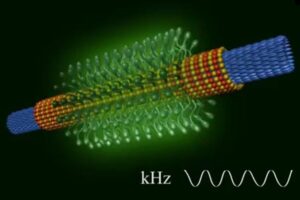
A microscopic layer of purified, liquid crystalline water envelops every macromolecule and forms around and within the mitochondria, the nucleus, along the entire cytoskeleton that is formed by numerous microtubules, and even within the microtubules themselves. Microtubules are small hollow protein nanotubes along which the intercellular transport of vesicles and transmitter substances takes place.
the edges of microtubules
Source: Anirban Bandyopadhyay
(Click for YouTube video)
Coherence states of both electromagnetic and acoustic oscillations arise in the miniscule cavities of the interior of the microtubules and also along their outer surfaces.6 Such standing waves of coherent (acoustic) excitations inside the confined cellular spaces were predicted by German physicist Herbert Fröhlich.7 If we consider how many of these vibrating tubes are present in the cell, it is not difficult to understand their ability to order the liquid-crystalline, gel-viscous biowater.
One of the most important discoveries in the context of coherence excitations in biology are the observations of Anirban Bandyopadhyay, a researcher at the National Institute for Materials Science in Japan, who demonstrated coherent microtubular oscillations in no less than three frequency bands.8 This means that the tiny nanotubes that structure the cell and ensure the transport of substances through the cells communicate in kilohertz, megahertz, and gigahertz frequencies.
The discovery of the fourth phase of water will turn out to be one of the most intriguing scientific discoveries of the 20th century and promises to lead to a profound rethinking of how biology works.9
Professor Gerald H. Pollack
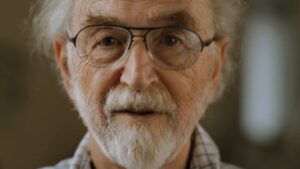
Prof. Gerald Pollack belongs to that group of innovative thinkers who have the capacity to change a whole scientific paradigm. His discovery of the “fourth state of water”—also termed “EZ (exclusion zone) water” and “interfacial water”—has done just that. The biochemistry and microbiology of the cell will never be the same.
Certainly, Pollack is not the first and only scientist to look at the role of structured water in biological action; others like Gilbert Ling, Alfred Szent-Györgyi, Mae-Wan Ho—and, over 100 years ago, the biologist William Bate Hardy—already had suggested that water molecules at interfaces form in liquid crystalline layers. But it is the meticulous execution of experiments and the professional expertise of Dr. Pollack and his team that led to the breakthrough publication of cellular water forming a liquid crystal lattice. The results are irrefutable and have been documented repeatedly, regardless of the offhand dismissal by some members of the scientific establishment.
In 2008, the University of Washington, where Pollack maintains a research lab, conferred the highest distinction it could give to its own faculty, the Annual Faculty Lecturer Award, for his research on water. Other awards include the prestigious Prigogine Medal for Thermodynamics in 2012 and an Honorary Professorship of the Russian Academy of Science in 2005, to name but a few of many.
Pollack’s three most important books have all won distinguished and excellence awards. In his 1990 book, Muscles and Molecules: Uncovering the Principles of Biological Motion,10 Pollack describes the mechanism by which muscles contract and relax, which was already based on the recognition that cellular water plays a role. This led to the 2001 publication, Cells, Gels and the Engines of Life: A New Approach to Cell Function,11 which details the role of cell water and the gel-like state of the cytoplasm. The research culminated in 2013 with the publication of The Fourth Phase of Water: Beyond Solid, Liquid, and Vapor,12 in which Dr. Pollack describes how water is not always H2O but also occurs in a fourth phase of structured water with a chemical formula of H3O2.
Since 2005, Pollack has organized and chairs an annual Conference on the Physics, Chemistry and Biology of Water that brings together the latest insights from water researchers worldwide; exceptional scientists such as V.L. Voeikov and the late Prof. Luc Montagnier have been among the event’s regular contributors. Pollack is also the founding editor-in-chief of the scientific journal Water and the initiator of the Institute for Venture Science, an affiliation of researchers exploring new scientific ideas that are not funded or that challenge existing paradigms.
For too long, biochemistry has left water out of the molecular equation. Prof. Pollack’s visionary thinking, coupled with painstaking experimental work and a profound understanding of the simplicity of nature, has brought it back. The science of the future will ultimately recognize that fact.
Footnotes
- Messori C. The super-coherent state of biological water. Open Access Library Journal. 2019;6:e5236. Available as PDF: https://doi.org/10.4236/oalib.1105236 ↩︎
- Mojica KT, Miranda Massari JR, Rodriguez JR, et al. Structured water and cancer: orthomolecular hydration therapy. Journal of Cancer Research Updates. 2023;12:5-9. https://neoplasiaresearch.com/pms/index.php/jcru/article/view/714/708 ↩︎
- Personal communication of preliminary results and photographs. ↩︎
- https://www.biophoton-realignment-mirror.com/en/the-mirrors/ ↩︎
- Fuchs EC, Sammer M, Wexler AD, et al. A floating water bridge produces water with excess charge. J Phys D Appl Phys. 2016;49(12):125502. doi: 10.1088/0022-3727/49/12/125502 ↩︎
- Blank M, Goodman R. DNA is a fractal antenna in electromagnetic fields. Int J Radiat Biol. 2011;87(4):409-415. doi: 10.3109/09553002.2011.538130 ↩︎
- Fröhlich H. Long‐range coherence and energy storage in biological systems. Int J Quantum Chem. 1968;2(5):641-649. doi: 10.1002/qua.560020505 ↩︎
- Bandyopadhyay A. Biological information processing in single microtubules. February 2012. https://www.researchgate.net/publication/277811630_Biological_Information_Processing_in_Single_Microtubules ↩︎
- Ho M-W. New age of water: liquid-crystalline water at the interface. Science in Society Archive, first published Mar. 31, 2008. https://www.i-sis.org.uk/liquidCrystallineWater.php ↩︎
- Pollack GH. Muscles and Molecules: Uncovering the Principles of Biological Motion. Ebner and Sons Publishers, 1990. ↩︎
- Pollack GH. Cells, Gels and the Engines of Life: A New Unifying Approach to Cell Function. Ebner and Sons Publishers, 2001. ↩︎
- Pollack GH. The Fourth Phase of Water: Beyond Solid, Liquid, and Vapor. Ebner and Sons Publishers, 2013. ↩︎