





























































































The Electric Universe: Big Bang or Plasma Cosmology?
“Einstein in his special theory of relativity postulated there was no medium, called the ‘aether.’ But Maxwell’s theory of electromagnetism requires it. And Sir Oliver Lodge saw the aether as crucial to our understanding. So Einstein, at a stroke, removed any possibility that he, or his followers, would find a link between electro-magnetism and gravity. It served the egos of his followers to consecrate Einstein’s ideas and treat dissent as blasphemy.” ~ Wal Thornhill1
by Ulrike Granögger
There is a crisis at the heart of modern cosmology, and it is not a small one. In standard cosmology—which has put forth the Big Bang Theory, also called the ΛCDM (Lambda Cold Dark Matter) model—95% of the universe is composed of entities that have never been seen, measured, detected, or produced in any laboratory: dark matter (accounting for roughly 27% of the universe’s total mass-energy content) and dark energy (accounting for approximately 68% more). Ordinary observable matter—stars, galaxies, gas clouds, planets, and everything we have ever touched or studied—constitutes a mere 5% of the Big Bang model.
Let that sink in. The most celebrated and institutionally dominant scientific theory in history cannot account for 95% of its own subject matter. In any other field of inquiry, this would be recognized as a crisis of staggering proportions. In mainstream cosmology, it is presented as a triumph: evidence of how far our mathematical models have advanced beyond what the human eye can perceive.
Even though one hardly hears about it in mainstream publications, there is an alternative to the standard cosmological model, and it is not even new, nor fringe in its physics. Moreover, it has very distinguished scientific champions. I am referring, of course, to plasma cosmology2 and its extended version, the Electric Universe Theory.3 4 These theories offer a framework grounded in observable and reproducible physics that can be tested in a laboratory and that does not require invisible matter, mysterious repulsive energy, mathematical singularities, and violations of known physical law. It is time for the electric universe to be recognized.
A Serious Alternative
Any serious alternative to the Big Bang Theory must begin with what is actually there—and what is actually there, beyond any scientific dispute, is plasma. Plasma is neither exotic nor theoretical. It constitutes over 99.9% of all visible matter in the observable universe. Every star, every galactic jet, every nebula, and the entire interplanetary and interstellar medium are plasma. The universe, in the most literal physical sense, is a plasma universe.
Where plasma exists, electric currents flow. Where electric currents flow, magnetic fields form. Where magnetic fields and currents interact, electromagnetic forces arise. Electromagnetism is 1036 times stronger than gravity and is the dominant power in the whole cosmos. In a universe constituted almost entirely of an electrically conducting medium (plasma), enormous electric currents flow. And it is those currents, not the feeble tug of gravity acting on invisible matter, that organize the structures we observe in the cosmos.
This is not speculation. The scientific legitimacy of plasma cosmology rests on foundations that are difficult to dismiss. They were actually laid by one of the most decorated physicists of the 20th century: Hannes Alfvén (see Biographies). Alfvén, who received the Nobel Prize in Physics in 1970 for his work on magnetohydrodynamics and plasma physics, spent much of his career arguing that electromagnetic forces play a decisive and largely overlooked role in shaping creation.
Abstract mathematics and theorists who built elaborate computer models of cosmic phenomena (but never reproduced them on smaller scales) have come to dominate astronomy. In his 1970 Nobel Prize acceptance speech,5 Alfvén warned that current cosmological models will fail if they continue to ignore experimental plasma science and the role of electric currents in space. In the decades after Alfvén’s warning, astronomy “invented” dark matter, dark energy, cosmic inflation, and a panoply of untestable theoretical constructs simply to maintain the myth of gravitation as the primary structure-building force in the universe.
Earlier, as mentioned in What Is Plasma?, Norwegian physicist Kristian Birkeland (see Biographies) had proposed that the aurorae observed at the Earth’s poles were powered by charged particles streaming from the Sun. It was not until decades later, when the satellites of the early space age detected the very electric currents that Birkeland had predicted, that scientists accepted his idea. NASA’s THEMIS spacecraft later imaged vast magnetic ropes stretching continuously from Earth to the Sun.
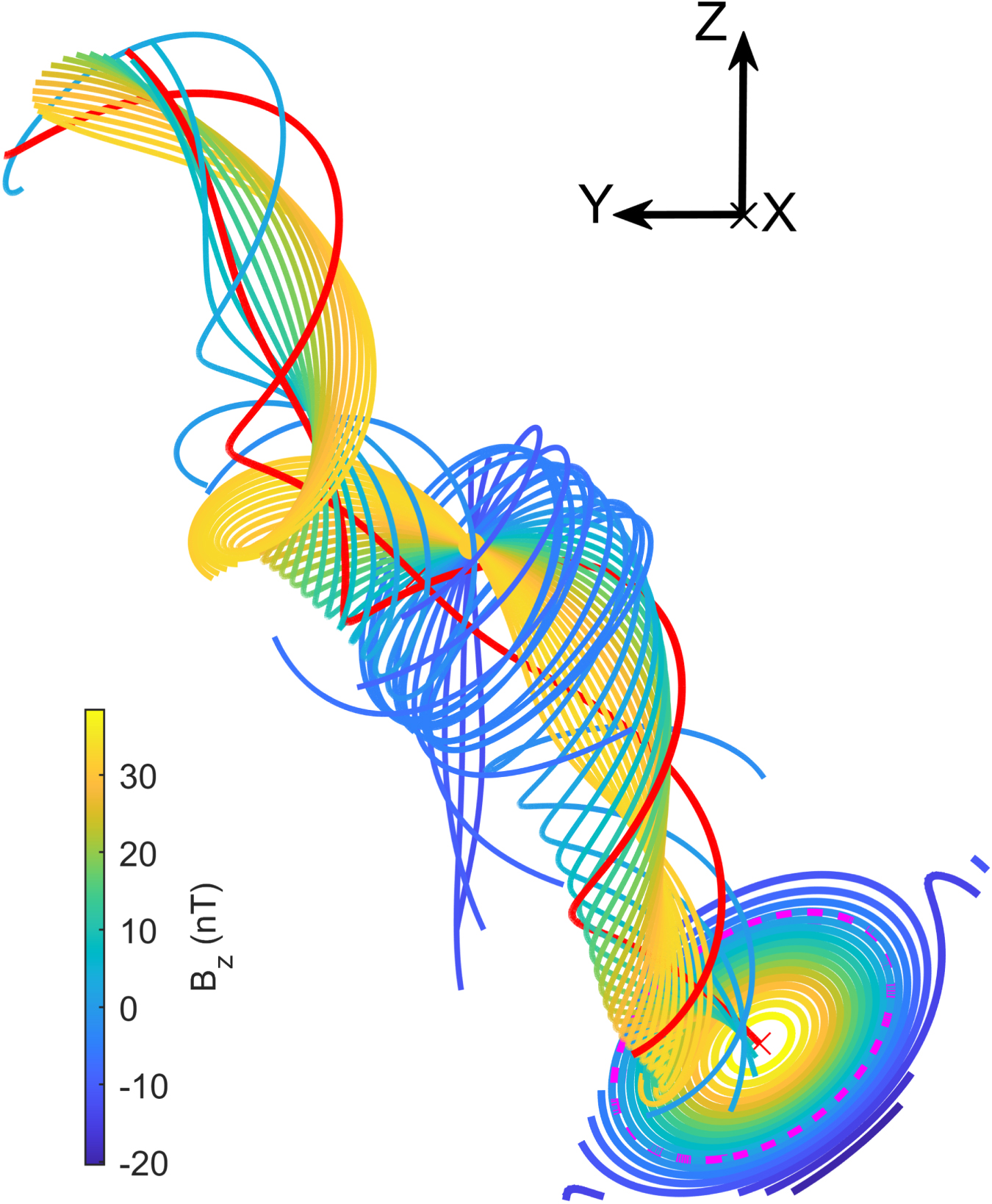
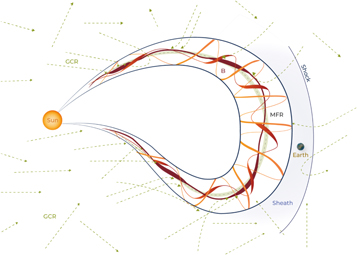
In other words, space is electrically connected. Earth is not an isolated body floating in a neutral vacuum; it is a charged planet embedded in a complex electrical environment maintained by the Sun, and the Sun itself is embedded in a galactic electrical environment.
Galactic Structure
One of the most visually striking and scientifically concrete achievements of plasma cosmology is the explanation of galactic structure. The great spiral galaxies that populate the universe, including our own Milky Way, present mainstream cosmology with a persistent and embarrassing problem: their rotation curves are wrong. Stars in the outer regions of spiral galaxies orbit the galactic center at roughly the same speed as stars that lie closer in, but according to Newtonian dynamics, they should slow down the further out they are. The response of Big Bang cosmology has been to postulate enormous invisible halos of dark matter surrounding every galaxy hypothesized to provide the additional gravitational pull to explain the observed rotation speeds. Yet, to this day, dark matter has never been detected. Not once, in any form, by any instrument. It remains a theoretical fabrication.
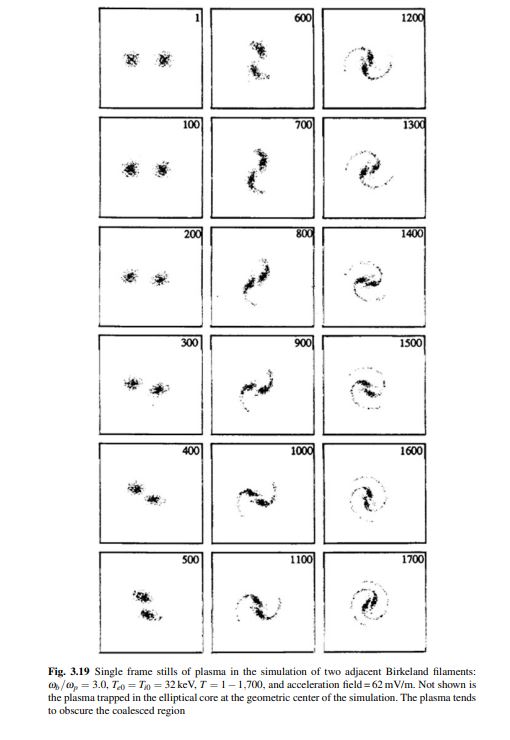
In contrast, Anthony Peratt (see Biographies), a plasma physicist at Los Alamos National Laboratory and a former collaborator of Alfvén, demonstrated through computer simulations that the rotation curves of galaxies are fully and naturally explained by the electromagnetic interaction of Birkeland current filaments.8 No dark matter is required. The previously mentioned Z-pinch effect—the tendency of parallel electric currents to attract each other and compress—naturally produces all the observations around active galaxies, without a single gram of invisible matter needed.
Peratt’s simulations of two interacting plasma filaments reproduced the spiral arm morphology of observed galaxies with a fidelity that gravitational models, even with arbitrarily placed dark matter, struggle to match.9
More Examples
Another difficulty for the standard cosmological model came in 1998, when observations of distant Type Ia supernovae appeared to show that the universe’s expansion is accelerating.11 Some unknown force seems to be pushing galaxies apart at an ever-increasing rate. The standard model responded by resurrecting Einstein’s forgotten cosmological constant and naming it dark energy. This mysterious energy, with no physical explanation, no laboratory analogue, and no direct detection, now constitutes 68% of the universe in the ΛCDM model.
Plasma cosmology offers a far simpler and more physically grounded explanation of the same observations. “Plasma redshift,” a concept developed by Ari Brynjolfsson, Alton Arp and Eric Lerner,12 explains that photons lose energy as they traverse the tenuous plasma of intergalactic space and interact with free electrons. Over cosmological distances, this energy loss produces a redshift that mimics an accelerating expansion. In other words, the distant supernovae observed in 1998 were not fainter because they were accelerating through “dark energy” and, therefore, receding faster than expected. They were fainter because their light had traversed more plasma and lost more energy to plasma interactions along the way, as per the well-understood physics of photons traveling through an electrically conducting medium.
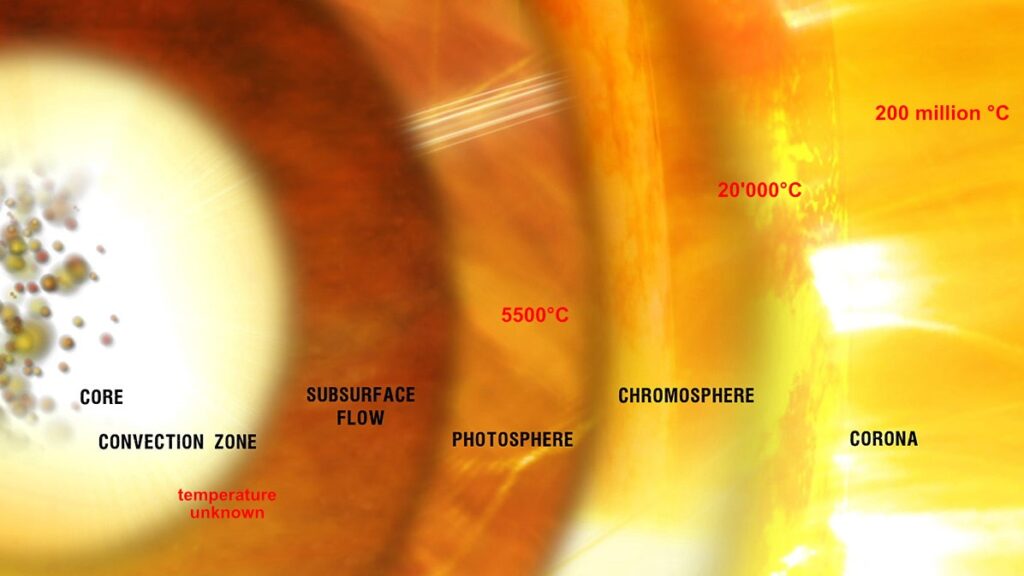
Many other observations that are problematic within standard cosmology find better and more elegant explanations in plasma cosmology. I want to conclude with one more example—namely, the reverse temperature gradient of the Sun. It is one of the most compelling and concrete arguments for the Electric Universe model. The standard model describes the Sun as a thermonuclear furnace powered from within, radiating energy outward from its hot core to its cooler surface. This predicts a decrease in temperature as one moves away from the solar interior, but what is observed is actually the opposite. The temperature at the photosphere (the visible surface of the Sun) is approximately 5500 degrees Celsius. Just above the photosphere, it drops briefly to around 4400 degrees and then rises continuously and steeply to 20,000 degrees at the top of the chromosphere (the layer above the photosphere), to hundreds of thousands of degrees at the base of the corona (the Sun’s outer atmosphere), and ultimately to over two million degrees in the corona itself. At distances of one to two solar diameters, ionized oxygen atoms reach temperatures of 200 million degrees. How could this be? It is completely inconsistent with an internally powered star, in which energy radiates outward from a hot core, but it is entirely consistent with an externally powered electrical discharge—the Sun as an anode in a larger plasma discharge field.
The Electric Universe theory has also produced some very fascinating overlap with observations of history on Earth and in the galaxy that are reflected in ancient mythologies. According to Peratt and astrophysicist Paul LaViolette, petroglyphs from former civilizations as well as ancient cosmologies described in scriptures and found as architecture could be records of tremendous cosmic plasma events in the past that were observed by prehistoric humans. Studying geoglyphs (rock art), megaliths, and stone circles, Peratt believes that several thousand years ago the terrestrial sky was alight with electrical activity, and ancient cultures may have witnessed devastating solar plasma events.13 14

LaViolette worked across the disciplines of physics, astronomy, and mythology, formulating a theory of “galactic superwaves,” a recurring cosmic catastrophe that previous civilizations on Earth may have witnessed and recorded.15
LaViolette’s central claim is that the nucleus of our own Milky Way galaxy periodically explodes, releasing an array of cosmic particles, electromagnetic radiation, and gravitational waves that propagate through the galaxy at nearly the speed of light. Astronomical and geological evidence indicates that the last major “superwave” impacted our solar system around 12,000 to 16,000 years ago and produced abrupt changes in Earth’s climate. This time period coincides with archaeological observations of ancient cultures (for example, Egypt and the age of the Sphinx or Turkey and Göbekli Tepe) which may have encoded detailed knowledge of the “superwave” phenomenon into their mythological, astronomical, and symbolic traditions as a deliberate warning to future civilizations.
In an electric plasma universe, stars and galaxies communicate, not only with each other but possibly also with life-forms on planets like Earth. While ideas like these may seem far-fetched, they are surprisingly more stringent than many assumptions of standard cosmology.
Summary
- The Big Bang model asks us to accept that the universe began from a mathematical impossibility, is powered by forces no one has ever detected, and is structured by matter no one has ever seen.
- Plasma cosmology asks us instead to accept that the universe is constituted of what is observable—plasma, electric currents, and electromagnetic fields—and that the physics governing these realities at cosmic scales are the same as the physics operating at human scales.
Next chapter: Technical and Industry Plasmas
Footnotes:
- Thornhill W. Electric gravity in an electric universe. Holoscience.com, Aug. 22, 2008. https://www.holoscience.com/wp/electric-gravity-in-an-electric-universe/ ↩︎
- https://plasmauniverse.info ↩︎
- https://www.electricuniverse.info ↩︎
- Electric Universe [documentary]. The Thunderbolts Project, 2019. https://archive.org/details/euniverse ↩︎
- Alfvén H. Plasma physics, space research and the origin of the solar system. Nobel Lecture, Dec. 11, 1970. https://www.nobelprize.org/uploads/2018/06/alfven-lecture.pdf ↩︎
- Hu, Q., Zhu, C., He, W., Qiu, J., Jian, L.K., & Prasad, A. (2022). Validation and Interpretation of a Three-dimensional Configuration of a Magnetic Cloud Flux Rope. The Astrophysical Journal, 934. DOI 10.3847/1538-4357/ac7803 ↩︎
- Alfaro, Romulo & Alvarez, Chikezie & Camacho, J. & Arteaga-Velázquez, J. & K. P., Arun Babu & Rojas, Deivid & Ayala Solares, Hugo & Belmont-Moreno, E. & Caballero Mora, Karen Salome & Capistrán, T. & Carramiñana, A. & Casanova, Sabrina & Colin-Farias, P. & Cotti, U. & Cotzomi, J. & de la Fuente, Eduardo & de León, Cederik & Díaz Hernández, Raquel & Zepeda, A.. (2020). Interplanetary Magnetic Flux Rope Observed at Ground Level by HAWC. The Astrophysical Journal. 905. 73. DOI 10.3847/1538-4357/abc344. ↩︎
- Peratt AL. Physics of the Plasma Universe. New York: Springer-Verlag, 1992. https://ia600804.us.archive.org/12/items/AnthonyPerattPhysicsOfThePlasmaUniverse_201901/Anthony-Peratt–Physics-of-the-Plasma-Universe.pdf ↩︎
- Ho MW. How the electric plasma universe creates galaxies and stars. Science in Society. 2015 Oct 21;68:28-33. https://www.researchgate.net/publication/286001508_How_the_electric_plasma_universe_creates_galaxies_and_stars ↩︎
- Peratt, Anthony L. Physics of the Plasma Universe. Springer, 1992. ↩︎
- “Accelerating expansion of the universe.” Wikipedia, last edited Jan. 26, 2026. https://en.wikipedia.org/wiki/Accelerating_expansion_of_the_universe ↩︎
- Lerner EJ. The Big Bang Never Happened. Knopf Doubleday, 1992. https://web.archive.org/web/20190103073616/http://www.bigbangneverhappened.org/ ↩︎
- Peratt AL. Characteristics for the occurrence of a high-current, Z-pinch aurora as recorded in antiquity. IEEE Trans Plasma Sci. 2003 Dec;31(6):1192-1214. https://plasmacosmology.net/Characteristics-for-the-Occurrence-of-a-HighCurrent-ZPinch-Aurora-as-Recorded-in-Antiquity-squatter-squatting-man-Anthony-Peratt.pdf See also Website http://etheric.com ↩︎
- http://etheric.com ↩︎
- LaViolette PA. Earth Under Fire: Humanity’s Survival of the Ice Age. Bear & Company, 2005. https://www.goodreads.com/book/show/1006168.Earth_Under_Fire ↩︎