













































Student Loans: The Fraudulent Inducement of U.S. Family Wealth
Introduction
November 16, 2026








No posts

“There is nothing so strong or safe in an emergency of life as the simple truth.”
~ Charles Dickens
[Publisher’s Note: In anticipation of the publication of our long-awaited review of outstanding student loan debt in the United States, we have decided to publish Catherine’s introduction.]
By Catherine Austin Fitts
I want to tell you a fairy tale from a faraway land in a time long, long ago. It is a tale of innocents, foolish people, and monsters.
In this land lived a young man and a young woman. Let’s call them Hansel and Gretel, since these are names of young people in fairy tales that we know. Hansel and Gretel were the heirs to a beautiful estate owned by their parents and grandparents, who had worked very hard to acquire the land and build the estate from the profits of enterprises they built and owned in their local community.
There came into that region a small network of Monsters. Fueled by new communications and information technology that helped extend their reach beyond the big financial centers in which they lived, the Monsters were eager to acquire the rich land that Hansel and Gretel were destined to inherit.
They set about implementing a scheme to defraud Hansel and Gretel and siphon off their family wealth.
First, the Monsters set up a series of health regimes to slowly and invisibly poison the people, including Hansel and Gretel’s family and community. They put poison in the foods that families bought at the profitable chain stores the Monsters had created across the country to compete with local enterprises. They employed richly paid scientists to find ways of making the foods taste delicious despite the poisons—lots of seed oils and sweeteners helped. Then, the Monsters arranged for doctors to recommend treatments when families mistakenly attributed their poisoning symptoms to illness. The treatments, which especially targeted children, included schedules of injections made by the Monsters’ companies; the injections changed genes and introduced secret, undisclosed, bioengineered ingredients.
As some children became sick, family finances were drained. Hansel became severely autistic and required special treatments and education. To help pay for it, his parents sold one of their businesses and took a mortgage out on their home. The time required for his care was significant and exhausting. Hansel’s mother had to stop helping the family businesses and struggled to properly care for their large property. Hansel’s father was tired at work, and innovation in his businesses slowed.
The time came for Gretel to go to college. Because of the drain on the family finances, Gretel did not want to burden her parents, so she took out student loans. When she borrowed the money, no one explained that the banks she was borrowing from were also financing a process (initiated by the Monsters) to help companies in her country to move plants and jobs abroad. They failed to warn her that this outsourcing would reduce her chances of being able to earn enough to pay back the loan. Under the law of the land, this was called “fraudulent inducement,” defined as having someone take on debt when the lender knows—and fails to disclose—something that will impair the borrower’s ability to pay it off. This is also called a “material omission.”
As the influence of the Monsters grew, fraudulent inducement, predatory lending, and fraudulent corporate practices became commonplace.
Gretel was hardworking and smart, despite being weakened by the poisons she was ingesting. Alas, she spent a lot of time on screens, and she and her friends did not realize that the Monsters were using propaganda and electronic means to brainwash them. Gretel, even had she heard of military-grade neurowarfare, could not fathom the technology being used to trick her. This included: tricking her into listening to doctors who did not understand nutrition or health and instead promoted drugs and injections made by the Monsters; tricking her into wanting to go to a “prestigious” university (persuading her that social status was important to happiness in life); and encouraging her to take courses that would not contribute to her ability to generate a strong income or to take over and build her parents’ businesses. Though Gretel applied herself to her education, she unfortunately was led to pursue a series of studies for which there was little demand from employers.
Upon graduation, Gretel found herself struggling to support herself and pay off her student debt. She decided to apply to law school and took on even more debt. Graduating near the top of her class, she accepted a job working for a large corporate law firm that helped Monster corporations evade laws, regulations, and taxes. Firms of this type also lobbied for legal changes—such as removing student loan borrowers’ ability to file for bankruptcy.
The corporate job was the only way Gretel could service her student loan debt, but the firm was located in the largest city in this faraway land, requiring her to pay a great deal for rent and food. Although she negotiated a new payment schedule on her debt, the servicer engaged in fraudulent practices, and she ended up with balances ballooning from refinancing and late fees.
While she was working long hours at the law firm, the faraway land announced a pandemic, and her firm mandated more injections. These, combined with the injections that had been mandated during her education and recommended by her doctors, contributed to a breakdown in her immune system. Unable to work, she returned home to live with her parents, who took on the burden of supporting both of their children. Gretel’s doctor—who worked for a hospital now owned by a private equity firm—prescribed painkillers made by a Monster company, and she became seriously addicted. Fortunately, and thanks to her parents’ generosity, Gretel was able to spend an extended period of time at a Monster-owned private clinic, where she recovered from the addiction.
The parents had prospered from building a series of enterprises—restaurants, car washes, and dry cleaners—in their local community. Although their businesses had done well, the drain of caring for their children, as well as their own health problems, had sorely detracted from the vitality of their businesses. There were no strong young children to help grow their businesses. In the meantime, their neighbors and customers struggled with similar problems and also grew poorer, which tempered the profitability of all the businesses in the community.
During the pandemic, the rulers of this faraway land had dictated that all of the local businesses must shut down—they said they were “non-essential.” Customers started going to the big-box corporate stores (which were allowed to remain open) and began shopping with large corporations online. As a result, Hansel and Gretel’s parents’ businesses were closed or sold. Meanwhile, the rulers injected $5 trillion of fresh money into the economy, saying that it was to “keep the economy going” while so many businesses and farms were closed. Private equity firms, rich with cash available for acquisitions, came to town and bought the buildings and land that had belonged to Hansel and Gretel’s parents’ enterprises and had once been worth so much more.
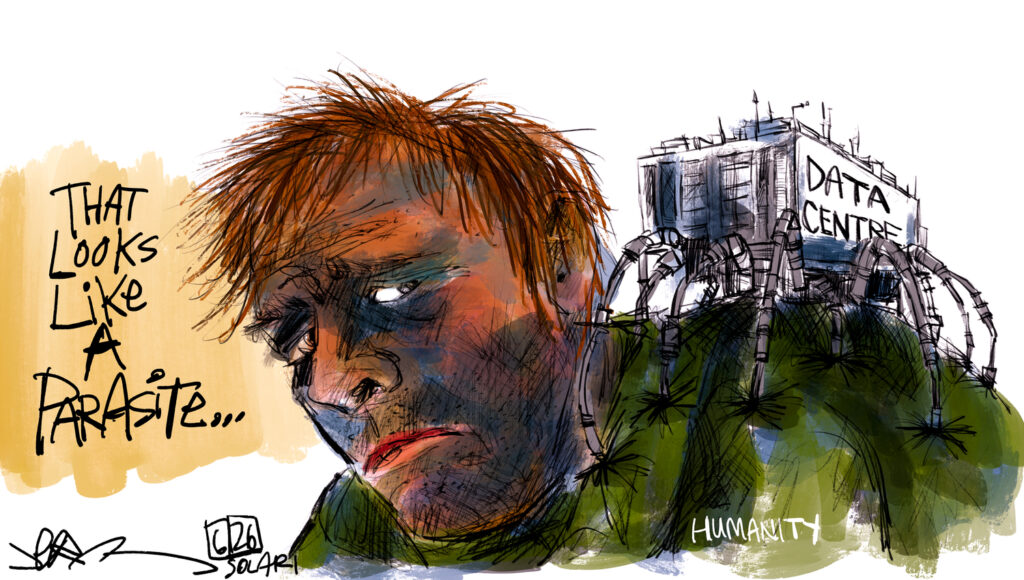
Hansel and Gretel’s parents prayed that they would not have to sell their personal home and property. They started to draw from their retirement accounts. Because their financial planner had persuaded them that the safest place to invest the majority of their money was in the Monsters’ companies, they found themselves helping to finance the plants making the poisons that had harmed their family. The parents also had a great deal of retirement money invested in financing AI companies and the data centers the Monsters were building. They began to be concerned that a data center might be placed near their family land, raising their electricity prices, draining their water, and lowering the value and health of their property.
The rich flow of retirement savings into the Monster companies helped the Monsters purchase advertising in media companies that pushed their companies’ products. The flows also generated capital gains that fueled political donations, ensuring massive fiscal and regulatory support for the Monsters and their companies.
The parents’ days were filled with the stress of figuring out how they could make provision for Hansel and Gretel after they passed on. Gretel was working hard to heal herself so she could contribute. However, so effective was the secrecy that the Monsters had maintained about their strategy and actions that Gretel’s family still could not see—or comprehend—their invisible enemy. Whereas Gretel and her parents did not even know that there were Monsters, the Monsters knew that if you want to take land, you must not only kill the people who own it but also kill the children who will inherit the property and bring strength and growth to the family.
The Monsters figured that people who were foolish enough to allow themselves to be brainwashed and to invest their savings in the Monsters’ poison factories instead of in their children’s education—leaving the children to put themselves in a student loan debt trap—deserved what they got. They considered the people stupid—and indeed, after years of poisoning, cognition was deteriorating rapidly in that land.
Before the fairy tale can have a happy ending, the people of that faraway land need to understand that the Monsters are real, that they are using poison and debt to invade the people’s lands, and that if enough of the people act, they can pull their support from the Monsters and invest in growing strong, healthy children and enterprises instead.
This fairy tale of Hansel and Gretel is about the only thing I have to say about student loan debt in America. Sometimes it pays to simplify what looks quite complicated—to see the world whole.
Sometimes the obvious is true.
Warsaw, Poland
October 4, 2026
The Student Loan Scam with Alan Michael Collinge (2015)
2024 Annual Wrap Up: Protecting Your Assets: Navigating the Financial Fraud Minefield, Part I and Part II with Carolyn Betts
The Great Poisoning Is Bankrupting America with Dr. Mark Skidmore
The Injection Fraud: It’s Not a Vaccine
Mind Control Tactics Used on Young People and Children (and Everyone Else)
Already a subscriber?

Our mission is to help you live a free and inspired life. This includes building wealth in ways that build real wealth in the wider economy. We believe that personal and family wealth is a critical ingredient of both individual freedom and community, health and well-being.
Nothing on The Solari Report should be taken as individual investment, legal, or medical advice. Anyone seeking investment, legal, medical, or other professional advice for his or her personal situation is advised to seek out a qualified advisor or advisors and provide as much information as possible to the advisor in order that such advisor can take into account all relevant circumstances, objectives, and risks before rendering an opinion as to the appropriate strategy.
Receive your free copy of Coming Clean
Be the first to know about new articles, series and events
Notifications