














































































































II. The Many Serendipitous Anomalies of Water
“Water is H2O, hydrogen two parts, oxygen one,
but there is also a third thing, that makes it water and nobody knows what it is.”
~ D.H. Lawrence
Water is the most important liquid for our existence and plays an essential role in physics, biology, chemistry, and all geosciences. Water’s uniqueness is seen not only in the universal need for water and its ubiquitous applications, but also in its anomalous behavior and properties. According to some scientists, without the unusual comportment of water, it is questionable whether life could have developed on planet Earth.1
Triple Point

As mentioned in the Introduction, water is the only natural substance on Earth that can be readily observed in all three aggregate states under mundane conditions: solid water (as ice), liquid water (as in a river), and gaseous water (as steam). This is because water’s “triple point” is within the relevant environmental pressure and temperature ranges in which life on Earth takes place. The triple pointis the location on the pressure and temperature graph where the phase transitions from gas to liquid to solid meet. Most substances have their triple points (if they have one) in temperature or pressure ranges outside the scales relevant for life. This is one of the reasons why water in all its states plays such a major role in every aspect of the real world.
The triple point of water—where solid, liquid, and vapor coexist in a stable equilibrium—is situated at a temperature of 0.01°C (degrees Celsius, or 273.16 Kelvin) and a pressure of 0.006 atm (atmospheres).2
Watch the triple point of water being reached in a laboratory experiment:
Numerous additional serendipitous anomalies of water have been listed and discussed for a long time, with researchers having found some 60-plus such anomalies to date. Let’s consider a few.
Heat Capacity
Source: Adapted by Ulrike Granögger from: See footnote 5.
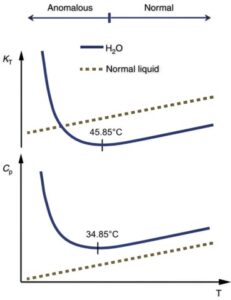
Water has a high specific heat capacity (C), defined as the amount of heat energy required to raise the temperature of 1 gram of a given substance by 1 degree Celsius. For water, this amount of energy is 1 calorie. Most substances (think of metals, for example) will get hot very quickly, but water can absorb a lot of heat before it begins to get hot. Hence, it is frequently used in engineering as a cooling system.
Although we do not think of this in daily life, the specific heat capacity of water also plays a determining role in the climate and habitability of the Earth. The high heat capacity of water regulates the temperature changes of air around bodies of water such as oceans, rivers, and lakes. These water bodies take longer to heat up and longer to cool down than arid land masses, keeping the climate “temperate,” which is one of the reasons why cities tend to establish themselves near oceans and by rivers.
Compressibility
Similarly, water’s compressibility (K) is unique. Compressibility is a measure of the change of volume of a substance when pressure is applied (that is, how much you can compact a substance). Normally, compressibility decreases with decreasing temperature, and water initially behaves in that way. However, just above the range where ambient (life-supporting) temperatures start, a change occurs in the behavior of water, and both the heat capacity as well as the compressibility begin to increase on cooling. This is remarkable; no other liquid does that, but it is essential for living processes.
Density
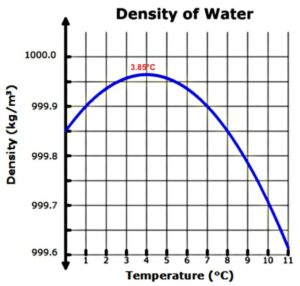
Then, take a look at the density fluctuations of water. The density (ρ) of a simple liquid increases with decreasing temperature. Most liquids contract on freezing and expand on melting. As long as it is hot, this is also true for water. However, water has its highest density at 4°C and not at its freezing point (0°C), so that water’s volume increases when frozen by about 9%. This is how ice floats on water and is why, at the bottom of a freezing freshwater lake, temperatures generally remain at about 4°C. The density change causes an inversion of the cold water, so that in a freezing lake, the warmer water sinks, whereas in warmer temperatures, the warmer water rises. That blessed anomaly has been remarked upon for centuries because it is the safeguard for survival of lifeforms in water.
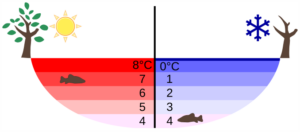
Density of water
Water at 4°C is denser than at 0°C and sinks to the bottom while ice floats on top.
Source: Wikipedia
Two Liquid Phases?
Despite intensive research efforts, the origin of these and many other anomalies of water is still under scientific debate. One hypothesis postulates that there may be two liquid phases of water, which differ in density—converging at a “liquid-liquid critical point” (LLCP). It was only recently, in 2020, that researchers at the University of Stockholm found a way to demonstrate that hypothesis.3,4 At very low (supercooled) temperatures (-63°C), the Swedish researchers and Korean colleagues were able to observe the two hypothesized liquid phases of water: a high-density-liquid (HDL) structure and a low-density-liquid (LDL) form. This is significant because it seems that on a molecular level and under ambient conditions, ordinary water, too, can fluctuate and create small local regions of different densities, which allows it to exist as two liquids at once. HDL water is more liquid-like, while LDL water is more crystalline and structured.
Is it possible that the fluctuations of the two liquid states also exist in the biological processes of living cells? In a 2015 paper titled “The Structural Origin of Anomalous Properties of Liquid Water,” the Swedish authors wrote:
“What is unique with water is that … [it] is anomalous at temperatures where life is sustained and where most processes of importance in nature and to our society occur. It would be interesting in the future to gain insight into whether this is a pure coincidence or has significant implications for understanding biology.”5
Surface Tension
Water has an abnormally high surface tension and surface energy. In fact, aside from mercury, water has the highest surface tension of all liquids. When we watch water droplets fall on a watery surface, we see them forming beads rather than melting evenly into the surface.
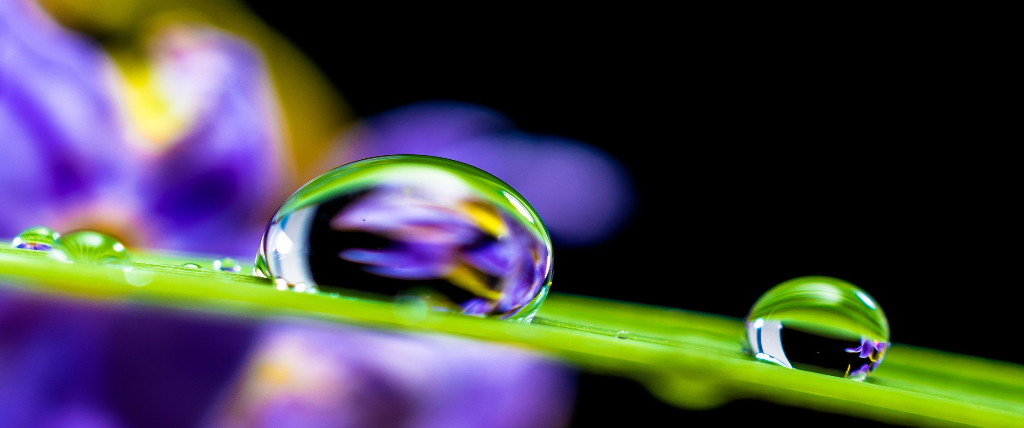
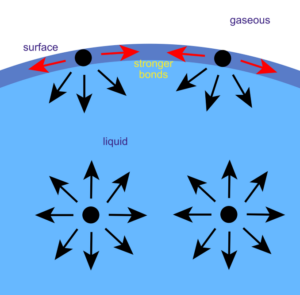
The reason lies in the relatively strong hydrogen bonds attracting the H2O molecules to each other. The very high intramolecular bond energy allows for a dense packing of the water molecules, which will be more attracted to each other than to other substances. At liquid-solid and liquid-gas interfaces, water molecules thus exhibit a different behavior than in the bulk of the water. They will bind to each other more strongly, forming a thin layer of highly ordered water molecules. (See also, Interfacial Water below.)
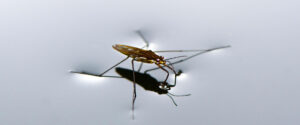
The reason is that at the surface, the H2O molecules do not have other like molecules on all sides and, therefore, the intermolecular attraction is stronger in the surface layer. In this way, a water spider can skip lightly across a lake.
Water’s anomalous surface tension is of utmost importance for living creatures on Earth in capillary action. It is the explanation as to why water can reach to the top of a tree against the gravitational force6 and is also present in the capillary action of tiny blood vessels and the interstitial spaces of the body.
Molecular Structure of Water
[Also see “Structured Water”]
Most of the unusual properties of water are due to its tetrahedral molecular structure. Because the geometry of the water molecule and the resulting clusters it can form are so important, we must take a closer look.
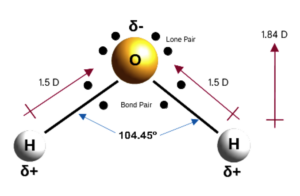
A water molecule consists of one oxygen atom (with eight electrons) and two hydrogen atoms (with one electron each), hence its molecular formula H2O. The molecule has the three-dimensional shape of a tetrahedron; that is, it is angular and not collinear. The angle formed between the “O” and two “H” atoms oscillates between roughly 105° and 109.5°, which is the angle found between the center and two vertex points of a regular tetrahedron (see illustrations).
Source: Wikipedia (click for larger view)
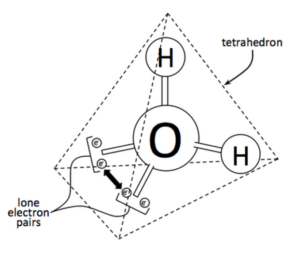
In the tetrahedral molecular geometry of water, the large and negatively charged oxygen atom sits at the center, attracting two positively charged hydrogen atoms positioned at two vertices of an (imaginary) tetrahedron. This occurs by covalent bonding, which means that electrons are shared between the oxygen and hydrogen atoms, creating a full valence shell and stable electron configuration. Because the oxygen has a total of eight electrons to share, two lone pairs of electrons remain, which will attract two hydrogen atoms from a neighboring water molecule (by hydrogen bonds) at the other two vertex points of the tetrahedral geometry.
Polarity and Clusters
The tetrahedral electric geometry just described primes the tendency of H2O molecules to form clusters. Water molecules are dipoles, since oxygen’s two lone electron pairs make it slightly more electro-negative while the hydrogens are electro-positive.
The polarity is an important characteristic for water to build clusters (as well as act as a universal solvent). To the naked eye, liquid water appears homogeneous, but on the nanoscopic length scales and time scales, it is not so—there are constantly clusters present, forming and transforming.7 A single water molecule can form up to four hydrogen bonds and, thus, has the ability to build three-dimensional networks, (H2O)n. In liquid water and in ice, the molecules arrange in a tetrahedral shape, so that every water molecule is bonded to four others forming a pyramid. Note that we are here speaking of a next level of the tetrahedral molecular geometry, as tetrahedrally spaced H2O molecules arrange themselves in tetrahedral relationships of four to five molecules.
These tetrahedral pyramids of H2O molecules, according to applied scientist Martin Chaplin,8 are likely to exist in even larger clusters of 14-molecule tetrahedra that will tend to expand into icosahedral networks.9,10
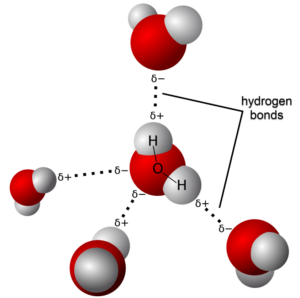
Four to five molecules in tetrahedral relationship
Source: Wikipedia
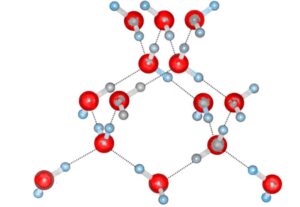
Forming 14-molecule clusters (H2O)14
Source: Martin Chaplin
Twenty of these 14-molecule structures together, containing 280 molecules of water, may form a three-nanometer diameter icosahedral network—the “icosahedral (H2O)280 water cluster.”
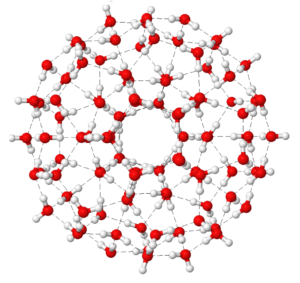
Source: Wikipedia
In 2018, the theoretical icosahedral cluster structure proposed by Prof. Chaplin received strong confirmation from the work of researchers at the University of Bristol and the University of Tokyo.11 Using supercomputers to calculate possible geometric alterations in the pyramid-shaped water molecule, they were able to change the anomalies of water and make water behave more like other liquids, for example, making ice denser than liquid water (which lets the ice sink to the bottom).
This indicates that many (if not all) of water’s anomalous properties are directly caused by its molecular structure and the clusters it forms. The University of Bristol’s John Russo stated,
“With this procedure, we have found that what makes water behave anomalously is the presence of a particular arrangement of the water’s molecules, such as the tetrahedral arrangement…”12
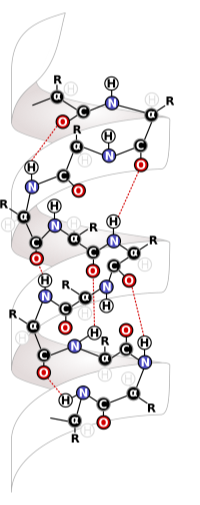
Could this also be the origin of the shape of biological molecules such as DNA-RNA and the geometry of folded proteins? The same hydrogen bonds that hold the water molecules and molecular clusters together are fundamental in biological processes such as protein folding or the formation of the double helix. Polymers and macromolecules of the living body rely on the balance between stability and breakability of these hydrogen bonds. Water and the specifics of its hydrogen bonding are key players in the chemical interactions going on inside the cell. (See also, III. Water Structure and Structured Water.)
Source: Danny Patrick. Wikimedia Commons

Interfacial Water
Another anomaly of water is observed at its surfaces or interfaces with other materials. These
“interfacial” layers of water display extraordinary properties and, in many cases, will even lead to a fourth phase of water, which unlike liquid, solid, or gaseous has been termed “liquid crystalline” (see the work of Professor Gerald H. Pollack).15
Even the air-water surface is a much more complex system than previously assumed. Air-water surfaces exist throughout our planet and are enormously large areas. For example, some 361 million km2 of ocean surface (covering 71% of the Earth) are in contact with air. Water-air surfaces are even larger in the combined aerosols of the Earth’s cloud cover, and a vast interface of water and air (some 150 m2) also exists in the human lungs with their alveoli.
Photomolecular Effect
[Added June 2024]

A very recent discovery by scientists at MIT16 has shown that water will evaporate not only under the influence of heat but also, and even more so, under light. Light can directly cause water to evaporate without the need for heat, and can do that much faster than heat alone.
When light strikes the water surface, at the interface of air and water, it can break the hydrogen bonds of water clusters causing evaporation in the absence of any thermal energy.
The effect – termed the photomolecular effect with reference to the photoelectric effect where electrons are freed from a material by incident light – occurs at any water surface exposed to light. Interestingly, the effect is stronger depending on the incident angle of the light, its color or frequency and its polarization. This should not be the case because water does not really absorb light particularly in the green wavelength of visible light, which showed the strongest effect of optical evaporation.
Best results were achieved with polarized light and an incident angle of 45 degrees. The findings may revolutionize more than climate models and our understanding of cloud behavior, but provide scientific underpinning of what we have called the “Wave Genome” and the existence of mitogenetic radiation or biophotons emitted from living cells. The light from cells and DNA is in fact polarized (laser) light which can be expected to exert a photomolecular effect on the cellular water content. Prof. Gerald Pollack [see chapter on Liquid Crystalline Water], of course, also discovered light as the energy source of unique water behavior forming ordered states along interfaces/surfaces. He may ultimately be the first to have proven the photomolecular effect in water.
Self-Ionization
Source: Wikipedia
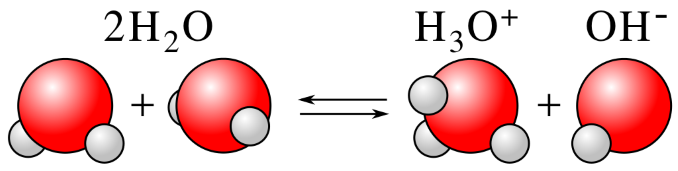
Remarkably, water has the ability to self-ionize. Liquid water never contains H2O molecules only, since the spontaneous dissociation of water molecules can produce hydroxide and hydrogen ions. This process is also called “autoionization” and occurs due to electric field fluctuations between neighboring molecules.
The resulting ions act kosmotropically—that is, they create order by forming stronger hydrogen bonds with surrounding water molecules. This favorable interaction of the water molecules through the presence of water ions has a stabilizing effect on the interactions of macromolecules such as proteins.
Water at the Nanoscale
In addition, researchers have found that water contains nanobubbles, also called ultrafine bubbles. Nanobubbles are 70 to 120 nanometer-sized gas-containing cavities in an aqueous liquid that can remain stable for days or months (unlike microbubbles, which will float to the top and escape). Their surfaces are negatively charged. This means that there can be innumerable surfaces inside the water along which special properties of interfacial water may manifest. Nanobubbles today are emerging as a new technology to aerate or oxygenate water and improve water quality.
Scientists at Lausanne’s Swiss Federal Institute of Technology (Ecole polytechnique fédérale de Lausanne or EPFL) have also shown that nanosized water droplets—such as we find, for example, as aerosols—display a highly ordered molecular surface. The molecules on the surface of the droplets are much more ordered than those of normal water, with the molecules showing exceptionally strong hydrogen bonding even at high temperatures.17
Source: Ulrike Granögger adapted from Wikipedia
Much new research is going into water at the nanoscale. In 2022, the European Union (EU) granted 10 million euros in funding for the study of the quantum mechanical properties of “nano-water.”18
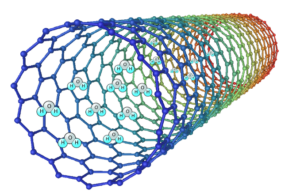
When water is spatially confined to nanometer dimensions—for example, inside a carbon nanotube19—it is no longer described as a continuum but shows entirely new phenomena on the molecular level. The water trapped in narrow, nanoscale cavities immediately enters a “hexatic” phase that is neither solid nor liquid, but somewhere in between (see also “Ordered Cellular Water” in Section V. Liquid Crystalline Water). Nanoscale water in this phase is highly conducting and flows almost without friction (a phenomenon called “superfluidity”). Such narrow cavities and ducts also exist in our bodies, where water is confined between membranes and small capillaries. Could cellular water be a superfluid with high electrical conductivity?
Quantum Tunneling
Finally, water can exhibit quantum tunneling behavior when caged. (Quantum tunneling is an effect of matter having wave properties, which allows a particle to surmount or “tunnel” through a seemingly impenetrable energy barrier.) Such ultra-confined states of water molecules can occur in rocks and crystals, but also in cell walls! This is a very recent discovery,20,21 even though it has long been part of the theories of a quantum holography of DNA (see my Solari Report from August 2018 on “The Wave Genome”).22
In orthodox science, the discovery that water is capable of quantum tunneling is unexpected and unprecedented. According to Alexander Kolesnikov, the lead author of “Quantum Tunneling of Water in Beryl,” published in 2016:
“This means that the oxygen and hydrogen atoms of the water molecule are ‘delocalized’ and therefore simultaneously present in all six symmetrically equivalent positions in the channel at the same time. It’s one of those phenomena that only occur in quantum mechanics and has no parallel in our everyday experience.”23
It may well turn out that such quantum behavior occurs countless times every minute in the water of our own bodies.
There are many more remarkable and unexpected properties of water, many of which are fundamental to the sustenance of life on planet Earth—of which 71% of the surface is made up of water.
Water Anomalies
The following is a list of over 60 water anomalies discussed on the website Water Structure and Science,24 created and maintained by Professor Martin Chaplin. The website is an incredible resource for the study of all things water.
Water phase anomalies
- Water has an unusually high melting point.
- Water has an unusually high boiling point.
- Water has an unusually high critical point.
- Solid water exists in a wider variety of stable (and metastable) crystal and amorphous structures than other materials.
- The thermal conductivity, shear modulus, and transverse sound velocity of ice reduce with increasing pressure.
- The structure of liquid water changes at high pressure.
- Supercooled water has two phases and a second critical point at about -91°C.
- Liquid water is easily supercooled but glassified with difficulty.
- Liquid water exists at extremely low temperatures and freezes on heating.
- Liquid water may be easily superheated.
- Hot water may freeze faster than cold water; the Mpemba effect.
- Warm water vibrates longer than cold water.
- Water molecules shrink as the temperature rises and expand as the pressure increases.
- A liquid-liquid transition occurs at about 330 K.
Water density anomalies
- The density of ice increases on heating (up to 70 K).
- Water shrinks on melting.
- Pressure reduces ice’s melting point.
- Cold liquid water has a high density that increases on warming (up to 3.984°C).
- The surface of water is denser than the bulk.
- Pressure reduces the temperature of maximum density.
- There is a minimum in the density of supercooled water.
- Water has a low coefficient of expansion (thermal expansivity).
- Water’s thermal expansivity reduces increasingly (becoming negative) at low temperatures.
- Water’s thermal expansivity increases with increased pressure.
- The number of nearest neighbors increases on melting.
- The number of nearest neighbors increases with temperature.
- Water has unusually low compressibility.
- The compressibility drops as the temperature increases up to 46.5°C.
- There is a maximum in the compressibility-temperature relationship.
- The speed of sound increases with temperature up to 74°C.
- The speed of sound may show a minimum.
- ‘Fast sound’ is found at high frequencies and shows a discontinuity at higher pressure.
- The NMR spin-lattice relaxation time is very small at low temperatures.
- The NMR shift increases to a maximum at low (supercooled) temperatures.
- The refractive index of water has a maximum value at just below 0°C.
- The change in volume as liquid changes to gas is very large.
Water material anomalies
- No aqueous solution is ideal.
- D2O (deuterium oxide or heavy water) and T2O (tritiated or super-heavy water) differ significantly from H2O in their physical properties.
- Liquid H2O and D2O differ significantly in their phase behavior.
- H2O and D2O ices differ significantly in their quantum behavior.
- The mean kinetic energy of water’s hydrogen atoms increases at low temperatures (disputed).
- Solutes have varying effects on properties such as density and viscosity.
- The solubilities of nonpolar gases in water decrease with temperature to a minimum and then rise.
- The dielectric constant of water and ice are high.
- The relative permittivity shows a temperature maximum.
- The relative permittivity shows a “kink” in its behavior with the temperature at 60°C.
- The imaginary part of the dielectric constant shows a minimum near 20 K.
- Proton and hydroxide ion mobilities are anomalously fast in an electric field.
- The electrical conductivity of water rises to a maximum at about 230°C.
- The electrical conductivity of water rises considerably with frequency.
- Acidity constants of weak acids show temperature minima.
- X-ray diffraction shows an unusually detailed structure.
- Under high pressure water molecules move further away from each other with increasing pressure, a density-distance paradox.
- Water adsorption may cause negative electrical resistance.
Water thermodynamic anomalies
- The heat of fusion of water with temperature exhibits a maximum at -17°C.
- Water has over twice the specific heat capacity of ice or steam.
- The specific heat capacity (CP and CV) is unusually high.
- The specific heat capacity CP has a minimum of 36°C.
- The specific heat capacity (CP) has a maximum of about -45°C.
- The specific heat capacity (CP) has a minimum with respect to pressure.
- The heat capacity (CV) has a maximum.
- The high heat of vaporization.
- The high heat of sublimation.
- The high entropy of vaporization.
- The thermal conductivity of water is high and rises to a maximum at about 130°C.
Water physical anomalies
- Water has unusually high viscosity.
- Large viscosity and Prandtl number increase as the temperature is lowered.
- Water’s viscosity decreases with pressure below 33°C.
- There is a large diffusion decrease as the temperature is lowered.
- At low temperatures, the self-diffusion of water increases as the density and pressure increase.
- The thermal diffusivity rises to a maximum at about 0.8 GPa.
- Water has unusually high surface tension.
- Some salts give a surface tension-concentration minimum, the Jones-Ray effect.
- Some salts prevent the coalescence of tiny bubbles.
- The molar ionic volumes of salts show maxima with respect to temperature.
Footnotes:
- Cf. Philip Ball. H2O: A Biography of Water. Gardners Books, 2000. ↩︎
- Compare this, for example, to the triple point of carbon dioxide (CO2), which is found at a temperature of −56.6°C and a pressure of 5.11 atm. ↩︎
- Kim KH, Amann-Winkel K, Giovambattista N, et al. Experimental observation of the liquid-liquid transition in bulk supercooled water under pressure. Science. 2020;370(6519):978-982. doi: 10.1126/science.abb9385. ↩︎
- Two liquids of water exist. Stockholm University, last updated Nov. 24, 2020. https://www.su.se/english/news/two-liquids-of-water-exist-1.528339 ↩︎
- Nilsson A, Pettersson L. The structural origin of anomalous properties of liquid water. Nat Commun. 2015;6:8998. doi: 10.1038/ncomms9998 ↩︎
- At least, this is the current theory, recently reinforced by laboratory experiments with a synthetic tree demonstrating the upward flow of a total mass of 458g of water to a height of 3m against gravity. See: Shi W, Dalrymple RM, McKenny CJ, et al. Passive water ascent in a tall, scalable synthetic tree. Sci Rep. 2020;10(1):230. doi: 10.1038/s41598-019-57109-z ↩︎
- Roy R, Tiller WA, Bell I, Hoover MR. The structure of liquid water; novel insights from materials research; potential relevance to homeopathy. Materials Research Innovations. 2005;9(4):98-103. https://doi.org/10.1080/14328917.2005.11784911 ↩︎
- Professor Chaplin is a Fellow of the Royal Society of Chemistry and a water genius who has created an online universe of collected facts about the structure and science of water on his website (comprising 315 pages and over 30,000 links). See https://water.lsbu.ac.uk/water/water_sitemap.html ↩︎
- Chaplin M. A proposal for the structuring of water. Biophys Chem. 2000;83(3):211-221. https://www.researchgate.net/publication/12666428_A_Proposal_for_the_Structuring_of_Water ↩︎
- Chaplin M. The icosahedral (H2O)280 water clusters. Water Structure and Science website, 2000 (last updated Oct. 4, 2021). https://water.lsbu.ac.uk/water/icosahedral_water_clusters.html ↩︎
- Russo J, Akahane K, Tanaka H. Water-like anomalies as a function of tetrahedrality. Proc Natl Acad Sci U S A. 2018;115(15):E3333-E3341. doi: 10.1073/pnas.1722339115 ↩︎
- University of Bristol. Understanding the strange behaviour of water. Press release, Mar. 27, 2018. https://www.bristol.ac.uk/news/2018/march/behaviour-of-water.html ↩︎
- McDermott ML, Vanselous H, Corcelli SA, Petersen PB. DNA’s chiral spine of hydration. ACS Cent Sci. 2017;3(7):708-714. doi: 10.1021/acscentsci.7b00100 ↩︎
- Perets EA, Yan ECY. The H2O helix: the chiral water superstructure surrounding DNA. ACS Cent Sci. 2017;3(7):683-685. doi: 10.1021/acscentsci.7b00229 ↩︎
- https://www.pollacklab.org/ ↩︎
- Lv, G., Tu, Y., Zhang, J. H., & Chen, G. (2024). Photomolecular effect: Visible light interaction with air–water interface. PNAS, 121(18). [https://doi.org/10.1073/pnas.2320844121] ↩︎
- Smolentsev N, Smit WJ, Bakker HJ, Roke S. The interfacial structure of water droplets in a hydrophobic liquid. Nat Commun. 2017;8:15548. doi: 10.1038/ncomms15548 ↩︎
- 10 million euros for nanoscale water research. Max Planck Institute for Polymer Research, press release, Oct. 25, 2022. https://www.mpip-mainz.mpg.de/en/press/pr-2022-14 ↩︎
- Sansom MSP, Biggin PC. Water at the nanoscale. Nature. 2001;414(6860):157-159. doi: 10.1038/35102651 ↩︎
- Gorshunov BP, Zhukova ES, Torgashev VI, et al. Quantum behavior of water molecules confined to nanocavities in gemstones. J Phys Chem Lett. 2013;4(12):2015-2020. doi: 10.1021/jz400782j ↩︎
- Kolesnikov AI, Reiter GF, Choudhury N, et al. Quantum tunneling of water in beryl: a new state of the water molecule. Phys Rev Lett. 2016;116(16):167802. doi: 10.1103/PhysRevLett.116.167802 ↩︎
- Fitts CA. Special Report: Future Science – The Wave Genome – Quantum Holography of DNA with Ulrike Granögger. The Solari Report, Aug. 11, 2018. ↩︎
- Walli R. New state of water molecule discovered. Phys.org, Apr. 22, 2016. https://phys.org/news/2016-04-state-molecule.html ↩︎
- https://water.lsbu.ac.uk/water/water_structure_science.html ↩︎