






























































































VII. Water on Earth
“Water is not a commercial product like any other but, rather,
a heritage which must be protected, defended and treated as such.”
~ (Foreword to the European Directive on Water Policy)1
We do not fully understand when or how water arrived on Planet Earth, or whether it actually came from somewhere. The original conditions on a cooling planet (from a “protoplanetary disk”)2 would have been too hot for liquid water to form. It is assumed that most of the water in the cosmos today is absorbed in interstellar dust particles that are bound in the tails of comets, as well as in meteorites—those that reached Earth and other planets in their early time of formation.
Moreover, it is not certain how the water molecule was synthesized at all in outer space, because three-body atomic collisions (two “H” and one “O”) in a low-pressure gaseous medium are extremely rare.
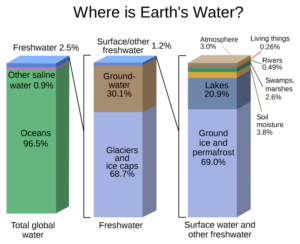
Source: Wikipedia (click to enlarge)
New research suggests that our planetary water may not have come from space alone but also is found deep in the Earth’s mantle (the layer that lies between Earth’s crust and outer core).3
Almost 71% of the Earth’s surface is covered by water, most of it (97%) being saltwater in seas and oceans. Fresh water accounts for only 3% of terrestrial water, 2.5% of which is locked in the polar ice caps, glaciers, and vapor. Thus, only a tiny fraction of the Earth’s water is available as fresh water, and yet that amount calculates to more than eight million liters for each human on Earth.
According to United Nations data assembled at Worldometer, which shows global fresh water use listed by country,4 the five countries with the highest water use (for the years 2004–2016) are India with 761 billion cubic meters (where 1 cubic meter [m3] equals 1,000 liters) as well as China (598bn m3), the U.S. (444bn m3), Indonesia (223bn m3), and Pakistan (183bn m3). The highest per capita daily water use (water usage divided by population) is found in Turkmenistan (almost 16,000 liters), Chile (roughly 6,000), Guyana (5,300), Uzbekistan (4,750), and Tajikistan (4,460).
On a global scale, 70% of the fresh water used goes toward agriculture, 20% to industry, and 10% for home use. In industrialized countries like the United States, these percentages can be reversed, with almost 60% going to industry, 33% to agriculture, and the remainder to domestic uses and drinking water.5
The Hydrosphere
The combined water on, under, and above the surface of the Earth (or a given planet) is called the planet’s hydrosphere (which includes the atmosphere). The water on Earth is continually involved in the water cycle—a steady movement and transfer of water by processes such as evaporation, precipitation, transduction, and others. This cycle is driven by the energy received through the light of the sun, particularly infrared radiation. Water on Earth absorbs the energy of sunlight in the oceans and other water bodies, and it is also water in the atmosphere that absorbs the infrared radiation that comes from the Earth after it has been warmed by the sun. About 70% of the radiation absorbed in the atmosphere is due to the water in the atmosphere. In this sense, water is actually the biggest driver of the so-called “greenhouse effect,” and it is that which ensures a habitable planetary climate. Plants release about 300 molecules of H2O for every molecule of CO2 they capture during photosynthesis.
There is more water in the atmosphere at any given time than is flowing in rivers. There are some 1260km3 of water flowing through the atmosphere every day, where the water can very quickly move great distances. The time cycle of water circulating in the atmosphere is circa one week, before it precipitates by rain or dew. A big part of this precipitation (20%) evaporates over land before it reaches the ground. Most of the precipitation goes into the soil and vegetation, of which 75% will return again (transpire) into the atmosphere.
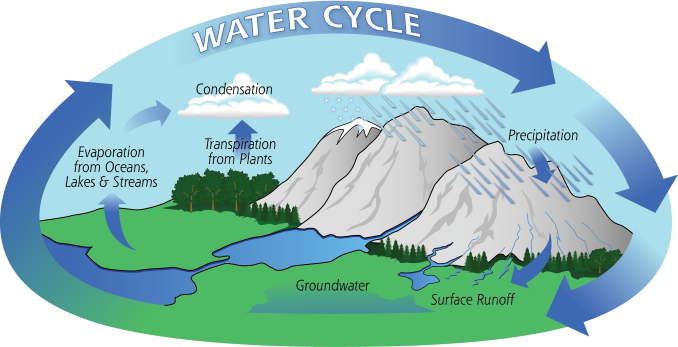
Source: Wikipedia
Mantle Water
During the formation of the Earth, the hydrogen and oxygen that encircled the accreting planet were captured in its rocks and minerals. By magmatic and volcanic activity, such minerals rich in hydrogen and oxygen can melt in the heat from the Earth’s mantle, and water can come gushing out.
Huge quantities of hydrogen and oxygen could be trapped inside the mantle, with estimates of as much as 10 oceans of water existing down beneath the Earth’s crust.
The Earth’s tectonic plate movement is facilitated by water in the mantle, reducing friction between the moving rocks. Scientists now believe that the subduction movement of tectonic plates (a process where one tectonic plate slides under another) draws water deep into the mantle in what is termed the “deep water cycle.”6 This means that our planet’s water cycle includes the Earth’s interior.
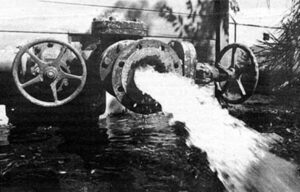
Source: San Diego Reader
Some researchers believe that mantle water—also called “primary water”—is virtually limitless and clean because all that water is created in the earth’s mantle. Drilling for primary water is like drilling for ground water with the exception that the drilling must go into a geologic fissure.
It was geologist and mining engineer Dr. Stephan Riess, a German immigrant to the U.S., who discovered the concept of primary water and was the first to understand that the Earth’s mantle holds water. He even introduced it to the California government, proposing to drill thousands of primary water wells along the western slope of the Sierra Nevada mountains. He believed he could solve California’s water crisis.
The Primary Water Institute8 and companies like Primary Water Technologies9 and Gamma Exploration10 are actively pursuing research and education about this intriguing source of fresh water.
Watch an interesting report on deep drilling and mantle research.
Sources for Water Statistics
- AQUASTAT: UN Food and Agriculture Organization website (maps and databases on water)11
- International Water Association (mainstream perspective)12
- The Water Project (hands-on; focus on sub-Saharan Africa)13
Footnotes
- European Union. Directive 2000/60/EC of the European Parliament and of the Council of 23 October 2000 establishing a framework for Community action in the field of water policy. Document 32000L0060. ↩︎
- From SK Haldar and J Tišljar, “Basic Petrology” at https://www.sciencedirect.com/topics/earth-and-planetary-sciences/protoplanetary-disk: “Star formation is a complex process, which always produces a gaseous protoplanetary disk around the young star. This may give birth to planets in certain circumstances, which are not well known.” ↩︎
- Redd NT. Where did Earth’s water come from? Astronomy, Apr. 1, 2019. https://www.astronomy.com/science/where-did-earths-water-come-from/ ↩︎
- https://www.worldometers.info/water/ ↩︎
- Water facts – worldwide water supply. Bureau of Reclamation, Central California Area Office, last updated Nov. 4, 2020. https://www.usbr.gov/mp/arwec/water-facts-ww-water-sup.html ↩︎
- Deep water cycle (Wikipedia). ↩︎
- Matthews N. Escondido’s Stephan Reiss [sic] finds primary water – where no one else can. San Diego Reader, Jun. 6, 1985. https://www.sandiegoreader.com/news/1985/jun/06/cover-theres-water-down-below/ ↩︎
- The Primary Water Institute (Website). ↩︎
- Primary Water Technologies (Website). ↩︎
- Gamma Exploration (Website). ↩︎
- Aquastat https://data.apps.fao.org/aquamaps/?lang=en ↩︎
- International Water Association https://iwa-network.org/ ↩︎
- The Water Project https://thewaterproject.org/why-water/water-crisis ↩︎