



































































































Intelligent Plasma
“I see no reason to suppose that the air about us and the heavenly spaces over us might not be peopled by intelligences, or entities, or forms of life… and—who knows?—perhaps the nebulae are sentient entities and what we can see of them are their bodies.” ~ Alfred North Whitehead
by Ulrike Granögger
In the 1957 science fiction novel The Black Cloud,1 famous British astronomer Sir Fred Hoyle describes how a huge plasma cloud arrives in the solar system and almost destroys life on Earth by blocking out the Sun’s light. Humanity realizes that the cloud is intelligent and begins to communicate with it. The cloud reconfigures itself to let sunlight reach Earth again, saving planetary life. While this plot is obviously humorous and fanciful, the science that Hoyle incorporated into the novel is by no means fictional.
A number of plasma physicists and serious researchers have hinted at the possibility that plasma is intelligent. Winston Bostick was struck by the self-organizing and strategic behavior of the plasmoids he produced in the laboratory, and David Bohm, seeing plasma respond to electrical probes, interpreted it as a form of conscious behavior. Plasma pioneers like Irving Langmuir and Hannes Alfvén, while not actually claiming plasma to be intelligent, were intrigued by plasma behaving like a sentient medium, which prompted Langmuir to coin the term “plasma” in the first place, because it reminded him of blood plasma. More recently, famous British biologist Rupert Sheldrake asks outright: “Is the Sun Conscious?”2 and Robert Temple and astrophysicist Chandra Wickramasinghe have argued that the Kordylewski Clouds could be intelligent,3 based on the charged interactions of their constituent dust particles. They calculate:
“…the total number N of such charged dust particles in a KDC (distance of < 1cm apart) would be truly vast …” namely something like N ≅ 2×1026. “A KDC […] may well have a total number of binary connections ∽ nC2 ≈ 1052 between its constituent oscillators, so defining a super-astronomical sum total for its potential computing power. This estimate exceeds the computing power available in all human brains and indeed all other intelligent life on Earth as well by very many orders of magnitude.”
The adaptive, self-organizing, structure-building, and information-carrying capacities of plasmas in response to their environment are undeniable, demonstrated most famously by the zero-gravity experiments on board the ISS (see Dusty Complex Plasmas in this volume).
Investigating whether plasma could be intelligent should probably begin with the question of what intelligence actually is—a question that the emerging field of artificial intelligence has brought to everybody’s attention. As difficult as it is to define life, it is equally hard to define intelligence.4 Intelligence is not necessarily related to a biological brain and is not only defined by a capacity for reasoning, learning, memory, and decision-making. Each time a machine learns to play chess, recognizes a face, or translates a language, for example, one may ask whether it is truly being intelligent. What is required to display intelligence? A nervous system? A computer chip? A language?
Alan Turing sidestepped the search for a substrate to intelligence—a brain, a network, etc.—by looking instead at what constitutes intelligent behavior. The Turing test proposes that if a system produces responses indistinguishable from those of a known intelligent being, then it should be treated as intelligent. Other researchers have further formalized this type of functional definition of intelligence, for example in Giulio Tononi’s Integrated Information Theory (IIT).5 According to IIT, consciousness is a fundamental property of physical systems and their capacity to integrate information (measured by Phi φ). It says that any system, not just a biological brain, with high internal connectivity and informational architecture can generate subjective experience.6
But perhaps the most compelling support for substrate-independence of intelligence comes not from philosophy but from biology. Over the past two decades, researchers have documented basic cognitive behavior in organisms that have no nervous system at all. The slime mould Physarum polycephalum, a single-celled organism, was shown to navigate a maze by changing its shape and finding the shortest path to food (minimum-length solution between two points in a labyrinth).7

Bacteria have been shown to exhibit forms of collective memory.8 Plants respond to repeated stimuli in ways that suggest habituation, the most basic form of learning. A large body of literature on what is termed “minimal cognition” has established convincingly that the capacity to sense, remember, and adapt is not the exclusive property of animals with brains. It is a much more widely distributed property of matter itself.9
Fundamental Properties of Intelligence
Plasma qualifies as intelligent in many ways. Consider four basic elements of intelligence:
- To receive and process information from the environment (computation)
- To retain traces of past input (memory)
- To detect patterns in that information and adapt in response (learning)
- To produce outputs appropriate to novel situations (self-organization)
Plasmas, especially dusty complex plasmas, have all of these covered.
Memory
As we saw under Dusty Complex Plasmas, the charged dust grains in a plasma can spontaneously self-organize into structured lattices known as plasma crystals. These configurations are not random but were formed under the influence of past plasma conditions. In this sense, the spatial arrangement of the dust encodes information about the system’s past—a physical form of memory written in its own structure.
Take the example of the Kordylewski Clouds. These dusty plasma clouds, even though located in a gravitationally “calm” region of space (called the Lagrange points L4 and L5) between Earth and the Moon, are themselves not static. They fluctuate, shift, and respond to perturbations from the solar wind, variations in solar radiation pressure, and the gravitational effects of nearby bodies. Charged particles enter and leave the clouds, the clouds respond electromagnetically, and waves propagate through the dusty plasma in nonlinear interaction. The internal structure of the clouds retain traces of past conditions (memory) through the organization of the charged dust grains and their electromagnetic configurations.
Information Processing
Plasmas have a variety of nonlinear wave modes (ion acoustic waves, dust acoustic waves, high-frequency Langmuir waves, etc.). Nonlinearity, here, is essential for intelligent response. A purely linear system or classic machine transforms inputs into outputs in a set, proportional way, and cannot distinguish complex patterns from one another. The nonlinear dynamics of a dusty plasma, in contrast, allow for different input signals to produce qualitatively different responses, a property needed for pattern recognition.
Adaptive Behavior
Dusty plasmas are self-organizing systems. Without external programming or instruction, they spontaneously develop vortices, filaments, wave structures, and crystalline arrangements in response to the conditions imposed on them. This self-organization is itself a form of adaptive response: the system is, in effect, continuously solving a “many-body problem,” that is, looking for stable energy configurations within given constraints. When those constraints change, the organization changes with them. The system reconfigures according to environmental changes.
Plasma Computers and Reservoir Computing
Interestingly, due to these fundamental computational and memory properties of plasmas, they have been used as components of actual computers in the past (for example, thyratrons in first-generation vacuum-tube computers10) and are still actively researched for future computational systems.
Plasma-Based Computing
Researchers have recently demonstrated that microplasma discharges can perform Boolean logic functions. Such microplasma devices can encode logic states, functioning similar to transistors but using ionized gas. The term is microplasma field-effect transistors (MOPFETs).11 The microplasma devices are arranged close together so that their electric fields interact and influence another. The logic outputs are thus produced via space charge effects. In other words: the plasma itself is both part of the wiring (hardware) as well as of the computing element (software).
Very early experimental and theoretical work is also taking place in plasma wave computing (essentially a form of optical computing12 13), where information is processed using waves propagating through plasma instead of electrons moving through solid circuits (like in silicon chips). The logic switches here come from wave interactions where the waves perform computations through their interference patterns. When waves in a plasma meet, they can either interfere constructively or destructively, which can implement logic gates in the form of AND, NOT, and OR.14
Reservoir Computing
Even more to the point is the emergent science of reservoir computing15 for machine learning and neural computation, developed in the early 2000s by Wolfgang Maass and colleagues, and by Herbert Jaeger.16 The core insight is fascinating and simple. Most of the artificial intelligence and large language models we have today are based on recurrent neural networks, which are powerful but notoriously expensive, energy-intensive, and data-hungry to train. All of the internal connections require complex computational algorithms. Reservoir computing, on the other hand, does not require any training of the network. The network itself remains “fixed and random,” essentially untrained, while only the outputs are trained. Almost any sufficiently complex dynamical system can serve as the reservoir.
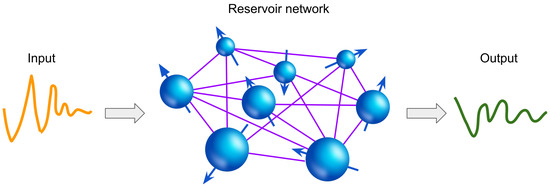
The image used to explain the process is that of water. Think of a pool of water into which you throw a stone; the water naturally responds with complex, rippling, high-dimensional patterns that depend on where and how hard the stone was thrown. There is no need to calculate all the nonlinear wave interactions; the water itself is the calculator. The reservoir computer does the same thing with information. It takes an input signal and transforms it into a rich, high-dimensional pattern of internal activity, but all of this happens by itself without the need for programming. Only the readout layer needs to learn how to map the result, which makes the entire process fast, efficient, and natural.17 (Even our own brains could be regarded as reservoirs. )18
A dusty plasma satisfies all of these requirements. It is nonlinear, it supports rich wave dynamics, it retains traces of past inputs through its evolving structure, and it responds to perturbations in complex and high-dimensional ways. In principle, a dusty plasma could serve as a physical reservoir computer where the medium (plasma) itself does the calculations, and the only training needed is to extract meaningful answers.
The Kordylewski Clouds and other complex dusty plasmas, in this light, are not merely passive accumulations of cosmic dust. They are, in the language of reservoir computing, a naturally occurring physical reservoir—continuously processing the information encoded in the solar wind, the radiation field, and the gravitational environment of the solar system.
If plasma clouds are in fact information-processing systems, then the entire cosmic space may be filled with an extraordinarily complex computation process. Perhaps the universe has been computing and processing information in plasma for billions of years. In that sense, humans with their neurons and silicon computers are most likely not the originators of intelligence—but rather the cosmos becoming locally aware of a process that has always, in some form, been its own.

Summary
- Many physicists and researchers have hinted at the possibility that plasma is intelligent.
- Plasmas have adaptive, self-organizing, structure-building, and information-carrying capacities in response to their environment.
- The spatial arrangement of dusty complex plasmas such as the Kordylewski Clouds encodes information about the system’s past.
- Dusty complex plasmas are characterized by nonlinear dynamics that produce qualitatively different responses to different input signals and enable pattern recognition.
- The computational and memory properties of plasmas lend themselves to computational applications.
Next chapter: Fire, Ether, and the Fifth Element
Footnotes:
- “The Black Cloud.” Wikipedia, last edited Mar. 8, 2026. https://en.wikipedia.org/wiki/The_Black_Cloud ↩︎
- Sheldrake R. Is the Sun conscious? Journal of Consciousness Studies. 2021;28(3-4):8-28. https://www.sheldrake.org/files/pdfs/papers/Is_the_Sun_Conscious.pdf ↩︎
- Temple R, Wickramasinghe C. Kordylewski dust clouds: could they be cosmic “superbrains”? Advances in Astrophysics. 2019 Nov;4(4):129-132. https://dx.doi.org/10.22606/adap.2019.44001 ↩︎
- Agüera y Arcas B. What is intelligence? Lessons from AI about evolution, computing, and minds. Antikythera, Oct. 22, 2024. https://doi.org/10.1162/anti.5czb ↩︎
- Tononi G. Phi: A Voyage from the Brain to the Soul. Pantheon, 2012. https://archive.org/details/phivoyagefrombra0000tono ↩︎
- Tononi G, Koch C. Consciousness: here, there and everywhere? Philos Trans R Soc Lond B Biol Sci. 2015 May 19;370(1668):20140167. https://doi.org/10.1098/rstb.2014.0167 ↩︎
- Nakagaki T, Yamada H, Tóth A. Intelligence: maze-solving by an amoeboid organism. Nature. 2000 Sep 28;407(6803):470. https://doi.org/10.1038/35035159 ↩︎
- “Bacteria can measure the information content of water” [Description of the work of Eshel Ben-Jacob.] In: Granögger U. Water. The Solari Report, 2023, pp. 40-41. https://solari.com/water-pdf-now-available/ ↩︎
- Levin M. “Where do minds exist?” YouTube, uploaded by the Center for the Study of Apparent Selves, Feb. 12, 2026. https://youtu.be/wDrdrXjQ-Ho ↩︎
- “Vacuum-tube computer.” Wikipedia, last edited Jan. 19, 2026. https://en.wikipedia.org/wiki/Vacuum-tube_computer ↩︎
- Tabib-Azar M, Pai P. Microplasma field effect transistors. Micromachines (Basel). 2017 Apr 5;8(4):117. https://doi.org/10.3390/mi8040117 ↩︎
- Rodriguez J. “Optical computing with plasma: Stanford PhD Defense.” YouTube, uploaded by Projections, Nov. 5, 2023. https://youtu.be/Mdh2pLwsK8Y ↩︎
- Rodriguez JA. “Progress toward a plasma-based optical computer.” YouTube, uploaded by Projections, Apr. 7, 2023. https://youtu.be/KN55Opscdv8 ↩︎
- “Logic gate.” Wikipedia, last edited Apr. 3, 2026. https://en.wikipedia.org/wiki/Logic_gate ↩︎
- “Reservoir computing.” Wikipedia, last edited Nov. 5, 2025. https://en.wikipedia.org/wiki/Reservoir_computing ↩︎
- te Vrugt M. An introduction to reservoir computing. In: Artificial Intelligence and Intelligent Matter. Springer, 2025. https://arxiv.org/html/2412.13212v1 ↩︎
- Maksymov IS. Analogue and physical reservoir computing using water waves: applications in power engineering and beyond. Energies. 2023;16(14):5366. https://doi.org/10.3390/en16145366 ↩︎
- “What is reservoir computing?” YouTube, uploaded by BrainOmega, Jul. 2, 2025. https://youtu.be/OTelR7ZVUus ↩︎