





































































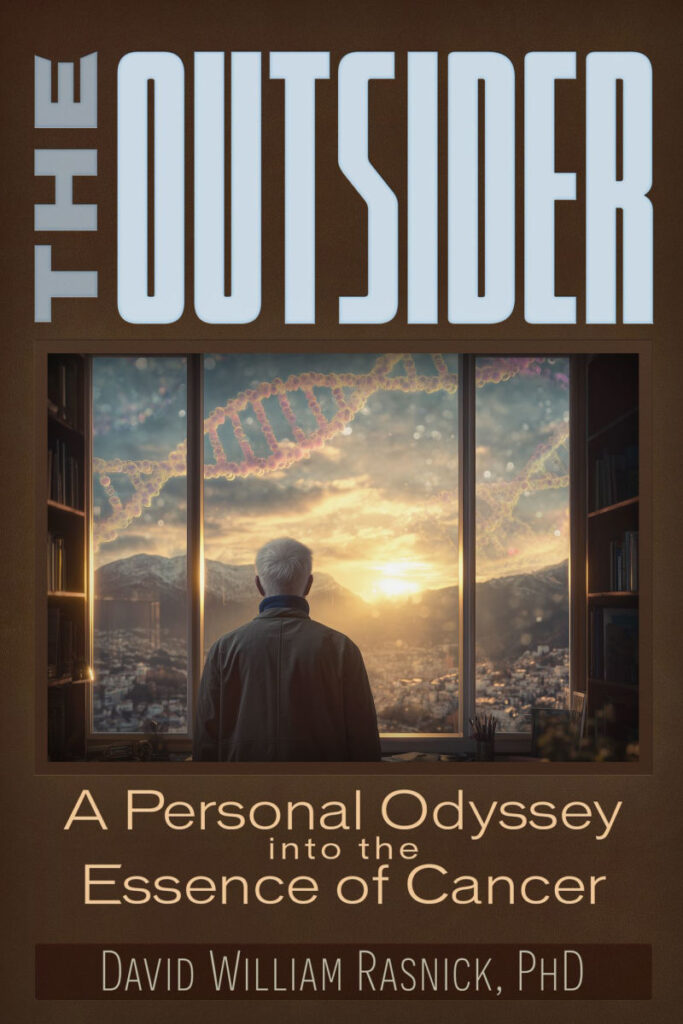












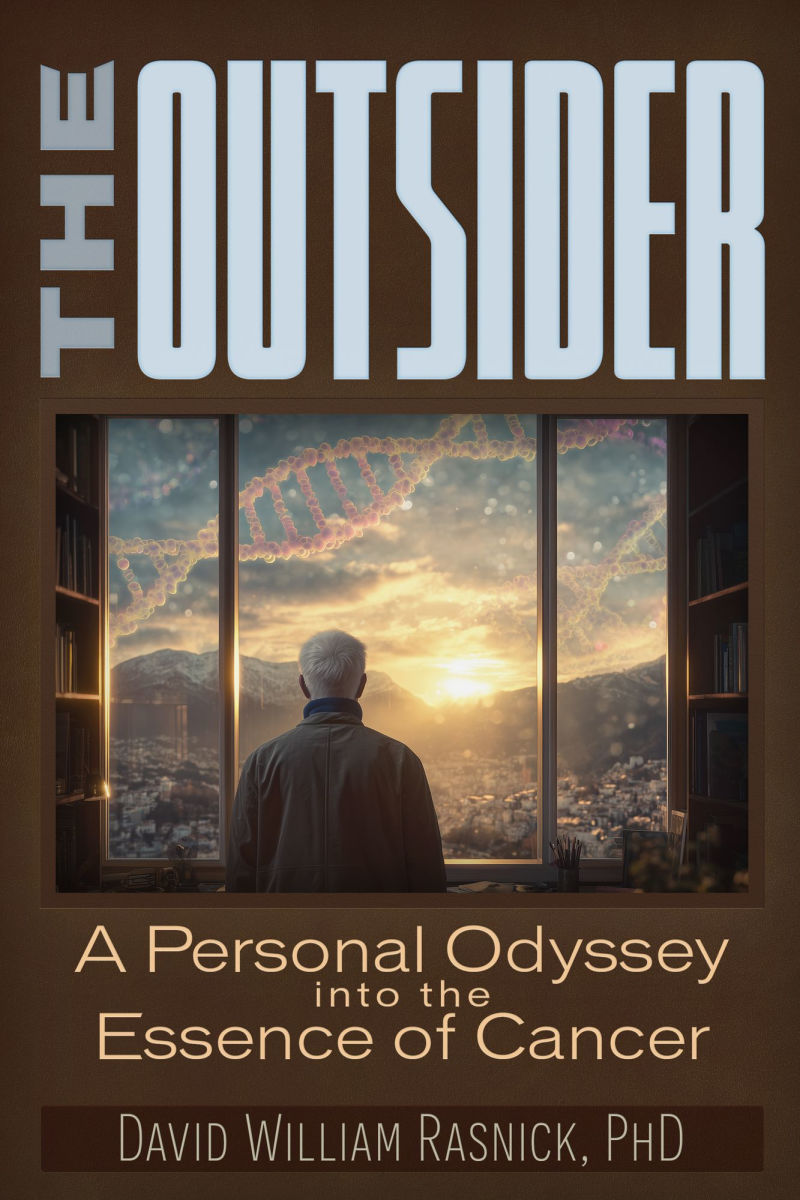
The Outsider
A Personal Odyssey into the Essence of Cancer
By By David William Rasnick, PhD
Book Review
The Outsider
A Personal Odyssey into the Essence of Cancer
May 8, 2026










“The charge of a scientist is to find the truth, to find the scientific basis of a problem.”
~ Peter Duesberg, PhD
By Jennifer Walters, BSN, RN, PHN, MFA
I was excited to review The Outsider: A Personal Odyssey into the Essence of Cancer, as I am a long-time admirer of the author. My journey into this field began after my son’s vaccine injury in 2008, which led to countless nights of research searching for ways to help him. Along the way, I discovered valuable experts like Dr. David Rasnick, whose website, books, interviews, and positivity became a guiding light—especially later during the difficult Covid lockdowns.
Rasnick’s book is not just about a scientific journey; it’s an invitation into the experiences that shaped him as a scientist. As he masterfully demonstrates, every encounter (whether challenging or rewarding) contributed to his pioneering chromosomal theory of cancer, a theory with the potential to save innumerable lives.
Let’s face it—the war on cancer has failed miserably. Cancer is becoming increasingly common, including among ever-younger people and even pets. Currently, the most common method used to understand and treat cancer involves sequencing the cancer genome to identify the genes responsible. However, numerous studies reveal significant diversity within tumors. It’s true: no cancer cells are alike! Finding the exact “bad gene” and fixing it with “gene therapy” are proving to be pretty much impossible.
One thing that all tumors do share is an imbalance in their chromosomes, a phenomenon called aneuploidy. Balanced and stable chromosomes are crucial to health, as even small deviations can increase cancer risk. Healthy human cells have a meticulously organized set of 46 chromosomes in 23 pairs, whereas cancer cells often exhibit a chaotic chromosomal landscape (typically containing 60–90 chromosomes), and that instability makes the cells increasingly susceptible to malignant changes.
To understand how Rasnick arrived at aneuploidy requires learning something about his formation as a scientist. That story opens just before Rasnick was drafted into the Vietnam War, an experience that profoundly shaped his views not just about war but about morality. Upon returning home, he pursued degrees in biology and chemistry, earning a chemistry PhD from Georgia Tech in the late 1970s. It was during a subsequent stint at Abbott Pharmaceuticals that he first observed the manipulation of scientific research and patient safety for profit. In Chapter 1 (“The Making of an Outsider”), Rasnick describes what happened during his second year at Abbott:
“I was part of a team that was supposed to turn the results of three Harvard professors into a general means of diagnosing cancer. As I recall, Abbott paid them five million dollars for the exclusive rights to their enzyme called galactosyltransferase isoenzyme II, which was hoped to be a universal indicator of cancer. The entire year was spent trying to duplicate the professors’ results. Abbott sent teams to Harvard. The professors came to Abbott. The diagnostic ability of isoenzyme II turned out to be a figment of the professors’ imagination. This was my first encounter with the unreliability of academic research.”
In 1980, Rasnick left Abbott to start a biotech company in California. He notes the significance of the 1980s/1990s time period to his story, “because this was … when the HIV juggernaut damaged the institutions of science and medicine in the United States, perhaps irretrievably.” Immersed in peptide research, Rasnick began regularly attending meetings of the Bay Area Peptide Group, a diverse group of academics and industrial scientists. Though the lectures were valuable, even more enriching were the informal discussions held afterward at a local Chinese restaurant. During one of those informal gatherings, Rasnick heard the first whispers of a mysterious illness affecting gay men, often young, with the condition characterized by unusual skin cancers and pneumonia more typically seen in elderly patients. At this time, the cause of the illness (later branded as AIDS) was unknown.
Some time later, the scientific community was astonished to hear Dr. Robert Gallo and HHS Secretary Margaret Heckler suddenly announce—at a press conference—the discovery of a retrovirus as the “probable cause of AIDS,” though there had been no prior hint of such a breakthrough. (Rasnick describes this event as the beginning of “science by press release.”) The government’s pronouncements—that AIDS had originated in Africa, was sexually transmissible, and was caused by a retrovirus called HIV—shaped policy, research, and public understanding for years to come.
As Rasnick describes here and in a later chapter, some scientists questioned the dominant belief that HIV caused AIDS. Kary Mullis (winner of a 1993 Nobel Prize for inventing the PCR technique) was skeptical, and even Luc Montagnier, the Nobel laureate who “discovered HIV,” could not provide definitive proof. Some were punished for daring to ask questions. Rasnick himself lost friends and colleagues for doubting HIV’s contagiousness, while the late Peter Duesberg lost his research funding after challenging the mainstream HIV narrative in a 1987 paper. Dr. Duesberg nevertheless managed to remain at UC Berkeley until his retirement, and in 1996, Rasnick left the pharmaceutical field to join him there, both focusing on the chromosomal theory of cancer.
Rasnick’s “lightbulb moment” came with the discovery of metabolic control analysis (MCA), a theory developed by Henrik Kacser and James Burns in 1973. Rasnick does a wonderful job of making this complex theory understandable to non-scientists like me. As a framework, he explains, MCA captures the interconnectedness of a living cell’s activities, illustrating how enzymes, substrates, and products relate to one another like links in a chain. MCA’s mathematical equations simplify complex systems, enabling analysis of large biological networks and how they adapt to changes or disruptions. As Rasnick writes in Chapter 4, MCA “is the first truly mathematical theory embracing the whole of biology. MCA provided the long-sought proof that only aneuploidy causes cancer. If there is no aneuploidy, there is no cancer.”
Chapter 5 elaborates on how chromosomal instability drives cancer’s progression. In a vicious cycle, aneuploidy (the wrong number of chromosomes) and general instability are mutually reinforcing. When chromosomes are unbalanced, cell division becomes challenging, prompting some cells into clever rearrangements that allow them to survive and continue dividing. This reshuffling further increases instability and produces a diverse cell population, fueling tumor evolution. Over time, the instability also promotes metastasis and drug resistance. Even a few drug-resistant cells can proliferate, which explains why chemotherapy resistance is so common and difficult to overcome.
As Rasnick takes pains to explain, genes can’t reliably predict cancer because genetic mutations don’t guarantee that cancer will develop; mutations linked to cancer can even appear in healthy cells. Relying on gene sequencing for diagnosis often produces false results and thus can be both misleading and potentially harmful.
A key part of Chapter 7 is its discussion of aneuploidy measurement and objective testing methods that can lead to accurate diagnosis, potential treatments, and the elimination of cancer-causing toxins. Aneuploidy measurement analyzes variation in chromosome numbers, which makes it possible to observe the progression from “normal” to “intermediate” to “cancerous” states. Tests like UroVysion, which uses fluorescence labeling, can detect aneuploidy in specific cancers. The Mayo Clinic and University of Utah utilize UroVysion for bile duct cancer, while the University of Texas employs it for pancreatic cancer, and researchers in Sweden have adapted it for mesothelioma detection. A collaborative effort involving the Mayo Clinic has successfully used it to diagnose and evaluate 42 cancers from diverse tumor locations, and other groups are exploring its potential for a range of cancers.
Rasnick suggests that studying spontaneous remission offers vital clues for both preventing cancer and treating it with non-toxic therapies. Cancer isn’t always an unstoppable force! It seems that spontaneous remission is more closely linked to changes in the host than to changes in the tumor itself, which could be a game-changer in how we approach cancer treatment.
William Coley’s pioneering work in cancer treatment during the late 19th and early 20th centuries, in which he ingeniously turned the body’s own defenses against the disease, illustrates the powerful impact of certain changes in the host environment. Recognizing the immune system’s potential, Coley developed “Coley’s toxins,” which were a unique blend of bacterial extracts designed to stimulate the body’s natural ability to fight cancer. This approach was rooted in his observation that some cancer patients experienced tumor regression following infections that caused high fever. To replicate this effect, he intentionally injected patients with bacterial toxins, inducing fever and triggering an immune response. In some instances, this innovative treatment led to tumor shrinkage and even remission, offering hope in an era when cancer therapies were otherwise limited.
Subsequent developments in Western medicine—including the rise of sterile surgical procedures, radiotherapy, chemotherapy, and the widespread use of antibiotics—gradually diminished the role of fever in cancer treatment. Now, however, hyperthermia treatments for cancer are regaining recognition, particularly in Germany but also in the U.S., and are often used alongside radiation and chemotherapy.
Rasnick also describes the decades-long ramping up of cancer screening—a source of substantial revenue for testing centers and surgeons. Discussing breast cancer screening, he notes that mammograms lead to an overdiagnosis rate of about 30%, leading women to be treated for cancers that would not have caused harm. In contrast to cervical cancer screening, breast cancer screening hasn’t resulted in a significant reduction in mortality. Additionally, mammograms expose women to radiation, a known carcinogen. There are also risks associated with biopsies and surgeries, which can inadvertently promote the spread of cancer in some cases.
Rasnick has numerous recommendations to make cancer research, prevention, diagnosis, and treatment safer and more productive. Where research is concerned, he urges the study of chromosomes instead of individual genes, the progression of aneuploidy in tumors, and spontaneous remission, all of which could be facilitated by funding more scientists (achievable through reductions in the size of individual research grants and the creation of competing funding sources). Additional suggestions include:
The profoundly moving final chapter (“The Life of a Dissident”) offers both heartbreak and inspiration, shedding further light on the unsettling targeting of scientists who challenge prevailing beliefs. These courageous individuals often face intimidation, professional isolation, and accusations aimed at discrediting them, fostering an environment of fear that suppresses independent thinking and pushes academics toward conformity. Rasnick provides more details about the severe professional consequences that Duesberg endured (showcasing the immense fortitude required of scientists who oppose mainstream perspectives) but also describes his friendship with Duesberg through their shared pursuit of the truth about HIV/AIDS and cancer. (Learn more about Duesberg and his book, Inventing the AIDS Virus, at his website.)
Rasnick then recounts how in January 2005, he embarked on what was supposed to be a two-year sojourn in South Africa with his wife Terri, accepting a position with the Dr. Rath Health Foundation to lead a clinical trial of vitamin therapy in patients diagnosed as HIV-positive. There, the couple encountered more political and professional obstacles, while gaining valuable insights about the intricate political landscape surrounding AIDS, including President Thabo Mbeki’s refreshing quest for alternative perspectives. Sadly, the trial was never approved, and the Rasnicks left early in July 2006.
Rasnick notes that because the CDC and other institutions following its lead put forth the narrative that South Africa was “ground zero of the AIDS epidemic,” this attracted “an alphabet soup of governmental and non-governmental AIDS organizations, HIV testing companies, and drug companies, all with a vested interest in the view that HIV, and only HIV, causes AIDS.” When he arrived in South Africa, over 400 clinical trials were underway; 508 were ongoing at the time of writing The Outsider. “All told,” Rasnick says, “there have been 2,538 clinical trials inflicted on the people of South Africa after they freed themselves from the tyranny of Apartheid.”
Rasnick shares a revealing story about a patient named Zola and a physician named Dr. August, encountered at a clinic in a poor township in Cape Town, which illustrated the superiority of nutritional approaches as compared to antiretroviral drugs:
“In addition to treating specific diseases and complaints, Dr. August provided each of his patients with a supply of fruits, vegetables, juices, vitamins, and micronutrients for life, compliments of the Rath Foundation. Most of the non-trauma complaints were diseases of malnutrition: fever, diarrhea, skin rashes, TB, depressed immune systems, and wounds that won’t heal. We [saw] with our own eyes the dramatic improvements due to good nutrition…. Zola [had] experienced symptoms of weight loss, night sweats, and coughing. She consulted a clinic and was diagnosed with [TB] and tested positive for HIV. She was advised that after finishing her TB treatment, she should start taking antiretroviral (ARV) treatment, but she objected because of the side effects of the ARV treatment. By that time, she had developed symptoms of full-blown AIDS, including a deep neck ulcer that would not heal, and she eventually developed a severe infection. She also had pain in her legs and other parts of her body. She went to Dr. August for treatment with the toxic drugs. Soon after she started the nutritional program at Dr. August’s clinic, her body pain stopped, and she gained weight. The infected wound began to heal, and after one month, it had completely healed.”
As The Outsider next describes, a vicious fight ensued between the activist and drug-oriented Treatment Action Campaign (TAC) and the Rath Foundation, eventually leading to a ruling by a South African judge that had unfortunate consequences. The judge expanded the definition of “medicine” to include vitamins, which made the distribution of vitamins and micronutrients subject to regulation by the Medicines Control Council. The judge also broadened the definition of “selling” to include donations. This led to the Rath Foundation and others being found guilty of distributing vitamins without proper authorization and conducting unauthorized clinical trials, a reversal of the South African government’s previous stance endorsing the use of nutrition to combat AIDS. I feel terrible for all those people who could have experienced improvement and healing with good food, vitamins, and minerals.
Rasnick’s wife’s journals offer a more poignant glimpse of their South African adventure, beautifully capturing both their professional endeavors and personal awakenings. One entry describes a day when they drove their assistant home:
“Just inside, we passed long rows of concrete structures, standing on end, looking like empty coffins. They were for toilets (outhouses) yet to be installed…. The shacks were made out of found metal sheets…. Some had the painted advertisements on them from their previous purpose…. Each plot was 80×100 feet…. When we arrived at [the assistant’s] house, we thought we would just drop him off, but he said we must come in. He wasn’t ashamed of his place…. His house is an L-shape, with one leg the kitchen area, using a kerosene stove for cooking, and the other is the sleeping area. He had a mattress and box spring, but no sheets. Just some kind of cover…. The poverty was overwhelming…. He told us that the area of Soshanguve was divided. On one side, people had toilets, and on the other, electricity. He lives on the side with electricity…. It runs up to his house, but he doesn’t have wiring inside and has not paid for the electricity to be turned on. He is located near a potable water tap, so he feels he can get fresh water quite easily. There used to be an outhouse at his place, but the company that was contracted to put in the sewage line for the future toilets destroyed it. Although it seems impossible, this made them even poorer than they were before! He said the money just ran out for the contractors, so the work just stopped. Thus, the lines of ‘coffin’ toilets. He says the government gives empty promises.”
An interesting section discusses Rasnick’s participation in efforts to launch a company called Viral Forensics. The goal was to develop methods to concentrate and purify virus samples, using transmission electron microscopy (TEM) analysis, and to demonstrate or refute whether viral particles could be directly observed in human specimens. (Just reading that sentence must have had big pharma quaking in its boots.) Having identified flaws in viral load testing and remarked on the absence of direct virus detection in specimens, the intent was to support legal cases, and notably to challenge the presence of viruses associated with HIV as well as hepatitis C (HCV) and human papillomavirus (HPV). However, the company encountered significant challenges, including a lack of available reference viruses and legal pressures on collaborators at the University of Massachusetts. It also struggled to secure resources and had a lab lease at the University of Greensboro abruptly terminated. By 2017, Viral Forensics was over for good. (Was something about to happen in 2020 that precluded the existence of a company able to “demonstrate whether viral particles could be directly observed in human specimens”? Hmmm….)
On the bright side—and that is where David Rasnick likes to be—the end of Viral Forensics gave him the chance to complete his book (started in 2014) and help us fight Covid nonsense for the past six years.
The Outsider is essential reading, distilling complex subjects into accessible insights while fostering a deep connection with Rasnick’s passion and empathy. It’s also a practical guide for embracing love and remaining steadfast through adversity! Everyone should have two copies in their library: one to keep, the other to loan to friends and family. Also, don’t forget to tell your local library to order a copy. At Solari, we are immensely grateful for Rasnick’s service to the people of the world.
The Outsider: A Personal Odyssey into the Essence of Cancer by David William Rasnick, PhD
David Rasnick, PhD (website)
Centrosomal Amplification and Aneuploidy Induced by the Antiretroviral Drug AZT in Hamster and Human Cells (article by Borojerdi et al. indicating that AZT causes cancer)
Turbo Cancer (David Rasnick discussing turbo cancer on the Vaxxed bus)
Retroviruses as Carcinogens and Pathogens: Expectations and Reality (by Peter H. Duesberg, Cancer Research, 1987 Mar 1;47(5):1199-1220)
Issels Immuno-Oncology Fever Therapy (Coley’s Toxin)
Environmental Working Group (EWG) (information on carcinogens in products, food, and water)
Already a subscriber?

Our mission is to help you live a free and inspired life. This includes building wealth in ways that build real wealth in the wider economy. We believe that personal and family wealth is a critical ingredient of both individual freedom and community, health and well-being.
Nothing on The Solari Report should be taken as individual investment, legal, or medical advice. Anyone seeking investment, legal, medical, or other professional advice for his or her personal situation is advised to seek out a qualified advisor or advisors and provide as much information as possible to the advisor in order that such advisor can take into account all relevant circumstances, objectives, and risks before rendering an opinion as to the appropriate strategy.
Be the first to know about new articles, series and events.
Your cart is currently empty!
Notifications