Ladies and gentlemen,
welcome to the Solari Report.
My name is John Titus.
I’m the co-host and co-producer of Money
and Markets with Catherine Austin Fitts.
I also have my own video
channels on several platforms,
YouTube, Odyssey, and Bitchute.
That channel is called Best
Evidence on All three Platforms.
This special report of the Solari Report.
This production in fact, is going to
appear on best evidence my channels,
one month after posting on Solari dot
com, which will happen on December
18th for Solari and roughly January
18th of next year on, on my channel.
Today I am joined.
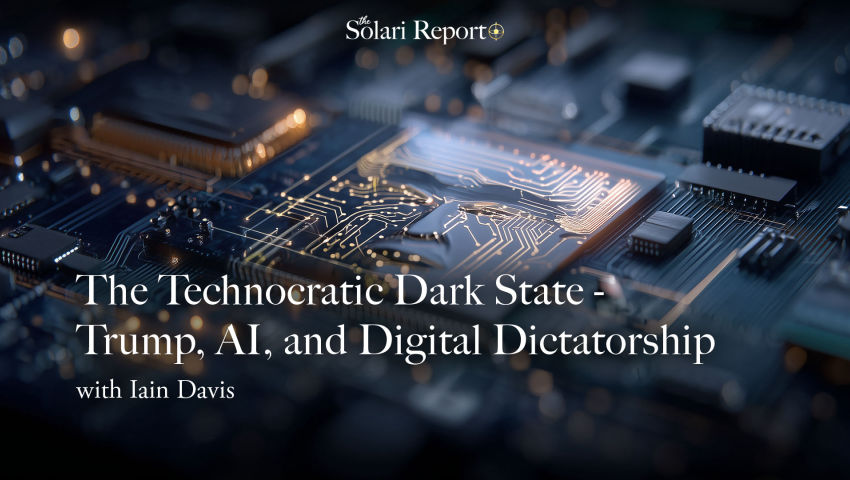
By Iain Davis, who has just
published a terrific new book
called The Technocratic Dark State
Trump AI and Digital Dictatorship.
I can
tell you, as I told Iain
when we talked about this book,
it’s one of two books that I’ve read
cover to cover in the last 20 years.
It is absolutely masterful summary of
what the tech bros have been up to.
I’ve been watching
’em what are they up to?
This Iain’s book nails it and
describes in excruciating detail
what they’ve been doing over the
last 20 years and really beyond.
There’s several examples from the late
nineties where everything fits into
place when you read this book and the
book is very thoroughly researched and
very well written.
Iain understands how to
write and it paints a very dark
picture of the digital plantation
that we’re all headed for unless we
get together and slam on the brakes.
To avoid the nightmare described in
his title, the title of the book, the
Digital Dictatorship, Iain is here today.
I’m
pleased to report to talk about this book.
When you see Iain, you will notice that
he has two i’s and so
does the spelling of his
name, Iain.
It’s IAIN Iain Davis, a name you will
want to familiarize yourself
with.
You can find Iain’s work@iaindavis.com.
Iain’s
published work has also
appeared@offguardian.org and
unlimited hangout.com, as
well as UK calm.org.
Iain is also a member of
the
Independent Media AllIaince,
along with Catherine
Austin Fitts and James Corbert and Richard
Grove, among others.
Iain, welcome to the Solari
Report.
Thank you very much for inviting me, John.
It’s a pleasure to be here.
It’s good to talk to you in
person and do an interview.
This is my first ever
interview that I’ve done.
For my website or for my YouTube
channel, for my video channels.
It’s also the first interview
I’ve done for Solari dot com.
So you’re my first interviewee.
You have to take it easy on me.
But it’s a pleasure to talk to you.
’cause I really your book really your
book helped me understand the world.
Cause I tended to ignore these guys.
These guys, these tech bros annoy me.
I’ll get into that.
And this book really describe,
I should not be annoyed.
I should be paying a lot more attention.
Your book has helped me.
But let me cut right to, I wanna
go right to my favorite part of the
book, which addresses money creation.
This is the part where
it’s oh, okay, I get it now.
But let me say this.
The people with the power to create money
at a thin air, they’re in control now.
They’ve been in control
for several centuries.
Their private parties.
And so my initial question is why
do they why do these, the old money
people, let’s call ’em, even tolerate
the tech bros who are offering crypto
schemes, especially stable coins, to
compete with the money issuance of
banks and central banks, frankly, why?
In other words, why don’t the monetary
powers that be just used in the US
the Department of Justice to snuff out
these would be tech bro competitors the
same way they killed prosecutions and
investigations into Wall Street in the
wake of the global financial crisis?
What, in other words, what are the tech
bros offering to the old money powers
that those powers don’t have already?
Yeah they’re offering essentially
they’re offering a workaround
for the US Constitution.
They.
The plan is clearly that they want
an international, a digitally, a
tokenized digital, international
monetary and financial system.
And in most places around the world we
have fully independent central banks.
So if we look at, for example, the
European Central Bank, it’s in there,
it’s in there, found in documents that
they literally state, no, no government
has any control over us whatsoever.
In fact, I think it’s part of their
documentation where they say, we will
not take any advice from any government.
So they are firmly independent,
other central banks around the world.
Certainly if we look at the Bank
of England, that’s independent
by virtue of its royal charter.
Where that situation exists.
And if we then look at and if we then
look at who controls Central Bank,
those kind of independent central banks,
it’s the private sector, it’s the,
it’s generally the major shareholders
of the leading commercial banks.
But nonetheless, while that
situation exists, they can create an
independent, privately controlled,
tokenized digital, international
monetary and financial system.
The situation is not quite the same in
the US as your excellent research pointed
out because constitutionally speaking,
the issuance of currency is theoretically
controlled by the people through Congress.
So you can’t have this total control of
this tokenized digital monetary system
using a central bank digital currency.
With the US and obviously
the US is probably the most
important economy in the world.
It’s got the world reserve currency
or the dominant reserve currency.
And so that’s a problem that, that is
a problem if you want a privatized,
tokenized digital, international,
monetary and financial system.
What the the tech bros that I
refer to in the book as neo nerds.
What they have offered is a
workaround through stable coins.
And the Trump administration has most
certainly obliged with the Genius Act
because the Genius Act by determining
that these stable coins are not a
national currency and they’re not an
asset class, therefore they’re not
subject to oversights by the Securities
And Exchange Commission has set these
firmly outside the reach of, in this
case, Congress and the Constitution.
But they are, they’re
called payment stable coins.
They are backed the they’re effectively
backed one to one by the dollar through
treasuries and other dollar instruments.
They are in every single practical sense.
A digital US dollar, they can be
exchanged one for one for the dollar.
Internationally.
Stable coins, if I’m understand what
you’re saying correctly, they spend
just like money in our bank account.
Yeah.
They’ll be spent just like that.
They’ll be used just as you would
use, just as you would use the dollar.
Now you can purchase goods with it
and even to the extent that, which,
that they’ve got bridging systems now,
which is something that the bank, bank
of international settlements has been
very keen to to put into place bridging
payment systems that enables you to use
a digital dollar as you would use the
dollar if you had a bank payment card
and paid for a product or service.
In the High Street or on Main Street.
So it’s not just about
online transactions.
You’ll also be able to spend them via
intermediary payment service providers.
In a in a shop or in a store.
So that, that, that’s such a great
point that ultimately what the tech
bros are offering to the powers that be
is an end run around the constitution.
So right now, under the currently
configured US monetary system, we, the
people in theory and legally we have
some measure of control over the money
issuing entities both over the Fed at
the wholesale level and over the banks,
the commercial banks through the FDIC and
through the office of the ER currency.
What you were talking about with
stable coins and with crypto is the
money issuance from private entities.
And I know this because in fact
I’ve been trying to learn about
stable coins and crypto and so I’m
like okay, I’ll just go to legal
treatises and start reading case law.
On stable coins and exchanges and all
the rest, and there is no case law.
It is completely private, it is
completely dark, and transparency
is an issue that we’re gonna
touch on later in this interview.
But that’s great.
But don’t, is there is one other feature
of the monetary control and stable
coins and digi and digital money and
tokenized money that is offering an
advantage to the old line money powers.
And that is, from where I’m sitting,
it doesn’t digital money, fully
digital money offer to the powers
that be a way of controlling debt
that might otherwise spiral out of
control irreversibly and fatally.
No, absolutely.
And I would suggest that’s very
much why they are so desperate to
get this new international monitoring
financial system up and running.
Because if we look at let’s say that
the estimated officially acknowledged
global debt is 320 trillion, and of
which about 40 trillion, I dunno what
it was this morning, but 39 trillion
or whatever it was, is US debt.
US public debt.
That’s public debt, not
private debt.
Yeah.
Yeah.
Not private debt.
Yeah, just public debt.
So then if you look at the if you then
add into that the nominal value of the
potential debt in the derivatives market,
then you’re looking at, some people
say one quadrillion, some people say.
Who it’s it’s debatable what that
is because as is, as was noted when
they looked at what happened during
the 2008 financial crisis, much of
that trading is over the counter.
And I think the investigating committee
that looked into it, which might
have been the FIDC, I can’t remember
that looked into it, actually said
that this is it’s unknown trading.
We dunno, it’s not talking
about transparency.
There isn’t any
They don’t know it.
It’s so in other words, you
don’t ever really know at any
given time what the money supply
is, how big the money supply is.
Yeah.
Now somebody knows, but it’s not
anybody in the public who knows.
And so this, when I read this in
your book, I was like this is, this
explains a lot because I’d seen LAR
review article by someone nominated to
be the head of the office of the comp,
control of the currency here in the us.
Then the LAR review article said, listen,
when debt, because money is issued, is
debt and debt can get outta control.
One thing you can do with a central
bank digital currency, which is an
alternate form of what we’re talking
about with stable coins, what you
can do is you can simply delete
money out of people’s accounts.
Yeah.
And so it’s a system of total.
Control that you’re
describing in your book?
Yeah.
No, it’s, it is total control.
You can delete money, you can
set the duration on money.
You can control where and when it is
spent sim simply through programming
it, through literally programming it.
And one of the great ironies I think
from a us the population’s
perspective in terms of electing Trump
is that he made a great deal of opposing
central bank digital currency because
quite rightly, a sizable number of
the population were very concerned
about that, and rightly absolutely.
But what he’s offered.
Instead what he’s gone ahead and done
instead through an executive order,
which is one of the first things that he
announced when he first came into office
is to create the, for want of a better
expression, the enabling environment,
the legal, like enabling environment for
stable coins, which are arguably worse.
They’re worse.
I was, one of the questions
though, why are they worse?
Why are they, because it relates right
back to what you were saying earlier,
because there’s no oversight,
there’s no control.
They’re privately issued
there’s no control of them.
Where, and I think because I asked
myself a question and it was really in
researching this book that I think I’ve
answered that question for myself and
hopefully for others, is that I couldn’t
understand why the US wasn’t on board
with Central Bank Digital Currency.
I was thinking, what’s going on?
Why are they your work?
Actually, yeah.
Started making me think ah there’s
a problem here with the constitution.
And then I looked at that as well,
and then it, then I rea ah, this, that,
that’s why the US has never been really
on board with Central Bank Digital
currency because of this problem.
They’ve been dragging their
feet of co compared to everybody
else in the, across the globe.
Yeah.
So that sort of wraps up why tolerate
the tech bros? What are they up to?
What do they offer the
old line powers to be?
I wanna move on to a concept you discuss.
And that I thought
was bogus for a long time.
I thought it was a buzzword.
Your book discusses
interoperability at length.
Before I read your book, I thought
that was simply interoperability.
That’s another buzzword,
but it really isn’t.
So why don’t you tell us what
interoperability is and what
crucial functions does it perform?
This goes to the heart of deceit
which is a big theme in the book.
Basically interoperability links.
What they call disparate data sets.
Now, those data sets could
be pertaining to anything.
So it could be a data set of digital
identity or a data set of a digital
ID product, which is a separate
card such as the REAL ID system,
although that is linked in the US
to Ient, which is a, which is the
kind of bigger overarching system.
Or it could be financial, it could
be a financial tokenized product.
For example, if you think
about your driving license is
issued that is controlled by
the issue of the driving license.
It is not linked to your bank card.
Your bank card is issued by a private
commercial bank or a payment provider.
The two things are not linked.
They’re not linked.
What?
Interoperability.
And if you look at what the Bank
for International Settlements has
been doing over the last 10 or more
years, it has been obsessed with
this notion of interoperability,
creating an interoperable system.
What that means is the data set
from your driving license so that
everybody’s can be linked via.
Usually via software such as Palantir,
Gotham or something like that, to
the data set from your bank card.
Your bank card.
So these two things can now
be linked into one unified.
The, what they’re looking to do that
is is a unified ledger of some sort,
whether that’s gonna be blockchain
or some other form of ledger,
while interoperability is in its infancy.
So is just security awareness.
And I think unfortunately
interoperability is accelerating a
little faster than security awareness.
And so it’s being done in a
dangerous way in a lot of times.
That’s an interesting point because EMRs.
Electronic medical record systems
have security controls, but what it
boils down to is the person setting
this thing up, doing it correctly.
Have they turned on the right settings
and turned off the wrong settings?
And the, i the answer according to these
2000 you says are exposed, obviously, no.
Now that what they’re trying, what
they have been trying to do on a
global scale for this digital,
international, monetary and financial
system is create interoperability
between all currencies, interoperability
between all digital currencies.
So yet the first thing they need
to do is convert the existing fiat
currencies into digital forms.
So that’s where outside of the US that
was very the favorite way of doing that
is through, or the favored way of doing
that is central bank digital currency
in the US For the reasons we’ve just
discussed, that was slightly problematic.
Therefore it’s stable coins in other
parts of the world, it’s deposit tokens,
but it all amounts to the same thing.
It is the digitization of existing
monetary sys of the existing monetary
systems whilst maintaining the
difference between currency.
So you still got a dollar
version, a a sterling version,
a Euro version, a yen version.
You’ve still got this, these
different distinctions, but through
interoperability and which converts the
transactions made into a single unified.
Standard for example, for
digital information exchange.
So one of the things that the
BI has worked on quite a lot,
I think it’s Project Juno,
is to introduce ISO
20022 standards for all
financial information exchanges.
Now, when in the digital world it’s easy,
it’s relatively easy to make transactions
in one currency, interoperable with trans,
with the transaction in another currency.
So if we’re talking about business
to business transactions globally, if
you are buying goods and services,
or if you are buying, say, commodities
from, or products, manufactured
products from China with the dollar.
You don’t have the problem.
It, what interoperability does is
remove the settlement, the clearing
and the settlement, and the delays
and the costs that are associated
with that and makes the transaction
instantaneous across borders.
So what that means is if you are
purchasing products from China into
the us, you can pay in dollars in the
us and that will be instantaneously
via interoperability received in
Rebi or whatever in China, without
any kind of sent any, they say,
without any kind of intermediary.
But of course, there is an
intermediary and that is the
permission block, universal Ledger,
which will be controlled globally.
Centrally.
Yeah.
Isn’t it true that one of
the features of stable coins.
That being interoperable with
the current monetary systems.
The stable coins spend
spend like dollars.
And so they’re interoperable with the
monetary system we have now, which is
two-tiered, it’s central banks on top
and it’s retail banks on the bottom.
Doesn’t the interoperability of
stable coins with the current system
offer to the US powers that be a
way to soak up more US debt, which
we obviously know is exploding?
Yeah, no, absolutely.
There in, I mean if you think
about the hesitancy that countries
have shown in recent years to take
on US debt, for example, Japan,
that makes the US debt situation,
which is precarious enough as
it is even more precarious.
So what’s by issuing your own
stable coins, if you like, although
these will be privately issued as
we’ve said, they can absorb debt.
They’re back, they’re backed by,
mainly they’re backed by treasury.
So they all they can
automatically absorb debt.
Now the projected value of market
cap of for stable coins, I think by
2035, and I may have got that wrong.
It might even be sooner.
It might even be about 20, 30 is
four.
I think it’s 2030.
Yeah.
Yeah.
It’s 4 trillion.
So that’s 4 trillion of debt
that can be siphoned off into,
if essentially into a new market,
into a new, into the stable coins.
And that would be, that’s a market, to be
clear, that exists as far away as Senegal.
It’s around the world.
Yeah.
People will be using us stable coins.
Yeah.
But if you think that the rate at
which the debt is in increasing and
I think the Trump administration was
the first administration to have a $1
trillion deficit within the first quarter.
So that the debt’s going
up, cons quite fast.
While stable coins, in my view, offer
a short term debt release valve,
and they def they definitely do.
I think if you look at what they’ve
got planned for a globalized, tokenized
digital economy, that is ultimately where.
Debt will be absorbed.
It will just be consumed.
Currently if they’re, if the tokenized
economy that, that, that is envisaged
certainly by the bank for international
settlements and its International
Central Bank partners, if they if
that achieves the potential four to
five quadrillion global economy that
they are suggesting by tokenizing
everything, including us, all of us
then obviously an official debt
of around let’s, for argument’s
sake, let’s call it 500 trillion.
It’s gone.
You, that you’ve solved that problem
between if you look at it from a
balance sheet perspective currently your
liabilities far outweigh your assets,
but you just can create new assets out
of the thin air by tokenizing everything.
And then you flip that on its head and
suddenly you haven’t got a debt problem.
And you have no problem.
There’s no impediment to doing any
of this if there’s no transparency.
True.
Yeah.
Yeah.
No, none.
So there’s no pushback.
There’s no feedback loop that
we’re talking about here.
It’s open loop control by
a bunch of technocrats.
Buy a bunch of billionaires of the
entire population with no, there,
there’s the issue of consent goes out
the window under what you’re talking
about, which is digital dictatorship.
True.
Yeah.
Yeah.
Yeah.
I wanted talk to on that note about
the, really the first part of the
book the indeed the first chapter.
You talk about technocrats and you
talk about the dark enlightenment.
I think I’m pretty sure people
who are watching c and watching my
channel best evidence, they have
a decent feel for technocracy.
And I’ll touch on that in a minute but
more importantly now is why don’t you tell
us what you mean by dark enlightenment?
Because that was a term that was new
to me and required some explanation.
So what is dark enlightenment?
What is that all about?
It was a treaties that was written by a
UK philosopher, a guy called Nick Land
that worked in the cybernetics culture
research unit at Warwick University.
And they were just toying with the
notion of the singularity, which is
the the point at which technology
becomes self perpetuating and
outstrips our ability to adapt to it.
And what that might, how
humanity might cope with that.
So they were very interested in Joseph
Schumpeter’s economic idea of creative
destruction, which it, which means, which
shater applied this purely to markets.
But what Shater meant was that a
market gets destroyed by technology.
For example a very easy one if you think
that the market for the steam railway
gets destroyed by the diesel engine.
That’s a very simple.
Analogy but you get the idea.
So they thought that creative
destruction could apply to all markets
for sure, but it could also be, but
rather than what Shumer described was
an effect of capitalism, either I,
capital investment in technological
development, created this situation.
What they thought was that you could
apply that to deliberately cr destroy
markets and seen as markets have
sociopolitical connotations, the
people that control markets monopolists
they have sociopolitical power.
You could therefore apply this
to the wider sociopolitical in
the wider sociopolitical sense.
So you could literally con, capitalism
could be freed up and utilized
as a tool to control not just
economic activity, but all kind of
sociopolitical structures as well.
Now that was an idea that
they were toying with.
But what they then came up with the dark
enlightenment is that as a product of that
idea, that underlying idea is horrific.
So they thought that the
singularity presented such a threat
to humanity that they, and I’ll
have to say that is an assumption.
That is an assumption that they made.
Therefore, our only
solution is to adapt to it.
And we can only do that
through transhumanism.
We have to become genetically engineered
cyborgs in order to cope with the assumed
approaching singularity that government.
Only serves to stifle innovation.
And the most important part of
creative destruction is that
innovation is unfettered and
free and allowed to flourish.
Therefore, government should
be done away with completely.
And innovation should be handed
to private corporations.
Private corporations are, were best
placed to undertake this revolution
in this global revolution.
And therefore private companies
private corporations should rule
unchallenged and unmolested by
any kind of democratic oversight.
At its core, the Dark Enlightenment
is a political and philosophical
movement that challenges some of the
foundational ideas of modern society.
The term itself was popularized by
British philosopher Nick Land in the
early 2010s, but the roots go deeper.
The core ideas were first
developed by American Tech theorist
Curtis Jarvin, writing under
the pseudonym Mencius Mold Bug.
Starting around 2007, through
his influential blog, unqualified
Reservations, Jarvin laid out a radical
critique of democracy liberalism and
the modern state proposing instead,
a return to centralized hierarchical
governance modeled on corporate systems.
Vin’s Central argument is that modern
civilization, especially in the West,
has been steered into stagnation
and decline by a rigid, overly
idealistic belief in
egalitarIainism and mass.
Participation.
According to this view, democracy is
not the pinnacle of political evolution.
It is a system that masks
inefficiency, encourages manipulation,
and creates the illusion of
choice without any real control.
Jarvin introduced the idea of neoism,
a political model in which a nation
state functions like a joint stock
corporation run by a CEO, accountable
only for performance, not popularity.
In this model, the government is not
elected, but managed like a business to
many, it sounds dystopIain to others.
It sounds
like a brutally honest assessment of how
things already work behind the curtain.
This worldview also gave rise
to one of vin’s most infamous
concepts, the cathedral.
In his framework, the cathedral
refers to the intertwined network of
elite institutions, including media,
academia, and bureaucracy that shape
cultural and political narratives.
This system according to Jarvin
controls society, not through laws
or force, but through ideology,
consensus, and cultural pressure.
It is not orwell’s boots
stomping on a face.
It is soft power that feels like truth.
Nick Land known for his cyberpunk,
fused Accelerationist philosophy,
took vin’s ideas and pushed them
further Land gave the movement
its name, the Dark enlightenment.
His writings injected a darker,
more philosophical edge.
Tying these ideas to themes of
posthumanism automation and the
collapse of liberal ideals in the
face of accelerating technology.
Some in this school of thought,
advocate for exit strategies.
Such as private digital societies,
independent city states, or breakaway
corporate enclaves where governance
is optimized, not voted on.
Others envision a world where technology
replaces outdated institutions altogether.
It is a blueprint for governance
in a time of increasing
distrust and systemic breakdown.
But what makes the Dark Enlightenment
truly unsettling is not just its ideas.
It is the mirror.
It holds up to our current reality.
It forces uncomfortable questions.
Are we truly free, or are we just
choosing between scripted outcomes?
Are democratic leaders really
accountable, or are they figureheads
managed by deeper forces?
And if the system is
failing, what comes next?
These are not conspiracy theories.
They are the kinds of questions
rising quietly in a culture that
feels increasingly unstable.
It is important to be clear.
The dark Enlightenment is not a mainstream
ideology, and many of its conclusions
are controversial and provocative.
Critics argue it
promotes authoritarIainism,
social stratification,
and a rejection of basic civil liberties.
And yet its critiques of political
stagnation, media control, and the
illusion of democratic power resonate
with growing numbers of people who
feel the system no longer serves them.
The theory is a window into a
radical re-imagining of power.
One that suggests our current systems
might not be sacred, just outdated.
You do not have to agree with it,
but understanding it might help
you recognize where some of the
world’s deeper currents are pulling.
Stay curious because the future might
not look like the past and some people
are already coding what comes next.
And that’s where all this is headed.
And I wanna read a section from chapter
one of your book from page 12, because
it was so on point and it was like the
penny dropped there because this process
that you’re talking about, which is hiving
off public functionality and basically
constitutional sovereign functions,
carving them off and distributing them
to private parties who are opaque.
That’s going on right now.
And I wanna read just a
couple sentences from the book.
The sort of oh, okay,
I see what’s going on.
Given that Elon Musk was neither
elected by Americans nor authorized
by the representatives in Congress,
the Doge projects represents a
formal shift in political power from
the public to the private sector.
It is fundamentally a private sector
dominated, think tech openly empowered
to restructure fund federal agencies.
And it goes on A technique would
afford its leading figures,
pecking order privileges.
So it’s that this process
is already underway.
True.
Yeah.
Yeah.
No, it’s and it’s, and I have to say
it’s not just in the us It’s everywhere.
Yeah.
And then it continues.
I wanna go on page 13.
This gets into technocracy and sort of the
more non-obvious features of technocracy.
Technocrats.
Unelected technocrats
rather than politicIains
set policy and technocracy
is based on the belief that there are
technological solutions to awe, social,
economic, and political problems.
Yeah.
Yeah.
That’s what we’re seeing
going on right now for sure.
Yeah.
And there is a massive overlap between
the dark enlightenment and technocracy.
If you look at the dark
enlightenment, the way that they
suggest that sovereign corporations
would be in charge of a realm.
And that there would be a
patchwork of realms controlled
by sovereign corporation.
So they’re talking about breaking
up the nation state into a
patchwork of realms, right?
And creating a kind of a
kind of network of realms, a
patchwork of realms, they call it.
If you, if, and that would be totally
controlled by sovereign corporations.
And the land spoke about this thing
called gov Corps, which would be the,
it’s not entirely clear, I have to say.
One of the reasons that I wrote the
book is because most of the things
that they say is not entirely clear.
So you really have to dig into
the weeds of it to figure out.
They use a lot of jargon and they
use a lot of, they even use words
that people don’t even know, like neo
caramelization and re territorial and
all this sort of jargon that they use.
But essentially what it boils down
to is smashing the nation’s state
apart, carving it up, selling it off.
Piecemeal to private corporations,
then reconstituting, constituent
that into a network.
Yep.
And then ruling that in
a is set, having a
centralized authoritarIain
control over that,
that is what they intend to do.
And if you look and if you look at what
a tech mate is, that’s pretty similar.
Okay.
So from an American point of view,
what you’re talking about, the
net effect of these changes you
just discussed, is they want to
destroy the consent of the governed.
Is that fair?
Yeah.
They think Lan said that our sovereignty
should be treated with derision.
Wow.
So we are nothing.
We are nothing.
To the, in their mindset.
If that’s right, they wanna destroy
the consent of the governed.
In other words, you have no sovereignty.
Your sovereignty is a joke.
You are an asset on our balance sheet.
Yeah.
Really what you’re talking about from
American point of view is just the open
repeal of the Declaration of Independence.
That’s what the whole Revolutionary
War was fought over was.
You are ex, you exerting control over us.
You’re punitive you punish us, you
steal our assets and all the rest.
And we have no say of it.
We try to have a say and
we don’t have any say.
And that was what causes revolution.
So this is a very it’s ironic,
and I’ll get to this in a bit,
that it, that an Englishman is
writing about the destruction of
the Declaration of Independence.
Yeah.
Why didn’t this book come out of the us?
I don’t know.
I’m not blaming you or anything anyway.
I wanna turn to another subject though.
And that’s a gut feel I get when
I watch a lot of these tech bros.
When I see a guy like Peter Thiel.
He can’t get through a sentence
without getting tackled to the ground.
It’s even simple sentences.
He just, he can’t do it.
I see Bill, Gates flailing about,
talking about topics that he
knows absolutely nothing about.
Like he’s a supreme authority.
I was glad to see in light of
that sort of gut reaction you
guys are pulling a con on me.
My gut feel is I’m being conned here.
I’m watching an act.
And so I was glad to see in your
book, very heavy stress that you
put on the topic of deceptions and
deception and deceptive practices.
Talk about the role of deception
and what the role it plays.
And maybe a couple of examples of
deception that we see in real time
from the dark net technocrats such as
ChristIainity and their push for
the push in
ChristIainity here or
libertarIainism there.
Te tell us about the role deception
plays in those ultimately con jobs.
If you think about what you’ve just
noted there about the Dark Enlightenment,
the idea that it essentially just
destroys the Declaration of Independence
and everything it means to be a
sovereign individual, human being.
It’s the end of it.
That’s what they’re, that’s
what they’re talking about.
And yet the people that say they
support this, I have a slight segue here.
I did question in the book whether
they really believe in things
like the dark enlightenment.
They openly support it.
People like Mark Anderson
said, I am an accelerationist,
or no, I’ll rephrase that.
He said, we are accelerationist,
which means that they believe
in the dark enlightenment, but.
Whether they actually believe it or
whether it’s just expedient to say that
they have some sort of quasi intellectual
underpinning for what they’re doing.
I don’t know.
I question that, but nonetheless, they’re
openly supporting such a thing as the
dark enlightenment, which is just about
the most authoritarIain, fascistic kind of
model of governance that
you could possibly imagine.
Why don’t we just come right out and call?
It is it’s a plantation.
That’s what they’re pushing
is a plantation and they’re
calling it libertarIainism.
They are
calling it libertarIainism.
It’s
and I have to say getting
away with it as well
and getting away with it.
So deception is part and parcel of
this push towards digital dictatorship.
Absolutely.
Yeah.
One of the things that I also explore
quite a bit in the book is this
notion of the decentralization to
recentralization trick, which people
like Bella Za, who wrote the network
state they tie themselves in.
And one of the reasons that I think
people like the, and stumble over very
simple questions is because if they
were honest about what they’re doing,
it they just couldn’t say what they,
they couldn’t say it without being,
probably, without being arrested.
So what do you think about the use of
artificial intelligence or lavender by
the IDF in identifying Hamas targets?
And secondly, do you agree with
Elon Musk about that the population
decline is a risk for humanity?
Look, I, again I’m not.
I with without going into all
the de I’m not on top of all the
details of what’s going on in Israel
because my bias is to defer to Israel.
It’s not for us to, to second
guess every everything.
And I believe that broadly the IDF
gets to decide what it wants to do
and that they’re broadly in the right.
And that’s the
perspective I come back to.
And if I fall into the trap of arguing
you on every detailed point I’m actually
gonna, I would actually be conceding
the broader issue that the Middle East
should be micromanaged from Cambridge.
And I think that’s just simply absurd.
And so I’m not gonna concede that point.
And what was your the other
So they can’t be honest.
So they have to lie and they have, they
are tied at tying themselves up in knots.
So at one point the net, the network
state concept is quite important
because that is very much the way
that it is being rolled out globally.
But one of the thing, one of the things
that is, that Bellagio Strand says
in the book is that the new system
will be different because it the new
system that he wants will be different
because it will be decentralized.
Now that is a libertarIain
principle, of course,
that the notion of decentralized
government, and it’s
not just a li libertarIain principle
it’s a small c conservative
principle as well.
The idea of localized governance
makes sense to a lot of people but.
What he then says is that once it’s
everything has been decentralized, it will
be that it will then be recentralized.
So hang on a minute.
So you are talking about, you’re
talking about devolving governance in
some way so that you can then exert
centralized, authoritarIain
control over all of
it.
That’s the opposite of
decentralization, right?
That’s not decentralization.
Yeah.
A another deception.
Yeah.
Just a massive deception
that you talk about.
180 degree deception that appears again
and again in the book is this notion that
these technocrats come out and they’re
like, oh, where are we anti-global this?
We don’t want a new world order.
And all these globalists
controlling everything.
But in fact, they themselves
are puppets of the globalists.
Yeah.
It’s ridiculous really.
But, Peter Thiel is one of the
people that has railed against he
calls global governance the
Armageddon or the Antichrist.
And yet he’s on the steering committee
of the Builder Berg Group with Alex
Karp, who then they both run Palantir,
which it, which has basically taken
the Total Information Awareness
project started by John Poindexter,
started by Poindexter.
When how far back does this go?
Yeah.
That was about 2000.
2000 when 2001, I’m gonna say.
But certainly by 2003 in Q
Tel CIA’s investment arm had.
Had they magic Palantir into existence?
I yeah, they, I think that’s not unfair
to say they certainly invested heavily
in Palantir which then ran the Total
Information Awareness project really
on behalf of the CIA for six years.
So I think that was six years or
so that, or maybe more that the
CIA was Palantir’s only client.
So that’s where Palantir comes from.
We’re gonna take a closer look
tonight at Privacy and Security.
We all know there’s a debate in the
country, thus giving the government
greater freedom to keep an eye on people.
Others would say Spy on people in the
name of security undermine the basic
American commitment to individual freedom.
The Pentagon is currently testing
something called the Total
Information Awareness Program.
The American Civil Liberties
Union calls it the most extensive
surveillance program in history.
And what adds to the controversy is
the man who’s being named to run it.
Here’s ABC’s Jackie Jut.
This is what the government would monitor,
where Americans travel, what they buy,
how much money they withdraw, electronic
records from all of those activities,
and more dump directly into the Pentagon
driver’s license information
about where people live.
Phone numbers conceivably you
could add in information that’s
obtained by law enforcement.
The Pentagon believes that by
putting all this into supercomputers,
suspicious patterns masked as
everyday activities would emerge,
you’re looking for trends and
transactions that are associated
with some potential terrorist act.
That’s what you’re looking for and you’re
trying to put those pieces together.
Supporters of the Total Information
Awareness Project, say private industries
such as credit rating companies, already
collects a lot of this material, so
why not let the government take a look?
We owe more to the victims of September
11 than just to say, oh, yeah, we did a
bad job last time, but it’s too dangerous
to try to do a better job next time.
Normally though, authorities would have to
get a warrant for electronic surveillance.
The big deal is that the government
is proposing to arrest people on the
basis of this, that the government’s
proposing to label people as terrorists
to have an impact upon their lives
in a very directed, significant way.
Not only is the idea controversial,
so is the person who came up with
it and is running the pilot Project
Admiral, do you swear?
President Reagan’s national security
advisor, John Poindexter, was convicted,
then cleared on a technicality of lying to
Congress during the Iran Contra scandal.
The test run now underway could take
a few years and real information, say
officials is not being used, but the
Pentagon is clearly moving to create
the largest electronic eye ever to
look at any and all Americans, Jackie,
Judd, A, b, c, news, Washington.
So in other words this
note, these guys, these
liberties alleged libertarIains
pushed this notion
that these rugged individuals,
these tough guys, these capitalists,
they survived competition.
They rose to the top because they
were the biggest, the strongest,
the smartest, and the best.
They were backed by the
government the entire time.
Yeah, that’s a huge deception.
No,
yeah, I know.
It’s immense.
And I, there isn’t anything that I
could find that anything with any
substance that’s important that I could
find that they’ve said or they’ve done
that is as it appears and is honest.
There just isn’t any, there’s none.
It’s, it is total deception
from start to finish.
It’s total deception and it’s
thorough and it’s everywhere.
I wanna read another quote from the
book and get your comment on this.
This is a, this is an episode that
happened earlier this year early
on in the Trump administration.
The official propaganda
narrative goes like this.
This is talking about a fallout and an
alleged fallout between Trump and Musk.
The official narrative goes like this.
Elon Musk was furious because
Trump’s one big beautiful bill act.
The government’s 2025 budget bill
reduced taxpayer subsidies for
electric vehicle manufacturers,
including Tes Tesla goes on.
Musk was said to have reacted angrily
by publishing his June 5th ex post,
in which he announced that Donald
Trump is in the Epstein files.
Tell us about that whole yarn.
Yeah it’s nonsensical for
start because Musk ended his
tenure at the head of the Doge.
On schedule as planned
180 days into office.
There was no, nothing happened.
When Musk there was some contention
because there was suspicions that he’d
been taking drugs on the campaign trail
and people were a bit upset about that.
But Musk not Trump.
I I got it.
But when he was there was a
public parting of waves when
Musk left on schedule as planned.
Left the Doge project.
And Trump even gave him a gold key, a
symbolic gold key to the White House.
So their best they’re obviously
Trump, and both JD Vance said,
we will be working, we will
carry on working with Elon.
They the media couldn’t really deny
that because they’d done a press
conference where they said exactly that.
So there wasn’t much
they could do about that.
One week later, we are supposed
to believe that Trump and
Musk hate each other so much.
That that Musk is now trying to some
of the ridiculous things that were said,
for example, that he’s an existential
threat to the presidency having paid
$250 million to put the president
in the office in the first place.
The, there was this threat and
therefore Musk had outed trumps
and I think there’s very much a
thing about saying, about Trump’s
involvement with the Epstein and the,
and his exposure in the Epstein files.
And then we have the big debacle about,
about whether or not they’re gonna
release the Epstein files or not.
As if those files need to be released
in order of us to know that Trump
was heavily involved with Epstein.
We don’t need, we already know that.
The files to
know that.
When you look at the photos guy, you’re
in the photos with these arms, with their
arms around each other
with young checks all
over the place.
It’s not, it’s pretty obvious.
He’s,
it’s,
yeah.
The whole thing’s a joke.
But in general, generally speaking,
when you have manufactured drama, like
this manufactured controversy, which
is completely synthetic, what are
those controversies designed to hide?
It’s to hard what they’re doing
and what they’re actually doing.
If you look at the we’ve already
discussed what the Doge did, but it
also created the framework for the inter
to, for companies like Palantir to come
in and take all the data from disparate
data sets, like the Department of
Justice, department of Defense, to take
them, to take all the data, homogenize
them, make it interoperable so that
they can create a centralized, unified
data structure that controls many
different parts of the US government.
That’s and also you would have to say,
harvest all the data that is stored in
note by those departments which is the
personal and private data of US citizens.
So that’s what they’re doing, that,
that’s what they’re, that’s what has
happened and that’s what they’re doing.
But instead, people talk
about whether or not.
Elon Musk has fallen
out with Donald Trump.
Yeah, it’s to totally irrelevant.
It doesn’t just meaningless to get
involved with the personal drama he said.
She said, rather than with
the fundamental issues.
That’s, it’s basically a distraction.
I hear what I hear you saying.
Yeah.
I wanna, I’ll turn to a topic which
is a subject, which is how close
are we now to having the trap sprung
to having the trap thrown and living
in a digital dictatorship and not
being able to escape the system
of slavery that you’re describing.
How close to realizing that are
we right now, how many moves do
the powers that be need to achieve
the plantation that they’re after?
Are there just, are there a few, I dunno,
let’s call ’em sufficient conditions
for destroying sovereignty, for
destroying go de Democratic governance
for good that you can identify now.
I think unfortunately technologically.
The infrastructure has already been built.
It’s al it’s already there.
But their massive problem they’ve got
is that they have to somehow entice us
into play, is into going along with it.
’cause ultimately this is a
behavioral control system.
Once our digital identity is
linked to programmable digital
currency, then they will have total
behavioral control over the humanity.
Okay.
Let me get at another other way.
What are the things that, what are the
biggest impediments to achieving digital
dictatorship that exist right now?
W we are the the people, if we don’t
go along with it if, for example it’s
slightly different outside of the US but
certainly in the US if the people of
the US demand that their constitution
is upheld, then they’ve got a problem.
They can’t go ahead with the
with their plans, for example.
Not a, not accepting and not using stable
coins and demanding that they are treated
as a currency, a national currency.
’cause that’s what they are.
Cash is a big impediment.
Oh yeah, absolutely.
Yeah.
Yeah oh, what could we do?
What can people do?
Yeah, sure.
So people can, I think the most important
thing is people realize the power that
they’ve got in their wallets, right?
The decisions that people make
about what they buy, who they,
let’s look at it this way.
There’s a reason why they
want to control what you buy.
Where you can buy it, who you buy it
from, and how much money you can save
and how, because once they’ve got control
of that, they’ve got control of you.
The flip side of that is that if you
consciously decide, make those decisions
that you are not gonna support this
digital dictatorship that you are going
to use cash, that you are going to be
as self-sufficient as possible, that
you are going to buy from people whose
values you respect that you are going
to do business with people who you
consider to be honest and trustworthy.
Then if we exercise that power,
that is precisely the power that
they’re trying, they’re desperate
to take away from us, right?
So clearly that’s the power
that they are most fearful of.
So that’s the power
that we should exercise.
In other words, when you see somebody
like August and Carson’s the head of
the bank for international settlements
get up, did you see that, that speech?
Yeah.
Where he was discussing the
distant distinction between cash
and central bank digital currency.
Yeah.
Did what did he say?
He said at the moment, I
think he was talking about a
hundred dollars note, wasn’t he?
But he was referencing pesos as well.
But he said, at the moment, we don’t know
where that expression of a central bank’s
liability is used or who’s using it or
where there is where they’re using it.
But with Central Bank digital currency,
which is just a that just means
programmable digital currency of any kind.
But with programmable digital currency
not only will we know who’s spending
what, where they’re spending it and
why and what they bought, we will
have the power to enforce control.
I’m paraphrasing right.
In
other words we can enforce our own rules.
He says we have our own rules.
We can enforce ’em, our sal, yeah.
In other words, a lot of times these
guys, they give themselves away and
they tell you what they’re after and
they tell you what they don’t like.
They don’t like not knowing where the
money is and what you’re spending it
on, and the inability to control it.
And they want rules to be able to
control what you spend your money
on and what amount, when and where.
Now.
Isn’t that when Jerome wasn’t
Jerome Powell on that call?
Was it When Jerome Powell, yeah.
J Jer Powell was his dummy out
it, it was on, it was in his diplomatic
way he did, it was October of 2020.
It was during the pandemic.
Yeah.
And Powell was sitting there and he is
I think there are a lot of advantages
of Central Bank digital currency, but
I think we also need to be concerned
about privacy and all the rest.
He had to make a token objection in
his diplomatic way, which he did.
But he was, you’re right, Powell
absolutely was freaked out because
Augustine Power, the head of the bank for
international settlements, had just gotten
up and had shown his true colors and
revealed his blood lust for total control.
So what you were talking about in this
book is not some hypothetical reality.
It is.
It’s a reality that is rolling out.
Right now in real time.
Yeah.
Yeah, absolutely.
And one of the thing I, this isn’t
included in the book, but one thing
that I wish I had now, but there
was a very important interview with
talking about how they view these people
that they’re called Neo Reactionary.
So people like the and Musk, and
they’re part of the Neoreaction
Neoreactionary movement.
The was asked, it was a
very simple question do you
want humanity to continue?
Was the question that he
was asked and he couldn’t?
So yes, no, he couldn’t.
Yes.
No, I don’t know.
Those are the answers.
He couldn’t answer it.
He couldn’t answer it.
So that gives you an idea.
If somebody asked me that question, I’m
sure you, it’s yes is a fairly simple,
but he couldn’t answer that question.
You would prefer the human race to endure.
You’re hesitating.
Yeah.
I, yes.
I don’t know.
I would.
I would this is a long hesitation.
There’s so many.
There is a long hesitation.
There’s
so many questions.
And plus shoot because they don’t want
us to continue to be the, I mean this c
seriously, if you look at their work and
what they say and what they don’t want us
to continue to be the species that we are.
They don’t want us to
continue to be that species.
They’re not for
self-determination by us at all.
I wanna turn back to an issue
you raised, which is governance
and what the system may look like.
Right now we have a system of nation
states and of sovereignty and most
throughout the west, mostly democracies.
Your book goes into what is coming and
what is coming to replace nation states.
Why don’t you go and explain a
little bit about what coming,
I guess you call it tech Nate.
What are we talking about with Tenet?
What sort of realms are we looking at?
I think we need to look very much
at special economic zones that are
proliferating around the world.
At the moment, I think there are
something like 5,000 special economic
zones of various types, and they go
from basically just subsidized
warehousing costs and some tax
breaks for foreign companies to
set up business in a particular
zone all the way to charter cities,
which are privately run zones.
So these are eec, especially economic
zones, broadly speaking, you could say
are deregulated zones with their own,
often with their own jurisdiction.
For not only regulation, but things
like policing those regulations and
enforcing the rules that whatever
it is that they want to enforce.
For example, a good example of that would
be Neo in Saudi Arabia, where Neo is both
a project city, the of the people are
probably familiar with the line in this
big modern thing that they’re building.
But Neo is also the name of the
wider special economic zone.
Now, Saudi Arabia is not known for its
legal tolerance.
And yet Neo is a
jurisdiction unto itself.
They don’t have to obey sha a law in Neo.
Neo is
outside of the Saudi ArabIain
state’s legal system.
It is its own jurisdiction.
Even though
geographically it is
wholly within Saudi Arabia.
Is that what you’re saying?
Yeah.
Yeah.
So it’s within Saudi Arabia, but it’s, but
jurisdictionally, it’s outside of Saudi.
Saudi.
So this is, it
sounds a, that sounds a lot to me, like
the bank for international settlements is,
it exists inside of Basel, Switzerland.
Exactly.
It’s
jurisdictionally independent.
You can’t reach inside and
get anything in secret.
So these special economic zones are
proliferating around the world, as I said.
Now there are particular ones.
So there’s a Peter Thiel and
the, and his entourage and his
partners, people like Mark Anderson.
And they are invested in a
company called Promos Capital.
And there’s, and also I suspect that
they’re behind Knee Way Capital as well.
But these two capital investment firms,
venture investment firms, they are.
Very keen on the notion of charter cities.
So these are private
jurisdiction, privately owned
and run and operated cities.
Now they’ve started various projects.
For example, they’ve got
one in Nigeria called it.
And there was a quote, and I’m
just looking for the quote here.
I can’t remember the professor’s name,
but he’s a US based Professor of African
Studies who just openly said that it’s
within, they’ve created this thing called
the NigerIain government has created
this thing called the LE Free Zone.
And what this professor said is that
when you are inside the zone, you
are outside the NigerIain
state, but the lucky
free zone is
territorially inside the NigerIain state.
Then you’ve got, and then at the same
time very much on the longest, same idea.
And one of his executive orders as
well, when Trump first came into
office was this notion of creating
what he called Freedom Cities.
Now, freedom Cities essentially would
be if they proceed as envisaged, and
they’re again backed by pr, promos,
capital, the charter cities in institute,
the Freedom Cities Coalition, which
is all backed by the same players
that you and I are discussing.
If they go ahead as planned, they
will be deregulated free zones
of innovation with their own
jurisdiction within the United States.
Wait, so let me get this straight.
If they’re deregulated these
places, whether they’re in the US
or whether they’re in Saudi Arabia
or Nigeria, or wherever they are.
I take it that people are free
to do whatever they want in these
places if you happen to live in one.
They I think that currently saying
they’ll have to abide by federal
laws, so they or if they’re outside
of the US they’ll have to abide by the
laws, so you can’t just kill people.
But so for example, in Honduras, in
Prospera, which is one of these, one
of these freedom cities that has been
set up in Honduras currently Peter
Thiel is investing in unregulated
genetic experimentation, gene editing
in Prospera because I see, so the
powers that beat, the powers that be
are free to do whatever they want.
Yeah.
But what about the man on the street?
Can he do whatever?
What money is he using?
Can he do whatever he wants or
there’s some restrictions perhaps.
Yeah.
So the idea is and this is very, and
that’s why I said that the, I think
the book the network state is quite
important because Biza is very much
linked into this neoreactionary movement.
And he’s also obviously very closely
associated with Theo and Promos capital.
He’s on the board of promos capital.
So he wrote that all value goes digital.
All val, all value goes digital.
So every asset, every not, and it’s not
just asset, all currency is digital.
Every asset is digital, tokenized,
stored on a permissioned blockchain.
So the founders of the network state,
or Freedom City or Charter City,
the founders are the equivalent
of what in our current system.
CEOs so that the CEO of the
sovereign state, so these would be
created as sovereign states run by
a sovereign corporation whose CEO
would be essentially the king.
Essentially the king.
Do the people living there,
are they like shareholders who
have a vote and what goes on?
No.
All value goes digital, including you.
So you would be a ta you would agree
initially when you joined or was
subject to the sovereign state, you
would sign a smart contract or agree
to a smart contract where essentially
you hand over all of your assets.
Control of all of your assets and all
of your personal income and every
and everything to, to the founder.
The founder.
Now that they’ll obviously frame
it in the sense that they’re
good custodIains of your assets and
your, but nonetheless you, it’s when
everything is digital on a permissioned
ledger, which is what they are
talking about, then obviously only
those with access permissions have
control of whatever is on that ledger.
So you’re gonna go from a system
where you’re a voter and you have
some control of your destiny to,
you’re an asset on a ledger fair.
Yes.
Yeah.
That’s the idea.
Yeah.
Yeah.
And you’re gonna have to, you’ll
sign, you’re gonna give it away.
That’s what I hear you saying,
people are gonna be deceived into
giving away their own sovereignty
because they
think it’s libertarIain,
they have managed to sell
this as what they talk about.
It is governance as a service.
And this was something that was
mentioned in the dark enlightenment,
and this was something that’s
mentioned in the network state,
this idea that you buy in governance.
So Sure, you can’t, you don’t have any
kind of influence or control over that
governance because it’s something that
you are, you agree to be subjected to.
So what the, what LAN said
was he took talk, spoke about
this idea called free exit.
So free exit would means, alright, I
don’t like the way you are running things,
so I am free to leave and go and buy
a governance service from someone else.
That’s all well and good,
obviously if you have the
the ability to do that.
But seen as most of us are tied to
where we live for all kinds of reasons.
Not just financial reasons we have
people that we love and that we care for.
We can’t just up sticks and move
vast majority, billions of us.
We can’t just uptick and move because
the government is oppressing us.
If that was true, then nobody would
be ever be oppressed, would they?
’cause they’d just leave
and go somewhere u utopia.
But, and that’s so what they’re
talking about is nonsense.
What they are talking about is
a highly hierarchical society.
Because if you have sufficient
assets to purchase what they
call sufficient sovereignty.
If you can buy sovereignty because
you are wealthy, then you know
your degree of sovereignty will be
greater than somebody who can’t
afford to buy so much sovereignty.
But it’ll also be subject to the whims
of the people who were running opaquely,
running the monetary system in whatever
technique you happen to be living in.
Isn’t that right?
Yeah, absolutely.
Yeah.
So you may
be rich today, you’re gonna be poor
tomorrow if they just start deleting
your money willy-nilly because you
said something wrong on social media.
Yeah.
And it is the perfect system for
picking winners and losers in all
not just for people that
might say the wrong thing.
It is to extrapolate this further, if
you think about it, we, that if they
managed to create the system, and they’re
certainly putting in the infrastructure
that would enable that to happen.
Potentially there, there
would be no need for law.
There would no be, no need for government.
There wouldn’t be no need for policy.
Go.
Government policy would be superfluous.
Oh, there’s laws that are being enforce.
They’re just not laws that you
can send it to or certainly wrote.
Yeah they, they would get, but
because what everything would
be controlled by AI algorithm.
So you can pro, pro program the algorithm
to control what people do, what they
say, where they go, even to the extent of
that, will start shaping what they think.
You, and especially if you can make
them into cyborgs and put genetic
in genetically enhance them or put
cyborg implants into their heads.
All of this rests on the deception
is part and parcel of the sales game.
Here.
I wanna read something from page 274.
It’s chapter 15 of your book.
That landed with me.
And that’s the role of deception
in what you’re talking about.
The establishment of these
techniques you write, while the
neo nerds are constructing their
gov type gov type techniques, the
public must be kept in the dark.
Government has to look like it’s
functioning as usual to head off a
public uprising against the total and
transformation to neo feudalism that
is taking place under everyone’s noses.
Yeah that’s a great way
of putting what’s going on.
So that’s to say to people I
talk to people that are
skeptical about all this stuff.
And I’m like
you gotta read Iain Davis’s book.
He is,
you’re outlining something that’s
going on and it’s going on in real
time, and your book provides example
after example of how what’s going on.
It’s taking place in real time.
It may be an e embryonic form now, and
it may be pitched as for your benefit
or for your convenience, but it’s most
certainly what you’re talking about is
in the title, the digital Dictatorship.
If we look at laws that are being
passed at the moment, for example in
the UK we’ve got the Online Safety Act.
They’ve got the Digital
Services Act in the eu.
You are now talking about, in the US
they’re talking about bringing in the
Kids Online Safety Act and all this
kind of stuff that is all about digital
control, that is all about dig digital
control of what we say and who we can
communicate with in the digital space.
Now, they want to create a society
which is that the parallel facsimile of
which exists only in a digital space.
There is no other,
there is no other space.
So in terms of you, do you think of
the kind of social interaction that
we have at the moment, which things
like lockdowns stop us being able
to do so they’re talking about.
Having a society, a digital tokenized
society which is totally controlled
by, even they call them city brains.
One, one of the, one of the things that
they’re talking about is in, and certainly
they’ve done this in places like Shenzhen
in China, where you’ve got, you, you’ve
got companies that oversee a city brain
that links together all social functions
of the city and monitors it from a
central kind of monitoring perspective
that, that pretty much controls everything
that everyone does within that city.
Now if we have this patchwork of realms
that, that is being constructed through
things like special economic zones and
that starts to take root within nation
states, one of the concepts that,
that they’re very keen on promoting.
And certainly one of the things that’s
within the network state is the idea
that the people that are behind it,
the private investors crowdfund and
crowdsource the development of their own
city states, their own free city states.
If you, if your crowdfunders are Peter
Thiel, Elon Musk Larry Ellison.
If they’re crowdfunding your city
state, within a nation state, pretty
soon your city state is gonna have far
more resources than the nation state.
So it’s like a kind of parasite that is
sucking resources out of your, out of the
nation state, weakening the nation state.
And you know what these things work
like when they first start rolling this
stuff out and they are rolling it out
around the world, first, it’s being
sold to the business community as being
an, as being innovation hubs where
they don’t have, they’re not subject
to the regulations and the, any of the
regulations that they’re subject to
by, under, under national government.
So it’s enticing the business
community to get on board.
But then when they get to the point
of enticing us to get onboard, get on
board, one of the ruse they’re using is
selling it as libertarIainism,
which it most certainly
is not.
And the, but the other one is that this
is your opportunity to break away from the
yoke of oppressive government overreach.
So you think, oh great I can and
I am right Certain that as they, when
they get to the point of enticing us to
go and live there live in one of these
city states, that’s the way we will be.
It’ll be sold to us with it’s
just perfect convenience.
We don’t have to we could, we
get everything we want if we go
there, but unfortunately, the
agreement that you have to make.
To live in one of these city
states that they’re building.
Is that you will give
away all your sovereignty.
You’ll just hand it over to
them, lock, stock, and barrel.
So isn’t it true that one of the
motivations of people in power now,
which is, let’s just call it the joint
venture between old line money and the
tech bros, isn’t, don’t, they have a huge
motivation now to make things under the
current system as miserable as possible?
Yeah yeah I’ve, there’s
already, I mean there’s the, you
can go back sort of 10, 15 years.
There have been papers written about
the the AI controlled government,
the agen state where governance
is controlled by algorithm.
Yeah.
Some people call it algo or whatever,
and that is very firmly in their mind.
That is exactly Mark Anderson said
that AI is their philosopher’s stone.
You’ve used his name a couple
times, re refresh people on who?
Mark Anderson is.
Mark Anderson is their head of
Anderson Horowitz, which is arguably
the biggest tech investment venture
capitalist firm in the world.
And he’s knee deep in the
Trump administration too.
Oh, yeah.
He’s been appointed, or he has
been instrumental in appointing
people to the Trump administration
and nobody elected Mark Anderson.
Yeah I always see
us, rather distinct head.
When I hear the name Mark
Anderson, I know who he is.
Yeah.
But I’ve heard his name a bunch of times.
Let me ask you this, how,
let’s talk about a timeline.
We’re about to go into 2026.
We’re a few days away from that.
When do you think what are we
looking at in terms of a year when
the trap would be finally sprung
if we don’t do anything right now?
I think, I’m not entirely clear
why, but I think 20, 20 30
is a is a pivotal point.
They’ve obviously, my view is
that if you look at the rollout
of the infrastructure globally
which is.
Already largely in place.
So in interoperability, using a unified
ledger of some sort is already possible.
There have already there’ve been plenty
of experiments already done to, to make
this system work around the world, not
just the bis have been formative but
the eu, the British government the Bank
of England, the, there’s been plenty of
experiments to make sure this will work.
Now that means that what they
really need, one of the problems
that they’ve got is data centers.
They need in order, if this is gonna
happen the way that they envisage,
there’d be a massive increase in energy
demand just to service the data centers,
which advances the agenda of making
life miserable by driving up energy
costs for the man on the street.
Yeah.
And which is why Trump announced that
the the government’s kind of acquiescence
to the Stargate project, although
the Stargate is privately financed.
But again it’s creating the regulatory
framework to enable it to happen.
If, so 2030, I think pretty sure
that the whole system will be set up.
We’re already seeing the push for digital
identity in the UK in the eu or as
close as they can possibly beat it,
actually rolling out Central Bank digital
currency linked to a digital identity.
They’ve already done that.
So they, so this is going
ahead, this is the point that I
stress a lot in the book, right?
This is, you can, and that’s
why I give so many examples.
This isn’t theoretical,
part of it’s theoretical.
’cause part of it is about this
wacky philosophy they’ve got.
But the other part the practical
application of what they’re doing is
not theoretical because there are so
many examples of this system being built
and 2030 looks like they want to
have all their ducks lined up.
They want it all in
place, ready to go 2030.
I gotta tell you, Iain, your book is such
an eye-opener and it’s really on
a personal note, it helped me get
off the fence in, in my own work
on war for bank ocracy, which I’m
gonna get back to that, but your book
reading that was like, okay, now it
clarified a lot and it helped me a lot.
And it also is something else I
wanna mention about your book.
I think there are a lot of people
out there, I know a lot of people
personally who think, oh you guys.
You’re so paranoid about this.
You believe in these conspiracies and
whatnot, and yet these same people
who might be skeptical toward the
alternative media and toward people
like you and me, they know something’s
wrong and they’re at least willing
to admit that the system is rigged.
And I think your book I’ve sent your
book to a couple people who are,
they have that sort of skepticism,
but they’re not really willing to
make the leap yet of, to where you
and I have been for quite some time.
Your book, because it is so well
footnoted in research and so well
written, is a great way to, to
nudge people over the line and get
’em onto our side of this fight.
And it is an existential
fight to be clear.
So I want to congratulate
you on writing the book.
How long is the line of people
who are looking to get movie
rights into dark technocracy?
It’s a very short line, non-existent
line is I, I. I’m really glad.
Thank you very much.
It’s very you to say that.
’cause your work as well is one
of the things that has that, that
has informed me over the years.
So it’s it’s nice to be able to
return the favor a little bit.
That is the point.
The point is, and one something that
I’ve always stressed in my work, and
I know exactly what you mean about
being considered fringe or whatever,
is that I have tried consistently
since I’ve been doing this and I’ve
been doing this about 10 bit, bit
more years, 15 years or something
is to say that, look, what
I’m referencing here is in
the public domain, right?
This is public domain information.
This isn’t, I’m using their documents.
That’s what I do on my channel.
You words your words, you said this.
Yeah.
This is what they said,
this is what they’ve done.
There are whole, there are massive global
think tanks that have produced books.
About this idea.
Yeah.
And it and yet, if you try and point
that point a mainstream media journalist
in that direction and ask them just to
consider this information it’s as
you well know it’s an almost
impossible task, probably because
the editors, their editors know that
they can’t publish that kind of thing.
In the UK we’ve got,
I’m talking about pe person to person
appeal, I fr friends and family.
Oh yeah.
I’m seeing a lot the resistance, like
you’re just described in so far as
journalists current, that resistance
as far as people is concerned,
acquaintances, friends, family, it’s
coming down, it’s coming down fast.
People know something’s wrong and
I think your book is a great way
to push ’em in the right direction.
Yeah, I really hope so.
Because that is, that’s the kind of
the main focus of what I’m doing.
I just want people to consider.
Just consider this information because
the problem is they’re not gonna get it
while they’re sitting there watching.
CNN is not gonna tell them.
Yeah, the BBC’s not gonna tell them.
Let me ask you this, as
we kinda wind down here.
What is the best place for
people to find your work?
Yeah it’s
Iain davis.com and you’re
quite right.
My name spelled with two i’s
IAIN davis.com, all one word.
My substack, which is
iaindavis.substack.com.
To get the book it’s all one word,
the technocratic dark state.com.
And that will take you
to the publisher’s page.
And the publishers are Paper
Cut Publishing run by Mark
Goodwin and Whitney Webb.
And I write individual pieces for
unlimited hangout at Whitney Webb’s site.
I also have, my work is
spread about quite a bit.
I’m quite fortunate that a lot of
other outlets distribute my work.
So the off guard in particular
technocracy News and Trends,
these are other outlets as well.
You pretty much, if you put in Iain
Davis, you’ll probably find a site
that’s got something that I’ve written.
Very good.
On behalf of Solari Report, I
wanna thank you for being here
on behalf of my own channel.
Best Evidence.
Thank you for doing this, and thank
you for the enormous undertaking that
writing that book had to have been.
But the book is absolutely dynamite,
and I urge people to go out and
get yourself multiple copies.
Give them out for Christmas.
Now’s the time.
This interview will post on solar,
like I said, on December 18th.
It’ll be after Christmas, after the New
York, when it shows up on my channel’s
best evidence.
But Iain Davis’ book is such
an eye-opener.
I thank you for your work and I
thank you for your time here today.
And happy Merry Christmas to you, sir.
And to you John.
Thank you very much for inviting me.
It’s been a pleasure.
Great.
All right.
That is it for the Solari Report.
Thanks for watching and we will
see you again in the new year.