







































































































Overbuilt Infrastructure, Underexamined Risk: Financing the Data Center Boom
By Taylor Hudak
October 22, 2026










No posts
“What’s truly noteworthy is the light the [data center] deal shines on AI data-center debt and how it can find its way into retail investors’ portfolios—specifically, their retirement savings—without their realizing it. This can also happen via bond funds, which most everyday people regard as the “safe” end of the market, a world away from risky tech bets or direct AI plays.”
~ Catherine Baab, “Big Tech might be betting your retirement savings on AI” (Quartz)
Note: The author gratefully acknowledges the research support provided by Corey Lynn of Corey’s Digs.
The expansion of the U.S. data center industry is unfolding with unprecedented speed and complexity. Billions of dollars from federal programs, private equity, and public retirement savings are pouring into artificial intelligence (AI), cloud computing, and digital infrastructure. This massive influx in funding often relies on creative and intricate financial structures that blur the lines among public policy, private capital, and everyday retirement accounts.
The following report, organized into four main sections, examines these extraordinary capital flows, spanning:
Part I: Federal subsidies
Part II: Asset manager index funds
Part III: Mega-fund private equity vehicles
Part IV: Off-balance-sheet debt
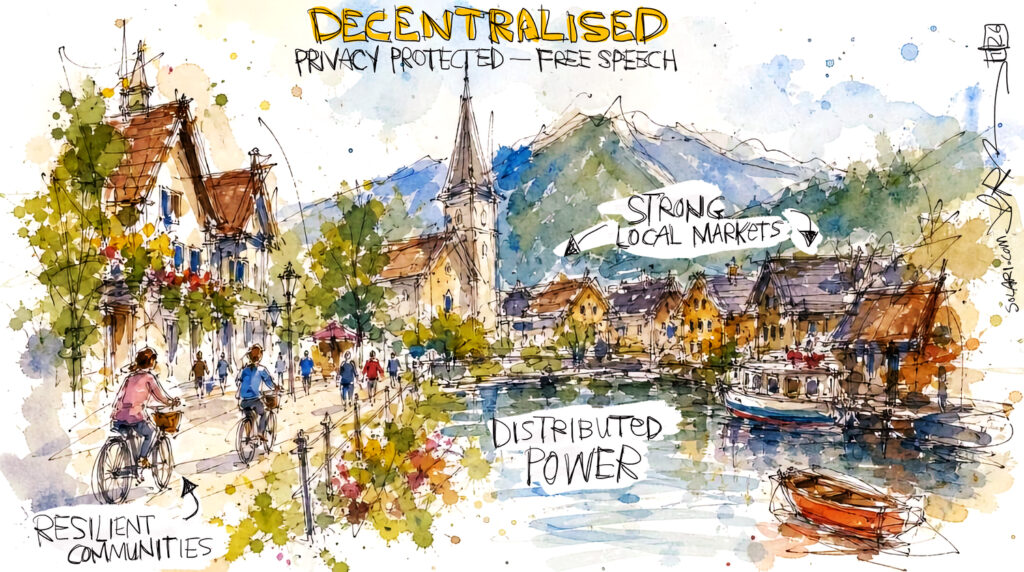
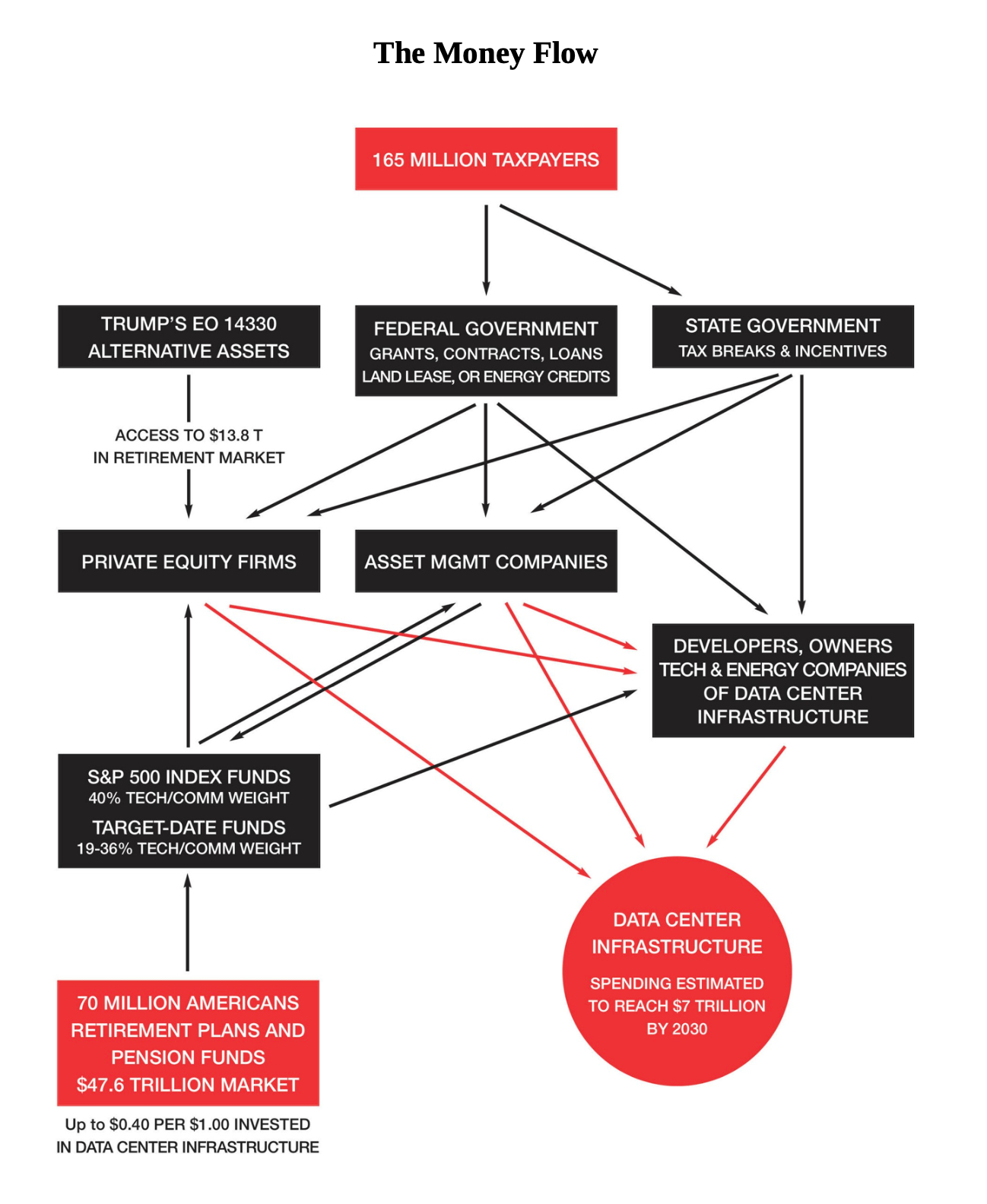
Ultimately, the data center build-out is a story that goes beyond technological progress, environmental destruction, and accelerating energy costs—as I discuss in Part V, it reflects how the desire for complete surveillance and control has enabled concentrated financial power to reshape a nation’s physical and economic landscape (Figure 1), often without the oversight or consent of the very people funding it. By charting the financial pathways funding one of the most unpopular and heavily protested industries in recent history, Americans can begin to redirect their investments.
The landmark $280 billion federal initiative, the CHIPS and Science Act of 2022, is rapidly advancing America’s AI, quantum computing, and semiconductor manufacturing sectors, with each having a profound role in the data center boom. Through massive Department of Commerce subsidies, tech giants like Intel, Micron, and Texas Instruments are rapidly building the domestic fabrication hubs needed to power these massive facilities. Alongside the semiconductor expansion, the Department of Energy’s separate ARPA-E COOLERCHIPS program extends to labs, universities, and infrastructure firms across the country to assist in the development of energy-efficient data center utilities.
The 2022 CHIPS and Science Act (“CHIPS Act”) was signed into federal law in August 2022 under the Biden administration with the expressed purpose of boosting domestic research and manufacturing while safeguarding national security and countering economic risks. The legislation authorizes approximately $280 billion allocated across various programs within research and development, manufacturing, as well as workforce development, including in the areas of AI, quantum computing, robotics, and manufacturing.
While the CHIPS Act does not provide direct funding to data centers nor the physical data center buildings, it does fund the advancement of the domestic semiconductor industry, including the construction, expansion, or modernization of facilities responsible for the manufacturing, fabrication, assembly, packaging, testing, production, or research and development of microchips and semiconductor materials necessary for the data centers to function. CHIPS Act grants and loans go toward several companies for the purpose of completing projects and producing products and services that parallel the companies’ work with data centers.
As part of the CHIPS Act, the CHIPS for America Program is a federal initiative managed by the U.S. Department of Commerce to revitalize domestic semiconductor (microchip) manufacturing, research, and development. It consists of two Department of Commerce Offices, including the CHIPS Research and Development Office, which has been allocated $11 billion for advanced semiconductor prototyping, testing, measurement standards, and advanced physical packaging. The second office is the CHIPS Program Office (CPO), or the CHIPS Incentives Office, which provides direct funding to commercial fabrication facilities for broad use, including automotive, defense, aerospace, consumer electronics, and general computing, in addition to AI logic and memory chips.
Of the $39 billion in funding allocated to the CHIPS Program Office, not all of it goes toward data-center-related initiatives. However, estimates indicate that approximately $28 billion is going directly to companies building the specific logic and advanced memory “fabs” (facilities in which semiconductor products are manufactured) that are mandatory for AI and the data center industry.
The following is a list of some of the recipient companies and entities of the CHIPS R&D and CHIPS Incentives Office (CPO) funds. The companies are grouped into three categories:
Micron Technology (MU), the top American semiconductor memory manufacturer, was awarded $6.165 billion in finalized CHIPS Act subsidies in December 2024. In mid-2025, the company committed to its own $200 billion total U.S. investment plan for domestic manufacturing and R&D, backed by an additional $275 million incremental CHIPS Act direct expansion package from the federal government. The subsidies and capital investments go toward the company’s expansion of leading-edge dynamic random-access memory (DRAM) and high bandwidth memory (HBM) packaging infrastructure. The total funding supports the development of new mega fabrication (“mega fab”) facilities in New York and Idaho, as well as the expansion and modernization of its facility in Manassas, Virginia.
Texas Instruments (TXN) was awarded up to $1.61 billion in direct CHIPS Act funding in 2024 to support three new semiconductor wafer fabs under construction in Texas and Utah. These funds will be issued in increments as the projects meet the designated milestones to manufacture the foundational analog and embedded processing semiconductors necessary for most electronic systems.
Intel Corporation (INTC) received $7.86 billion in finalized CHIPS Act direct funding in 2024 to expand and modernize Intel’s commercial semiconductor manufacturing and advanced projects in Arizona, New Mexico, Ohio, and Oregon, which build processors used across cloud computing and enterprise data centers. Additionally, in 2024, the company was awarded a $3 billion contract under the Pentagon’s Secure Enclave program, which is intended for military-related endeavors. In August 2025, Intel Corporation reached an agreement with the Trump administration in which the U.S. government issued an $8.9 billion investment in Intel common stock to acquire equity stake in the company. The government will fund this equity stake with the $3.2 billion under the Secure Enclave funds and the $5.7 billion of the remaining CHIPS Act grants. As a result, Intel has significant up-front capital flexibility while maintaining its legally binding obligations to complete the commercial fabs and the advanced microelectronics delivering pipelines.
Among S&P 500 listed companies that are part of the networking, connectivity, and hardware fabs industries, Analog Devices (ADI) is set to receive up to $105 million in CHIPS funds after signing a non-binding preliminary memorandum of terms (PMT) in January 2025 with the U.S. Department of Commerce. The funds will be split among several projects in Massachusetts, Oregon, and Washington, with the intent of modernizing and expanding a front-end mature node semiconductor manufacturing facility.
That same month, in January 2025, Infinerna Corporation (INFN) finalized an agreement in which it will receive up to $93 million in finalized direct CHIPS Act funding for the construction of a new fab in California and a new testing and packaging facility in Pennsylvania. Both locations specialize in manufacturing optical transport chips used for high-speed data center interconnected routing.
HP Inc. (HPQ) was awarded $53 million in finalized direct CHIPS funding in support of the company’s microfluidics and micro mechanics semiconductor fab in Corvallis, Oregon. The agreement was finalized in January 2025, and the funds are intended to modernize and expand the “lab-to-fab” hardware facility campus.
IBM Corporation (IBM) finalized a deal for $1 billion from the CHIPS and Science Act Quantum Initiative under the CHIPS Research and Development Office (CRDO) in September 2026. The funds will support the development of Anderon in Albany, New York, a quantum chip foundry designed to supply enterprise-scale quantum cloud data centers and to manufacture specialized quantum wafers.
Semiconductor foundries are companies that manufacture the microchips and processors necessary to power data centers, and these companies, too, receive financial support under the CHIPS Act. While serving as the foundation for high-tech hardware and digital development, these companies are not involved in building the physical infrastructure, such as the facility, power grids, or cooling systems. Two examples of semiconductor foundries that receive CHIPS funding are the Taiwan Semiconductor Manufacturing Co. and GlobalFoundries.
Taiwan Semiconductor Manufacturing Co. (TSMC) finalized a binding deal in November 2024 to receive $6.6 billion in direct CHIPS Act funding to finance a massive three-fab semiconductor manufacturing center in Phoenix, Arizona.
Around the same time in November 2024, GlobalFoundries (GF) received up to $1.5 billion in finalized direct grant funding to construct a new chip fab facility in Malta, New York, expand its existing facility there, and modernize another existing facility in Burlington/Essex Junction, Vermont. The deal was celebrated by Senator Chuck Schumer in a press release, in which he stated, “This investment will make sure America’s semiconductor future is made in the Capital Region, not China.”
Beyond the billions in federal grants distributed under the Department of Commerce’s CHIPS Act programs, a separate U.S. Department of Energy (DOE) initiative is providing funding to energy and cooling companies. Administered by the Advanced Research Projects Agency-Energy (ARPA-E), the Cooling Operations Optimized for Leaps in Energy, Reliability, and Carbon Hyperefficiency for Information Processing Systems (COOLERCHIPS) Program launched in September 2022 to distribute millions in federal grants aimed at reducing the energy used by data center cooling systems.
According to the program description, the goal is “to reduce total cooling energy expenditure to less than 5% of a typical data center’s IT load at any time.” Additionally, ARPA-E committed $42 million to several universities, national laboratories, and private industry leaders to develop physical engineering solutions intended to lower data center energy consumption. A second operational phase, called COOLERCHIPS 1.5, launched in August 2026 to provide additional funding for selected projects to advance these efforts.
Non-chip infrastructure companies that received DOE grants under the ARPA-E COOLERCHIPS program include Vertiv (VRT), which partnered with Nvidia on a $5 million grant to develop advanced cooling, combining direct-to-chip and immersion loops. The second project is between Vertiv in partnership with Advanced Cooling Technologies (ACT), which secured $1.1 million in subcontracts to develop energy-efficient data center cooling loops and heat exchangers. Additionally, JetCool Technologies was awarded a nearly $1.3 million federal allocation, while Raytheon Technologies (RTX) received a $2.5 million grant to develop thermal management systems utilizing oscillating heat pipes.
In 2025, the DOE issued land-lease partnerships for nuclear and geothermal power sites. These leases act as an indirect financial subsidy that allows data center operators to build directly on federal nuclear and energy laboratory lands to access clean, hyper-reliable power. Instead of cutting checks, the DOE issued federal land-lease request for proposals (RFPs) through the Office of Environmental Management and Office of Science.
The DOE selected four locations, including the Oak Ridge Reservation in Tennessee, Idaho National Laboratory (INL), the Savannah River Site, and the Paducah Plant in Kentucky, with each opening up massive tracts of land for private tech infrastructure development. This enables tech companies to develop data centers near advanced energy infrastructures.
Given that data centers are expected to cause an immense strain on the domestic electrical grid, the federal government is distributing funds to utilities and power infrastructure companies. In March 2026, the DOE introduced the third wave of funding within the 2023 Grid Resilience and Innovation Partnerships (GRIP) Program. This time, the initiative was renamed the Speed to Power through Accelerated Reconductoring and other Key Advanced Transmission Technology Upgrades (SPARK) Program. The SPARK Program ($1.9 billion) offered grants to support an upgrade of the high-voltage power lines for the data center hubs.
In September 2026, the DOE announced another round of funding under the SPARK Program for $5.25 billion. The announcement states that “project recipients are expected to reconductor or rebuild more than 1,500 miles of transmission lines and deploy Grid-Enhancing Technologies (GETs) across nearly 21,000 miles. Together, these efforts will make over 23 gigawatts of additional electricity capacity available.” This latest initiative is expected to impact 31 projects across 26 states.
As part of the DOE’s ARPA-E COOLERCHIPS initiative, several university engineering teams and private research laboratories were awarded federal energy-efficiency grants, which cover non-chip infrastructure, the development of ultra-efficient liquid cooling, heat exchangers, and thermal management systems. In 2022, the DOE announced under its ARPA-E program that it will allocate “up to $42 million in funding to overcome technology barriers associated with the development of high-performance energy efficient cooling solutions for data centers.” Notably, 100% of the $42 million allocated under the ARPA-E program is directly connected to advanced technology, research, and engineering for thermal management systems that facilitate necessary cooling equipment for data centers.
Table 1 and Table 2 list the university engineering teams and private research laboratories awarded federal energy-efficiency funding under the DOE’s ARPA-E COOLERCHIPS Program. Some of the universities and laboratories listed in the table are also participating in COOLERCHIPS 1.5.
|
University |
Funding Amount |
COOLERCHIPS 1.5 Beneficiary? |
Description |
|---|---|---|---|
| University of Maryland |
$3.4 million |
Yes |
Developing unified, high-density phase-change thermal storage and advanced heat exchanger systems to safely decouple data center workloads from ambient weather fluctuations
|
| University of Texas at Arlington |
$2.84 million |
Yes |
Engineering a holistic, novel hybrid liquid-and-air cooling technology tailored to reduce localized hotspots inside high-power server farms
|
| University of Illinois at Urbana-Champaign
|
$2.5 million |
Yes |
Developing a high-flux, multilevel two-phase cooling system using capillary-driven micro-structures to eliminate standard mechanical pumping requirements |
| Purdue University |
$1.88 million |
No |
Designing an innovative chip-level, direct two-phase impingement jet cooling solution to lower thermal resistance while consuming minimal electricity
|
| University of Florida |
$3 million |
No |
Creating a modular open-loop vapor chamber system specifically designed to handle localized thermal flux inside intensive AI computing nodes
|
| University of California, Davis |
$3.5 million |
Yes |
Developing low-cost micro channel heat exchangers tailored to scale energy-efficient thermal management down to edge computing
|
| University of Missouri |
$1.6 million |
No |
Building a scalable “Dual-Mode Hybrid Two-Phase Loop” cooling system capable of dynamically handling severe server load spikes |
Sources: U.S. Department of Energy ARPA-E COOLERCHIPS Program, U.S. DOE COOLERCHIPS Official Press Release, and ARPA-E National Project Database Tracker (energy.gov and energy.gov/articles/doe-announces-40-million-more-efficient-cooling-data-centers); Dallas Innovates (UT Arlington Grant Announcement) (dallasinnovates.com); University of Illinois Mechanical Engineering News (illinois.edu); University of Florida Engineering Award Profiles (ufl.edu; Data Center Knowledge (COOLERCHIPS Projects Overview) (datacenterknowledge.com); Utility Dive (Advanced Infrastructure Funding Reports) (utilitydive.com); COOLERCHIPS 1.5 (energy.gov/documents/cx-271071-cooling-operations-optimized-leaps-energy-reliability-and-carbon)
|
Company or Nonprofit |
Funding Amount |
COOLERCHIPS 1.5 Beneficiary?* |
Description |
|---|---|---|---|
|
Nvidia Corporation (Enterprise Lab Division) |
$5 million |
Yes |
Building a physical, modular data center unit equipped with an integrated two-phase cold plate cooling system capable of achieving ultra-low thermal resistance |
|
Flexnode (Private Modular Architecture Lab) |
$3.5 million |
No |
Developing prefabricated micro-data center pods using high density liquid immersion chassis designed to be independent of geographic climates |
|
Raytheon Technologies Research Center (RTX) |
$2.5 million |
No |
Creating a high-efficiency multi-kilowatt topology that uses micro machined internal features to move massive amounts of thermal energy away from the core server array |
|
National Renewable Energy Laboratory (NREL) |
$1.46 million |
No |
Actively constructing open-source digital twin models and standardized hardware testbed facilities to run real-world testing on the physical cooling prototypes built by other teams |
|
Advanced Cooling Technologies (ACT Labs) |
$1.1 million |
Yes |
Manufacturing the high-performance liquid cooling loops and localized hardware components utilized across the university systems |
| HRL Laboratories (Boeing & GM Joint Research Lab) |
$1.05 million |
No |
Building low-cost, ultra-thin polymer-based thermal siphon matrices intended to replace heavier copper cooling structures inside legacy server frames |
*HPI Federal LLC and International Business Machines Corporation, Thomas J. Watson Research Center are also receiving funding under COOLERCHIPS 1.5
Sources: U.S. Department of Energy ARPA-E COOLERCHIPS Program, U.S. DOE COOLERCHIPS Official Press Release, and ARPA-E National Project Database Tracker (energy.gov and energy.gov/articles/doe-announces-40-million-more-efficient-cooling-data-centers);
Data Center Knowledge (COOLERCHIPS Projects Overview) (datacenterknowledge.com);
Utility Dive (Advanced Infrastructure Funding Reports) (utilitydive.com); COOLERCHIPS 1.5 (energy.gov/documents/cx-271071-cooling-operations-optimized-leaps-energy-reliability-and-carbon)
Data center mergers and acquisitions are undergoing a massive surge. In 2025, deal volumes reached a record high of more than $69 billion. According to an analysis from S&P Global Market Intelligence, this total reflects 113 completed transactions, exceeding the previous year’s figures by $8 billion. Additionally, in 2025, there were 32 data-center-focused infrastructure funds launched, hitting a new record. This aggressive consolidation is driven by the ongoing expansion of AI and digital infrastructure associated with the data center boom.
The financing and ownership of this rapidly expanding industry is highly concentrated among a small group of elite financial entities, including the top asset management companies. The Thinking Ahead Institute’s 2025 asset manager’s report indicates that the entire global asset management market sits at an estimated $140 trillion. Out of this immense pool, the 20 largest global asset managers control 47% ($65.8 trillion) of all industry assets, and the top 10 firms hold approximately 40% to 44% of that multitrillion-dollar total.
This capital concentration creates a forced investment loop due to index replication. Given that the majority of tech stocks driving AI and data center development are also the top companies in the S&P 500 and Nasdaq, any manager offering an index fund is required to purchase them. As massive cloud-computing providers, these top tech companies are often referred to as “hyperscalers.” The top hyperscalers include Amazon, Microsoft, Alphabet, Oracle, Meta, Google, as well as others.
Thus, when trillions of dollars flow into generic retirement target-date funds or workplace 401(k)s, asset management firms are mathematically required to put that capital into the largest, most liquid public companies matching the index, ensuring they share near-identical overlapping ownership across AI, technology, and data center infrastructure stocks.
When these top asset management companies insert capital into the data center infrastructure, their ownership becomes heavily concentrated across four key areas within the data center supply chain:
With a current total of $15.3 trillion in assets under management (AUM), BlackRock is and has been ranked as the top asset management firm for the past 17 years. Understanding BlackRock’s complex structure reveals the massive reach of the world’s largest asset manager, which is aggressively funding U.S. data centers and their supporting power grids.
In data-center-related deals, BlackRock operates through its subsidiary, Global Infrastructure Partners (GIP), a private market asset manager that the company acquired for $12.5 billion in 2024. It was also at this time that BlackRock underwent a more drastic structural shift, transitioning from simple stock market index ownership to injecting billions in direct private equity, joint ventures, and acquisitions to control AI infrastructure and data center developers. This shift was also marked by the acquisition of Preqin, a private analytics and market research firm, in March 2025.
Through an initial $30 billion equity partnership via the Global AI Infrastructure Investment Partnership (GAIIP) in 2024, BlackRock aims to now mobilize nearly $100 billion in total investments alongside Microsoft, MGX, Nvidia, and xAI. Since 2022, GIP, alongside leading global investment firm KKR, also co-own the data center operator, CyrusOne. In July 2026, BlackRock’s GIP alongside MGX and the Artificial Intelligence Infrastructure Partnership (AIP), acquired Aligned Data Centers in a $40 billion deal. The deal included 51 massive data center campuses with more than 6.4GW of operational and planned capacity across several U.S. states and Latin American cities.
Given BlackRock’s trillions of dollars in AUM, it relies on passive index-tracking funds like the iShares family and core institutional pooled portfolios. Due to this structural framework, BlackRock likely holds any publicly traded company belonging to major benchmarks like the S&P 500, Russell 2000, or MSCI World. As a result, BlackRock is a major shareholder in companies that directly own, operate, and build data centers. BlackRock’s top equity investments in data center physical real estate and infrastructure companies include Digital Realty Trust (DLR), Equinix Inc., (EQIX), and Iron Mountain Inc. (IRM).
BlackRock’s broader technology portfolio holds substantial stakes in the hardware and cloud hyperscalers that fuel and operate server facilities. BlackRock is consistently within the top three largest institutional holders globally, typically owning between 7% to 9.5% of an entire company’s outstanding stock. It is important to note that BlackRock’s holdings are often in the capacity as an asset manager on behalf of clients.
BlackRock holds billions in tech-related equities, including the hyperscalers, such as:
Additionally, BlackRock holds billions in hardware, power, and real estate giants, including:
BlackRock and other large asset management companies receive significant attention for their substantial participation in the financing of the AI data center industry, but private equity (PE) firms such as Blackstone and Brookfield Asset Management have an equally critical role and impact.
Whereas BlackRock dominates passive index funds, private market financing is heavily driving the AI-related investment cycle. As hyperscalers are projected to spend more than $5 trillion on AI and data centers by 2030, private market fundraisers are generating record pool commitments to keep the pace. In fact, Blackstone and Brookfield Asset Management are the only two private alternative investment firms operating at a scale that greatly exceeds BlackRock’s direct private equity footprint, bypassing public stocks to directly acquire land, power, and developers.
As the world’s largest alternative asset manager with $1.3 trillion AUM, financial reports show that Blackstone’s global data center portfolio has grown significantly. Unlike tech companies that build data centers for their own software, Blackstone as a private equity asset manager purchases entire data center operators, builds out the physical structures, and leases them to hyperscalers.
Blackstone’s top institutional shareholders include the Vanguard Group, BlackRock, and Morgan Stanley. The private equity giant treats AI infrastructure as its highest-conviction global investment theme, managing a massive $150 to $165 billion in global digital assets with a prospective $160 billion in the development pipeline. Through its subsidiaries, Blackstone owns and operates more than 70 data centers globally (in the U.S. and Europe), with a pipeline that expands its reach to more than 90 facilities, including sites currently under active development. These physical facilities support more than three gigawatts of power capacity, leased to support storage and AI heavy workloads to hyperscalers like Amazon, Meta, and Google. In addition, Blackstone effectively owns or has a controlling stake in more than 175 data center facilities internationally.
Blackstone secured its massive cross-border expansion to become one of the world’s largest data center owners by acquiring AirTrunk in 2024, which operates hyperscale data center campuses throughout prominent Asia-Pacific tech hubs including Australia, Japan, Singapore, Hong Kong, and Malaysia. Additional acquisitions include Blackstone’s 2021 purchase of QTS Realty Trust for $10 billion, transforming the company into the fastest-growing data center operator in North America. In 2026, Blackstone made a $5 billion equity commitment on a joint venture with Google which finances a “compute-as-a-service” product combining Google’s proprietary TPU AI chips with Blackstone’s physical data centers and energy procurement.
To further bolster its footprint, Blackstone launched the Blackstone Digital Infrastructure Trust (BXDC) in 2026, an investment vehicle targeting newly built hyperscale properties valued up to $2 billion. Historically, Blackstone restricted its prime digital real estate to multibillion-dollar institutional funds. However, the company now has created distinct public, private, and semi-private structures to grant individual access.
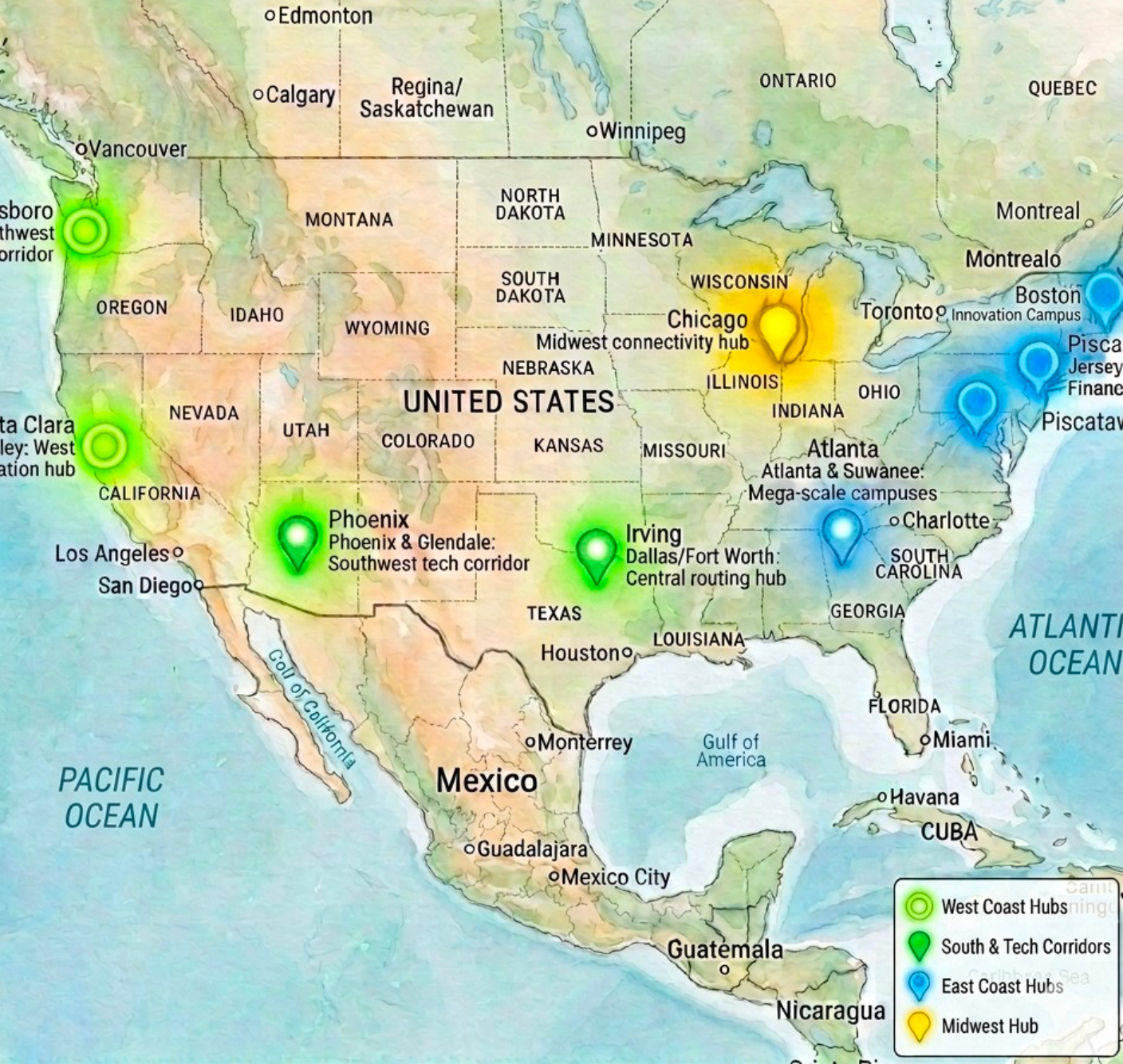
Figure 2 shows a map of the U.S., which highlights the locations of the major Blackstone data center hubs.
Whereas Blackstone dominates the physical real estate assets, Brookfield Asset Management dominates the clean energy grids required to power the physical facilities. Data centers are non-functional without massive utility infrastructure and require several gigawatts of power. This gives Brookfield—with more than $1 trillion AUM, including in the energy sector with a focus on renewable power—a necessary role and advantage in the data center industry.
Brookfield’s top shareholders include Brookfield Corporation, Partners Value Investments LP, and the Royal Bank of Canada, operating alongside other major private infrastructure spenders like Digital Bridge, KKR, and Stonepeak. Brookfield’s leadership publicly estimates the global AI build-out will require nearly $7 trillion in cumulative infrastructure spending, and the company is prepared to invest accordingly. As one of the largest global infrastructure investors in the data center, digital real estate, and digital infrastructure industries, Brookfield is aggressively expanding its digital portfolio by acquiring large-scale data center platforms.
In May 2024, Brookfield signed a historic framework agreement with Microsoft, estimated to be worth more than $10 billion, with the intent to deliver 10.5 gigawatts of new renewable energy capacity between 2026 and 2030. This milestone stands as the largest corporate power purchase agreement (PPA) in history. Beyond its massive power capacity backlog, Brookfield operates its own data center platform, Centersquare. According to Brookfield’s macroeconomic forecasts, the entire global AI data center industry is projected to expand tenfold from its baseline to scale to 82 gigawatts by 2034. To capture this international momentum, Brookfield secured a $20 billion strategic joint venture with Qai, a national AI company backed by the Qatar Investment Authority (QIA), dedicated to building out integrated AI infrastructure in Qatar and select global markets.
Private equity firms have fundamentally transformed their role in data center financing, shifting from niche secondary players to a dominant force in the market. According to the Americans for Financial Reform Education Fund (AFREF), PE firms and institutional investors have quietly deployed nearly $200 billion into data center financing since 2022, with the vast majority of these transactions hidden from public view.
PE firms have driven 80% to 90% of completed mergers and acquisitions in the entire global data center sector since around 2022. This represents a complete structural shift from the pre-2020 environment, which was dominated by publicly traded real estate institutions, telecom corporations, and public data center operators. Data from S&P Global Market Intelligence reveal that private equity investment in U.S. data centers surged to a record high of $45.7 billion in 2025. This single-year dramatic increase accounted for approximately 72% of the overall $63.35 billion investment (including non-PE backed transactions) in the data center industry.
Publicly traded companies, such as Equinix or Digital Realty, are inherently constrained by quarterly earnings demands and debt-to-equity ratios. In response, hyperscalers (such as Microsoft and Meta) are actively bypassing public entities to secure multibillion-dollar joint ventures directly with private alternative credit giants like Blackstone and Blue Owl, drawing upon unlisted institutional retirement and sovereign wealth capital loops without impacting corporate balance sheets. I describe this phenomenon in greater detail later in the report.
While mega-acquisitions capture the news headlines, private equity’s broader strategy involves buying out small-to-medium regional operators and aggregating them into massive networks to secure dominant localized pricing power—a “buy-and-build” approach that generates much less media attention. PE firms are actively purchasing vacant industrial parks, old corporate headquarters, and decommissioned military facilities for adaptive infrastructure reuse. Recent notable regional developments include Novacap partnering with H5 Data Centers to acquire a data center portfolio from 365 Data Centers, alongside the long-term infrastructure acquisitions of Altum Digital Infrastructure and US Signal by Igneo Infrastructure Partners.
This aggressive accumulation extends to the secondary data center supply chain to secure critical hardware, logistics, and cooling technologies. Private equity funds are buying up midsized thermal management and component manufacturing firms. For example, in 2026, Blackstone acquired Advanced Cooling Technologies to capitalize on high-demand liquid cooling infrastructure. Concurrently, public corporate giants like Vertiv are completing strategic acquisitions of specialized service providers on their own balance sheets, while leading developers like Aligned Data Centers leverage proprietary, water-free cooling technology internally as a core competitive advantage rather than spinning it off.
Downstream logistics have also been impacted. In January 2026, Park Place Technologies merged with Service Express—both companies operated as third-party data center hardware and technical support firms. The merger deal was facilitated by private equity giant, Warburg Pincus, and both companies now operate under the Park Place Technologies name.
Private equity firms and alternative asset managers are actively raising billions in new capital and deploying unprecedented “mega-funds” to facilitate the energy grids, land, and physical infrastructure driving the global AI buildout.
With hyperscalers projected to spend more than $5 trillion on AI technology and data centers by 2030, private market fundraisers are generating record pool commitments to keep the pace. Five distinct mega-funds are leading this unprecedented capital deployment:
According to data published in August 2026, private equity firms own or invest in at least 1,220 fossil fuel assets globally, with many likely to profit from the energy demands of the AI industry. By controlling both power generation and data center infrastructure, these firms play a significant role in shaping modern electricity markets. By bypassing public stock markets to directly own land, developers, and utilities, private equity now commands unprecedented influence over modern electricity markets.
The 1,220 fossil fuel assets are heavily concentrated under five primary private equity giants: EIG Global Energy Partners, KKR, BlackRock GIP, Brookfield (Oaktree), and Blackstone. Of the 1,220 assets, “569 include fossil fuel pipelines, terminals, tankers, and storage facilities, 374 include fossil fuel-fired power plants and refineries, and 277 include oil and gas extraction assets.”
This heavy convergence of data infrastructure and intensive power generation corresponds with the massive, documented strain on public utility grids. A 2026 study revealed that U.S. electricity consumption attributed entirely to data centers increased from 1.9% to 4.4% between 2018 and 2023. The study estimated that in the future, the national average electricity costs for everyday consumers could spike between 6% and 29% by 2030, with high-density data center hubs like Virginia potentially facing a cost increase of nearly 57% explicitly tied to data center infrastructure expansion.
Beyond grid infrastructure, the monopolization of the physical resources required to run these facilities is generating substantial backlash from the local communities affected. In May 2026, residents in Fayetteville, Georgia, living near a massive QTS data center (owned by Blackstone) expressed intense frustration after experiencing low water pressure due to the facility draining nearly 30 million gallons of water for infrastructure cooling without initially paying for it.
This intersection of rising consumer utility costs, localized resource depletion, and opaque private market loops culminated in a high-profile regulatory intervention. In June 2026, Senator Elizabeth Warren issued a formal information request to the leadership of Blackstone, BlackRock, KKR, and Brookfield to investigate the industry’s expanding footprint.
The letter reads, in part:
“As of 2025, private equity firms own or invest in over 150 fossil fuel power plants. By positioning themselves to control everything from the ground that data centers are built on to the electricity consumed by data centers, private equity firms are becoming an ‘especially outsized force driving the data center boom, pouring billions into construction deals while also … profit[ing] from supplying AI’s insatiable energy demands.’ While American customers see their utility bills skyrocket, private equity firms want to have their cake and eat it too.”
The initial inquiry was intended to examine potential market conflicts of interest in which private equity firms simultaneously control both energy-demanding data centers and utility providers while raising concerns over potential increases in electricity rates. The companies declined to respond.
In late September 2026, a group of lawmakers led by Sen. Warren urged federal agency regulators to block the $33.4 billion acquisition of power company AES by BlackRock subsidiary Global Infrastructure Partners, alongside EQT and others. The lawmakers argued, once again, that the transaction could escalate utility costs for consumers and disproportionately advantage energy-intensive data centers amid rising national electricity demand.
A massive index fund pipeline that automatically funnels everyday Americans’ retirement savings into digital infrastructure and AI technology is advancing the data center boom. This automated capital injection comes at a time when Big Tech hyperscalers are spending significant billions on the physical data center infrastructure. Through standard equity funds, the average 401(k) contributor, through passive indexing, has become an aggressive, primary financier of the global data center build-out.
Many American savers are thus unintentionally and unknowingly financing data centers through routine retirement contributions. According to a 2026 Gallup report, 59% of U.S. adults invest in retirement savings accounts including 401(k)s, 403(b)s, or IRAs. This represents approximately 70 million Americans actively participating in 401(k) plans. This collective capital forms an immense financial pool.
As of mid-2026, the total U.S. retirement market sat at $51.2 trillion, with $10.8 trillion held specifically in 401(k) plans. Fifty-eight percent of U.S. adults owned stocks as of April 2026, yet according to the Federal Reserve’s 2025 Survey of Household Economics and Decisionmaking, 37% of adults held stocks or funds in personal brokerage accounts outside of their retirement account in 2025. This means that many everyday investors hold stocks through a 401(k) or IRA, in which they frequently choose to invest in passive index funds. Through these funds, the investor’s money is automatically allocated into a predetermined list of companies designed to match a specific market benchmark, rather than individual stocks selected by the investor.
The total U.S. retirement market sat at a record $51.2 trillion as of Quarter 2 (Q2) 2026, according to the Investment Company Institute (ICI). Americans held $15 trillion in all employer-based defined contribution retirement plans, of which $10.8 trillion were held in 401(k) plans.
The following includes the ICI’s Quarterly Retirement Market Data figures for Q2 2026:
For the majority of Americans, their retirement plans rely on a standard S&P 500 index fund or target-date fund (TDF) as their default 401(k) options. Target-date funds are typically tied to a specific year (the target date) and include a diversified mix of investments that automatically shifts over time along a dynamic glide path. An index fund corresponds strictly to a specific market index, such as the S&P 500. In both instances, the individual does not select which specific stocks to invest in—this is done automatically according to an index, or by professional portfolio managers allocating assets across an array of broader funds.
After the 2020 Covid crisis, the S&P 500 market concentration became much narrower and has been dominated by Big Tech companies. Information technology alone accounts for 37.4% of the S&P 500. Other data-center-related industries within the S&P 500 are represented as industrials (8.7%), energy (3.3%), utilities (2.0%), and real estate (1.9%).
Nine of the top 10 largest S&P 500 companies are AI and tech-adjacent firms, spending billions on data center technology and infrastructure. These companies, several of which are considered hyperscalers, include Nvidia, Apple, Microsoft, Amazon, Alphabet, Broadcom, Meta, Tesla, and Micron. These top AI-linked stocks account for approximately 40% of the index, with some reports indicating a figure between 40% to 45% of the S&P 500’s total market capitalization. Thus, if one allocates 100% of contributions to an S&P 500 index fund, between 40% to 45% of the money flows straight into the data center pipeline through the top 10 listed companies. Stated another way, for every $1 that an American worker contributes to an S&P 500 tracking fund, approximately $0.40 to $0.45 automatically buys shares in these massive tech companies.
A long-dated target-date fund typically holds a diversified mix of global equities and fixed income, in which a substantial portion of the U.S. stock allocation is concentrated in S&P 500 mega-caps. While massive technology and data-center-adjacent firms command approximately 35% (some estimates are as high as 45%) of the index’s weight and are pouring billions into AI, buying into the fund means the investor is backing their business models, including their data center infrastructure endeavors. Additionally, Vanguard, BlackRock, and State Street are the top three institutional shareholders of these leading S&P 500 companies, acting as structural custodians on behalf of the millions of retail investors who own their index products.
To put this structural flow into perspective, every standard $100 contribution made into a stock-focused 401(k) plan is automatically distributed across the data center supply chain:
Ultimately, this immense capital allocation is an unintentional result of passive indexing. With millions of American workers automatically enrolled in diversified target-date funds and S&P 500 index funds, their retirement money automatically pours into the largest sectors of the market. Therefore, a massive portion of the nation’s private retirement wealth is structurally tied to the physical and digital architecture of the AI and data center boom.
With the top 10 AI-linked stocks currently accounting for nearly 40% of the S&P 500’s total market capitalization, many refer to this phenomenon as the “Great Narrowing.” During the past decade, the stock markets have become tech- and AI-dominated. In 1990, in contrast, the S&P 500 looked far more diverse, and the 10 largest companies by market cap held approximately 19% of the index weight. Years later, with the technology boom of the late 1990s, the index began to change with the top 10 concentration peaking at around 27% (at its highest) in 2000.
Eventually, in the early 2000s, the concentration declined with the resurgence of energy and consumer stocks. However, after the 2008 financial crisis, the market experienced a more substantial shift with the rise of the platform economy, yet the concentration remained relatively modest with the top 10 stocks on the S&P 500 accounting for approximately 19% of its weight and total index earnings at the end of 2015.
Fast-forward to the years following the Covid crisis, and the market began to narrow sharply around 2021. This trend accelerated dramatically, leading to the notable market concentration observed today. According to historical financial research, this marks the highest single-sector stock market concentration since the 1932 Depression-era peak.
In August 2025, President Trump issued Executive Order (EO) 14330, “Democratizing Access to Alternative Assets for 401(k) Investors,” which sets the regulatory framework to allow alternative asset classes, including private equity (which had been historically restricted from entering retirement portfolios for most individuals), to enter employer-sponsored 401(k) plans. Following the executive action, in March 2026, the U.S. Department of Labor (DOL) proposed a landmark rule that would establish a “safe harbor” for employers who choose to include private equity, private credit, and other alternative assets in 401(k) investment portfolios.
According to the DOL, the executive order could impact as many as 90 million Americans with defined-contribution plans. While individual private equity firms will not manage the overarching 401(k) plans of everyday workers, these individual PE firms will be permitted to offer specialized funds that can be included in a plan’s investment options as a portion of diversified target-date funds. Historically, employers acting as plan fiduciaries have avoided private equity due to the risks of being sued by employees for including complex or costly investments. The proposed DOL rule, or “safe harbor” shield, aims to protect employers from these lawsuits by outlining a specific checklist of factors to consider, such as fees, liquidity, and performance.
There are differing perspectives on EO 14330 and the “safe harbor” shield. Proponents argue that the higher costs are justified by the long-term returns. Wall Street private equity managers have lobbied to gain access to the trillions of dollars held in American 401(k) plans, arguing that the EO, which opened up a $13.8 trillion retirement market to private firms, will significantly boost portfolio diversification and investment yields for everyday savers. Meanwhile, advocates for financial reform as well as financial professionals and several lawmakers have strongly opposed the new EO and rule, warning that these assets are often illiquid and carry higher fees, and arguing that private equity’s opacity introduces avoidable risk into retirement portfolios.
Specific data from 2024 shows that the State Street Private Equity Index, for example, returned only around 7.08% compared to 25.02% for the S&P 500. Similarly, a report from 2025 released by the Center for Economic Policy and Research (CEPR) states: “[P]rivate markets research firm MSCI estimates that between 2022 and the third quarter of 2025, an index of U.S. private equity funds saw annualized returns of 5.8 percent, compared to 11.6 percent for the S&P 500.” Additionally, a 2024 study conducted by the CFA Institute Research and Policy Center estimates that this type of structure “cost investors $0.05 to $0.26 per dollar committed over funds’ lifetimes. The corresponding fee drag on gross-to-net total value to paid-in capital is 0.1x to 0.7x and 5% to 8% in annualized terms.”
Setting the foundation for private equity to enter retirement portfolios through EO 14330 creates a highly lucrative dynamic for firms such as Blackstone, by turning what appears as direct competition into a multilayered financial win. When a standard 401(k) portfolio buys mainstream tech stocks, it indirectly fuels the data center boom. When Blackstone opens the 401(k) market to its own funds, it captures that massive wave of capital directly, and thus, Blackstone profits from both sides of the digital economy. Just months after EO 14330 was signed, Blackstone launched a dedicated defined-contribution business unit specifically to channel workplace retirement savings into its private market investments. Shortly prior to this, Blackstone formed a partnership with Vanguard and Wellington Management to collaborate on creating public-private target-date funds.
When an employee contributes to their 401(k) and buys mutual funds that hold Big Tech hyperscaler stocks like Microsoft, Google, and Amazon, it drives up those tech giants’ market valuations and creditworthiness. The hyperscalers, backed by their massive corporate revenues, then use this money to sign multibillion-dollar, decades-long lease agreements (often with a special purpose vehicle) for data centers managed by firms like Blackstone. Simultaneously, under EO 14330 and the DOL’s safe harbor rule, a portion of the same employee’s 401(k) check can flow directly into Blackstone’s private infrastructure funds.
Blackstone then collects highly profitable management and performance fees on this retail capital, which it uses to purchase the land, power rights, and infrastructure necessary to fulfill those tech leases. Given that 401(k) contributions are automated through biweekly payroll deductions, Blackstone secures a highly predictable, recession-resistant stream of fresh cash. This steady capital allows Blackstone to confidently fund massive, multiyear data center construction projects that take years to build and monetize.
To capture this massive wave of retail capital directly, Blackstone distributes its alternative investments through partnerships with major retirement plan administrators, financial advisory networks, and asset managers. Key distribution channels include Empower—which hosts Blackstone alongside other top-tier asset managers like Apollo Global Management, Ares Management, and Franklin Templeton—as well as the dedicated strategic alliance between Blackstone, Vanguard, and Wellington Management. By securing placement across these major platforms, Blackstone and its competitors turn everyday retirement contributions into a direct, reliable stream of cash to facilitate private infrastructure growth
[Author’s note: In Part IV, I revisit the Hyperion data center project referenced in this section.]
The data center exposure is not limited to equities (stocks or shares in a company). In fact, AI data center debt is covered by even the safest corners of Americans’ retirement savings—bond funds through 401(k) allocations. For workers nearing retirement, or those with conservative target-date funds with high fixed-income allocations, a significant part of the plan’s bond portion is actively holding data center development debt.
In recent years, Big Tech hyperscalers secured private debt deals to fund massive data center projects, including the $30 billion Hyperion data center partnership in Louisiana. (I discuss the details of such arrangements in greater detail in subsequent sections.) The project was launched as a joint venture between Meta and alternative asset management entity, Blue Owl Capital, in which both companies launched Beignet Investor LLC, which leases the real estate to Meta. (I cover the details of the lease agreements in Part IV.)
To fund its massive Hyperion AI data center campus in Louisiana leased to Meta, Beignet issued $27.3 billion in senior secured bonds due in 2049 with a 6.58% coupon. Beignet borrowed that amount from investors and lenders to be repaid with interest by 2049. To secure the funds, global investment management firm Pacific Investment Management Company LLC (PIMCO) purchased $18 billion of the bonds, while BlackRock purchased more than $3 billion. When these institutional bonds were issued, they flowed into broad core bond mutual funds managed by PIMCO and BlackRock, which serve as foundational holdings within mainstream 401(k) target-date funds. Thus, this massive wave of AI infrastructure debt is directly backed by everyday Americans, with the up-front capital flowing from their retirement accounts through target-date funds—and straight to Beignet.
Given that the Beignet bonds are issued as private 144A securities intended to attract large institutional buyers, they were sold privately to large institutions and are not available for public trading. Individuals cannot purchase them through a financial entity. However, PIMCO, as one of the largest bond managers, is able to purchase these bonds directly. PIMCO then places these securities into flagship bond funds, which become the foundation for the TDFs used as default options in 401(k) plans.
The income fund, a type of mutual fund or exchange-traded fund (ETF), authorizes investments in 144A private placements. The majority of core and total return bond options available within 401(k) plans track benchmarks that incorporate investment-grade 144A debt. Target-date funds build the fixed-income exposure by investing in these identical underlying funds, using an automated glide path that increases bond allocations as one approaches retirement. Consequently, the historically low-risk segment of the average retirement portfolio now serves as a primary indirect pipeline funneling retail capital straight into AI infrastructure and the data center industry.
Given that target-date funds oversee approximately $4.8 trillion in U.S. retirement assets, and with AI-linked and data-center-related enterprises projected to comprise 14% of major investment-grade bond indices, public retirement savings have quietly transformed into a fundamental financing engine for the AI expansion and the data center boom.
A second example of data center debt being covered by public retirement funds is the $16 billion hyperscale campus located in Saline Township, Michigan, known as “The Barn.” The real estate is being developed by Related Digital for Oracle and OpenAI. The project is backed by equity from Related Digital and Blackstone-affiliated funds. Following the project’s launch, Bank of America issued $14 billion in corporate debt. PIMCO then purchased approximately $10 billion of those corporate bonds, which were issued as private 144A securities, and thus are restricted from public trading. The bonds are held in major institutional mutual funds, which inject this massive AI infrastructure debt into the target-date funds and default 401(k) portfolios of millions of everyday workers.
Digital infrastructure allocations are the fastest-growing sector within private markets, acting as a prominent growth driver within pension funds’ alternative investments portfolios—which also feature dedicated real estate and private infrastructure buckets. Industry analysts indicate that standard institutional portfolios typically allocate between 1% and 6% of total assets to the private infrastructure asset class as a whole. To be clear, digital infrastructure represents a specialized, high-growth subset of this sector, including data centers, fiber-optic networks, and telecom towers. However, infrastructure asset managers argue that to keep up with the compounding demands of the AI boom, institutional portfolios will need to aggressively pivot, increasing the digital share to 15% to 25% of their total infrastructure budget in the coming years.
Real-world examples of this institutional shift include:
The dual exposure across public pensions and private bond markets leaves retirement systems vulnerable to a two-pronged systemic risk. If the commercial return on AI underperforms, the massive underlying debt funding these data centers will underperform and threaten fixed-income portfolios. Alternatively, if AI overperforms and rapidly automates upper- and working-class industries, the broader corporate employment and payroll contribution base that funds future pension payouts will shrink. This leaves institutional savers exposed whether the technology fails or succeeds.
Data center projects are enormously expensive, with capital spending figures in the hundreds of billions. According to Goldman Sachs, in 2026, capital spending by hyperscalers will exceed $500 billion in the U.S. By 2027, capital spending is expected to exceed $1.3 trillion, and that figure increases to $7.6 trillion by 2031. For the world’s five largest cloud hyperscalers—Meta, Amazon, Microsoft, Google, and SpaceX—Morgan Stanley forecasts capital spending at $1.4 trillion in 2028.
For comparison, in 2025, total capital expenditures (CapEx) for all S&P 500 companies combined reached approximately $1.2 trillion, with capital spending by hyperscalers accounting for $420 billion. With surging figures, traditional financial methods alone will not suffice. As a result, to finance these massive data center endeavors, hyperscalers are adopting creative financial strategies instead of relying on cash or taking on direct corporate debt.
With data center costs quickly hitting the trillions, hyperscalers are increasingly partnering with private equity firms to establish special purpose vehicles (SPVs). In finance, an SPV is a separate, legally independent company created by a parent organization to manage a specific task. Its assets and liabilities are separate from that of the parent company and, therefore, its debt and obligations are often kept off the parent company’s balance sheet. This reduces financial risk for the parent company by improving its financial ratios and credit metrics. In the context of the AI data center industry, hyperscalers’ joint-venture partnerships with private equity firms to establish SPVs are most often used during the foundation of a major construction project.
Off-balance-sheet financing allows a company, in this case the hyperscaler, to keep debt off the corporate balance sheet and keep debt-to-equity ratios low, which otherwise could affect a company’s credit rating and make future borrowing more expensive. This approach allows the hyperscaler to maintain cleaner return on invested capital (ROIC) metrics, thus giving the appearance of artificially high financial metrics and stock valuations. Through the joint ventures, hyperscalers shift the risk to the private markets. The investor provides the up-front bulk cash, while the hyperscaler promises the returns through leasing the completed data center facility.
Although this strategy benefits hyperscalers in the short term, it invokes potential risks to the project itself and the broader financial system as well. The financial timelines for the real estate and data center construction are, on average, between 15 to 20 years; however, the expensive chips necessary for data centers to function become obsolete and need replacing every three to five years. This adds massive additional costs before the initial off-balance-sheet debt from the real estate is paid off. This debt is sourced from a heavily saturated market of hyperscalers and relies on the credit strength of those few companies.
According to official data from the Bank for International Settlements (BIS) March 2026 Quarterly Review, tech companies moved more than $120 billion in AI and data center infrastructure spending off their balance sheets through late 2025 using various financial mechanisms. The BIS characterizes this trend as “shadow borrowing,” warning that hyperscalers are funding the data center build-out through joint ventures and SPVs. This practice shifts infrastructure risk away from traditional banks and directly onto private credit funds, insurance providers, and institutional asset pools, thus tightly binding everyday retirement savers to the volatile and uncertain AI and data center industries.
Off-balance-sheet data center debt is directly tied to the lease agreements between hyperscalers and SPVs. Most data center lease agreements are between a hyperscaler and a newly established SPV, rather than directly with a private equity giant itself. It is important to note that a data center lease agreement is vastly different from a standard commercial property lease agreement. Technically, most agreements between a hyperscaler and an SPV function as a complex, multibillion-dollar financing mechanism. Due to the aggressive AI data center race, these agreements do not adhere to traditional physical real estate metrics. For example, instead of renting square footage, Meta or the relevant hyperscaler leases electrical power and the industrial cooling equipment required for the facility.
Typically, these lease agreements follow a triple net (NNN) structure, which is used by several data center projects, including Hyperion, The Barn, and Project Jupiter (with the latter two being for OpenAI and Oracle). In a hypothetical NNN lease agreement between Meta and an SPV, Meta pays rent based on delivered megawatts (MW) and not based on building size. Meta, or the relevant hyperscaler, assumes all maintenance costs and is responsible for the real estate taxes. The SPV secures the grid and power connection in collaboration with the developer and hyperscaler. Thus, put simply, with these agreements, the tenant (lessee) agrees to pay all operating expenses in addition to the monthly rent.
Hyperscalers such as Meta use joint ventures and SPVs to finance data center construction in order to maintain good corporate credit and financial ratios. Instead of signing commenced 20-year lease agreements—which, under ASC 842 accounting, require the hyperscaler to immediately record the billions in right-of-use assets and lease liabilities on the balance sheet—the lease agreements are structured as long-term capacity commitments or uncommenced leases while the data center is under construction. Once the facility is completed, Meta or the relevant hyperscaler will use the facility through an operating lease agreement as part of the joint venture, which has a four-year cancelable term with options to abandon or extend the agreement.
Given that the four-year cancelable operating lease agreements that are used post-construction present a risk for the relevant bond lenders and SPV investors, a hyperscaler such as Meta provides a residual value guarantee (RVG), which ensures that after a certain number of years (15 to 16 years), Meta will financially compensate the lenders and investors if the data center’s market value drops below a certain threshold due to technology shortfalls. In other words, the hyperscaler guarantees the end-of-term property value and the repayment of the institutional debt which accounts for it. Given that tech hardware depreciates rapidly, the RVG makes the deal far more appealing. In most data center deals, the RVG is provided by the hyperscaler (tenant) to the bondholders and SPV investors, and it is included in the lease agreement.
The SPV leases the physical data center facility (including the land, building, power, and cooling systems) to a tech hyperscaler through a NNN lease. To mitigate real estate and hardware risks—specifically that the technology and/or building may become obsolete or the hyperscaler may fail to renew after several years—the hyperscaler provides an RVG on the real estate asset itself as part of the lease agreement. If the property’s fair market value falls below the previously agreed figure by end of term, the hyperscaler pays the difference per the RVG. Meanwhile, a midterm default or abandonment is protected by standard lease provisions and corporate parent guarantees covering all remaining rent.
To fund the construction of the project, the SPV issues billions in corporate bonds to public market investors. Given that the SPV does not have a credit history, bond investors rely entirely on the underlying real estate lease cash flows for repayment. The RVG serves as a credit enhancement for the bonds. Credit rating agencies view the property-level RVG as a secure corporate backstop, allowing the SPV’s bonds to receive the exact same high credit rating as the tech hyperscaler. While the bond debt is legally issued by the separate SPV, the lease and RVG commitments require the hyperscaler to eventually recognize a corresponding lease liability on its own corporate balance sheet under ASC 842/IFRS 16 rules.
Figures published in a September 2026 Financial Times report show that during the prior year, tech companies (the hyperscalers) spent nearly $300 billion in residual value guarantees to finance data center projects without immediately recording the debt on their balance sheets. The report refers to the Hyperion data center project in Louisiana, launched in October 2025 as a joint venture between Meta and alternative asset management firm Blue Owl. Meta provided Blue Owl a $27 billion RVG to support the Hyperion data center initiative. The real estate and infrastructure consists of a two-gigawatt facility spanning four million square feet that uses enough power to supply approximately 1.5 million homes. According to the Wall Street Journal, the RVG enabled Meta to raise the $27 billion of debt for the data center “within 150bp of Meta’s own bonds, with little exposure recorded on Meta’s books.”
The October 2025 partnership between Meta and Blue Owl was the largest private debt deal in history. As already described, the two companies formed an SPV, Beignet Investor LLC, which owns the Hyperion campus and leases it back to Meta through an NNN lease. To fund the project, and as previously noted, Beignet issued $27.3 billion in 144A private-placement senior secured bonds due in 2049 with a 6.58% coupon. PIMCO ($18 billion) and BlackRock (more than $3 billion) were the primary buyers of those bonds. Despite the inherent risk of technology depreciation, the bonds secured a stable investment-grade rating due to Meta providing a residual value guarantee, which promises to cover a portion of the financial losses if Meta does not renew the project at the end of the lease. To reiterate, this financial strategy—which is becoming a trend observed with other massive data center projects—allows Meta to keep massive debt off its books and thus protects Meta’s credit metrics, free cash flow, and stock price.
It cannot be overemphasized that this enormous wave of AI data center debt is flowing directly into the retirement portfolios of many Americans without their knowledge. Because these bonds are issued as private 144A securities, retail investors and individuals cannot buy them directly. Instead, institutional managers like PIMCO and BlackRock place them into flagship bond funds, which serve as the foundation for the TDFs used as default options in 401(k) plans. With TDFs managing around $5.3 trillion in U.S. retirement assets and AI-linked companies projected to control 14% of major investment-grade bond indexes, it is clear that public retirement capital has quietly become a primary engine for the AI build-out. [Author’s note: I describe how AI data center debt enters retirement portfolios in greater detail in Part III.]
The use of this type of creative financing is becoming more prevalent within other data center projects as well. Earlier this year, Meta used a similar financial agreement in a $14-billion joint data center venture in El Paso, Texas. Broadcom also adopted this financial strategy for its chip financing venture with Anthropic and Nvidia. Google and its parent company Alphabet are expanding its use of off-balance-sheet financial guarantees to accelerate the production of its tensor processing units (TPUs) in an effort to compete against Nvidia in the AI chip market. Google’s/Alphabet’s maximum exposure under these data center lease guarantees increased from $6.5 billion to nearly $44 billion in less than one year. Alphabet’s total off-balance-sheet obligations tied to data center infrastructure exceeded $150 billion with a traditional debt spike of $98 billion. These figures factor in future unfinalized guarantees, unsigned leases, and power commitments.
The rapid debt accumulation in this instance is just one example in which hyperscalers are carrying massive funds of up to $1.5 trillion in off-balance-sheet debt to advance the data center build-out beyond traditional credit markets.
It is important to note that while RVGs incorporated into NNN data center lease agreements provide credit support and allow financial firms to secure cheap debt financing, there are still significant risks associated with such agreements. The most significant risk for investors is technological obsolescence due to rapid shifts in AI hardware. While the RVG legally shields the SPV by forcing the hyperscaler to pay for severe asset depreciation at the end of the lease, investors face substantial equity losses if the hyperscaler claims insolvency or bankruptcy, rendering the residual value guarantee unenforceable.
The strain of this debt-heavy infrastructure strategy is already having an impact. In late September 2026, Oracle invoked a force majeure to Blue Owl on its multibillion-dollar “Project Jupiter” data center site in New Mexico due to permitting delays, which have stalled construction progress at the large-scale site. The site serves as the physical anchor for Oracle’s AI and cloud infrastructure build-out. The force majeure notice is also intended to mitigate potential power-securing delays and protect against cost increases. Oracle maintains that the project will continue to fulfill its financial obligations. However, this maneuver has caused concern among bondholders and analysts, who have been evaluating what this could mean for the data center project itself as well as the markets. Shortly after the announcement, Oracle’s stock price declined.
However, Project Jupiter faced challenges long before the decision to issue a force majeure. Prior to this, Oracle was under significant financial pressure following an $18 billion loan from a consortium of banks in late 2025, and the data center initiative itself encountered local opposition due environmental concerns and heightened investor scrutiny over its aggressive spending and mounting debt load. In July 2026, Oracle’s heavy borrowing led to a credit downgrade by S&P. Lead lenders on the project, including Santander and Jefferies, are quoting the debt at a discounted $0.89 to $0.91 cents on the dollar. Efforts to sell this debt to a broader pool of investors have stalled. As a result of this compounded situation, banks have been forced to hold more Oracle-linked project debt on their own balance sheets than originally planned.
This historic injection of billions in capital comes with significant risks and is reshaping both the physical and economic foundations of the U.S., leaving local communities, energy grids, and retirement savers to experience severe resource strains. But a fundamental question remains—for what purpose?
An important contribution in this debate comes from a white paper published by Manuel and Susan Luschas in September 2026, titled Data Centers: What Do We Need All This Data For? A Mathematical Analysis. The pair, who are both PhD engineers with previous experience in Silicon Valley, mathematically analyze current and projected data center power consumption to better understand the industry’s rapid growth. Out of numerous key findings, one fact from the study stands out in particular, highlighting a stark disparity in capacity. Whereas the U.S. possessed 54 gigawatts of data center power capacity in 2024—a figure projected to reach 148.2 gigawatts by 2030—everyday digital activities (including video streaming, consumer AI, driving, and crypto mining) require just 17.7 gigawatts nationwide. Therefore, this means the nation already maintains three times more capacity than is needed for everyday digital life.
Given that typical consumer demand and essential data uses cannot justify this massive overcapacity, the two authors consider alternative motivations for the data center build-out and investigate the technical feasibility of a comprehensive digital surveillance system. They calculate that a continuous biometric and behavioral control grid capable of providing mass facial recognition, video monitoring, and automated decision-making for every citizen would require approximately 3 terawatts (3,000 gigawatts) of power. While current infrastructure cannot support this, the paper warns that rapid advances in chip efficiency could soon bring a total control apparatus and surveillance state within technical reach. Further compounding these findings and considerations are recent U.S. policies and regulations, including the attempted extension of the Foreign Intelligence Surveillance Act Section 702 and the Transportation Security Administration’s (TSA’s) new REAL ID policy.
Ultimately, the findings of the Luschas’s paper serve as a clear and urgent warning. There is substantial evidence to suggest the data center expansion may be intended to store surveillance data on American citizens, while simultaneously being financed by American citizens. Through exposure of these discrepancies, policymakers and the public are encouraged to confront critical questions regarding accountability, individual freedom, and the true drivers behind the construction of this digital infrastructure.
The expansion of the U.S. data center industry is creating a fragile and highly complex network in which capital allocation, public policy, and everyday retirement savings are deeply intertwined with the success of AI infrastructure. As billions, and even trillions, of dollars flow through obscure financial entities and off-balance-sheet vehicles, the ambitious pursuit of digital scale comes at a heavy cost to transparency, economic stability, and human rights.
Already a subscriber?

Our mission is to help you live a free and inspired life. This includes building wealth in ways that build real wealth in the wider economy. We believe that personal and family wealth is a critical ingredient of both individual freedom and community, health and well-being.
Nothing on The Solari Report should be taken as individual investment, legal, or medical advice. Anyone seeking investment, legal, medical, or other professional advice for his or her personal situation is advised to seek out a qualified advisor or advisors and provide as much information as possible to the advisor in order that such advisor can take into account all relevant circumstances, objectives, and risks before rendering an opinion as to the appropriate strategy.
Receive your free copy of Coming Clean
Be the first to know about new articles, series and events
Your shopping cart is empty
Notifications